

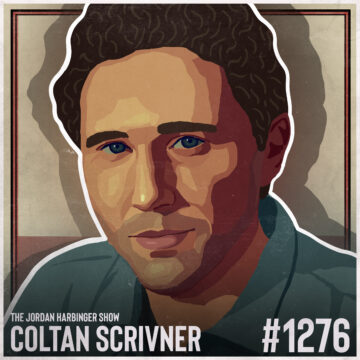



Why do we rubberneck accidents and binge true crime? Behavioral scientist Coltan Scrivner explains the surprising psychology behind our morbid curiosity.
What We Discuss with Coltan Scrivner:
- Morbid curiosity isn’t a character flaw — it’s an evolutionary feature. The same instinct that makes us rubberneck at accidents helped our ancestors learn about threats without becoming victims themselves. It’s your brain’s built-in threat-assessment system, gathering intel from a safe distance.
- Horror movies work because of a specific formula: an overwhelmingly powerful villain versus a vulnerable protagonist. That imbalance — think Pennywise hunting kids or Jason stalking camp counselors — triggers our threat-detection systems in ways action films simply can’t replicate.
- True crime’s massive female audience isn’t random. Women face threats primarily from people they know, so their curiosity focuses on spotting danger signals and understanding how predators operate. Men, who historically face violence from strangers, gravitate toward watching combat simulations like UFC.
- Decades of research and millions of dollars confirm: violent video games don’t create violent people. The Mortal Kombat moral panic of the nineties produced the ESRB rating system — but the generation raised on those pixelated fatalities turned out just fine.
- Engaging with scary play — whether horror films, spooky games, or even childhood tag — actually builds emotional resilience. Kids who experience controlled fear learn to regulate anxiety, giving them psychological tools to handle real-world stress as adults. So don’t skip the haunted house.
- And much more…
Like this show? Please leave us a review here — even one sentence helps! Consider including your Twitter handle so we can thank you personally!
 You’re scrolling through your phone at 2 a.m., three episodes deep into a true crime podcast about a serial killer, and you think: What does it say about me that I find this fascinating? Don’t feel bad. Instead, take comfort in knowing that this pull toward the disturbing and gruesome is not a bug in your psychological software, but a feature. The same instinct that makes you rubberneck at a car accident is the ancient survival mechanism that kept your ancestors from becoming some predator’s lunch. Morbid curiosity is your brain running threat simulations, gathering intel about danger from the safety of your couch. The real question isn’t why some people are drawn to dark content, but why we’ve spent decades assuming they must be broken.
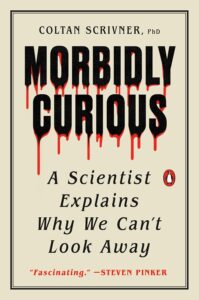
Behavioral scientist Coltan Scrivner — author of Morbidly Curious: A Scientist Explains Why We Can’t Look Away — has dedicated his career to understanding exactly this phenomenon, and what he’s discovered upends nearly every assumption we hold about horror fans and true crime junkies. In this conversation, Coltan walks us through the evolutionary logic of why we can’t look away, revealing that horror movies work through a precise formula: an overwhelmingly powerful villain versus a hopelessly vulnerable protagonist. He explains why women dominate true crime audiences (it’s tied to the types of threats they historically face), debunks the decades-old moral panic around violent video games, and shares research showing that kids who engage in scary play actually develop stronger emotional resilience as adults. Whether you’re someone who knits peacefully while watching Saw or you still can’t handle a PG-13 thriller, Coltan’s insights will fundamentally reshape how you think about fear, curiosity, and what our darkest interests reveal about our humanity. Listen, learn, and enjoy!
Please Scroll Down for Featured Resources and Transcript!
Please note that some links on this page (books, movies, music, etc.) lead to affiliate programs for which The Jordan Harbinger Show receives compensation. It’s just one of the ways we keep the lights on around here. We appreciate your support!
- Sign up for Six-Minute Networking — our free networking and relationship development mini-course — at jordanharbinger.com/course!
- Subscribe to our once-a-week Wee Bit Wiser newsletter today and start filling your Wednesdays with wisdom!
- Do you even Reddit, bro? Join us at r/JordanHarbinger!
This Episode Is Sponsored By:
- HelloFresh: Get $80 off your first order at hellofresh.com/jhs80
- Bombas: Go to bombas.com/jordan to get 20% off your first order
- DeleteMe: 20% off: joindeleteme.com/jordan, code JORDAN
- Audible: Visit audible.com/jhs or text JHS to 500-500
- Homes.com: Find your home: homes.com
Thanks, Coltan Scrivner!
Click here to let Jordan know about your number one takeaway from this episode!
And if you want us to answer your questions on one of our upcoming weekly Feedback Friday episodes, drop us a line at friday@jordanharbinger.com.
Resources from This Episode:
- Morbidly Curious: A Scientist Explains Why We Can’t Look Away by Coltan Scrivner, PhD | Amazon
- Morbidly Curious Thoughts | Substack
- Official Website | Coltan Scrivner
- Coltan: The Conflict Mineral Used in Electronics | Wikipedia
- The Goodness Paradox: The Strange Relationship Between Virtue and Violence in Human Evolution by Richard Wrangham | Amazon
- Richard Wrangham on Proactive versus Reactive Aggression | Harvard Gazette
- The Final Girl Trope in Horror Films | Wikipedia
- “Women in Danger” — Sneak Previews Episode (September 18, 1980) | Intermission Society
- Siskel and Ebert’s Feminist Analysis of Slasher Films | Sociological Images
- It (1990 Miniseries) | Prime Video
- The Black Phone (2022) | Prime Video
- Predator (1987) | Prime Video
- Halloween (1978) | Prime Video
- Friday the 13th (1980) | Prime Video
- 1993–94 US Senate Hearings on Video Game Violence | Wikipedia
- Entertainment Software Rating Board (ESRB) History | Wikipedia
- Mortal Kombat Controversy and the Creation of the ESRB | Wikipedia
- Violent Video Game Engagement Is Not Associated with Adolescents’ Aggressive Behaviour (Oxford Study) | Royal Society Open Science
- No Clear Link Between Video Game Violence and Aggression in Children (Meta-Analysis) | Association for Psychological Science
- Pandemic Practice: Horror Fans and Morbidly Curious Individuals Are More Psychologically Resilient During COVID-19 | Personality and Individual Differences
- The Murderer Next Door: Why the Mind Is Designed to Kill by David Buss | Amazon
- The Threat Simulation Theory of the Evolutionary Function of Dreaming | Consciousness and Cognition
- The Reinterpretation of Dreams: An Evolutionary Hypothesis (Revonsuo) | Behavioral and Brain Sciences
- Saw (2004) | Prime Video
- Official Website | Nightmare in the Ozarks Film Festival
1276: Coltan Scrivner | The Evolutionary Logic of Morbid Curiosity
This transcript is yet untouched by human hands. Please proceed with caution as we sort through what the robots have given us. We appreciate your patience!
Jordan Harbinger: [00:00:00] Jordan here. Before we start this show, I wanna let you know this episode contains violence and some explicit themes, so no kids in the car for this one. And if you leave the kids in the car and you still play the episode, don't blame me when they have nightmares. Coming up next on The Jordan Harbinger Show.
Coltan Scrivner: Darwin, of course, was famous for his theory of evolution.
He was a theorist. Heard about this story from a zoologist named Alfred Brim who gave a story about these monkeys that saw a snake inside of a bag. This, this experiment that he did. A monkey would look inside the bag and scream, and then another monkey would come up and look inside the bag and scream and run away.
The other monkeys had to come up and see it because he survived. The other monkey survived. He was fine, and he signaled danger. So I kind of wanna know what that thing is, and that's a very similar thing to, oh, this thing is terrible. You don't wanna see it. Now I kind of do.
Jordan Harbinger: Welcome to the show, I'm Jordan Harbinger. On The Jordan Harbinger Show, we decode the stories, secrets, and skills of the world's most fascinating people and turn their wisdom into practical [00:01:00] advice that you can use to impact your own life and those around you. Our mission is to help you become a better informed, more critical thinker through long form conversations with a variety of amazing folks.
From spies to CEOs, athletes, authors, thinkers and performers, even the occasional drug trafficker, former Jihadi or four star general. In fact, if you're new to the show or you wanna tell your friends about it, and I always appreciate it when you do that, I suggest our episode starter packs. These are collections of our favorite episodes on topics like persuasion and negotiation, psychology, geopolitics, disinformation, China, North Korea, crime, and cults, and more.
That'll help new listeners get a taste of everything we do here on the show. Just visit Jordan harbinger.com/start or search for us in your Spotify app to get started. Today, we're talking about why so many of us are drawn to things that are objectively disturbing horror movies, true crime, car accidents.
We can't stop staring at haunted hotels you swear you'd never pay for, but you still wanna hear all of the details. Are hoarder fans secretly violent? Is morbid curiosity a bug in the human brain, or is it a [00:02:00] feature that kept us alive back in the day? And why does Halloween feel cozy to some people? Even though it's basically a celebration of morbidity and death, we're getting into the neuroscience of fear.
Why scary play works, why empathetic people often love horror, and why enjoying Blood and Mortal Kombat doesn't mean you're about to snap. Even if Nintendo really wanted you to think so. So if you've ever rubberneck a car crash, binged true crime for research purposes or felt weirdly relaxed watching something like saw, you're definitely going to feel extremely seen today.
Here we go with Coltan Scrivner. You were born to be a scientist. You're named after a mineral.
Coltan Scrivner: Yeah, I didn't know that until, uh, later on. It's like a combination mineral, right? The unfortunate thing is if you search my name, there aren't a lot of people with my name that is spelled C-O-L-T-A-N. The only other thing in the world that's spelled like that is this like slave mining that happens in the Congo.
Jordan Harbinger: Before that was a well-known thing. I met this guy at a club in New York 'cause I was friends with the dj and she's like, this is my friend. And I was like, oh, you wanna [00:03:00] go dance? He's like, I can't dance because we're all going on the dance floor. And he's like, I can't dance. And I was like, don't worry about it.
I'm a terrible dancer. He is like, no, I literally can't because I have $30,000 worth of gold strapped to my leg. And I was like, okay, first of all, why? And he is like, well, I just came from the airport, but also I don't wanna leave this in my hotel room and it only has a really crappy safe. And I just flew in from Sierra Leone or something like that.
And I was like, okay. Still wondering why you have gold strapped to your leg. He's like, places like that, you never know what you're gonna need when you're gonna need it. If you have to escape a place like that, you don't have time to go back to your house and get stuff because chances are your house is on fire and has already been raided by a militia.
So he is like, I always keep this gold strapped to my leg even when I'm sleeping because I don't want it to get stolen. 'cause it's worth like 30 grand. This kilo of gold or whatever it's, and I was like, why do you live there? And he is like, well, I'm mining for coltan. And I was like, you're mining for coltan.
What is that for? And he explains how it's in cell phones [00:04:00] and stuff. Bear in mind, this is like 2009, so I'd never heard of rare earth minerals or whatever, any of these things are, rare earth elements. And he explains how it's in every phone, every electronic device. And I was like, you're a minor. That seems like a really bad, unhealthy thing to do.
You're like an educated European guy. I don't get it. And he basically explained that he doesn't do the mining. He showed me photos. He lives in like a shack made out of some sort of local wood and thatch. And he lays around while these guys stand around with machine guns. And then a bunch of other local people dig in watery pools with their bare hands and go down into holes and they pull out coltan.
And it's like a really good gig. And I said, how did you even find out about that? And he's like, well, I'm friends with the president of the country and he allows. These operations and it was basically, it was like the most crooked, corrupt, like shady thing that I'd ever heard.
Coltan Scrivner: It's the shadiest thing you can do. Yeah.
Jordan Harbinger: Yes. I was like, okay. So white European guy goes to Africa and is friends with the president and has militia guards around him, but may need to escape at any point [00:05:00] in time and basically has what I'm hoping are not slaves digging for coal. Tan in the dirt. Yeah. Eh, exactly. So yeah, kept in touch with 'em for a while, but didn't kind of make the cut after I started finding out about this.
Yeah. I feel like I have people in like that in my life where uh, they do something interesting, but it's so morally. Opaque. And I'm like, I don't know if I can be close to you, but they're like a lens into another part of the world.
Yeah. It's like, oh, you run a porn cams site. I wanna know about that. Then I never want to talk to you again.
Coltan Scrivner: Yeah, exactly. Yeah. You don't feel warm towards them. You know you're curious about them, but maybe you don't feel to warm towards them.
Jordan Harbinger: And then it's like, how do you get payment cryptocurrency. Oh, so you're basically money laundering slash tax evasion. Oh, that's why you live in another country that has weak rule of law.
Okay, so how are you getting away with this? Surely they know about it. Oh, you're bribing law enforcement. And then it's like, yeah, if I ever go to X, Y, Z country, I will call you. 'cause the parties are gonna be off the chain. However, I also know don't want anything to do with you and I need to go take a shower now [00:06:00] anyway.
How about we jump on topic? What do you think? So morbid curiosity, this is such an interesting idea. I never would've thought that there was science behind this. I don't know why, of course there is, but I always grew up thinking horror movies were scary. I didn't really like them. Yes, I watched them sometimes, but like on tv, so they're all edited down and they weren't that bad.
But then when I saw something like saw, 'cause a girlfriend of mine was interested in horror movie. I was like, what kind of morally bankrupt people are watching all of this? And what was really creepy about her was she would be knitting while we were watching someone get their head. She's
Coltan Scrivner: just like
Jordan Harbinger: relaxing.
Yeah, she's just relaxing. And someone's getting their head chainsawed off and she'd be like, Ew, ew. At least. So what's going on here?
Coltan Scrivner: Well, I thought the same thing when I first started studying this, I thought, oh of course people are studying this because if you talk to anyone on the street or at a bar or wherever and you just use the phrase morbid curiosity, you ever been morbidly curious?
People give you a hundred examples of when they've done that. Maybe they're curious about this shady guy they met at a club [00:07:00] who works with
Jordan Harbinger: coal
Coltan Scrivner: Tan mine. The Congo with, yeah, yeah. With coal tan mining. I think that's a form of that. Right? And so I thought surely people have studied this. And when I started looking into it, there was just no science on this.
And this was not that long ago. Maybe five, six years ago, seven at the most. So I thought, okay, this is interesting as a grad student, right? I found this thing that everyone knows about, but nobody has studied. I mean, that's a gold mine. Yeah. So I, the first thing I had to do was just try to define it, right?
We had all these concepts about what morbid curiosity is in popular culture. So film critics talked about it a lot, especially with respect to horror movies. And a lot of the film critics had a similar opinion as you at first where they said, who watches this morally bankrupt stuff? And that was just the answer is like, well, they watch it because they're morally bankrupt, or they watch it because they lack empathy, or they watch it because they need an adrenaline rush.
And I think everyone just kind of accepted that, including psychologists and media researchers. And I was a little skeptical of that. I thought, okay, that maybe explains some portion of it, but I thought it maybe it's really more about the curiosity than it is [00:08:00] about needing to see something morally gross because you are morally gross.
And so I started looking into it, and that's what I started to find was that for most people, this really was. A lot like other kinds of curiosity. It just happened to be about something that was dangerous. So I define morbid curiosity as an interest in or curiosity about things that are dangerous, right?
And that can come in nonfiction forms like true crime is obviously probably the most popular example of that. But I think even the news, like on our news is pretty threat laden and that it can also come in fictional forms because Fiction does a really good job of tailors the story and the characters to be, in the case of horror movies, to be threatening, does a really good job of kind of pulling on those cognitive strings.
And so it attracts us in the same way that real threats or stories are real threats would,
Jordan Harbinger: I'm thinking of Stephen King's it and I remember being like a clown. How scary can that be? And then it's a clown, and then it's also sewers and it's also sharp teeth, and it's also, I don't know, it goes [00:09:00] after kids particularly
Coltan Scrivner: well.
That's what makes it scariest, right? So of the work that I'm doing now is looking at how do we even define what horror is, right? We have this conception again, of if I see a horror movie, I can say, oh, that's a horror movie. I have a hard time like coming up with a recipe for it. What makes a horror movie?
The traditional answer again, has been, if it scares you, that's kind of a flimsy definition, right? 'cause what scares me may not scare you, or what scares you today may not scare you in 10 years. And then there's this definition of if the creator meant for it to scare you, like their intention was to scare you.
And I was like, okay, that's an okay definition. But again, if a director creates something that's not scary to anyone, but they intended it to be scary, does that make it horror? Or if it is scary to everyone and they didn't intend it to, is it still horror? And so I was trained largely in biology, right? I think about these things as a biologist, and I think, okay, what in like the format of, of the animal kingdom, what would this look like?
So we tell stories where there's a protagonist and an antagonist. That's a pretty typical thing that all animals encounter. There's people they want to ally [00:10:00] with and people they want to fight against. And in horror, what I found, and I used LLMs to annotate hundreds of movies, right? So I had summaries of these movies and examples of the characters and what they were like, and all these traits.
What I found was that in horror movies, it was distinctly a very powerful, bad guy, powerful villain. So Pennywise and it, right? And that was really unique to horror. It's the only genre where the hero is not very strong, not very capable, or at least is very overwhelmed by the villain. So in the case of it, again, you have powerful villain, supernatural clown thing, shapeshifting clown.
But then you also have just regular kids, right? Which are the most vulnerable protagonists you could imagine. And that creates a perfect formula for a horror story, and it triggers our morbid curiosity in an incredible way because it's showing you like, if you're this vulnerable, how do you even go about approaching something this terrible and awful?
Jordan Harbinger: As I prepped this, I also watched the black phone. Have you seen that?
Coltan Scrivner: Yeah, the first one.
Jordan Harbinger: Yeah. I watched both actually because [00:11:00] my wife's outta town and so the in-laws took the kids and I was like, wait, I actually have free time. I need to waste this in the most non-productive way possible. But I sort of justified it by, Hey, it's related to this show and prepping.
But yeah, I watched both and it's interesting, right? 'cause again, it's kids and they get kidnapped by this scary guy with a Satan mask on who's like just ridiculously crazy and evil and. They have to escape or kill him, and they're aided by other kids who are basically ghosts. I guess you would just say, I don't think I'm spoiling anything.
I think all of this is in the trailer. And you're right, it's a unique recipe. You don't go watch anything. Like in the traditional hero genre, Thor is not a vulnerable character who stands no chance. And Rambo is not a vulnerable character who stands no chance against the enemy. You know, it's kind of the opposite where they can take out a thousand people just by sheer will, whereas this kid is never gonna beat this hatchet wielding murderer.
But the formula's always like that, right? It's teenage camp [00:12:00] counselors and then Jase or whatever is out there with his hockey mask on, chopping them into little pieces.
Coltan Scrivner: And I started looking at edge cases, right? Because that's where you can really test kind of a theory like this. And so one of the edge cases that I thought was a good one was the movie Predator.
I dunno if you've seen any of the Predator films.
Jordan Harbinger: The original.
Coltan Scrivner: The original, sure. Yeah. With Arnold Schwarzenegger. Yeah. So I thought, okay. Predator is perfect because it's literally in the name, right? You have this incredible, perfect hunting machine that should be the perfect villain, right? So if horror movies are really about fear and terrible bad guys, only then predators should be a horror film.
But if you watch it, you realize that yes, they're a little bit taken aback at first 'cause they're caught by surprise by this perfect hunting machine. But they're also a group of Green Berets led by Arnold Schwarzenegger. Like they're not vulnerable.
Jordan Harbinger: They have machine guns for God's sake.
Coltan Scrivner: Yeah, yeah. They have machine guns and there's lots of studies showing like that specific thing that if you show people a picture of a hand holding like a screwdriver or a hammer, and then you show people another hand holding a handgun, [00:13:00] and you ask people, Hey, imagine who's holding this right?
What do they look like? How big are they? How tall are they? How strong are they? Interestingly, they will say that the person holding the gun, they'll imagine them in their mind's eye as larger, stronger, more formidable. And that's because the mind is. Taking the fact that this person has a gun that makes them stronger and more dangerous.
And the mind maps that onto this very evolutionarily old cognitive mapping of bigger things are stronger. So when you go to imagine it, you imagine it's bigger and stronger, right? So even when we see Arnold Schwarzenegger, and then we see him with the machine gun, we're imagining like, oh my God, this guy is not vulnerable at all.
And then you tack onto the fact that he has Green Beret training, and he also has a lot of allies. Now they are in a forest, they're kind of in an unknown place. They're kind of at a disadvantage in that way. But as soon as they get attacked by the predator, they then start planning how to attack back.
And in in horror movies, you never do that unless you're like truly cornered, just like animals. So prey animals take a mouse. A mouse is never gonna fight back against a cat or squirrel or something, right against a dog, unless it's cornered. [00:14:00] It's like a last resort kind of thing. And that's what you see in horror movies too.
You see that it's mostly the antagonist chasing the protagonist for 80 of the 90 minutes. And then in the last 10 minutes, usually the protagonist gets trapped. Like a squirrel or a rat might, and it's forced to fight back and it's forced to get creative. And usually a hero will find some kind of weakness in the antagonist, or they suddenly get allies who come in and that's how they defeat them.
But it's not because they're more formidable. It's not because they're smarter. It's not because any of that. It's usually like luck or they get allies that come in at the last minute.
Jordan Harbinger: I remember in it back in the eighties, the kid had the silver earrings from his mom or something. I don't know how they figured out that the clown was susceptible to that.
They shot it and of course the first one misses, but the second one, you know, hits him with the slingshot in the head and the light comes out. I just remember that moment where it's like, oh my God, these kids took out this psycho crazy clown. I wonder if the same thing applies to lifted trucks with nuts hanging off the back.
Coltan Scrivner: For sure. Bigger is stronger, right? So whoever can handle that must be [00:15:00] bigger and stronger.
Jordan Harbinger: Right? But the cliche is, wow, small dick energy, your truck is lifted and you drive it around suburban San Jose and you literally put nuts on the back. Like you can't. Broadcast smaller dick energy than that.
Coltan Scrivner: And you see that in the animal kingdom, right?
You get these ritualistic fights, right? The classic example people could probably think of are two gorillas like standing up and beating their chest. You get a lot of examples of these ritualistic fights, and the reason animals do that is because it's cheaper than getting into a real fight. There's less chance of actual damage happening to you, but you can also fake it, right?
If you can make yourself look bigger, look larger, then you're gonna have a better chance of scaring off the other people. And so yeah, humans do that all the time in cultural ways, right? One example is lifting your truck or making it look like you can handle something bigger and larger than what it needs to be.
Jordan Harbinger: It's easy to conflate somebody who's morbidly curious with somebody who likes the violence or maybe hates women or something like that. It sounds like you disagree with that, and funnily enough, most of the people that I know that love horror movies and [00:16:00] kind of only watch those, or mostly only watch those, it's actually all women.
Coltan Scrivner: Yeah, yeah, yeah. I think people are often surprised by that. But if you look at the demographics, women like horror just as much as men, and when it comes to. Examples of sort of real life horror, like true crime. They are huge consumers of that, even more so than men.
Jordan Harbinger: That's what I was gonna say, is when I think true crime, I think 80 to 90% female audience.
At least with podcasts.
Coltan Scrivner: With podcasts, probably. Yeah. With documentaries, it's still more, it's probably 60 to 70%. And that's interesting with podcasts. 'cause I think men are a little more likely to listen to just podcasts in general, right?
Jordan Harbinger: Definitely. Yeah. I think podcasting generally is 60 40 men women, but, and if you take out true crime, it's probably like 70 30 or 80.
It's like 80 20. Yeah. And then when you throw true crime in there, it just so heavily weighs everything down. You take out Joe Rogan and you take out true crime. The stats are one way, and then true crime just comes down like a hammer.
Coltan Scrivner: The first thing that I found when I started looking into the literature on this, okay, nobody has really studied this, but surely people have talked about this.
So one of the examples I found was Roger [00:17:00] Ebert and Gene Cisco, who were two of the most famous film critics of all time, and they had a TV show in the eighties where they would essentially review movies.
Jordan Harbinger: I remember that. That was sad, that show, because that meant cartoons Were over on Saturday morning and you're stuck watching these two old talk about movies you're not allowed to go see.
Coltan Scrivner: Yeah. Sneak previews was on for, I don't know, a couple seasons at least, and they had dedicated one entire episode to what they called Women in Danger Films. They did that because both of them hated slasher films. They liked Halloween, which I think is actually more of a thriller, and I think that's probably why they liked it.
The original Halloween they liked, and then everything that came out after the slasher, they just absolutely hated. And so they dedicated this entire episode called Women in Danger Films to all of these like spate of slashers that came out after, and in particular, Friday of the 13th is the one they were targeting the most because they had the widest reach or the broadest reach.
Like Gene, Cisco for example. So he wrote for I think the Tribune Ebert wrote For The Sun Times, both in Chicago and in Cisco's official review of Friday the 13th and the Tribune, which a million or more people at that time [00:18:00] read. He spoiled the endings to dissuade people from watching it. And then he did like an OG version of cancellation where he docs the chairman of, I think it was paramount that put that out.
He published the address of the chairman and encouraged people to send hate mail. And then he published the address of the main actress. Her name was Betsy Palmer, I think was her name.
Jordan Harbinger: So he published her name and it was like, harass this woman that's so unhinged.
Coltan Scrivner: Yes. And like the address of the chairman and said, send them hate mail.
Encouraged them not to do things like this again. And in this TV show they talk about this and both of them, what I found really interesting was, sure, it's a film critic's job to hate movies. There's gonna be movies they hate. That is their job. But what I thought was interesting is they talked a lot in this episode about the psychology of people who did like the film.
So not only did they say, Hey, this film sucked because the story sucked and the acting sucked and the whatever.
Jordan Harbinger: But if you like it, you're a bad person.
Coltan Scrivner: Exactly. If you like it. And in particular, they thought that people who liked it hated women and were very sick people. And it shocked me because these were two, again, like of the best film critics in [00:19:00] the world, and they couldn't separate their personal viewpoint of what they thought of the people who liked the films from just rating and critiquing the film itself.
And so I thought, okay, this has to be studied. Right?
Jordan Harbinger: I know one of those guys passed away decades ago.
Coltan Scrivner: Gene Sisco passed away, I think before Roger Ebert and Roger Ebert passed away in the past maybe decade or so.
Jordan Harbinger: I wonder if towards the end of their career they were like, ah, we overshot the Mark A.
Little bit on that one. I get it now. It's a whole thing.
Coltan Scrivner: I thought the same kind of thing, like maybe times have changed. That was like four years ago, right? That was the rise of the women's movement. And maybe they thought, okay, maybe this is a counter to that. I think if they had put a little more thought into their expertise as film critics, they would've realized that most of those early slashers in particular, what is the biggest trope of the eighties Slashers the final girl that is a woman who is severely outmatched and yet she still finds a way through her smarts or her endurance to overcome these really terrible things.
That's like the most feminist thing I can think of.
Jordan Harbinger: Right. And she usually has some sort of badass hostile lavista baby moment too, where she's about to [00:20:00] drive a wooden steak up, the guy's keister and she's like, suck on this or whatever, and jam something down his throat. And you're like, yeah, the whole audience is like clapping.
'cause she exactly slices the Jase on fire. And you're like, whoa. Right. Yeah, you're right. It's like the most feminist thing ever. Maybe watch the ending next time. Ebert.
Coltan Scrivner: Yes. I was surprised 'cause I was like, surely these guys saw the whole movie. Right. They understand that. Like what the trope is in these, you know, I saw when the movie Spiral came out that was like the ninth installment in the soft franchise.
There was another. Well-known film critic who published a scathing review, which is fine. But again, he didn't just critique the film. He had thoughts about the psychology of the people who liked the film, and he called them depraved lunatics, who should not be around most people or other living things.
Jordan Harbinger: At what point are you kind of like, but there's nine of them.
It's different if it's like, Hey, we tried this new thing. Look, this is not working for you. And that's like going to fast and furious and you're just like, you know what? Too many cars, this isn't gonna work. And you're like, people don't like this scoreboard. We have 18 of these and there's plans for 25 [00:21:00] more with pretty much the same crew until they die and we have to make them out of ai.
And maybe you don't like cars, but that's kind of a you problem pal. Yeah. I don't
Coltan Scrivner: know. Yeah. When I give talks on this, I talk about that and then I show a chart of the saw films and how much money they've grossed over a billion dollars worldwide. And it's like, well that means there's a lot of psychopaths running around out there if that's true.
Right. So again, I thought, okay, this really needs to be studied because this is not just a past, you know, thing.
Jordan Harbinger: Psychopaths just sitting there next to me, knitting in the theater, talking about Michigan football's over the dialogue because they know it's irrelevant. She turned out to be a serial killer.
But I'm sure that's an exception to the rule.
Coltan Scrivner: It says an exception to the rule. Yeah, absolutely.
Jordan Harbinger: Yeah. Sorry Megan, I'm kidding about that. I'm sure she's a successful attorney. So you mentioned that for some people Halloween, and I assume you mean the holiday and not the movie, gives them a cozy feeling.
What's that Danish or Norwegian word where it means
Coltan Scrivner: huga?
Jordan Harbinger: Huga. Yeah. It means cozy. That's kind of the same thing I would say is I don't think Halloween U, it's gonna be scary. It's oh, fake goblins and there's a [00:22:00] Yoda and there's, oh, here's a couple princesses. And it's a fun kid's thing, and it's almost diet Christmas with a spooky theme in many ways.
And so I get that huga feeling, especially growing up in Michigan. It's a little different in California when it's 70 degrees in Halloween, but the kids are wearing their costumes and they don't wanna wear a coat and they're, they wanna come in and show it to you, and all the neighbors are socializing because they're all out on the street with each other's kids.
Like it's a whole thing. I don't really know if that qualifies. That doesn't seem like the same morbid curiosity, but is that a different. Angle on the whole thing because it's not really like death and intestines and gore. It's a princess. And the latest Disney, it's K-pop demon hunters, but it's everyone and their mother.
Coltan Scrivner: Yeah. Yeah. I would say it depends, right? So for the kids, it probably is a little scarier, right? We put up some great Halloween decorations, given what I do, and we live in a very Halloween centric town, and I organize some of the big Halloween events here. And so we have a good Halloween setup. We have a leather face, like a six foot six animatronic leather face,
Jordan Harbinger: [00:23:00] Texas chainsaw.
Okay.
Coltan Scrivner: Yeah.
The
Jordan Harbinger: leather face.
Coltan Scrivner: Yeah, with a leather face. Yeah. And the chainsaw. And he like raises it up and yells, and I'm always worried that's gonna scare the little kids, and they're always cautious around it, but they wanna see what he does. So they're like, can you turn him on? Can you make him yell and do the thing?
I think for some of the kids it is actually kind of like a horror movie would be for an adult or even a teenager. And so I think it is a type of morbid curiosity for the kids. The ones who dress up as gross, terrible villains, they're playing that role. And the others who dress up as the princess, they're still out there seeing.
The gross, terrible villains and all the scary decorations for the adults. It's a time of year where it's not seen as weird to go to a haunted house or watch a scary movie that's just seen as what you're supposed to do. And so I think it gives a cozy feeling because if you like horror movies or you like spooky stuff, you're morbidly curious.
This is like the time of year where your personality is not seen as obscure or weird or strange or morally wrong. It seems as totally normal and acceptable.
Jordan Harbinger: I think you're right. The only thing that's really scary on Halloween is the doorbell ringing at nine 30 and you look through the hole and it's two six foot tall, 13 year olds wearing ski [00:24:00] masks.
And you're like, is this still Halloween or are we in the purge now? Right. I don't know if I should open the door. Sorry outta candy, but I, I have some bullets if you want 'em. Get off my property.
Coltan Scrivner: You just play the uh, home alone, uh,
Jordan Harbinger: clip. That's right. Yeah, that's right. You give you eight seconds to get your no good red ass off my property.
1, 2 10 and then you gotta crank the volume. That's right. God, that's such a funny scene.
Coltan Scrivner: So home alone's funny because somebody asked me one time, they said, well, given your definition of horror, wouldn't Home Alone be a horror movie? And I said, well, that's a good point. You're thinking about it the right way.
I said, but if you think about it, Kevin is like really clever and he has all of this stuff at his disposal. And the two villains are just like comically. Horrible. Like they're terrible villains. They don't work together well, they're idiots. Yeah.
Jordan Harbinger: Yes.
Coltan Scrivner: And they're just totally incompetent as burglars. And so really, Kevin kind of is out matching them in some ways, right?
I mean, that's the purpose of the movie is that he does outmatch them.
Jordan Harbinger: He's a smart ass, right? You done? Or you're thirsty for more, right? He's dishing it up.
Coltan Scrivner: Yeah, exactly. Yeah. So if you had competent burglars, that [00:25:00] would be a horror movie. You're right. But if you had the black phone guy come into his door, that would be a horror movie.
But it's not because they're incompetent. The villains aren't strong enough, and the protagonist is somewhat, you know, when you use the phrase formidability, there's a lot of things that play into that. Like the core of that is how big and strong are you? That's how our brain processes it. But there are things that make you more formidable, right?
If you have a gun, if you're really smart, you have a lot of allies, these are all things that increase your perceived formidability, right? So Kevin is smart. He is got a lot of resources. He's not very big and strong, but neither are the burglars and they're really dumb and they don't have a lot of resources.
They don't work well together. So their formidability goes down.
Jordan Harbinger: They're getting wrecked by Christmas ornaments, micro machines or whatever, and it takes place during Christmas and they made it just a knockout Christmas movie. I mean, it's up there with diehard, in my opinion, as a,
Coltan Scrivner: it's one of the
Jordan Harbinger: best, yeah.
Christmas movie. So you have four categories of, is it morbidly curious people?
Coltan Scrivner: I would say four types of morbid curiosity. So you have morbid curiosity. It's like this overall trait that you have, that's your total interest in things that are dangerous, right? And then there's different [00:26:00] ways you can express that out in the world.
So one of those is minds of dangerous people, which we talked about. So that would tap into this interest in understanding who's dangerous, how can you spot them? People come to your door, how do I know if they're really trick or treaters or if they're actually people who are trying to purge me? True crime would obviously be the perfect fit into this category.
And this one's interesting because I think there's a good specific evolutionary reason why we're interested in this as humans. So there's a really popular book that came out I think two years ago, written by Richard Ranum. He is a biological anthropologist. He spent his whole life studying apes and trying to understand human evolution through with apes and and our closest ancestors.
And it's called the Goodness Paradox. And in it, he puts forward this new theory of why humans are uniquely what he calls proactively aggressive. So there's two kinds of aggression in the world, right? So you have reactive aggression, which you can probably imagine what that means. It means you react aggressively when someone transgresses you.
So this is how like most animals [00:27:00] engage in aggression. So if you imagine a chimp troop, you have an Alpha chimp and you have this hierarchy of chimps below him. And the Alpha Chimp goes and he takes the fruit he wants, or the mates he wants, or whatever he wants. And if someone tries to take that from him, another chimp tries to take that from him.
He's gonna react aggressively. He is gonna bear his fangs, he's probably gonna bite them. He is gonna push him around, he's gonna scream. He is gonna do things that look like reactive aggression. He does that to signal to the chimp that's transgressing him and to the other chimps around that, Hey, don't try to take that from me.
I'm still the alpha Chimp. I'm still this big and strong, and that's the way that almost every animal engages in aggression or deals with aggression when it comes to members of their own species. Humans are different. So we still do that. There's still bar fights, there's still things like that happen in humans, but we do it to a significantly less degree than our closest primate relatives.
So instead, humans engage in a lot of what's called proactive aggression. So this means that they sit back and they plan their aggression. Zero killers are a good example of this, but even like battles, like wartime battles, almost none of that is [00:28:00] reactively aggressive unless you're defending yourself.
Most of it is you are planning and plotting on how you will attack another group of people. This is the origins of conspiracies as well. I mean, the classic conspiracy in the Roman Forum with Caesar, it was people who plotted to kill powerful figure because he was powerful individually. They couldn't do it themselves, so they had to conspired to kill Caesar.
Ranga argues that when language evolves, so let's say roughly 300,000 years ago, there's obviously quite a big error bar on either side of that, but let's say 300 or so thousand years ago, humans had this new ability to plot and plan and then share those plans with other people. And that's something no other animal obviously has, is like sharing plans with someone and then planning to do something in the future.
And what that allowed humans to do is actually shift their social hierarchy, is how their social structures were organized. Because now, let's say the second ranking and third ranking, or third ranking and fifth ranking chimp or human rather, could plan together to overthrow the person who's at the top because maybe they, he's bad for the group.
Maybe it's not a selfish thing, it's just he's [00:29:00] bad for the group. Nobody likes him. Let's overthrow him and we can do it together. Here's how we're gonna do it. And that completely shifted. It made the human hierarchy more egalitarian than say, a chimp hierarchy. That was a good thing, right? That ended up being a good thing.
But what it did is it selected for humans who were good at planning. Who had control over their aggression, who were aggressive, but they could control it, right? And who were good at thinking into the future. And those are all good things. As long as that person is on your side, as long as that person is moral for in the way that you understand morality.
Occasionally you would get an antisocial person who also had those abilities. And so what do they become? They become someone who, a parasite, someone who, if they're extra violent, could be a serial killer. And so humans had this whole new type of aggression that no other species had encountered, and they were entirely unprepared cognitively to predict this.
Again, in the past with reactive aggression, the reactively aggressive person or animal is telling you, I'm going to hurt you if you try this. Right? There was no question about it. With proactively aggressive people, [00:30:00] they sit back and they let those thoughts kind of fester, and then they plot and they plan.
And when they see you, they're not gonna give you any indication that they're gonna try to hurt you because that would lower their chances of success. And so what's the only way to learn about somebody who's proactively aggressive? It's to learn about. Their story after they did the thing. So after they committed the crime, how did they do it?
Why didn't we know this person was gonna do that? What cues did they miss that they could have picked up on? Why didn't Caesar know that the senators were conspiring against him? That's the essence of the true crime story, right? That's why true crime stories mostly focused on the aggressor. It's not because the stories themselves are morally bankrupt or the people who are telling them are morally bankrupt.
It's because the thing people are most interested in is who is this person? Why didn't we know that they were going to do this, and what would've caused them to do this? And how can I spot people like this in the world? And that's what they're most interested in.
Jordan Harbinger: While you're busy fantasizing about killing your boss, using the most gruesome methods possible.
Let's hear about the murderously, good deals on the fine products and services that [00:31:00] support this show. We'll be right back. This episode is sponsored in part by HelloFresh. People don't really talk about the mental load of feeding everyone every meal every day. Jen's taken on the heroic task of feeding the six of us every night, and HelloFresh has become a staple in our routine.
Genuinely a lifesaver. HelloFresh just makes dinner way easier. You get pre-portioned ingredients, step-by-step recipe cards. Jen finds it therapeutic to follow these and dinner on the table in about 30 minutes. They've got over a hundred recipes every week, so you can even plan your meals out weeks ahead, which is huge when life gets busy and the quality is legit, sustainably sourced.
Seafood, antibiotic free chicken, seasonal produce that actually tastes good. Plus they have steak and seafood options at no extra cost. Three times more seafood options than before, and 35 plus high protein recipes weekly, including Mediterranean and GLP one friendly options. We've been using HelloFresh for years now, and it's one of those things that just makes our lives run a whole lot smoother.
Jen Harbinger: Go to hellofresh.com/jordan10fm to get 10 free meals plus a free Z willing knife, which is [00:32:00] $144.99 value on your third box offer valid while supplies last. Free meals applied as discount on first box. New subscribers only varies by plan.
Jordan Harbinger: This episode is sponsored in part by Bombas. One of the goals this year and all year round is to stay comfy, and Bombas is leading that charge in my house.
We love Bombas so much. It's all we wear. We even gifted to our family and our friends and our nanny. We're big fans of the grip socks, so we don't slip around on our floors. Bombas just launched their new sports socks, which are amazing for whatever year into running, golf, hiking. We're planning to do more snowboarding this year, and these things are cushioned, sweat wicking, and packed with techy features that make it feel like your feet are finally on your side around the house at night, I'm living in their Sunday slippers, which keep my feet cozy during those cold winter nights.
And Bombas also has underwear and teas. Buttery, soft, breathable, the kind of base layers that ruin every other brand for you. Plus, for every item you purchase, Bombas donates an essential clothing item to somebody facing housing insecurity. One purchased, one donated over 150 million so far.
Jen Harbinger: Head over to bombas.com/jordan and use code to Jordan for 20% off your first purchase.
That's [00:33:00] bombas.com/jordan code Jordan at checkout.
Jordan Harbinger: Don't forget about our newsletter Wee Bit Wiser. It's a two minute read every Wednesday. It's highly practical. A lot of feedback on these every single time. 'cause you can hit reply and reach us right away. It's a great companion to the show. And Jordan harbinger.com/news is where you can find it.
JHS Trailer: Now, back to Coltan Scrivner.
Jordan Harbinger: You do have that aside in the book about why humans are less aggressive than chimps. Chimps defend social hierarchy with violence. Humans don't really do that. Maybe we killed off the very aggressive males over generations. And ironically, we used violence to make society less violent.
But we did that because. A bunch of guys who just live a normal life. Were like, we have to kill this guy who randomly starts snapping people's necks. And yes, he's just a bad person. I can be left in camp with your wife and kids, and you come back and they're still there. We leave him alone and he kills everyone.
It's, we can't have this guy around. So we get rid of people like that over generations. But yeah, you're right. The human mind evolved to be prepared for [00:34:00] threats. So it follows that learning about those threats as much as possible, it incurs a survival advantage. And that does support the theory about true crime.
Right? I've said this on the show before, people, especially women, they love true crime. It's like kind of murder porn in a way.
Coltan Scrivner: Yeah, a little bit.
Jordan Harbinger: I mean, exaggerating, of course, but a lot of the people who watch true crime. I'll ask them, Hey, what do you like about this? And they're like, I just feel like I could kick a serial killer's ass now because I know all these red flags and I will know in advance and I will have my escape plan.
And I carry my mace and then I've got my sharp pen and I'm gonna jab 'em in the eye. 'cause that worked for this one lady who got away when she was getting attacked in a national park or something. And you're like, okay, look. True crime obsessed ladies who listen to the show. I'm curious if you think that listening to true crime gives you a survival advantage, real or imagined?
It doesn't matter if it actually does. I wanna know if you feel empowered afterwards. It doesn't matter if in the back of your head you're still worried about it. What do you think afterwards? And I really do think that people probably feel that way. This does not, however, [00:35:00] explain why I might rubberneck at a car accident and try and see a dead body, which I know is gonna be gross and it doesn't have any value for me.
It's almost like, alright, I haven't seen a dead body in a long time. Maybe I should try to catch a glimpse of this one. 'cause it's so rare. But that's the most charitable interpretation of me doing this gross thing that slows down traffic.
Coltan Scrivner: Well, I think the other thing is usually when you're driving by a car wreck, you are in a car.
And so you're in the same position that this person on the side of the road was 10 minutes ago and look how they ended up. Right? And so it also, it reinforces, I think the dangers that come along with what you're currently doing in the place that you're doing it. Most people when they turn to look at the car wreck, they're not hoping that there's somebody injured.
But if there is, you don't wanna miss out on that information because how often are you gonna come across that It produces mixed feelings In a lot of people when you drive by the car wreck, if you do end up seeing something, you feel disgusted and you're like, man, why did I look at that? And that's pretty typical of a morbidly curious experience, especially one that involves bodily injuries.
That would be a good example of [00:36:00] curiosity about what happens to the body when you engage with something dangerous, whether it's an accident or intentional, you know, the result of violence. That's the bodily injuries interest. And this one's interesting too, because I think there are actually multiple pressures on interest in bodily injuries.
I think that's one of 'em. You get a good taste of like, okay, how dangerous is this thing I'm doing? What are the consequences of it? The other thing is it gives you, in the case of something dangerous, like a predator or a dangerous person, if you see a crime scene, for example, of a break-in, if you see what happened to the body, it gives you a pretty good indication of how dangerous that person or that predator is.
If you're walking through the forest, you come across a body and it's got like a few cuts on it, but nothing really major, you are not gonna be that concerned. You're like, man, what happened to this person? You might call, you call the police, of course, but you're not gonna be too concerned about your own safety.
If you're walking through the forest and you come across somebody whose head is missing, you're gonna immediately be more concerned, right? You're gonna be more afraid. Why is that right? Why would you be more [00:37:00] afraid? Both people are dead. They both had the same outcome. The reason you're more afraid is because it, the thing that caused the person's head to disappear or be smashed or whatever, is obviously more powerful, probably more aggressive, and you get a cue from that because it takes a lot of power to remove someone's head or smash someone's head.
It takes a lot of aggression to do that. And so you do get cues about how dangerous something is from bodily injuries, and not just predators or villains, but even diseases, right? Like even, uh, medical curiosities, I think would fall into this. Doctors and nurses have to have some morbid curiosity about how the body works and how things go wrong in order to be interested in their job.
Jordan Harbinger: I know I have a show fan, at least one who does autopsy pathology for a living and she posts stuff on Instagram and it's always autopsy pathology one G and backup. And I'm like, what's going on?
Coltan Scrivner: It sounds so clinical, right? Yeah,
Jordan Harbinger: yeah. But it's also like, Hey, what's this? I thought I was following you. And she's like, my account got deleted again because it's actually really interesting stuff and she loves the science, but it's, here's an arm that was severed in a lathe.
And you're like, and Instagram's like, [00:38:00] oh, it's gratuitous violence. And she's like, yeah, but it's kind of also science. It just happens to be kind of gross. So she like has to tow this weird line where she's like, if you wanna see the other photos of this, you have to go to this website. And it's like such a pain to do that.
Coltan Scrivner: Yeah, I used to work at Meta and I worked in that realm and because of my background I tried to enact some changes that ended up not happening with that, you know, about showing gross stuff and like how you censor certain words. And I dunno if it's still the case, but it used to be the case that if you type in horror like on Facebook or Instagram, you would get.
A popup, an interstitial that says, Hey, is everything okay? And I was like, you can't do that to people who are not actively suicidal because you can push someone to become that way. If they're not and they're just looking for like a horror group or something, you know, a horror Facebook page or something.
Jordan Harbinger: Is everything okay? Yeah. I kind of want to find out where other horror movie fans are talking about Saw 11. Oh, are you sure? But
Coltan Scrivner: if you're telling me I'm not okay,
Jordan Harbinger: only gross horrifically sick people watch this.
Coltan Scrivner: It's that same kind of thing. Right?
Jordan Harbinger: Yeah.
Coltan Scrivner: And I think it comes from a good place. It's okay.
We're trying to prevent people who are. Suicidal or might harm themselves from [00:39:00] seeing things that might influence. I think it does come from a good place. It was just done with such a broad brush and without knowledge of like, oh, not everyone who does this has something wrong. It just shows again that people have this intuition that if you're searching for something like that, there must be something wrong with you.
Right.
Jordan Harbinger: Yeah. The morbid curiosity really does seem like nature's way of putting us in a position to learn something about the dangers around us, and you see it in fables. The example you give in the book is Little Red Riding Hood, right? The Wolf, and then they identify what a wolf looks like in the woods.
Tell me a little bit about that.
Coltan Scrivner: Yeah, yeah. Well, that sounds silly, right? If I asked you like, do you think Little Red Riding Hood teaches anyone anything? You're gonna be like, no, not really. Maybe don't go in the woods. Maybe that's the lesson. But if you think, okay, if you're a kid living a thousand years ago, right?
Somewhere in medieval Europe, you can't read. There's no writing anyway, I guess. But you can't read. You don't have internet, you don't have television, you don't have picture books, nothing like that. How do you know what a wolf looks like? How do you know? You should even avoid one? Of course, the way you learn that as a kid is you hear a story about a wolf.
Kids are really afraid of things like that. So if you just tell them a story about a wolf and all the [00:40:00] terrible things it's gonna do, that's probably just gonna scare them. And like it's not really, they're not gonna be that interested in it. So what you do is you soften it a little bit. You make it a story that's a little more engaging, where the protagonist is someone who is like the kid and naive young child who's wandering through the forest alone.
Exactly. The kind of person who would be prey to a wolf. And then you describe what the wolf is like by describing the antagonist when she goes to meet her grandmother, who's the wolf of course, dressed in sheep's clothing or whatever. Spoiler alert, if you have not read Little Red Riding Hood,
Jordan Harbinger: the grandma doesn't make it.
Coltan Scrivner: The grandma doesn't make it. She's not there. You know, he says, uh, what big arms do you have? And she has this, well, all the better to hug you with. Of course, wolves and canines in particular use their front hind legs to grasp prey, which is a little different actually than how like big cats. Yeah. Big cats will jump and they'll to go straight for the jugular with their teeth.
Wolves do more of like a grasping thing and bite at the legs, and they don't really bite at the jugular immediately in the same way that big cats do. She says, what big legs do you have? And of course she says, all the better to run with wolves are of course, very fast, right? What big ears and [00:41:00] eyes you have?
And she says, all the better to see you with and hear. Are you with what? Wolves are great trackers, right? They're really good at finding people, finding prey. Then of course, finally what big teeth you have, all the better to teach you with. It's a silly way to teach kids like, Hey, a wolf is a thing. It's not gonna just present itself to you.
It's probably gonna try to hunt you, right? It's gonna be sneaky. You're gonna find it in the woods, especially if you're alone. And I think if you didn't have that story, the kids would never know what a wolf really looked like or acted like, or where you would find one. And importantly, we've had domesticated dogs for what, 30, 40,000 years?
Jordan Harbinger: I don't know. A long time. Yeah.
Coltan Scrivner: And so the only thing that a kid would see that had looked or sounded like a wolf, even resembled a wolf would be their domesticated dog, which would give them the wrong idea about how friendly wolves are. Again, I think it's a mixture of like pedagogy and just entertaining stories, but humans tell a lot of stories that.
Have a piece of learning in it. Even modern films, even outside of horror, we always try to attach like a moral lesson to a film or we have like a moral point that we're trying to make in most stories. And I think just in the past there was definitely moral [00:42:00] points, but there were also some practical ones about just what you're likely to run into in your local environment.
'cause we had a much smaller world back in the day. It was like your world was 200 people you knew really well and a few square miles of land that you knew really well. And so it's important to know everything you could about that and that that included wolves. Then you would probably have folklore about wolves.
If it included jaguars, you'd have folklore about jaguars. You see that all across the world.
Jordan Harbinger: So don't go into that gingerbread house in the forest because you'll get baked in the oven.
Coltan Scrivner: Yeah. Or, or don't hang out with old women who live in the woods.
Jordan Harbinger: Yeah. Is that a concern? Are there old women that live in the woods that eat children?
Coltan Scrivner: That's probably a good transition into the supernatural domain. So almost every culture on earth at one point or another. Has had some kind of belief in witches. Witches are just like the most common bad guy in cultures around the world, and witches can come in a lot of forms, right? We have our own sort of modern idea of what a witch is, but witches can look like all kinds of things.
They don't even necessarily have to be women, but what does a witch [00:43:00] do? A witch is someone who is a bit of a social outcast who can harm you from a distance without you knowing about it. Sounds a lot like a virus or bacteria or other kind of infectious disease. And I think what's happening here, so the domain I call paranormal danger, it has nothing to do with whether you believe in ghosts or even if ghosts are real or aliens or anything like that.
What it has to do with is humans have this unique interest in things that they don't quite understand that are dangerous or misfortunate. And what they tend to do is they tend to ascribe those actions to something with agency. So if a bad thing happens to me, if I fall sick, or my family member falls sick, especially before the scientific revolution.
We need an explanation for that. You can't just be like, well, that's just how it is. You look for an explanation because that is actually the more adaptive thing to do, is to try to find an explanation for an event that is misfortunate to you. Now, humans have this. We are super social creatures. Most things that happen to us because other people make them happen or are involved in the event.
So of course we have a bias for thinking like [00:44:00] a bad thing happened. Probably a person was involved or some kind of person like thing was involved. Sometimes that's God. Sometimes that's witches. Sometimes in modern times it's aliens. Oftentimes it's ghosts or ancient ancestors or spirits or demons or whatever you wanna call it.
Always some kind of thing that you can't see that is really powerful and malicious. And that just happens to often take the form of a witch who has curses. I give an example in the book of Gottlieb was her name. She's an anthropologist and she, she was in Papua New Guinea or somewhere, and there was a really bad outbreak of Guinea worm.
Guinea worm is really nasty parasite you can get from nasty drinking water. And she knew that there was a Guinea worm outbreak, so she was boiling her water to kill the parasites, kill the eggs, kill, whatever. Right? And she was trying to convince the uh, people, she was studying like, Hey, you should boil your water because there's an outbreak of Guinea worms.
And they look in the water and they go, I don't see any worms in there. And she says, well, there's microscopic. You can't see them. And they're like, how do you [00:45:00] know they're there then? And she said, because my scientists tell me they are again, some wise practitioner is telling you that something you can't see is causing harm to you.
Jordan Harbinger: This woman didn't make it, did she?
Coltan Scrivner: She definitely wasn't convincing to them because they would say, it's not worms, it's witches. The witches who are, who are cursing the water because we did this thing.
Jordan Harbinger: I thought you were gonna tell me they ate her because Papua New Guinea, like, oh, this is the one who knows why we are all getting sick and she's not getting sick.
Coltan Scrivner: That would've been a great movie. That would work well for the movie. And so she tried to convince them and she finally did. She said, look, there really are worms in here. And they're like, fine, maybe there's worms. But even if we take the worms out, that won't stop the witches. Even with diseases, it maps onto our intuitions about there's something small that I can't see or something invisible that I can't see that is affecting me negatively.
If you don't have science, usually you then ascribe that to someone else who's doing it. Yeah. That's how we ascribe bad environmental things like volcanic eruptions or pandemics or diseases or all kinds of climactic or weather [00:46:00] events that are terrible. But also anything misfortunate that just happens to us, we, we tend to think another bad person doesn't.
Jordan Harbinger: Sure. Something I thought was interesting in the book, prey, animals and predators live in close proximity, and they're often within each other's line of sight. For example, lions and zebras are often. Chilling near the same watering hole all day long. And it's no big deal until the zebras detect cues that the lion is hungry or hunting.
And this was crazy to me because the human equivalent is like sitting at a coffee shop in a bunch of alligators rolling, and you're like, it's fine. I saw him eat a live chicken outside. He's not hungry.
Coltan Scrivner: Yeah, he's not even hungry. Look at him.
Jordan Harbinger: I'm not staying in that coffee shop and taking your word for it.
Even if I saw him eat the chicken.
Coltan Scrivner: Yeah. The zebras don't really have a choice in much of nature. You live near your predators, right? That's just how it works. Because predators want to eat you. And so of course they follow you around and they live near you. Right? So you might imagine zebra should always run every time it sees a lion because that would be the obvious thing to do, right?
But if they did that, they would just be [00:47:00] running all the time and they would exhaust all their caloric resources. They wouldn't have time to mate. They wouldn't have energy to mate, they wouldn't be able to eat and sustain energy. Of course, that's exactly what the lion would want, is for that zebra to run all the time and then be exhausted.
'cause then when it gets hungry, it can just catch it with no problem. So zebras then are incentivized from an evolutionary perspective. They're incentivized to understand or try to understand when their predator is actually dangerous. So when it's hungry, in the case of a lion or when it's motivated to hunt, if you have a cat at home, you probably know that cats spend about 20 or so hours a day sleeping.
It's like what they do most of their life.
Jordan Harbinger: There was a cat behind you for the first half of the show.
Coltan Scrivner: Yeah. Cat. Yeah. Hey, what was he doing? He was sleeping, right?
Jordan Harbinger: Sleeping. Yeah. And I didn't even know if it was real. I was like, is that a zoom screen of a fake cat? Is have a cat pillow? And then it got down and was like, I'm sick of this interview now it's sleeping in another room.
Coltan Scrivner: Yeah. He's like, I've heard this conversation before. I'm gonna go somewhere else. Yeah. So big cat's the same way. Lions sleep 18 or 20 hours a day. And so it's again, when the zebra notices that the lion does not look hungry or does not [00:48:00] look like it's motivated to hunt and it's in a safe position to observe it, it'll do that because gathering information about it is a good thing.
It can recognize how many lions are out there. Does it look like he's actually hungry? Is he actually hunting? Is he really just laying around? So they're assessing their landscape of danger, their landscape of threat and zebras are not alone here. Gelles do this with cheetahs, minnows. Do this with pikes and water, bodies of water.
Uh, it's a pretty common instinct for prey animals to, under certain conditions, inspect predators. Now, humans are really unique because the rest of the animal kingdom, the only way to learn about your predator is to stop and look at it. You can't learn about it from your peers because they can't really speak to you in a, in the same kind of way.
You don't have books or you know, transmissible culture in any kind of way. You can't learn about it like that. Humans, of course, have stories. We can tell true stories, but we can also create versions of stories that are realistic. Where we can essentially have an unlimited number of ways that you can interact with something dangerous.
And so it's very cheap for us to learn about danger because we can tell it in the form of a [00:49:00] story where you really are in no danger when you're learning about it. And that makes us incredibly morbidly curious compared to other animals,
Jordan Harbinger: I read that men and women have fantasized vividly about killing someone.
Most men and women have done this, but the murder rate is low. So I guess most of us don't act on these desires. I just thought that was kind of interesting that most people had thought, I wanna kill that person. I don't know, thought I was alone, but I guess not.
Coltan Scrivner: Yeah, I thought that was just me. Yeah. That was a study that David busted with some colleagues.
I forget how many different countries. It was like thousands of people though, men and women. It was a little more common with men, but it was like 80 to 90% of people or something had fantasized about killing someone. So of course you ask the question, well, why haven't they done it? Because there are consequences to killing someone.
Of course.
Jordan Harbinger: Yeah. That's mainly what's keeping me back. Pesky prison and laws and law enforcement just keeping me from murdering everybody who gets in my way.
Coltan Scrivner: Yeah, and of course you have other psychological, uh, detractors that motivate you not to murder people. What that study says that's really interesting is that the sort of cognitive [00:50:00] machinery is there to plot and plan and be ready to kill someone if you really had to.
I think that's what that thing is showing. And so I guess we could talk about that fourth dimension. Now, violence is kind of the center of all of this, right? It's all about not becoming a victim of violence in whatever fashion, whether that's an accident or a predator or a dangerous person or someone you think is dangerous like a witch or other person.
It's all about not becoming a victim of violence. That's really what morbid curiosity is about. But there's still a distinct domain within morbid curiosity that is about violence because there are a lot of ways to learn about violence. So we talked about three of them. One is learning about it by learning about the minds of other people, predicting who's gonna be dangerous and when and why.
Another one is, uh, learning about the outcomes of violence. That's the bodily injuries one. The third one, the supernatural one, is actually very similar to the minds of dangerous people, but it's about things or people we can't see or access. We have to like learn about these people who we just don't have any access to, right?
The ghosts, the aliens, the gods, the whatever the violence domain is about, just [00:51:00] witnessing violence itself and seeing how that unfolds. We talked about women with true crime and how they're feeling more prepared. Maybe now that they've listened to this True crime podcast, they carry mace with them or they carry a pen with them or whatever.
They know what they're gonna do if somebody tries to capture them. I think men do something similar with boxing or UFC. So you watch a UFC fight, right? What are you doing? Well, you might enjoy the sport or you enjoy the competition nature of it. Maybe you have a favorite fighter. You're also just watching simulations.
I mean, they're real fights. Of course, people are injured, but they have boundaries, right? There's a ref who stops it if it goes too far. There are a few rules. So when I call it a simulation, I just mean that it's not an all out fight, but you're watching the closest thing you can see to an all out fight, and you're seeing what is successful and what is unsuccessful, and who is successful and who is unsuccessful, and how does that unfold.
And I think men do that to a much greater degree than women. Women tend to do the, uh, pre-planning thing. They tend to plan, okay, who's even gonna be dangerous? Who can I predict that would be dangerous? And men are a little more interested in the act of violence itself. And I think that maps onto the kinds of [00:52:00] violence that men and women are subject to, right?
Men are killed more than women by far in any kind of violence. But women, if they are going to be harmed, tend to be harmed by someone they know really well, which is usually in the case of a true crime story. It's like a partner or a romantic interest or someone who's trying to get close to them. Men tend to get killed by people they don't know at all.
So they tend to get killed by strangers, and that's true historically as well. Battles and wars and bar fights. Today, you tend to get injured or killed by someone you don't know. That tends to be how fights are, right? It's not someone you're like living with or someone you're best friends with. It's like a rival or a stranger.
And so I think it simulates something that men historically have had to face, which is the danger of a unknown person or an unknown man. In the case of that, also face-to-face violence as opposed to proactive violence.
Jordan Harbinger: I do want to talk about video games and violent video games because I remember when Mortal Kombat came out and it was just crazy and it was like, alright, you have Street Fighter, which is a [00:53:00] cartoon guy fighting, but no, now this looks kinda real, even though they're ninjas or whatever and they're doing supernatural things.
But like you can throw a spear outta your sleeve and spear this guy and pull him in and then you give him an upper cut and he flies in the air. There's blood everywhere. And then it came out for Nintendo and Sega and it was like the Nintendo version had just some kind of white slop that looked like whatever.
And then if you put in the blood code on Sega Genesis, it had blood and spikes and everything and people were buying Sega just to get Mortal Kombat on there. 'cause they're like, I'm not playing this Nintendo version with Sweat. Get outta here.
Coltan Scrivner: Yeah, I looked into that story 'cause I kind of knew about Mortal Kombat and the fuss.
It kicked up when it came out on home platforms. It was similar to what happened when slasher movies came out. Slasher movies came out in the eighties. But they also coincided with the release of widespread use of VHS in homes. So people were not just concerned about teens sneaking into a slasher movie.
They were like, now they can have it at home. It's gonna pollute the minds of children at home, and there's nothing we can do to protect them. When video games started coming onto consoles, there was a similar sort of [00:54:00] moral panic of, oh my God. Now not only do we have to keep them outta the arcades, we have to make sure that they're not getting these things and playing them at home.
Jordan Harbinger: What if they're playing Pac-Man at night while I'm asleep thinking that they're also in bed?
Coltan Scrivner: Yeah. So yeah, when Mortal Kombat came out, it came out on these two platforms. The Sega Genesis and the Super Nintendo and Super Nintendo was way more popular, right? I don't know what the statistic was. I don't even remember if I cite it in the book, but it's just like significantly more popular in US households when it came out.
Nintendo was like, we're kind of a family friendly video game company, but we don't wanna miss out on the money. We don't wanna miss out on, you know, the success we know this is gonna have. So how about we just turn the blood into sweat, this gray goopy stuff. We don't let subzero rip your spine out and show it to the audience.
Maybe we, we tone down some of the finishing moves and then Sego is like, nah, we'll just do the whole thing.
Jordan Harbinger: Yeah. No more fatalities now it's just a finisher and the guy falls down and you're like, this is so unsatisfying.
Coltan Scrivner: Yes. What happened was when the game came out, the Sega Genesis version outsold Nintendo five to one, despite [00:55:00] being way underrepresented in US households.
Jordan Harbinger: Dude, it would've been 20 to one if you could get your parents to buy a new system. But people were like, I'm not spending $300 or whatever, a hundred dollars on a new system for one game. So yeah, it would've been 50 to one man if people didn't already commit.
Coltan Scrivner: Exactly. Yeah. And that concerned people, so there was a US Senate hearing on this about, hang on, we gotta figure this out.
And that's how the ESRB, the games rating board, where you see like teen or mature or whatever that came from that. Yeah. And I thought that was a great example of, again, just another moral panic of, oh, what's gonna happen if our kids are playing these violent video games, these pixelated video games where they rip a pixelated spy out of a pixelated man, and there's.
Red pixels,
Jordan Harbinger: people are gonna start getting violent. Kids are gonna start ripping each other's spines out and throwing spears at each other.
Coltan Scrivner: People truly thought that, look, I'm actually sympathetic to the common view that if you play violent video games or you love horror movies, maybe there's something psychological a little off at you.
I'm sympathetic to that, but that's just not what the data shows. It's not what the data has shown for decades with violent video games. I mean, there were millions of dollars [00:56:00] spent between the early nineties when that happened up until the mid two thousands or 2010 millions and millions of dollars spent, and the outcome of that was just that violent video games don't seem to really have an effect on real world violence.
Yes, kids who are incredibly violent, a lot of them also like violent video games, but they were already violent.
Jordan Harbinger: Right? I've played a lot of Grand Theft Auto Man. I have yet to carjack anybody and throw them out of a moving vehicle. Yet? No, it's not that I don't want to, again, these pesky laws are getting in the way of all my fun,
Coltan Scrivner: these consequences and like intellectualizing all of these consequences.
Jordan Harbinger: Right? That's right. Assassin's Creed.
Coltan Scrivner: I would love to travel back in time and to come in
Jordan Harbinger: assassin again, I keep trying, but I'm just too busy these days, especially with kids to raise and a business to run. But yeah, my whole generation would be Mad Max. If video games made people violent, it would be terrible.
And here we are and it's mostly fine and the video games are even worse and people are like, they're so realistic. It's gonna make people violent. We thought Pacman was gonna make people drug addict. Well, that might have happened.
Coltan Scrivner: Yeah. Yeah. There might be some,
Jordan Harbinger: but like Mortal Kombat was gonna make people violent.
[00:57:00] Street Fighter was gonna make people violent. I don't know, man. I don't see it.
Coltan Scrivner: Yeah, and I think that, as you mentioned, the uh, people who grew up on slasher films and Mortal Kombat, they seem fine and the fact they may be a little better. Right. I've done some studies showing that people who engage with scary things, scary play generally, especially as kids.
And that can take a lot of forms, right? Kids can watch a scary movie or play a scary video game, but they can also engage in. Scary pretend to play, and they often do, like if you have young kids and you leave them alone with their friends, what do they do? Play things outside before there were phones and things.
The games they play tend to have a bad guy or an evil monster or a terrible thing. That's just the kind of stories that they intuitively come up with. Even the group-based games that kids play, like tag or hide and seek, those are just predator prey mapped games, right? You have someone who's it, and they're trying to get you, and if they get you, you are out or they are hunting you and you have to hide from them.
For kids, those are probably actually a little bit thrilling, a little bit scary, a little bit. They don't look like it to adults, but they're like a little bit thrilling for kids, and there's some good evidence that kids who engage in [00:58:00] thrilling play are less likely to develop anxiety later in life. I've done some studies showing that how engaging in scary play might actually help you build emotional resilience, in particular to fear and anxiety, which makes sense, right?
If you're growing up as a kid and you never experience fear, never experience anxiety, right? You never do any scary play. You don't watch scary movies, you don't play scary games. Your parents shield you and protect you. You're just not gonna be practiced in, uh, regulating fear, regulating anxiety. And so when you grow up and the adult world hits you in the face and you start feeling fear and anxiety in uncontrollable ways, you're not gonna be well suited to regulate those emotions, right?
But if you engaged with scary play as a kid, you would've developed those emotion regulation skills for downregulating your fear, downregulating your anxiety, dealing with uncertainty. And it doesn't mean you have to go and watch saw as a 13-year-old. You just need to engage with things that scare you, right?
So that you feel truly afraid, truly anxious, but still safe. You have the opportunity to regulate [00:59:00] those emotions, and then you just get good at regulating those emotions as a byproduct, rather of doing that.
Jordan Harbinger: I found it interesting that people look at faces and photographs, except if there's violence and then people are,
Coltan Scrivner: except if there's
Jordan Harbinger: violence.
Yeah. Focused on that. And it, it does make sense though, right? When, when somebody's injured or murdered, for example, if somebody gets killed, if I hear about this, I wanna know the reasons. If I read about somebody who like got murdered while hiking and then they were just chopped into little pieces, I'm like.
Okay. But I'm hoping that they did something bad and this was like, oh, it wasn't just a random guy followed them to the national park like they
Coltan Scrivner: were an aggressor or something.
Jordan Harbinger: What happened is this person had an affair with this other person's wife and that guy was a violent criminal and this guy was also in the underworld and he was going into the woods to check on his marijuana grow and he got killed and then he got chopped into little pieces.
That's much more palatable than family goes for hike and super crazy psychopathic serial killer murders. Everyone.
Coltan Scrivner: Are you referencing the Devil's Den? [01:00:00]
Jordan Harbinger: No.
Coltan Scrivner: So that's exactly a story that happened a few months ago. I live in Eureka Springs, Arkansas, and this happened like maybe half an hour from where I live in Devil's Den State Park, which unfortunate name for, for a place like this to happen.
Jordan Harbinger: Yeah. Might wanna rename that after this particular incident.
Coltan Scrivner: Yeah. So this guy that didn't have a record or anything. Went into a state park and murdered a man and his wife in front of the kids and they think the kids got away somehow. He's in trial right now and they don't know like why he did it or anything, but of course people want to know why did he do this?
And importantly because you can then make an assessment about what are my odds of being a victim, right? Because as you mentioned, if it's like he was sleeping with the wife and then he found out that she was actually married and that's what caused it, or maybe he and the husband had some kind of shady arrangement and it fell through, that makes you feel safer about hiking in the woods.
But if it was truly just a random act of violence that makes you feel a little more afraid and you are suddenly you can put yourself in that position and be like, wow, maybe I should think twice about doing this or doing that, or maybe I should carry mace with me, or maybe I should [01:01:00] carry whatever with me.
Right?
Jordan Harbinger: Was he armed? How did he do it? This is gross.
Coltan Scrivner: I don't know. I think it was a knife. Yeah, it was a terrible like sad story like, and again. Being interested in a story like that does not mean that you don't feel sad about it. So I think that's another thing people mistake.
Jordan Harbinger: This is terrible. This is genuinely horrible.
Coltan Scrivner: Yeah. I think people think about emotions as like singular things. I feel happy or I feel sad, or I feel afraid, or I feel X, y, Z. It's not uncommon to feel multiple emotions, right? You can feel curious about something, but also sad or disgusted by it. In fact, you usually feel curious about things you are sad or disgusted by.
Those are the kinds of things that are important to learn about, important to know about, and they matter. And like in this case, people often ask me, are there any downsides to morbid curiosity? 'cause I often talk about the potential benefits. And I do that because I truly think there are some potential benefits that are underexplored.
And because historically there's kind of in this stigma already against morbid curiosity, like people already have intuitions about how it can be bad. So I was curious about if it can be, how can it be good? And there are some downsides to it, right? If I sit at home and I just watch [01:02:00] true crime all day and I don't go out into the world and engage with people, I'm gonna start.
Feeling paranoid. I'm gonna think that the world is more dangerous than it is. I'm gonna think people are more dangerous than they really are. I think that some of the downsides like that though are pretty easy to counter. Like you just have to go out into the world and interact with real people to put some guardrails on those beliefs.
So I think there can be downsides, like there could be downsides to any personality trait. You could be too extroverted, you could be too agreeable, you can be too neurotic, you can be too whatever. Uh, you can also be too morbidly curious, but it's pretty easy to counteract those downsides.
Jordan Harbinger: Some people meditate.
Others knit while people get dismembered on a screen. I know which one I'd rather date. We'll be right back.
This episode is sponsored in part by DeleteMe. DeleteMe. Makes it easy, quick, and safe to remove your personal data online. At a time when surveillance and data breaches are common enough to make everyone vulnerable, it's disturbing how easy it is to look up someone. Now, have you tried searching for yourself?
You'll probably find your address, phone number, parents' names, all sitting in those data broker [01:03:00] sites. And the more that's out there, the more exposed you are to bad actors because anybody can just purchase that information. You don't need to be qualified or anything vetted. I don't love the idea that random sites can compile a profile on me and my family and then just sell it.
That's why I use and recommend DeleteMe. They will help remove your info from hundreds of data broker websites, which can help you protect yourself from things like doxing and harassment before your data gets exploited. Super easy to get started and the New York Times Wirecutter named DeleteMe their Top Pick for data removal services.
Jen Harbinger: Take control of your data and keep your private life private by signing up for DeleteMe Now at a special discount for our listeners. Get 20% off your DeleteMe Plan when you go to joindeleteme.com/jordan and use promo code Jordan. At checkout. The only way to get 20% off is to go to Joindeleteme.com/jordan and enter code Jordan at checkout.
That's Joindeleteme.com/jordan code Jordan.
Jordan Harbinger: This episode is sponsored in part by Audible. I burn through at least two audio books a week, prepping for the show. And let's be real. There is just no timeline where I'm sitting down and staring at a page. That's not how I learn at all. Audio is my [01:04:00] mode. I'm listening on Audible while I'm getting my 10,000 steps in, sipping coffee on the couch, all while jotting notes down into my phone.
Honestly, I wish I'd had Audible back in the day instead of zoning out to hours of mindless tv. Imagine how much smarter I could have turned out. Listening on Audible feels like downloading knowledge straight into my head. Lately, I've been into Michael Aaron Flicker and Richard Shot's hacking the Human Mind.
Super fascinating stuff on influence decision making. What actually drives people, and Audible's wellbeing Collection goes way beyond that. Brene Brown, Jamie Oliver, Ron Nutrition, even Nature Sleep sounds from the sleeping world. Whatever supports your mindset, health, or daily routine, audible has it.
Membership is 1495 a month after 30 days. You can cancel any time, audible. There's more to imagine when you listen. Kickstart your Wellbeing journey with your first audiobook free when you sign up for a free 30 day trial at audible.com/jhs. I've got Homes.com is the sponsor for this episode.
homes.com knows what when it comes to home shopping. It's never just about the house of the condo. It's about the homes. And what makes a home is more than just the house or property. It's the location. It's the [01:05:00] neighborhood. If you got kids, it's also schools nearby parks, transportation options. That's why homes.com goes above and beyond To bring home shoppers, the in-depth information they need to find the right home.
It's so hard not to say home every single time. And when I say in-depth information, I'm talking deep. Each listing features comprehensive information about the neighborhood complete with a video guide. They also have details about local schools with test scores, state rankings, student teacher ratio.
They even have an agent directory with the sales history of each agent. So when it comes to finding a home, not just a house, this is everything you need to know all in one place. homes.com. We've done your homework. If you like this episode of the show, I invite you to do what other smart and considerate listeners do, which is take a moment, support our sponsors.
They make the show possible, and they're searchable and clickable on the website at Jordan harbinger.com/deals. If you can't find a code, you can't remember a code, you're not sure if the code exists or it's not working for you, email me: Jordan@jordanharbinger.com. We're happy to surface codes for you. It is that important that you support those who support the show.
Now, for the [01:06:00] rest of my conversation with Coltan Scrivner. There are whole subreddits. Well, these are banned now, but there were subreddits like Watch People Die.
Coltan Scrivner: Or rotten.com. Back in the day.
Jordan Harbinger: People still talk about it and they'll be like. This reminds me of that video where something happens and then it'll be like, oh, are you talking about Funky Town?
And people are like, don't link it.
Coltan Scrivner: Oh God. Yeah.
Jordan Harbinger: And you're like, huh, I wonder what that's all about. And people are like, don't Google it. Don't watch it. Trust me, I'm a grownup. I saw it when I was 18. I'm 25 now. I wish I could unsee it. I still think about it. And you're like, yeah, okay. I, I won't watch this, but God, I want to know what's in, like somebody just tell me what it is.
Coltan Scrivner: Somebody gimme a description. Yeah. I just want a description.
Jordan Harbinger: Yeah. And it's really, really gross stuff. Yeah. For people who are gonna Google this, don't bother. It's a cartel murder. And it's just absolutely disgusting. I haven't seen it, but the description alone is just terrible and disgusting. And I won't even say it on the show.
It's absolutely vile.
Coltan Scrivner: It's awful. Yeah. And again, like most people when they watch that feel awful, and yet they still feel [01:07:00] compelled to be like, oh, I kind of wanna know what it is though, not because I'm glad it happened. Not because I approve of it, not because I think it's a good thing, not because I even feel neutral about it, but specifically because.
I feel bad about it, right? Because it feels awful. I give an example in the book of Darwin. Notice it does seem like humans do that more often. So he talks about these monkeys that he heard about. Darwin, of course, was famous for his theory of evolution. He was a theorist, not an empirical scientist, didn't do studies, but he heard about this story from a zoologist named Alfred Brim who gave a story about these monkeys that saw a snake inside of a bag.
This, this experiment that he did. A monkey would look inside the bag and scream, and then another monkey would come up and look inside the bag and scream and run away. And it's exactly what you're describing here where people are like, oh, I've seen this. You don't wanna see it. That's the human version of looking inside the bag, shrieking and running away.
And yet the other monkeys had to come up and see it because he survived. That other monkeys survived. He was fine, and he signaled danger. So I kind of wanna know what that thing is. And that's a very similar thing to, oh, this thing is [01:08:00] terrible, you don't wanna see it. Now I kind of do.
Jordan Harbinger: I have a real life experience with this.
When I was living in Manhattan, my doorman, I was in the lobby hanging out, talking to the doorman and the other doorman ran in and he goes, 'cause we heard a loud noise. And he thought like scaffolding fell. And he ran in and he goes, oh my God. And he's like all shook up and he said, call 9 1 1 right now.
He's like, don't go out there. And I was like, I'm going out there obviously. And he's like, don't go out there. And I was like, what happened? And he, someone jumped off the roof and the slam we heard was them hitting the ground. And we were just like, oh. He looked at me in the eyes, so sad. And he was like pleading with, he's like, don't go out there.
And I was like, yeah, maybe I won't go out there. You could just see in his face.
Coltan Scrivner: But because he told you what it was, essentially what he was emphasizing is. What you're gonna learn from this will not counterbalance how you will feel about it.
Jordan Harbinger: Yes, exactly. That's a good way to put it. But man, gruesome anything really creates that morbid curiosity.
Coltan Scrivner: Yeah.
Jordan Harbinger: And it does make sense that medieval leaders were like, don't just kill these people and [01:09:00] make them disappear. Take their heads and put them on spikes and put them all the way to the road, all the way to our border with the other place so that they can see when they come in, what happens when they send invaders.
They're gonna get dismembered and hung up and let the birds eat them or whatever it is.
Coltan Scrivner: Or even better do a public execution so people can come watch and they can see the power of the state and how, like what will happen to them. Yeah. That's exactly what that's doing.
Jordan Harbinger: And it's not gonna be a regular way, it's gonna be some Braveheart ish where they're like taking a hook,
Coltan Scrivner: like on the wheel.
Jordan Harbinger: They're pulling his intestines out while he is watching it and screaming and everyone's like, ah. There's no risk to viewing violence today like there used to be back in the day, you had to be close to violence. You had to go to the public execution to see it, and unless you live in Iran or something like that, you're not North Korea.
You can't do that anymore. And now you just watch tv, play some video games. It's safer. It appeals to a wider audience. I have no interest in a public execution. I mean a little bit if we're being honest, but not really. Not really,
Coltan Scrivner: but also because you have access. You're like, I can Google that, but if you lived in a [01:10:00] world where you couldn't Google it, one of the most common questions I get asked is, are we because of the easy access to any kind of violent thing you could imagine, like I can type in any violent thing in Google and I could find a video of it probably.
Are we more morbidly curious or is that bad? We usually say, well, we definitely have more access to it, and we have access to things that are irrelevant to us. We have access to things that are happening thousands of miles away that don't pertain to us or anyone we know. That's not really that helpful.
Now, historically, that would've been helpful because if you saw something like that, you didn't have a screen. So it's something that happened to you or someone you knew, or someone you might know. It's like in a small community. Right. I don't think it makes us more morbidly curious though, because 500 years ago you would've packed up your family and walked five miles to watch a public execution.
Like that takes a lot of motivation to engage your morbid curiosity. But
Jordan Harbinger: it is the only thing going on this week, so come on, kids.
Coltan Scrivner: Yeah, exactly. But it takes a lot of energy and motivation to be like, all right, I'm gonna walk barefoot five miles to watch this guy get his head lopped off. To me, that's just as morbidly curious as watching some [01:11:00] videos online.
Right.
Jordan Harbinger: Yeah, no, you're right. Except I might not have my five-year-old on my shoulders for the cartel execution video here.
Coltan Scrivner: Yeah, exactly. Yeah.
Jordan Harbinger: I wonder if there's anything evolved in sort of humans wanting to see how someone die. Like, do I wanna see this? Oh, did they die of a disease? Did they die? Okay.
They got their head cut off. That was by that guy. He did something bad. Okay, we're good. Why did this person just suddenly die and have it boils all over their face? I need to know more about this because I don't want that happening. To me,
Coltan Scrivner: one of the unique features of humans, which famous last words, we always end up finding something animals do that we thought was unique to humans.
But one thing that does seem to be somewhat unique to humans is healing. We heal other members of our species in ways that other animals don't really do, and we're really good at it. That would've never happened, like that cultural artifact would've never came about if we weren't curious about why are there boils on that person's body?
How can we stop that? Why did this person fall over and die mysteriously, and we didn't realize? For a long time, we're like, well, it's witches, it's whatever. And we did try to come up with solutions, right? We came up with [01:12:00] counter curses. We came up with effigies or totems that would heal you or protect you.
We did try to come up with ways to heal things that we didn't understand. Now, if it was a visible injury, we would often have pastes that we put together, put on the wound, and you do see chimps do that a little bit, but when it came to things that we, as you said, like somebody just died and we don't know why.
Now with science, like the reason that got developed is because we were curious about that. Like why did this happen and what bad thing caused it and how can I stop that bad thing? That's the essence of medicine. Right?
Jordan Harbinger: That's a good point. I'd love to talk about dreams, because dreams look, obviously, we often simulate.
Conflict with threats that some of which we would encounter in the real world. Plenty of which we would not. I definitely run from supernatural beings occasionally in my dreams that I doesn't make sense, but I don't know. Or they're people and I'm just having a bad time. But I thought it was interesting.
In the book you write about a study done on men who live in the jungle in South America, so somewhere in the Amazon and their dreams [01:13:00] were about spiders and snakes and things like that. Not though about jaguars or anything like that, though I guess they're probably a lot more likely to get bitten by a snake or a spider than, than a big cat.
I don't know.
Coltan Scrivner: Yeah. Well, there were some gender differences there. So gender men, this is done in like the eighties by an anthropologist, by the last name of Gregor. Men were more likely to have bad dreams or scary dreams, nightmares about snakes and spiders. So why would that be? Or flying insects like poisonous insects.
If you live in the jungle, it's kind of hard to be prepared. You don't have a weapon. That is particularly good dealing with poisonous insects or poisonous snakes. You just have to find them and you can kill 'em with anything. But there's not like a real effective way of dealing with it. The men would go out, of course, and they would hunt, and that's the kind of thing that they would encounter that they were unprepared for.
Jaguar is a really, a really, uh, common predator in South America and have been an issue for humans and other primates for a long time, but we've kind of had a chance to [01:14:00] learn a little more about them, where we might find them, how we counter them, right? You can counter a jaguar with a spear probably more easily than you could a snake 'cause a snake.
You're not gonna see it's gonna bite your leg and then you're screwed. The jaguar. He might get the jump on you or one of your group mates a little bit, but that as soon as you see him, he's a big target. Women would actually have worse nightmares about jaguars or other dangerous tribesmen or things that they were unprepared to deal with.
So if a Jaguar comes into the village. The women are there by themselves. The men are out on a hunt or something. That's the kind of thing that they are unprepared for. That's really dangerous. And so there were some gender differences there between that. And we see that, I dunno about in modern dreams, but certainly again, in modern fiction, women tend to like stories about men who are dangerous to other women.
And men tend to like stories about men who are dangerous to other men. The only books that men read more than women is military history. That's the only genre that men read more than women. And military history, of course, is about men harming other men.
Jordan Harbinger: Yeah, that's a good
Coltan Scrivner: point. Which is the kind of thing that men historically have had to deal with.
Jordan Harbinger: So dreams [01:15:00] are kind of a threat learning system. Well, some dreams, I suppose, are a threat learning system. I wonder if horror movies help us with that. 'cause you know, after I watched the black phone, I was like, huh, how am I getting outta the basement? Those are my dreams for the next few days.
Coltan Scrivner: Dreams are still kind of the, uh, last frontier of consciousness.
We don't really understand 'em that well. There's of course the question of, okay, everybody has had a dream before. Of course they know about it. They know what it is. They know that dreams are weird, that they don't make a lot of sense. The plots have some holes in 'em, and the visuals are kind of weird.
Sometimes you can fly or do other crazy things, but they are still audio visual simulations that have a plot of some kind, even if it's weird. And if you didn't have the nerves to your muscles kind of shut off when you're sleeping, you would actually act them out. And there's studies showing in other animals that if you sever certain neuronal connections, animals act out their dreams.
Right? And typically they're acting out defensive maneuvers. So not only is it this audio visual hallucination, it's also stimulating the correct [01:16:00] motor neurons to make you move. And then we evolved a way to stop that. So that's just a lot of complex machinery for something that doesn't have a cause or doesn't have a reason to exist, right?
If you're a biologist and you see something like that, like wow, that took a lot of very specific evolutionary directing. For this machinery to come about. So it probably serves some kind of purpose, right? Probably did something that enhanced fitness at some point, even if it doesn't still. And so there's an interesting theory out out there about why dreams ever came about in the first place.
And the theory goes that, well, it would've been pretty useful to essentially simulate encounters with different kinds of threats while you're asleep because you can prepare for them, maybe literally, but also emotionally, again, preparing how you handle stress essentially, but also maybe the dangers that are local to you and relevant to you.
And so that could be a good explanation for why that machinery evolved in the first place. Now, once it's there, we might dream about all kinds of things, but it's like the people who would've initially [01:17:00] been able to dream about these things would've probably also been seen as some kind of like clairvoyant.
Wizard in their society. Like, oh, I, I had a dream about this and this happened, right? Probably gonna butcher the pronunciation. But it's like, own your ancy. Understanding what dreams mean, how they can tell the future. Every culture's been interested in that because dreaming is kind of a weird thing. Like you go to sleep, you die for like eight hours.
You don't exist in the real world, but you are in another world. You know? It's kind of a weird thing that happens.
Jordan Harbinger: Yeah. You can't tell what's real and what's not. And our body often can't tell what's real and what's not. I mean, you've mentioned in the book, we've all seen a dog or a cat dream if we've had a pet and they're running and they're going err and then even Octopus's dream and they shoot ink in their sleep.
So they're wasting those resources and energy. For no reason. It's just that we can't tell the difference most of the time.
Coltan Scrivner: Yeah, and what's interesting about it is like cats, you talked about cat, like cat stream, rat stream, dog stream. We're at least, let's say conservatively 70, maybe million years diverged from small mammals like that.
Meaning that that machinery has been [01:18:00] around for a long time in mammals. And then the example with octopus. Octopus have an entirely different nervous system than us. So not only is it interesting that they dream, it's interesting because they evolve that ability separately from the mammalian line because it's an entirely different type of nervous system.
So dreaming must have been so important in some way that not only has it been conserved for millions of years, but it actually evolved separately twice in kind of the same way in different nervous systems. So again, just a suggestion that it's important for something or it was at some point and potentially threats or threat learning might be a good explanation for that.
Jordan Harbinger: Is fascinating. Dr. David Eagleman, who's been on the show, he is a neuroscientist. He said that one of the functions that dreams have, I guess we think is that. When your brain is not using something, the neurons can get repurposed for something else or another area, the brain can take over. So you need your visual and auditory cortex while you're asleep, because if you don't use it, then, I don't know, whatever, some other part of your brain's like, oh, you're not using these for eight [01:19:00] hours, 10 hours, I'm gonna start using these.
So it's like, no, no, no. We're dreaming. So I am seeing things, even though my eyes are closed, I am hearing and feeling things. Even though my eyes are closed, I'm asleep. So the brain's like, all right, this is in use. So there's that. But then again, you could just have a giant kaleidoscope with a music show.
You don't have to simulate a threat. So,
Coltan Scrivner: yeah, yeah, yeah. Just have an acid trip.
Jordan Harbinger: Right. So it's basically, it does serve a function other than the brain conservation theory or whatever it is.
Coltan Scrivner: I think there just, there wouldn't need to be a plot and there wouldn't need to be necessarily
Jordan Harbinger: Yeah.
Coltan Scrivner: Connections to motor neurons and then severing those connections so that you don't actually act it out and hurt yourself in your sleep.
Like that requires a lot of engineering.
Jordan Harbinger: Yeah. The whole like sleep paralysis thing where it's, I'm jumping and it's like, but I'm not really jumping and maybe I kick it off the blankets, it carries another bit. I'm not outside on the roof of the house now unless I have a sleep disorder of some kind, which some people of course have.
And then, gosh, there's a whole lucid dreaming thing where it's like part of my brain's like, wait, this doesn't make sense. Oh, I'm dreaming in that case, screw this monster. Get outta here. Yeah. I wanna go to a sick party in a [01:20:00] tropical island. No, no, no, no. I don't need to be getting chased through the cold snow barefoot by this dude in a hockey mask.
Get outta here. I can just change the whole recipe. I'm the director and I got magical powers. This is not how I wanna spend this time. No. I found it interesting that if you're a nervous person, nervous people rent horror more often. So scaredy, cats love horror. And then I've asked friends about this and they'll say something like, I was stressed about not getting my pay on time and my kid not doing this thing and my mother giving me a bunch of crap, but now I'm watching this person get chopped into little pieces with a hatchet.
Suddenly I feel better about my life. It's like, okay.
Coltan Scrivner: Yeah. And it's not really s shad and Freud, right? It's not like, oh, I'm glad this happened to this person again, like with the car wreck, you're not happy it's happening to them. It's just that we compare ourselves to every other person that we see and know.
That's why Instagram kind of sucks, 'cause people are like curating their lives to be perfect. And so when you go on there, you're like, oh my God, my life sucks compared to this person who has all these things going on. When we watch a horror movie, we're typically watching someone who's having the worst day of their [01:21:00] life, and almost always, whatever's happening to us pales in comparison to that.
So it's kind of just a nice reality check. You're right. School stuff sucks, work sucks, whatever. That man, life could be a lot worse, and life historically has been way worse. Like we live in the cushiest of times compared to every other human that's ever existed.
Jordan Harbinger: Yeah, no, that's true. And it's, yeah, my paycheck was late, but I'm not being dismembered by a dude in a dirty basement.
You know what? I'm just gonna go get some Cheetos.
Coltan Scrivner: Yeah, and it doesn't mean that like those things that are happening to you don't suck. Of course they suck, but it does give you some perspective on how bad things really are, which can have some psychological benefits as well.
Jordan Harbinger: I think you make a great point in the book where you can adjust your immersion.
I do this, I'm not a scary movie guy, but if I know there's gonna be a jump scare and they're gonna show a dead body, turn the volume down, maybe I'll only watch outta the corner of my eye. 'cause they're gonna be like, boom. And they're gonna show a dead body that's been frozen for a year. It's gonna be scary.
I turn down the volume, they're gonna play one of those loud ass sounds where the violins and the cellos all hit the same note at once. I don't wanna [01:22:00] deal with that. I can do something like that. I can't adjust my real life exposure very easily. So,
Coltan Scrivner: yeah, and what you can do, you know, you're feeling anxious.
It's really hard to like just stop feeling anxious. If it was that easy, we would be a lot more successful species. But it's, it's hard to just stop anxiety.
Jordan Harbinger: A lot of those prescription drugs, Xanax sales, this would be something most people don't need.
Coltan Scrivner: It wouldn't be a multi-billion dollar prescription drug market.
Jordan Harbinger: That's right.
Coltan Scrivner: One thing you can do is fight fire with fire, right? Give your mind something that's scary to compete with these scary thoughts you're having. The story is told well, and you have this scary stimulus, scary movie. In this case, you kinda get sucked into the movie a little bit. Now you're feeling anxious or afraid maybe because of the movie instead of whatever thing you're worrying about.
Then when the movie ends, your brain gets a signal that like, oh, well the thing you were scared of is now going away. It will upregulate your parasympathetic nervous system, which is for your rest and digest part of your nervous system, and it can actually physiologically calm you down a little bit.
Jordan Harbinger: Is there a sweet spot [01:23:00] for fear or for being scared?
Because, again, I'm not much of a horror movie fan, but when I watch a movie, the Black Phone, I guess it was successful enough to have a sequel, but everybody I talked to was like, yeah, I don't like that one. The Scary Guy wasn't that scary. And I'm like, actually, that kind of works for me. I don't need like a crazy demonic, disgusting, gore filled movie.
It's just scary enough for me. I don't want something that's more terrifying. It's gonna make me anxious. And I wonder if everyone is like this. Is it possible for a haunted house that they have at a farm to be too scary? Is there like a way where you can figure out, I like a certain level of scary, I don't want it more than that.
Or this level of scary is therapeutic. This level of scary adds more anxiety to me and I don't need this.
Coltan Scrivner: Yeah. Yes. A lot of my. Studies take place outside the lab because it's really hard to study true engagement with fear in the lab. 'cause the ethics committees don't like it. And it's really hard to even generate something that people can engage with in a scary way in a laboratory.
And so a lot of my stuff takes place at haunted attractions around Halloween, for example. And one of the studies we [01:24:00] did found that there does seem to be a sweet spot, like a Goldilocks zone for the perfect amount of fear in order for you to have the most amount of fun. And so it looks kind of like on the x axis, like a one to 10, a y axis, one to 10.
And on the x axis is how scared are you? And the Y axis is how much fun are you having? It peaks around like seven or eight for most people. This was of course people at a haunted house. Maybe they have a little higher sweet spot, but about a seven. But everybody's seven is different, right? Like what gets me to a seven is different than what gets you to a seven.
But if you know that there is this, it's at the cusp of I can handle this, but it challenges me a little bit. That's where people thrive in general, in life, if you're trying to learn something new. You tend to want something that's about a seven out of 10 in difficulty as well. Something that kind of challenges you, but it's not so hard that you're just incapable of making progress.
Jordan Harbinger: It's like a workout. I don't wanna be barfing everywhere and like not be able to finish.
Coltan Scrivner: Yeah, it it. Same thing with fear, right? So people like having their fear like kind of right at the edge of where, oh okay, it's scared me but I'm still able to tell this is uh, fiction. I'm okay, I can handle it, I can regulate it.
So yeah, there does [01:25:00] seem to be this sweet spot of fear and everybody's is about a seven outta 10. But again, everybody's seven outta 10 is a little different. And so finding that is a good way to find stuff then that you can engage with that's spun free still. And for some people that might be the black phone.
For other people it might be. Saw six or whatever.
Jordan Harbinger: Yeah, a little slightly different. I suppose maybe you build a tolerance, you watch the black phone and then you're like, okay, and then you watch something else. And so the black phone, the reason my horror movie fan friends didn't like it is 'cause they're used to saw and then they go to the black phone and they're like, that's it.
Just the guy with some scratches on his face and then a couple jump scares, whatever. I'm outta here.
Coltan Scrivner: And the protagonists are, you know, they're not resonating with the protagonist very much because the protagonists are kids. I think the exception to that are people who grew up maybe in that time era.
Where serial killing had its golden era, like in the seventies and eighties. And the danger of stranger in the van to kidnap you as a kid was probably a real fear for some kids that age. And so that might actually, uh, work for some people in that age range. Who, who experienced that?
Jordan Harbinger: That is a good point.
'cause the guy grabbing kids and putting 'em in the van. That was a thing that happened to kids that were near me. There [01:26:00] was a guy dressed as a clown that was trying to kidnap kids around my school, which is like the most cliche thing ever. Yeah. This is again in the eighties or the early nineties. And it was a good community.
So people were like, there's a guy dressed as a clown with literal balloons in his car trying to talk to kids. There was a couple more reports and then the cops were like, we found this idiot who of course lives with his mother and he is a dude who is trying to kidnap kids and he hasn't killed anyone so far as we know, but he's, we've gave him a talking to and he is not doing that again.
Yeah. So we had a little bit of that. I would love if you could take the last sort of couple minutes and explain why childhood is so long in humans. This is totally an aside, but I thought it was quite interesting from your book.
Coltan Scrivner: It's only kind of an aside. I think it is related to some of this stuff we're talking about.
Yeah. If you look at juveniles and other animals, most animals have a pretty short juvenile stage and that makes sense because childhood is very expensive. Like it's energetically costly for the individual. It's costly for the family because the juveniles don't engage in food gathering or any other kind of thing.
[01:27:00] They just consume resources.
Jordan Harbinger: Little parasites. Exactly.
Coltan Scrivner: Little parasites. Yeah. It's very expensive to have kids or to be a kid, and so you try to get it done as fast as you can. Now, what's interesting is humans appear not only to have a really long juvenile period, but we actually evolved like additional stages.
We have a late childhood that other animals don't really have. We have an extended adolescence that other animals don't really have. So we have, realistically, I think people pretend like they're kids until they're 30. Now, realistically, you're a kid, at least until you're 14, maybe 15. You're still kind of learning.
In our society, it's, I think we would say 18, I guess, when you become an adult, right? A little bit arbitrary, but 18. So 18 years as a juvenile is not unheard of. Even if you take that as a percentage of our lifespan, that's a huge amount of time where we're just sucking resources and not really contributing.
So the question of course, is why would we have this longer juvenile period? And there's a couple reasons. One is that animals who have complex food gathering techniques tend to have longer juvenile periods [01:28:00] because it takes them longer to learn how to gather the food. Now, historically, humans have had that.
Now we just push a button on our screen and it just shows up.
Jordan Harbinger: Yeah, DoorDash is pretty easy to use these days.
Coltan Scrivner: Yeah. But historically, we've omnivores, we hunt and we gather and we grow food. We do all these like really complex food gathering activities. That's one thing that tends to cause longer juvenile periods.
Another thing is complex social life, which of course, humans have. Arguably the most complex social life, at least among mammals and probably among any animal. And so we have these two things that extend our childhood so that we have time to learn how to be a human. And that's probably why this, you get this like fake extended childhood we're seeing today where it's like, oh, I'm still a kid in my twenties.
Because the world's just getting more complex. Like complex. Learning how to be a human in the world is just getting harder because things are evolving. Technology's evolving so quickly that we never feel like really prepared. And I think that plays into this morbid curiosity story really well too, because if you have complex social lives and complex food gathering, you're also gonna encounter lots [01:29:00] of complex threats, especially since humans aren't native to anywhere like migratory species, right?
We've conquered the entire earth. And so every time we go somewhere new, we're gonna run into a new kind of threat that we've never seen before. Whether it's an illness or a predator or a new tribe with dangerous people. So it just takes time to learn how to be a human, including learning what's dangerous to us.
Jordan Harbinger: Coltan Scrivner. Thank you so much, man. Super interesting. And the book, of course, was also interesting. We'll link it in the show notes. Science, I suppose you had to watch a lot of horror movies and a lot of interesting rabbit holes to go down. Now you're the fear guy. That's your scientific niche.
Coltan Scrivner: I'm the fear guy.
Yeah.
Jordan Harbinger: Good for you. Thanks for coming on.
Coltan Scrivner: It's a blast. Thank you. Glad we did it.
Jordan Harbinger: What if the person charming your lonely aunt isn't after love, but her home, her will, and her life savings? In this preview, Javier Leyva reveals how modern romance scams have evolved into full blown identity takeovers, hiding in plain sight.
JHS Trailer: A lot of con artists, they are very generous at first. They're the types of people that are gonna pick up the [01:30:00] tab. When you go to dinner, they're buying you stuff. They're very generous and they're doing that. It's almost like they're fattening you up for when they need that favor. When they need that favor, when they need that loan, you wouldn't question it because this guy is so generous.
Why wouldn't I trust him with money from a distance? We're thinking about these romance scams, like, how could anybody fall for these things? Right? But the closer you look into it and put yourself in the shoes of the victim, you realize that when you're in the center of the cyclone, it all makes a lot more sense.
Another thing is when somebody smothers you and just consumes all of your time, that's a warning sign too, because what they're doing is that they're cutting you off from your surroundings. They create the urgency so that you could make stupid decisions, and you kind of bypass your reasoning. Don't forget your friends.
Forget your family. Their opinion counts, and you should take it honestly. When you start seeing all these [01:31:00] signs, you recognize that maybe this is a situation where you gotta create personal space. You have to create boundaries. Most victims of any con artists, they feel so ashamed that they don't want to tell their story because they've been violated their trust, and they're no longer trusting people.
Jordan Harbinger: To hear how predators turn affection into control, listen to episode 1195 of The Jordan Harbinger Show. So if you love horror movies, true crime, or stories that make other people deeply uncomfortable, congratulations, you are probably not broken. Morbid curiosity is not about enjoying suffering. It's about learning where the edges are without having to fall off.
It's rehearsal. It's emotional practice. It's your brain saying. Let me understand this so I'm ready if it actually ever matters, which explains why empathetic people often love horror, why nervous people seek controlled fear, and why our minds would rather invent meaning than accept randomness. Even when that meaning is wrong.
Fear isn't the enemy. Now I'm off to watch something scary and screw with my sleep for [01:32:00] the next five days. All things Coltan Scrivner will be in the show notes at jordanharbinger.com. Advertisers deals, discount codes, and ways to support the show. All at Jordan harbinger.com/deals. Please consider supporting those who make the show possible.
Also, our newsletter Wee Bit Wiser is really knocking it out of the park if I do say so myself. A lot of great feedback from you guys. I'm really stoked that I write this. I think it's a great companion to the show. And the idea is something specific and practical that'll have an immediate impact on your decisions in psychology and or your relationships in under two minutes every Wednesday.
Jordan harbinger.com/news is where you can find it. I'd love to see you there and Six Minute Networking is well over at Six Minute Networking dot com. I'm at Jordan Harbinger on Twitter and Instagram. You can also connect with me on LinkedIn. This show is created in association with PodcastOne. My team is Jen Harbinger, Jase Sanderson, Robert Fogarty, Tadas Sidlauskas, Ian Baird, and Gabriel Mizrahi.
Remember, we rise by lifting others. The fee for the show is you share it with friends when you find something useful or interesting. In fact, the greatest compliment you can give us is to share the show with those [01:33:00] you care about. So if you know somebody who loves horror movies and might want a little insight as to why, definitely share this episode with them.
In the meantime, I hope you apply what you hear on the show so you can live what you learned, and we'll see you next time.
Sign up to receive email updates
Enter your name and email address below and I'll send you periodic updates about the podcast.


 Tiktok
 Spotify
 Apple Podcasts
 Overcast