





Nuclear power could save the planet — so why are we terrified of it? Here, Rad Future author Isabelle Boemeke breaks down the science behind the stigma.
What We Discuss with Isabelle Boemeke:
- Nuclear energy is the cleanest major power source available — producing no greenhouse gas emissions or particulate matter during electricity generation — yet public perception remains trapped in Cold War-era fears and Hollywood disaster imagery rather than modern scientific reality.
- The math on safety is staggering: fossil fuels cause roughly four million premature deaths annually from air pollution, while even the most generous estimates attribute around 4,000 deaths to history’s worst nuclear accident at Chernobyl — meaning you’d need 200 Chernobyls every year for nuclear to match fossil fuel fatalities.
- Nuclear fuel is approximately one million times more energy dense than coal — a gummy bear-sized pellet of uranium contains the same energy as 2,000 pounds of coal — which translates to dramatically less mining, less land use, and a lifetime of personal energy consumption producing only a soda can’s worth of spent fuel.
- Germany’s post-Fukushima decision to phase out nuclear power backfired spectacularly, leaving the country dependent on Russian gas (effectively funding the Ukraine war), while China’s critiques of Fukushima’s tritium release were pure theater — their own nuclear plants routinely emit more tritiated water during normal operations.
- The infrastructure for a nuclear transition already exists — coal plants share nearly identical turbine and cooling systems with nuclear facilities, meaning workers can be retrained and sites repurposed, creating jobs in communities devastated by fossil fuel shutdowns while building genuine energy independence.
- And much more…
Like this show? Please leave us a review here — even one sentence helps! Consider including your Twitter handle so we can thank you personally!
Suppose the energy source we’ve been taught to fear — the one that conjures images of mushroom clouds and three-eyed fish — is actually the cleanest, safest power technology humans have ever developed? While fossil fuels quietly kill roughly four million people every year through air pollution, we’ve yet to build a blockbuster HBO drama about coal ash. Meanwhile, nuclear energy powers millions of homes with zero emissions, and the total death toll from its worst-ever disaster amounts to what coal accomplishes in about eight hours. The fear is an irrational, inherited psychological hangover from Cold War duck-and-cover drills and a technology that had the profound misfortune of being introduced to the world via Hiroshima and Nagasaki.
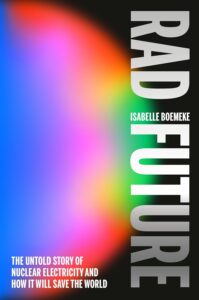
Rad Future: The Untold Story of Nuclear Electricity and How It Will Save the World author and Isodope nuclear advocacy platform founder Isabelle Boemeke knows this territory intimately. A fashion model turned nuclear energy advocate, Isabelle brings a refreshingly accessible lens to a topic usually buried under jargon and political baggage. In this conversation, she walks us through the staggering math — like how a gummy bear-sized uranium pellet contains the same energy as a literal ton of coal, or how Germany’s fear-based decision to shutter its nuclear plants left it funding Russia’s war machine through gas dependency. Isabelle unpacks the Chernobyl myths we’ve all absorbed, explains why Fukushima’s “radioactive water crisis” was largely theater, and reveals how existing coal plant infrastructure could be converted to nuclear without starting from scratch. Whether you’re a climate-anxious millennial wondering if hope is even possible, a policy wonk tired of energy debates that ignore basic arithmetic, or just someone who’s curious why we’ve spent decades running from our best solution, this conversation delivers the rare gift of genuine perspective shift. Listen, learn, and enjoy!
Please Scroll Down for Featured Resources and Transcript!
Please note that some links on this page (books, movies, music, etc.) lead to affiliate programs for which The Jordan Harbinger Show receives compensation. It’s just one of the ways we keep the lights on around here. We appreciate your support!
- Sign up for Six-Minute Networking — our free networking and relationship development mini-course — at jordanharbinger.com/course!
- Subscribe to our once-a-week Wee Bit Wiser newsletter today and start filling your Wednesdays with wisdom!
- Do you even Reddit, bro? Join us at r/JordanHarbinger!
This Episode Is Sponsored By:
- BetterHelp: 10% off first month: betterhelp.com/jordan
- Fitbod: 25% off: fitbod.me/jordan
- HexClad: 10% off: hexclad.com/jordan
- Progressive: Free online quote: progressive.com
- Homes.com: Find your home: homes.com
Thanks, Isabelle Boemeke!
Click here to let Jordan know about your number one takeaway from this episode!
And if you want us to answer your questions on one of our upcoming weekly Feedback Friday episodes, drop us a line at friday@jordanharbinger.com.
Resources from This Episode:
- Rad Future: The Untold Story of Nuclear Electricity and How It Will Save the World by Isabelle Boemeke | Amazon
- Isabelle Boemeke’s Nuclear Energy Advocacy Platform | Isodope
- Isabelle Boemeke: Nuclear Power Is Our Best Hope to Ditch Fossil Fuels | TED
- This Influencer Is Using Her Platform to Help People Understand Nuclear Energy | TIME
- The Prevalence of Climate Change Psychological Distress among American Adults | Yale Program on Climate Change Communication
- For Gen Z, Climate Change Is a Heavy Emotional Burden | Yale Environment 360
- 2019 Amazon Rainforest Wildfires | Wikipedia
- 2019–20 Australian Bushfire Season | Wikipedia
- Attribution of the Australian Bushfire Risk to Anthropogenic Climate Change | World Weather Attribution
- December 1938: Discovery of Nuclear Fission | American Physical Society
- Otto Hahn, Lise Meitner, and Fritz Strassmann | Science History Institute
- Cuban Missile Crisis | Britannica
- Three Mile Island: Accident and Meltdown | HISTORY
- The China Syndrome (Film) | Prime Video
- Chernobyl Accident 1986 | World Nuclear Association
- Deaths Due to the Chernobyl Disaster | Wikipedia
- Midnight in Chernobyl: The Untold Story of the World’s Greatest Nuclear Disaster by Adam Higginbotham | Amazon
- Chernobyl (HBO Miniseries) | Prime Video
- How Accurate Is Chernobyl? True Story vs. HBO Miniseries | History vs. Hollywood
- Chernobyl’s Babushkas – The Women Who Refused to Leave the Exclusion Zone | The Guardian
- The Babushkas of Chernobyl (Documentary) | Amazon Prime
- Nuclear 101: How Does a Nuclear Reactor Work? | US Department of Energy
- Nuclear Power and the Environment | US Energy Information Administration
- Ambient (Outdoor) Air Quality and Health | World Health Organization
- What Are the Safest and Cleanest Sources of Energy? | Our World in Data
- Nuclear Power Reactors | US Nuclear Regulatory Commission
- DOE Explains: Nuclear Fusion Reactions | US Department of Energy
- Nuclear Fuel | Nuclear Energy Institute
- Technology-Specific Cost and Performance Parameters (Annex III) | IPCC
- Nuclear Energy in California | California Energy Commission
- Uranium Mining Overview | World Nuclear Association
- The Workings of an Ancient Nuclear Reactor | Scientific American
- Spent Fuel Storage in Pools and Dry Casks | US Nuclear Regulatory Commission
- Storage and Disposal of Radioactive Waste | World Nuclear Association
- Fukushima Daiichi Accident | World Nuclear Association
- Frequently Asked Questions: Fukushima Daiichi Treated Water Release | IAEA
- Expert Reaction to IAEA Safety Review on Japan’s Plans to Release Treated Water | Science Media Centre
- Radiation Contamination Versus Exposure | CDC
- Germany to Pull the Plug on Three of Its Last Six Nuclear Plants | Reuters
- World Energy Outlook 2023 | International Energy Agency
- 3 Reasons Why Nuclear Is Clean and Sustainable | US Department of Energy
- Oliver Stone | Nuclear Now | The Jordan Harbinger Show
- Nuclear Now (Documentary by Oliver Stone) | Prime Video
1277: Isabelle Boemeke | The Rad Future of Nuclear Electricity
This transcript is yet untouched by human hands. Please proceed with caution as we sort through what the robots have given us. We appreciate your patience!
Jordan Harbinger: [00:00:00] Welcome to the show. I'm Jordan Harbinger. On The Jordan Harbinger Show, we decode the stories, secrets, and skills of the world's most fascinating people and turn their wisdom into practical advice that you can use to impact your own life and those around you. Our mission is to help you become a better informed, more critical thinker through long form conversations with a variety of amazing folks, spies to CEOs, athletes, authors, thinkers, performers, even the occasional rocket scientist, war correspondent, or arms dealer.
If you're new to the show or you're looking for a handy way to tell your friends about the show, I suggest to our episode starter packs. These are collections of our favorite episodes on topics like persuasion and negotiation, psychology and geopolitics, disinformation, China, North Korea, crime, and cults and more.
That'll help new listeners get a taste of everything we do here on the show. Just visit Jordan harbinger.com/start or search for us in your Spotify app to get started. Today's guest has a wild resume. She's an international fashion model who became a nuclear power influencer. Yes, a fashion model and a nuclear expert.
Put that in your pipe [00:01:00] and smoke it folks. She goes by isotope online. That's pretty creative. I'll give you that. While most of us were doom scrolling, climate anxiety, memes, humans are the virus. Fire skies in China. Highways in Hollywood that looked like Blade Runner, but is it Blade Runner 2049 or the old one?
Anyway, she was asking the question, what if the thing we're all terrified of is actually the thing that saves us nuclear? The word that makes everybody think Chernobyl, hazmat suits glowing, three eyed fish. But what if everything we think we know about nuclear is wrong? In her book Rad Future Nuclear, Isabelle Boemeke argues that nuclear electricity and energy might actually be the cleanest, safest, densest, most reliable shot we actually have at a sustainable planet.
And she does it with humor. Sas, a little more scientific rigor than most of the people yelling at each other on the internet. So how does a model become a nuclear energy evangelist? Come for the fashion stay for the fiss. How does an international model become a nuclear power influencer? It's a weird career path.
And I say that as somebody who also has a weird career path. What happened there?
Isabelle Boemeke: [00:02:00] Yes. Well, first you go on YouTube and you watch how to become a nuclear energy influencer starting off as a fashion model,
Jordan Harbinger: right?
Isabelle Boemeke: I have no idea. And quite frankly, I think if I look back in my life, you know, we did those exercises where you have to imagine where your life is going to be in five years from now.
Mm.
Jordan Harbinger: I don't think I've ever done that.
Isabelle Boemeke: I have never done it. And now having had the trajectory that I've had, I definitely will never do it because I could have never predicted this turn in my life. I guess it was a really just out of necessity. And one thing that has been pretty consistent throughout my entire life is I try to be useful, whatever that moment requires, and in the case of becoming a nuclear energy influencer, I was trying to be useful and help solve climate change in whatever capacity that I could.
So I guess you get creative when you feel the need to do something, you know, about a really big problem that you have no idea how to begin to solve. And, uh, I remember my [00:03:00] desire to do something about climate really was inspired by seeing images of the Amazon on fire back in 2019. And this was the same year that there were huge Australia fires and also California fires.
I I think those are the original orange sky photos that went all around.
Jordan Harbinger: Yeah. If those are scary. I remember when the fires were in L.A. and people were driving along, was it 1 0 1 or whatever it is, or the 4 0 5. They're driving along and the, the fire was just right up to the side of the highway because the grass was burning.
And I remember my friend who's been on the show, Derren Brown, he is a mentalist. He told me he was driving to go do shows in L.A. and he's like, I've never, this is like, what Hell must be, right? You're just driving through a tunnel of fire. And I don't know why they didn't close the highway. I guess they just felt like they couldn't, it was absolutely insane.
And the Getty was going to burn, and then they said, no, we have this crazy fireproof. I mean, it was like, why are we thinking about how to fireproof art and buildings in extreme ways? I mean, yes, the stuff in there is priceless. [00:04:00] So it's a good idea. But also like, man, maybe we should manage the problem itself.
I know your career started with climate change fears, but I think a lot of Gen Z, they have climate anxiety. Would you say you had that or is that overstated?
Isabelle Boemeke: I think it was definitely climate anxiety and I, I think back then I couldn't have pointed at it and said, I have climate anxiety.
Jordan Harbinger: Mm. Yeah.
Isabelle Boemeke: But even before then, I really thought I didn't want to have kids because why bring them into such a messed up world?
Jordan Harbinger: Yeah.
Isabelle Boemeke: And in a world where we're all going to die in a decade or whatever because of climate change, and this is the belief that a lot of young people grew up with and still hold. Which is sad and tragic and, and also scary because it, it leads to this feeling of, um, apathy. Yeah. You know, they feel like they don't have any agency in the world and they can't possibly solve this very complex and big problems.
So I think this is something that a lot of young people definitely have. And, and I would say I suffer to some extent as well, [00:05:00] just having grown up with climate change being such a big issue. Everybody in my generation, I'm, I'm a millennial, but everybody in my generation and younger, we all grew up with hearing about climate change.
Jordan Harbinger: Yeah, it's true. And it's different also when you see it. Like if you live in L.A. and you saw those fires, if you watched a lot of videos about the Australia fires Also, I, when I went to Peru, I remember driving in, we were in a really rural area. I was in the middle of the jungle, and then we finally got to some small town, and then we took a bus to a larger town that had a small bush airport.
But when we were driving, we would see, it would be like jungle, jungle, jungle. And then there'd just be an open space and there'd be some cows in it. The next to that open space would be more jungle and then a little house. And then we saw fires, like tons of fires. And we're like, why aren't the people panicking?
This is a huge fire. And then we realized they were just burning the jungle down to get the land and then they were going to put their cows on in there or farm on there or something like that. And the fire was right up to the road. I mean, it was really intense and huge. And I'm thinking like, [00:06:00] there's no way these don't get out of control here and there.
So you have Hollywood highways, you got the bush fires in Peru. I've been to China, uh, especially 15 years ago when it was really, really dirty and it looked like winter, even though it wasn't because of the smog clouds. It's gross. You see the fires, you see the skies, you see the highways, and you just realize like, humans are the virus.
Remember that Hashtag humans are the virus.
Isabelle Boemeke: Well, I disagree with that sentiment 'cause I think it's also behind a lot of this feeling that, uh, we can't make the world better. I think a lot of this sentiments that humans are bad and we've destroyed the planet. It drives also a lot of apathy.
Jordan Harbinger: It does, yeah.
Isabelle Boemeke: And quite frankly, it also drives bad policies that actually harm humans. But it's funny 'cause people who don't believe in climate change, they'll say, oh, climate change started this fire. Whenever the news came out recently that the Palisades fire in L.A. were caused by an arsonist. They'll say, oh, I thought it was climate change.
But you know, nobody's saying that climate change is starting the fires. [00:07:00] Obviously the fires start because of, you know, humans trying to clear up land either for logging or raising cows or just building something or you know, of course somebody smoking and throwing their cigarette away. So there's a variety of reasons why fires do start, but climate change is just making it, making the fires more extreme.
It's drier. So you know, obviously fire spreads faster and so on.
Jordan Harbinger: Sure.
Isabelle Boemeke: But you know, it's interesting 'cause specifically the L.A. fires, 'cause they're so recent, the ones in Palisades, it couldn't have been totally avoid. It definitely could have been made better or less severe with a few practices that, you know, you mentioned the Getty mentioned, why isn't the city of L.A. preparing to face those fires as well, since it seems to happen every single year?
Uh, so there are things that can be done like brush management and controlled burns, even things like that that are not at least being implemented, but, you know, it's a huge tragedy and, and trying [00:08:00] to point fingers is kind of useless.
Jordan Harbinger: Of course. Let's switch to nuclear here because I don't, I think we're not here to talk about fire policy in la.
Um, people are super afraid of nuclear. They think it's bad and dangerous. Why is that the case? I mean, I remember growing up and not really having much of an opinion and then thinking like, oh, we shouldn't do that. I don't know why, but we just, we just shouldn't because Chernobyl actually maybe back up one little step.
Is there a big nuclear, like there is big oil and gas because you never really hear about the uranium lobby. Does that exist?
Isabelle Boemeke: If it exists, it's very ineffective.
Jordan Harbinger: Yeah.
Isabelle Boemeke: Because I don't personally take money from the nuclear industry, but there are people who are happy to take money from the nuclear industry and they just won't give any away.
So if there is big nuclear or big uranium, I'm not aware of it. But you know, just to step back, like why are people so afraid of nuclear? And it's interesting you mention you didn't really know much about it, but you just had this vibe that it was bad or [00:09:00] dangerous.
Jordan Harbinger: Yeah. Or like it's not cool, like hey, anything can happen.
I remember my mom telling me like Three Mile Island, I still don't even know what that is, but that apparently there was some nuclear thing there and my parents were like, Chernobyl. You know? That's what I remember learning about nuclear growing up. 'cause I grew up in the eighties.
Isabelle Boemeke: Yes, exactly. So I think even your generation, certainly my generation, we don't really know why, but we just have a bad feeling about it.
You know, if you want to go all the way back to the beginning, you really have to go to, whenever nuclear fission was discovered, and this is when a few scientists in the lab, you know, found out that by bombarding uranium with neutrons would create the atoms of the uranium to split and that would release energy.
And I'm just really simplifying the history here because there was a lot of people involved in steps and so on. But, you know, this discovery unfortunately took place in 1938 in Germany. So we were a year away from entering World War ii. And of course, [00:10:00] the fear automatically became that Hitler was trying to develop bombs using the underlying science.
It, it was very clear already at that time that this technology could be used for making weapons or also for making electricity. Right? I like to compare it to AI right now where we are. It can be, you know, this incredible thing that cures cancer and, and, and gives all of this, uh, creates all new jobs.
Also it can destroy human civilization,
Jordan Harbinger: right? Yeah. Well maybe we'll see. Right now it's fancy Auto complete plus Google. But yeah, maybe somewhere down the line it kills all of us.
Isabelle Boemeke: Right?
Jordan Harbinger: That's the fear. Anyway.
Isabelle Boemeke: Well, but with the difference being that, that at the time, this technology was certainly discovered in Germany,
Jordan Harbinger: Nazi Germany, to be
Isabelle Boemeke: clear, Nazi Germany, to be clear, exactly.
Nazi Germany, to be clear. And so Albert Einstein co-wrote a letter to President Roosevelt at the time, urging him to do something about that, to try to get ahead of Hitler. And so the United States started the Manhattan [00:11:00] Project, which obviously culminated with the bombings of Hiroshima and Nagasaki.
And that was the introduction to the world of nuclear technologies. And you have to think about the fact that people automatically started equating nuclear or atomic with a mushroom cloud image with photos of children crying, you know, running away from crumbling buildings. Imagine the emotional scar that that created in that entire generation that witnessed that.
Jordan Harbinger: Yeah. My parents talk about those drills where you stick your head under your desk and then it's like, yeah, you're going to get vaporized, but sure. Make sure you don't have a book land on you before that happens. Right? Or whatever. And it seems like if we'd had a slightly different introduction to this technology, we'd be in a totally different place.
Because I would think right now, if they were like, Hey, we figured out how to split the atom. It's like, wow, every vehicle's going to be electric. Skyscrapers in New York are going to be running essentially green, right? Carbon net, what is it called? Net zero whatever. [00:12:00] We're going to have clean cities, we're going to have clean air.
You're going to be able to clean up all the garbage everywhere and clean up all the water that's dirty because we have unlimited electricity. Man, it would've really turned out differently. We wouldn't energy politics, we would not have a lot of the dictatorships. We have now the Middle East crazies that are still largely living in the Stone age, warm up those angry emails.
Now folks, uh, would not have all the power and money that they have, and a lot of autocratic regimes sit on huge amounts of natural resources, just kind of by design. And I've done shows about this and so we, that might also just never have really happened.
Isabelle Boemeke: Yeah, totally. That was kind of the theory that I came into writing my book Write Future and which just came up.
But it was kind of the theory that I came into writing the book with, you know, imagine if we had this covered nuclear fission at a different time, at a different place. Yeah. I think right now could have been scary if it was discovered in like Iran.
Jordan Harbinger: Yeah.
Isabelle Boemeke: Or, or North Korea.
Jordan Harbinger: Sure.
Isabelle Boemeke: But you know, let's say in the nineties, in the United States,
Jordan Harbinger: yeah.
Isabelle Boemeke: The [00:13:00] world would've looked a lot different than it does today.
Jordan Harbinger: That's right.
Isabelle Boemeke: Or certainly even back then, if it was discovered in the United States, maybe it could have been different as well. It's hard to tell. You know, we are emotional creatures and we react to ideas and things and people in an emotional way, and then we use all sorts of logical explanations to justify why we feel that way.
But it always goes back to feeling. And so you have that entire generation card by the image of the mushroom cloud, and then you brought up your parents right after World War ii. We go straight into the Cold War with Russia, and this is a time where Russia and the United States are just stockpiling nuclear weapons, and there's a fear of imminent nuclear attack for years, it culminated clearly with the Cuban Missile Crisis, and this was a period of about 10 days where people in America went to sleep every single night thinking, I'm not going to wake up tomorrow.
You know, during the cold work, kids were [00:14:00] doing drills in school where they would duck underneath their desks in preparation for a nuclear attack, which to your point. Not a very good method to protect yourself from nuclear attack, right?
Jen Harbinger: Mm-hmm.
Isabelle Boemeke: But again, just reinforcing that idea. This is dangerous, this is scary.
Be on guard with this technology. And for the first 15 years after the discovery of nuclear fission, only governments could build nuclear reactors,
Jordan Harbinger: right?
Isabelle Boemeke: So only governments could build reactors for research, for submarines, for making weapons. So, you know, it was a technology that was extremely tied up with government as well.
Jordan Harbinger: Why does that matter? Because we don't trust the government. Is that why? Or I don't understand what,
Isabelle Boemeke: yeah,
Jordan Harbinger: why that's important.
Isabelle Boemeke: So why does that matter? People are already super scared. It's very tied with government. And then you have the movements of the 1960s and seventies, which were in large part also inspired by this anti-government, [00:15:00] anti-establishment feelings.
And so nuclear, which was already, you know, scary. It was very tied with government, became the boogeyman. And I think people don't understand also how powerful and huge the anti-nuclear movement was. So then you, you know, you have scary bombs, government, and so what happens when there is the first accident, which is through my island, which you brought up.
Jordan Harbinger: Yeah. I don't even know what that was. I just remember it was something nuclear. Is that in the United States?
Isabelle Boemeke: That was a nuclear power plant in Pennsylvania. And in 1979 it had a partial meltdown. It was an accident. There was a release of some radioactive gases into the atmosphere, but several studies have been done since then.
And they confirmed that there was no impact on people's health. It was just not enough radiation to cause any diseases. Certainly nobody died, that's for sure. I think the bigger question back then was, would people have cancers down the line? But people got really spooked and also I have to say. [00:16:00] This accident happened 12 days after a big movie called the China Syndrome.
Came out in the movies, and this was starring Jane Fonda and she was a reporter in the movie who was visiting a nuclear power plant. And she caught that the nuclear power plant was having issues and eventually the nuclear power plant has a partial meltdown.
Jordan Harbinger: Oh, wow. The
Isabelle Boemeke: accident happened to be very similar to what happened in real life at Through my island.
Jordan Harbinger: Wow.
Isabelle Boemeke: And so it just had this outsized impact. So you know what you see now, the connection.
Jordan Harbinger: Yeah.
Isabelle Boemeke: If you already think that something's dangerous, something's scary. The first little thing that happens, you automatically say, see, this is reason why this is scary. Instead of saying, well, any technology has incidents,
Jordan Harbinger: that's a really unfortunate coincidence.
Isabelle Boemeke: Yeah. Plus coming out right after the movie. So people are already on edge. Yeah. It's just like one confirmation point. See, this is scary. And then, you know, Chernobyl happens in 86, which is less than 10 years later. This is a completely different accident. This was in the [00:17:00] Soviet Union, and it was a shitty reactor design.
It had no like concrete around the reactor, so in case of an accident, radiation would not come out into the environment. So there was an explosion, and this was a lot of radiation that came out and got into the atmosphere. And what made things worse in this case specifically, was that the Soviet government didn't tell people about the accident.
As a matter of fact, they lied that there was even an accident for a couple of days. And so people around the area were drinking contaminated milk and eating contaminated food, and those are the people that got sick. But even in the case of Chernobyl, which without a doubt was the worst nuclear accident in human history, it's just so overblown.
You know, the confirmed number of fatalities is 59. Period.
Jordan Harbinger: I would've added a zero to that if you had made me guess. 'cause you see, you know, I watched the show on HBO, which I'm sure is historically accurate to the detail, but yeah, you see these firemen or whatever, and they're shoveling [00:18:00] the radioactive carbon or whatever, and they all go to the hospital and basically melt into some kind of liquid.
And then the woman visits her boyfriend and she's pregnant, the fetus die. Like all this stuff happens that's just awful. And everyone's burned. And you think like 59 dead. Like what are the odds of that?
Isabelle Boemeke: 59 confirmed. Right? So this includes the first responders that you mentioned, this firefighters going in shoveling, which is crazy that not all of the people who were shoveling the super reactive stuff actually died from radiation.
Jordan Harbinger: Yeah,
Isabelle Boemeke: right. It would seem to be the case that everybody who did died, and there's a scene, if you remember the show at Chernobyl, there's a scene where these three workers go down to the basement of the reactor to open a valve. They go on a so-called suicide mission.
Jordan Harbinger: Right.
Isabelle Boemeke: And that's actually true. There were three workers that went down to the basement to open a valve, except one of them was still alive last year, 2024.
And the two other ones died like 10 years ago of totally unrelated stuff, like heart issues or,
Jordan Harbinger: yeah,
Isabelle Boemeke: something else,
Jordan Harbinger: which is pretty [00:19:00] common in Belarus or wherever Chernobyl is
Isabelle Boemeke: was it was, uh, current day Ukraine.
Jordan Harbinger: Yeah.
Isabelle Boemeke: So it was just to say, you know, everything that's related to nuclear accidents in Chernobyl is completely overblown.
Another crazy fact, one of the reactors obviously exploded, so nothing, you know, it was shut down. Another one was shut down maybe a decade after that reactor exploded. But the Chernobyl power plant, there were four reactors originally, and one of them kept making electricity until the year 2000. So there were workers coming in and that's a reactor that shared a wall with the reactor that exploded.
Jordan Harbinger: Oh wow.
Isabelle Boemeke: So people were coming in, the power plant was still producing electricity. 'cause people tend to think generally like everybody died and it became this wasteland that nobody can go in.
Jordan Harbinger: Right? Yeah.
Isabelle Boemeke: And it's just not true.
Jordan Harbinger: The exclusion zone when I look at it on a map is, that's why I thought it was in Belarus.
'cause there's something called the Chernobyl exclusion Zone, which I guess is. Part Ukraine, part, Belarus part. I don't know what else. Maybe some Russia in there. I, I'm not sure [00:20:00] exactly, but it's like a, a grayed out area on the map with lines through it, depending on the map you're looking at. And there's, the borders kind of aren't really there because there's no people living in there or, I mean, no people supposed to be living in there.
Mm-hmm. And there's cities that have like wolf packs in them and wildlife and all kinds of crazy stuff. My buddy went through a motorcycle trip through there, so you can go through it, but it's, you know, nobody's there. But yeah, you think there's power plants there and it's an a post-apocalyptic disaster zone.
But really it's an operate or was an operating power plant with working roads that you could drive through if you actually wanted to do that. And I think it includes part of Belarus, part of Ukraine. How long is that out of commission? Like is that going to be centuries before people move back there or what?
Isabelle Boemeke: So people have moved back there. Not everybody, but there were some people who said, you cannot tell me what to do. And they just went back. There's this whole, I think it's a BBC piece. There is this whole piece on the people who went back to live in the, in the Chernobyl exclusion zone. 'cause it was their homes.
Jordan Harbinger: People live in [00:21:00] subway tunnels and sewers. So I don't know if that's quite the flex, uh, we're looking for, but like when is it?
Isabelle Boemeke: No, it's not a flex at all. But it's like, but it's interesting that they have gone back and they're growing food there and they're eating their food and they're hunting and whatever.
Jordan Harbinger: Yeah.
Isabelle Boemeke: And these people are like a hundred years old.
Jordan Harbinger: Citation needed, but okay. I get your point. I get your point.
Isabelle Boemeke: No, it's true. Like they made this whole profile piece on these people who are in their nineties who went back to live in the exclusion zone. And they don't, they don't care. And obviously like you have to go around with a little radiation monitor 'cause it's not evenly distributed.
So in some parts there is more radiation than others. And you can be going through like a little field that has no radiation or very little radiation and then right next to it there is a very hotspot. They're constantly measuring as well to make sure that whatever they're touching, building and eating is not super radioactive.
Jordan Harbinger: That's a place I would go. It might not take the kids, but, uh, I would definitely check something like that out. But I'm weird. I went to North Korea too. I don't, I don't think people should say, oh, well Jordan went there, so it's totally fine.
Isabelle Boemeke: No, I mean, I, I'm not recommending people go back. It's just [00:22:00] like,
Jordan Harbinger: have you been there?
Isabelle Boemeke: No, I haven't been. Just because when I started doing this work, it was COVID and then obviously the Russia and Ukraine War started, so, oh yeah,
Jordan Harbinger: that's a good point. You can't really go there now. I didn't think about that.
Isabelle Boemeke: Yeah, you can't really go there now, but, but I would like to visit with the respect that it deserves.
'cause I think it's easy to, to be, oh, it's not a big deal because the fears are so overblown. So you have to like walk that fine line of saying yes, it was terrible. And you know, people suffer the consequences, especially of being kicked out of their homes and never be able to come back. But also this is not the thing that people make out to be.
Jordan Harbinger: Right. Okay. Well, what they were, forgive the tangent folks. I'm just, I'm really interested in these kinds of things as people know. But what the point is, is, is nuclear, this is a hard argument to make now after we just talked about Chernobyl. But the nuclear is a primary source of energy, but it's clean.
And by, can you tell us what primary source of energy is? 'cause I think a lot of people, I mean I hadn't really thought about this. 'cause you know, electricity is electricity, so what?
Isabelle Boemeke: Yeah, exactly. So, you know, we're very [00:23:00] familiar with electricity. You get home, you turn on the lights, you charge your phone, charge your computer, do all the things that we do without thinking twice about electricity, right?
But electricity is a secondary source of energy. And what that means is that we need to use a primary source of energy to create electricity. 'cause yes, electricity exists in nature, but it's not like we're harnessing that electricity to power our stuff. So the primary sources of energy that we use to create electricity are coal, oil, methane gas, solar, wind, hydro, geothermal, and nuclear is one of those.
So those are all different ways that we can create electricity. There are more, but they're niche. I'm just going to focus on, on the biggest ones.
Jordan Harbinger: Sure.
Isabelle Boemeke: And so nuclear is actually the largest source of clean energy in the United States. It's the second largest source of clean energy in the world. And what I mean by that is that whenever we make electricity with nuclear, we're not releasing, um, greenhouse gases into the atmosphere or even particulate matter.
So [00:24:00] there are no emissions that happen whenever you're creating electricity with nuclear. But it's still, you know, even though it's the largest source of clean energies. Still very far from being our primary source of electricity generation. This is still, uh, fossil fuels like methane gas or, or coal in the United States.
Specifically,
Jordan Harbinger: if we burn methane, what comes out of that? Do you know?
Isabelle Boemeke: So methane, whenever we burn it, we don't actually get the same stuff. Coal is by far the worst, right? So
Jordan Harbinger: yeah, sure.
Isabelle Boemeke: When you burn coal, you get a ton of shit into the atmosphere. You get, actually, you even get radioactive ash
Jordan Harbinger: from burning coal.
Isabelle Boemeke: Yes, there is more radiation in the environment from burning coal than there is from nuclear plants because of the radioactive ash.
Jordan Harbinger: That's crazy to think about. I did not know that. Okay.
Isabelle Boemeke: And by the way, this is not the reason why coal is bad. The reason why coal is bad is because of the particulate matter.
So it emits this tiny particles of pollution that we breathe and get lodged into our lungs, and they cause a bunch of [00:25:00] problems. So this is something that people die from. This is already causing at least 4 million premature deaths every single year. Not to go on a tangent, but whenever people say, oh, climate change is is not real, or it's a hoax or whatever, I always say, okay, even if climate change is not real or a hoax, what about the 4 million premature deaths from burning fossil fuels?
Jordan Harbinger: 4 million deaths is a lot more than nuclear deaths. Yes. Considering you just said 59 at Chernobyl, and I don't know how far we have to reach for other nuclear disasters.
Isabelle Boemeke: Yeah, exactly. So like with Chernobyl, 59 confirmed, and then there's like this projected deaths that maybe are caused later because people got exposed to higher levels of radiation.
Jordan Harbinger: Sure.
Isabelle Boemeke: And the most credible estimates of that are around 4,000 deaths. We have no way of verifying that because it's really hard to track. You know, cancer is very common and it's been increasing for many, many decades, so it's impossible to trace a specific cancer case back to Chernobyl. But there are different ways.
And so the estimates are 4,000. So let's just say Chernobyl called [00:26:00] 4,000 deaths or will cause 4,000 deaths. He would need like at least 200 Chernobyls happening every single year for nuclear to be as dangerous as fossil fuels.
Jordan Harbinger: Yeah. Wow. That says it all. I suppose at that point, at that point, you're building nuclear reactors in your garage.
If you want to kill that many people using nuclear, you'd have to try.
Isabelle Boemeke: It's illegal. It wouldn't be able to, but yeah, you'd have to basically try
Jordan Harbinger: a challenge accepted. Yeah. But I, I suppose you'd have to try, but that's great though. 'cause nuclear is a primary source of energy, but it's essentially clean.
Right? So you're is the argument we've outgrown fossil fuels? 'cause I, I think I would agree with that generally.
Isabelle Boemeke: Yeah, definitely. And I think that that's the mistake that some people make is that those say fossil fuels are evil and we have to ban fossil fuels. And, and in reality, I think that's not a great argument because if you look at human civilization, fossil fuels really are the primary source of energy that have enabled all of our progress as, as a civilization.
We have hospitals and, and better healthcare and all of these things [00:27:00] because we've had access to insane amounts of fossil fuels. But where I think the arguments that people who are just super pro fossil fuels make that is wrong is that they'll say, well, it's because of fossil fuels themselves. And in reality is just higher access to energy.
That's it. Wherever that energy is coming from really doesn't matter. But as long as we can have access to lots of energy, to, you know, keep building our civilization as it is, that's the best argument. And so nuclear is just a better way to make electricity in this case, because it's cleaner, because it doesn't put greenhouse gases into the atmosphere.
It also doesn't put particular matter, but from every single aspect that you look at it, nuclear is just superior.
Jordan Harbinger: You're looking for a glow up that doesn't require enriched uranium. Check out our sponsors. We'll be right back. This episode is also sponsored in part by BetterHelp. Every January we all get hit with that New Year, new you nonsense.
And I'm like, Hey, I can barely keep track of current me. Thank you very much. That's where therapy [00:28:00] comes in. A good therapist helps you spot the stuff. You're too close to see your patterns, motivations, relationship issues, and BetterHelp makes the whole process so easy. There's no reason not to start. You complete a quick questionnaire with 12 plus years of experience and a super high match success rate.
BetterHelp will pair you with a therapist switch anytime if it's not a fit. These are legit professionals, too fully licensed, strict code of conduct. All that BetterHelp got over 30,000 therapists, has helped more than 5 million people. In live sessions average 4.9 out of five stars from over 1.7 million reviews.
That is a whole lot of people who didn't try to fix everything alone. So if you want to start the year a little lighter, not reinvent yourself from scratch. BetterHelp is a great place to start.
Jen Harbinger: BetterHelp makes it easy to get matched online with a qualified therapist. Sign up and get 10% off at betterhelp.com/jordan.
That's betterhelp.com/jordan.
Jordan Harbinger: This episode is also sponsored by Fitbod. You don't need a personal trainer to hit your 2026 goals. All you need for a personalized workout is Fitbod. It feels like having a trainer in your pocket. You open up the app, punch in your goals, the [00:29:00] equipment you got and how much time you have.
It builds the workout for you really fast, like you choose what to focus on. It just handles the rest. I love that. I don't have to think. It tells me what's next. Tracks my sets and weights keeps me moving and it adapts as you get stronger so you're not stuck doing the same routine forever. No boredom, no plateaus, just steady progress.
It also tracks muscle recovery, which is huge because it helps you push hard without accidentally grinding yourself into the floor. Plus you get over a thousand demo videos so you're not guessing form or hoping you'll do it right. FitBot is built around real training best practices, and it makes staying consistent way easier even when you're traveling or you're short on time.
So if you're trying to level up in 2026, give the Fitbod app a shot.
Jen Harbinger: Level up your workout in the new year. Join Fitbod today to get your personalized workout plan. Get 25% off your subscription or try the app free for seven days at fitbodme/jordan. That's fitbodme/jordan.
Jordan Harbinger: If you're wondering how I managed to book all these authors, thinkers, creators every single week, it's because of my network, the circle of people I know, like, and trust, and I'm teaching you how to [00:30:00] build the same thing for yourself in our course without any shenanigans over at Six Minute Networking dot com.
I don't need your credit card number. This is a free thing from us to you in six minute. Today is all it takes. Dig that well before you get thirsty, folks. Build relationships before you need them. Many of the guests on the show subscribe and contribute to the course. Come on and join us. You'll be in smart company where you belong once again, all free at Six Minute Networking dot com.
Now, back to Isabelle Boemeke. A lot of people are going to say, you said there's no emissions, but I, you know, I driven past a nuclear power plant before. What are those big smoke stacks for if they don't have emissions?
Isabelle Boemeke: So those are not smoke stacks. The smoke stacks are different. They're like thinner,
Jordan Harbinger: right
Isabelle Boemeke: stacks.
And those are usually in coal plants and they're putting out shit into the environment,
Jordan Harbinger: right?
Isabelle Boemeke: But the nuclear power plant, you're not actually seeing smoke stacks, you're seeing cooling towers. What the thing that they're putting out is actually just water vapor. So nuclear power plants, nuclear reactors actually get very hot.
That's how they make electricity. They use the energy trapped [00:31:00] inside of atoms to heat up water, which creates steam. And the steam then spins the turbine that is connected to a generator, and that's how it makes electricity. So nuclear reactors get very hot and they need to be cooled down. And one of the most popular ways in which they're cooled down is we get water from a large body of water nearby.
It can be an ocean or a lake or a river, and you suck that water into a cooling system that goes around a secondary loop in the reactor. So it's not actually touching the reactor. That's where the radiation would be, but it's coming out. Usually in most nuclear power plants, it also just comes right back out into the lake river Ocean, just hotter than what it was in the beginning.
Jordan Harbinger: Okay, so it's not actually becoming radioactive by going through the power plant?
Isabelle Boemeke: No, it's not touching anything that's radioactive. So, no, but some power plants actually have cooling towers. Not all of them do, but the cooling towers, they help recycle that water, and so the water comes in from a large body, cools the reactor down, [00:32:00] goes to the cooling tower, which then basically just like drops the water really from a really high point, and it cools down that water.
Then that water goes back in and helps cool the reactor again.
Jordan Harbinger: And those big vases that look like smokestacks, it's basically just raining crazy in there with water that was hot. And that cools as it goes up and then just rains back down inside that the giant vase.
Isabelle Boemeke: Yes. And then, so the stuff that's coming out is like water vapor.
Jordan Harbinger: Yeah.
Isabelle Boemeke: Um, so that's, you know, a huge difference, obviously.
Jordan Harbinger: And that's a light water reactor, right. There's different kinds of reactors, but that's what we use to generate electricity. Generally.
Isabelle Boemeke: That's the vast majority of them.
Jordan Harbinger: I see.
Isabelle Boemeke: There are a couple of different ones in the world, but that's the vast majority of nuclear reactors are what, what are called light water reactor.
And what that means is just that these types of reactors, they use water as both a moderator and a coolant. We can get into the details of that if you want, but,
Jordan Harbinger: eh, that's all right. Probably bigger fish to fry on that. We can maybe come back to it. But tell me the difference [00:33:00] then between what, what are, we're using fission, right?
What's the one we don't have yet? That's the holy grail, right? Is that fusion?
Isabelle Boemeke: That's fusion
Jordan Harbinger: and fission is the one we, what is the difference between those two things?
Isabelle Boemeke: The easiest way to think about it is both are harnessing energy that was inside of atoms. Yeah. Which is really cool, right? Yeah. We can't even see atoms and yet we're somehow able to tap into that energy and use it to power our lives.
So in the case of fission, you can think of a heavier atomic nuclei. So, uh, the nucleus of an atom that's bigger, and you shoot it with neutrons and it splits apart, and once it splits apart, you get energy that come out of it, and that is in a form of heat. Now with fusion, it's the opposite. You then imagine two smaller atomic nuclei coming together and smashing with such force.
They fuse together. And that process also releases energy. So both our nuclear energy, we've only been able to do fission so far. [00:34:00] So every single nuclear reactor in the world is a fission reactor. Now, fusion, like you said, is the holy grail. This is what the sun does in its core. But if you have noticed, the sun needs a lot of energy to make fusion happen, right?
Sure. So that's one of the biggest problems here on earth, is how do we actually create the conditions necessary for fusion to happen? And that means it just needs a lot very, very high temperatures. You just need to recreate the conditions of the sun, basically. So that requires a lot of energy.
Jordan Harbinger: That's all.
Just recreate the sun on earth without killing everyone. Exactly. And so, okay, maybe take it slow, folks.
Isabelle Boemeke: Well, but the biggest thing is really that it just takes too much energy to get a tiny amount of energy out. And so in the last couple of years, there have been announcements coming out of labs saying, we finally got a little bit of energy out, more energy out than we've put into the whole system.
But
Jordan Harbinger: right.
Isabelle Boemeke: When people say, oh, fusion is 10 years away, I say, talk to me whenever we have. A product.
Jordan Harbinger: Yeah.
Isabelle Boemeke: That I can buy tomorrow.
Jordan Harbinger: [00:35:00] Right. Or or a fusion power plant somewhere in the world that's actually operating,
Isabelle Boemeke: that's actually competitive. That's actually, yeah. You know, 'cause there can be one maybe in 10 years, which I highly doubt, but it's going to cost an insane amount of money.
And I'm not saying that to say we shouldn't pursue fusion, but it's just to say it's not an existing technology at the moment, so.
Jordan Harbinger: So it's not relevant to the discussion. I was just curious. Yeah, because I know like nuclear is unbothered by the weather. Solar and wind, they're weather dependent. Here in California, we always worry about that.
Hydro power is clean too, but it seems like there's downsides to that because you have to build a massive dam and then flood a bunch of little villages in China or whatever to make this thing. It's got to have tons of people working on it and it takes years to complete and you screw up all the ecosystems and stuff like that.
And then, man, I would imagine that a disaster at a hydro plant could be way, way worse than a nuclear disaster, really. I mean, generally speaking, right? Because you hear what happens if the three gorg dam explodes in this big [00:36:00] flood or this storm and, and I think I said three Gorges, I meant three River Gorge in China.
We're talking like six figure or more casualties of human life. And that doesn't count property, right? Just massive, massive destruction.
Isabelle Boemeke: So Hydra obviously has downsides, like you mentioned. You know, you have to flood certain areas and there are also some emissions associated with it. I think it's because, I can't remember exactly, but like basically a lot of plant material gets trapped into these giant dams and it dies and it's like.
Puts off a bunch of CO2. There's something like that with hydro.
Jordan Harbinger: That's interesting. I have to look that up 'cause that's something I'd never heard. Plant met are getting trapped and then something, something emissions.
Isabelle Boemeke: There's something like that where Hydropower Dam specifically leads to higher CO2 emissions because of dead plants.
And I can't remember exactly the connection, but you know, I do think that we tend to get lost a little bit in these discussions because at the end of the day, yes, hydro has some downsides. It's still way better than fossil fuels just because of what we talked about in terms of the particular matter and the greenhouse gases that are associated with it.
[00:37:00] So I still think it's a step forward. You know, it's technology that's better Now the biggest problem with hydro really is that we've, we're very tapped out on hydro.
Jordan Harbinger: Yeah. There's only so many rivers you can dam up, uh, before you run out of the ability to do this. By the way, I looked up why this happens if you want to hear it.
Yes,
Isabelle Boemeke: yes.
Jordan Harbinger: So hydropower plants create emissions primarily because of the decomposition of organic matter in the reservoir. So when you dam it up and you make that huge lake. All of that flooded vegetation decomposes, and it does so anaerobically. So it produces methane as a byproduct, which is one of the worst, you know, sort of greenhouse gases.
And then that just goes into the atmosphere through diffusion or bubbling up from the sediment. Imagine you flood several hundred acres or whatever. All that stuff just turns into one of the worst greenhouse gases and then goes into the environment. You could also argue that making the concrete creates a lot of CO2.
I mean, it's just sort of like there's going to be emissions with everything. It just matters how much emissions it saves in the future. I think that's really the important part, right?
Isabelle Boemeke: Yeah, [00:38:00] exactly. And that's why I feel about, about hydro, you know, we can nitpick every single clean energy source.
Jordan Harbinger: Yeah.
Isabelle Boemeke: And say, well, you know, it creates emissions if we do this.
And of course, because everything we do creates emissions because our civilization is, again, so dependent on fossil fuels and energy in general. But it's still, it's a step forward and, but I think the biggest thing is, what I mentioned is we're very much tapped out. Hydro is, is the largest source of clean energy.
And most countries have already developed hydro in the, in the best places. So it gets to a point where, because you know it, it is not just really big bodies of water. You also need some height. You need water that basically goes down. Right. And so
Jordan Harbinger: you need a difference in elevation. Yeah. Yeah. So it's hard to find the exact natural circumstances that can, you can do this.
And of course, as the human population grows and we develop more areas, it's going to be less possible to do this. Right. Because if you go, oh, we can do this. We just have to flood St. Louis, we're not doing that. Right. It's not going to happen.
Isabelle Boemeke: So you, it's funny you mentioned that it seems like a bigger chance that there will be a disaster with hydro [00:39:00] power plants and
Jordan Harbinger: Yeah.
Isabelle Boemeke: The biggest energy disaster in history was actually a hydropower dam collapse in China. And it happened in 1979, the same year that three Mile Island, the big nuclear disaster happened. That didn't kill anybody. This actual disaster went down in China and the world didn't learn about it for decades because China.
Jen Harbinger: China,
Isabelle Boemeke: right. But you know, it was this massive dam that got flooded and collapsed, and as it collapsed, it flooded then dozens of other smaller dams that were downstream from it. So entire villages were swept away. It's estimated that 200,000 people died. Oof. Between just being swept away, but then being, you know, not having food and, and dying from contaminated water later on.
And so even when you compare that to nuclear, if you compare the worst nuclear disaster to the worst hydropower disaster, the worst hydropower disaster completely eclipses nuclear. And so it's interesting, right, that we have all this weird fears about nuclear when the facts and the reality just point to it being actually extremely safe.[00:40:00]
Jordan Harbinger: Yeah. You also, in your book, you bring up the idea that nuclear is energy dense. What does that mean? Is that the fuel that's being used? Is that what you mean by that?
Isabelle Boemeke: Yeah. So nuclear fuel is extremely energy dense. It's about a million times more energy dense than fossil fuels. Let's just say you're getting like a tiny, uh, gummy bear.
Everybody has seen a gummy bear before, right?
Jordan Harbinger: Yes.
Isabelle Boemeke: So that has the same amount of energy as 2000 pounds of coal,
Jordan Harbinger: 2000 pounds of coal,
Isabelle Boemeke: 2000 pounds of coal.
Jordan Harbinger: You just need a gummy bear worth of uranium and your good.
Isabelle Boemeke: Yes.
Jordan Harbinger: Wow.
Isabelle Boemeke: To create the same amount of energy. So it's almost impossible to wrap our minds around.
It's incomprehensible and there is no other, I don't think there's anything else on the planet that has the same energy density. So why does that actually matter besides being a very cool, fun fact?
Jordan Harbinger: Yeah,
Isabelle Boemeke: and well, it's because when we talk about nuclear being better in every possible way, it means that we need way less mining because we need to use way less fuel than we [00:41:00] would with any other source of energy.
That also means that you need way less space, both to just have a, a power plant, but then also to store, you know, the fuel and so on. So that's why nuclear takes the least amount of land, and it also requires the least amount of mining out of all energy sources.
Jordan Harbinger: I see. So if I have a train that's full of coal.
I basically need a pocket full of gummy bears to make up the nuclear fuel. That would be a train full of coal.
Isabelle Boemeke: Right?
Jordan Harbinger: Or maybe two pockets full of gummy bears. Right. But I certainly don't need thousands of trucks or trains worth of nuclear fuel every year.
Isabelle Boemeke: Exactly.
Jordan Harbinger: And then I'm not creating those emissions either.
Isabelle Boemeke: So you're not creating those emissions both from transporting, but also from mining.
Jordan Harbinger: Is uranium in the ground? Is it in big ch because it coals in like huge chunks in the ground, right. So I think so anyway. If there's chunks of coal in the ground, are there chunks of uranium in the ground? Yep. Or is it like a grain of, okay.
Yes, because I'm thinking, you know, you don't necessarily need less mining if it's a grain of sand each time you find uranium. But if it's a chunk like a [00:42:00] rock, then, and that's enough for 2000 pounds of coal. You're right. We need way less mining. Like it's not even close.
Isabelle Boemeke: It's not even close. And that's why when people, you know, I'll talk about nuclear and they'll say, but what about the emissions associated with mining and transporting?
Yeah,
Jordan Harbinger: I was going to ask you about that.
Isabelle Boemeke: And building the reactors.
Jordan Harbinger: Yeah. Isabelle, what about that?
Isabelle Boemeke: What about it? Well, that's good. The people do this thing called lifecycle analysis. So they look exactly into that. Like,
Jordan Harbinger: right.
Isabelle Boemeke: You know, what are the emissions associated with mining, with building, with then fueling and then even decommissioning these nuclear plants.
Jordan Harbinger: I see.
Isabelle Boemeke: And again, nuclear has the lowest lifecycle emissions out of all energy sources because of what we talked about. And also, nuclear plants last for a very long time. We have no reason to believe why they wouldn't last for 80 years. Versus something like solar and wind, solar panels and wind turbines.
They last for about 25 to 30 years and they have to be fully replaced. And then because also they are more intermittent, you also need a lot more of them to be able to even get [00:43:00] close to the same amount of energy. And it's not the same profile 'cause they don't work all the time.
Jordan Harbinger: Yeah. How does that work?
How? Like how much nuclear would California need? I know I'm putting you on the spot. Feel free to choose a different state or something. How much nuclear would California need if we had nuclear versus wind versus solar? And of course, and I'm aware that like solar doesn't work in Michigan for most of the year, right?
So we're going to have to almost ignore the fact that it only works for a third of the year and that wind only works on the seaside or wherever there's a lot of wind. But like how much space is that going to take up? Do I need a city of L.A. sized nuclear power plant to power the whole state? Because that's not that bad.
Really.
Isabelle Boemeke: Well, so let's just take a real life example, which is Diablo Canyon, which is California's current only nuclear power plant. And that plant has two reactors. It can power about 4 million people, I believe is the latest number.
Jordan Harbinger: Okay.
Isabelle Boemeke: It's not fully, but it's around 10% of the state's electricity. So
Jordan Harbinger: Wow.
Isabelle Boemeke: You would need 10 [00:44:00] of those.
Jordan Harbinger: That's so much less than I thought,
Isabelle Boemeke: right?
Jordan Harbinger: I thought you were going to say like 50 or 60. That's crazy.
Isabelle Boemeke: No, about 10 if it's 10% of the state's electricity. Right? And then you have to also think that you could potentially build two other reactors at Diablo Canyon. So let's just say you build two more, you get to 20% of the state's electricity.
So you don't have necessarily have to build one nuclear power plant per reactor. You can have. Nuclear power plants that have two or four reactors.
Jordan Harbinger: Wow.
Isabelle Boemeke: You could save a lot of space as well.
Jordan Harbinger: So for people who think I'm crazy, 'cause I said 50 or 60, there are 1,600 power plants in California right now.
Let's say that you really do need 10 Diablo Canyons to power the whole state. It's just not even close. It's just orders of magnitude, more effective, more efficient and and has less emissions. It's just, it's crazy to me that we don't do this. What about the energy needed to mine the nuclear fuel? I know you said there's less mining.
Is it more complicated? I'm trying to find a catch here. I'm trying [00:45:00] to find a gotcha Isabelle, where this just doesn't work out right. Like where the math doesn't hold up.
Isabelle Boemeke: The truth is like the math really holds up there. I mean it's, you know, like I said, it's less energy and there are two different ways to mine uranium.
One of them is the old way of just shoveling some rocks.
Jordan Harbinger: Sounds simple enough. Okay, simple
Isabelle Boemeke: sounds simple enough. And the new way is something called in situ mining. Which is basically like they dig a hole and they get to the uranium reserves and pump some liquid through it, that then brings the uranium to the surface.
And so it involves no people shoveling and that sort of stuff. But truthfully, you know, in reality, even the normal uranium mining has been done in a very, very safe way in the past few decades. And one of the biggest producers in the world is Canada. You know, there are all these different countries that have huge uranium reserves.
I think the biggest one is Kazakhstan and then Australia, Canada. So in terms of the mining and the energy takes to mine, it's without a doubt, it's just better than anything else. Just because of, again, [00:46:00] going back to the energy density, just a fun fact about mining that I don't, I don't know if it's even that fun, but to me it is.
So there is this big uranium reserve in Africa in what is now called Gabon in Africa. And um, some French nuclear power plants were buying uranium from that region. You know, because uranium is highly regulated and so on, they have to measure everything and make sure everything looks good when they receive shipments of uranium.
And they noticed that this uranium was slightly less radioactive than it should have been. It's a very simple way of putting it. And they were concerned that somewhere along the way people had stolen uranium. So a bunch of scientists went to this uranium deposit in, in Gabon in Africa and started analyzing the uranium chunks and the rocks and, and they started realizing that all the uranium from that mine was quote unquote less radioactive than it should have been.
Jordan Harbinger: Okay.
Isabelle Boemeke: And then they started detecting [00:47:00] so-called fission products, which is basically what you find in nuclear waste. And that's how they realized that those uranium deposits 2 billion years ago had actually been natural nuclear reactors. Just the conditions of the place was were such that whenever it rained and the water pooled in the cave, it allowed for chain reactions to happen.
That water would get hot and would then evaporate and it would stop until it rained again. So for hundreds of thousands of years. This caves served as natural nuclear reactors. If we were to go back in time and stick
Jordan Harbinger: wow,
Isabelle Boemeke: stick a a steam generator and a turbine, we could have actually made electricity with them.
Isn't that so cool?
Jordan Harbinger: That is really cool. I don't know if I'm just nerding out on this kind of thing, but I find that to be completely fascinating. It's also a little scary, I think, 'cause some people are going to go, oh yeah, that's really cool. Fun fact kids, but doesn't that mean that nuclear waste lasts for hundreds of thousands of years and we can't really get rid of it?
That's sort of a [00:48:00] counter argument to that kind of thing, right? I'm, I mean like, yes, this is great. We have free energy, but also like it's free energy that you can't turn off if you want to. So what about nuclear waste? What? What do we do with that stuff when it's not as radioactive as it should be? So we have to get rid of it, but it's still radioactive, you know, what happens to the fuel?
Isabelle Boemeke: Yeah, so definitely nuclear waste is one of the biggest concerns that people have, and I totally get it. That was the thing for me that I came into it thinking, is this really worth it? Because we're creating this radioactive waste. And it's true. While there are no emissions, there are no carbon emissions, there are no particulate matter emissions.
It is creating radioactive waste,
Jordan Harbinger: right?
Isabelle Boemeke: That lasts forever, hundreds of thousands of years, which in human lifespan is practically forever, right? So what do we do that,
Jordan Harbinger: yeah.
Isabelle Boemeke: Is it worth it? And the way I slowly started understanding and seeing it differently was, first of all, again, going back to the energy density and the quantity.
So [00:49:00] because of the density of this fuel, the amount of nuclear waste that we live behind is actually very small. So if I were to get my whole life's energy from nuclear, the amount of spent fuel, which is the waste that people talk about when they say this, waste is reactive forever, the amount of that waste would fit inside of a soda can.
Jordan Harbinger: Oh, okay.
Isabelle Boemeke: So we start with that. It's a small amount, but still, if you're powering the entire world with nuclear, it's still a significant amount. Then I learned that actually 95% of the waste, the spent fuel that is now being, you know, taken care of around the world is recyclable. 95% of it is still uranium.
Jordan Harbinger: Yeah, that was my next question. Can it be recycled? 'cause it seems like anything that's still hot for another 10,000 or a hundred thousand years, you could do something with that. Right?
Isabelle Boemeke: Exactly. Yeah. And exactly to your point, because there's different types of radiation and usually the stuff that is extremely dangerous and extremely radioactive also tends to go away fairly easily.
'cause it's [00:50:00] shooting off so much of it's energy. Right, exactly. It's
Jordan Harbinger: like a fire burning really hot. Yeah, it's
Isabelle Boemeke: like a fire burning really hard. But the stuff that lasts for a really long time, that is way less radio reactive. That's the stuff that we can, you know, that 95% of it is still uranium that we can just use again for energy.
Now that's a whole other conversation that then, you know, we have talk about proliferation concerns and we have talk about waste to deal with that waste and so on. But it's 95% of it is still uranium. So if at any point we want to recycle it, we can. And then the last part was truly understanding that when you look around us every single day, especially if you leave like in New York City and you walk on the street and you just stare at a sheer amount of waste that we create as a civilization every single day.
And then you think, you know, yes, most of this waste, whatever breaks down in a couple decades, maybe in a couple hundred years,
JHS Trailer: hopefully
Isabelle Boemeke: debatable because there's a ton of plastic waste that we're just now, you know, learning takes [00:51:00] way longer than we anticipated. In the process of breaking down, it's actually going to the environment and being eaten by fish, which then goes into our bodies and all of a sudden, every single man that has been tested has plastic in their testicles.
Jordan Harbinger: Okay.
Isabelle Boemeke: But anyway, thanks for that. Yeah, you're welcome. You might, you might be the exception.
Jordan Harbinger: I don't think so. Yeah,
Isabelle Boemeke: but I get it. But you know, I guess what I'm saying is we create waste, a ton of waste, some of it toxic, some of it already causing health impacts like plastic waste, and yet nuclear waste because it has the potential to be so dangerous, we've had to develop all of these very sophisticated systems to separate it and isolate it from people and the environment.
Jordan Harbinger: Yeah.
Isabelle Boemeke: And for that reason, nuclear waste as it stands, has never hurt a single person.
Jordan Harbinger: Nuclear doesn't care if it's sunny, cloudy, windy, or if Mercury is in retrograde. It just works. You know what else just works? The fine products and services that support this [00:52:00] show, we'll be right back. This episode is sponsored in part by HexClad.
We recently did something we should have done years ago. We tossed our old cookware and upgraded everything to HexClad. Our non-stick pans had reached that phase where they were just sticky, uh, all stick pans, I guess. So we finally donated the whole graveyard of. Crappy mismatched pans and made the switch.
HexClad is pretty much all we use now. HexClad's got this unique hybrid design. You get the performance of stainless steel so you can actually get a proper seer, but then you get the convenience of non-stick. So cleanup is ridiculously easy. Most cookware makes you pick a lane. Great cooking or easy setup, but HexClad somehow does both.
And they're dishwasher safe. Metal utensil safe oven safe up to 900 degrees. And the handles, they stay cool. I don't know how they actually did that. That's kind of amazing. Plus everything comes with a lifetime warranty, so it's not replace this in two years kind of situation. It's the last set you'll ever need.
Highly recommend these. Everyone here loves using them.
Jen Harbinger: New year, new you, new cookware. For a limited time only, our listeners get 10% off your order with our [00:53:00] exclusive link. Just head to HexClad.com/jordan. Support our show and check them out at HexClad.com/jordan. Make sure to let them know we sent you. Bon Appetit.
Let's eat with HexClad's revolutionary Cookware Square.
Jordan Harbinger: This episode is also sponsored by Progressive fiscally responsible financial geniuses, monetary magicians. These are things people say about drivers who switch their car insurance to Progressive and save hundreds. Because Progressive offers discounts for paying in full, owning a home and more.
Plus, you can count on their great customer service to help you when you need it. So your dollar goes a long way. Visit progressive.com to see if you could save on car insurance. Progressive casualty insurance company and affiliates. Potential savings will vary not available in all states or situations.
If you like this episode of the show, I invite you to do what other smart and considerate listeners do, which is take a moment to support the amazing sponsors who make this show possible. They're all searchable and clickable on the website at Jordan harbinger.com/deals. If you can't remember the name of a sponsor, you can't find that code.
That code's not working for you. You email me personally, we are happy to [00:54:00] surface codes for you. It is that important that you support those who support the show. Now for the rest of my conversation with Isabelle Boemeke, if it's that small and you just need so little of it, you can put it in a bulletproof earthquake proof flood proof barrel and bury it in the ground with armed guards around it 24 7 and it's a thousand years worth of fuel in this area, right spent fuel because.
It's small. It's not like a landfill. Imagine saying you need to secure all the landfills in America with high secure. This is not going to happen. Right. But if you, if you just need a few acres of, so it's like a military base, right? You just need to secure this thing and put it, don't put it on a fault line and make sure that this stuff is being inspected so that it's doesn't have a crack in it.
And like, yeah, it just seems like a simpler process. A more secure process.
Isabelle Boemeke: Well, it's actually a simpler process. And then it also makes me think that this is how we should be approaching the ways that we create as a society. Not that we bury everything and secure with armed guards,
Jordan Harbinger: right?
Isabelle Boemeke: But at least think thinking about all the possible things [00:55:00] that can happen a hundred years from now, a thousand years from now.
'cause the people who think about long term nuclear waste disposal, they're thinking about every single possibility, including what would happen if human civilization loses the ability to communicate in English and collapses. How do we warn this future to humans that this is nuclear waste?
Jordan Harbinger: I hope they're not spending too much time on that because if human civilization collapses, there's probably going to be a reason for it.
That and, and just, I don't know, you just paint the barrel and make it look really scary and the people who dig it up 5,000 years from now are going to be like, you know, maybe just like a, don't smash this with a rock kind of thing. And you know, I'm going to file that firmly in the not my problem, not our problem bucket.
Uh, what happens if aliens land and they dig up our nuclear waste and then they decide to open like, you know what? Not worrying about that right now. Got bigger fish to fry.
Isabelle Boemeke: But that's what people worry about literally. Geez, when people say that, when people say, we don't know what to do with nuclear waste, that's what they're saying.
They're [00:56:00] saying, we don't know what's going to happen a thousand years from now. And you know, the, because of stuff like Okla, which is that natural nuclear reactor that I talked about in Gabon Africa, we actually learned a lot about how nuclear waste moves. They thought it was going to be spread over a much larger area and it just didn't move that much.
Jordan Harbinger: Yeah, interesting.
Isabelle Boemeke: And mind you, that this was, there were no engineer barriers, you know? This was just,
Jordan Harbinger: just a cave, just a hole in the ground.
Isabelle Boemeke: Just literally a rock.
Jordan Harbinger: That's crazy. Again, I'm putting you on the spot with the meth, but if I lived my entire life just using nuclear power for everything, no coal, no oil, no gas, how much waste would I create as a, as just a solitary human?
Do you have any idea?
Isabelle Boemeke: So spend fuel, I always focus on spend fuel because Yes. Here's the thing.
Jordan Harbinger: Spend fuel.
Isabelle Boemeke: There are three different types of waste. There's what's called low radioactive waste. So this is stuff like the gloves that somebody who worked at a nuclear power plant created. But that stuff is not going to be radioactive for hundreds of thousands of years.
It's just Right,
Jordan Harbinger: right.
Isabelle Boemeke: Slightly. Radio reactive,
Jordan Harbinger: I just mean spent fuel. 'cause otherwise, I don't know how you calculate this, right? [00:57:00] Just
Isabelle Boemeke: exactly
Jordan Harbinger: how much spent fuel, what is it? Is it a truckload? I, I have no idea.
Isabelle Boemeke: So if you were to use energy for your entire life's needs. You would live behind a soda can worth off spent fuel.
Jordan Harbinger: So per person. Per person, one soda can for my whole life. That's actually really hard to
Isabelle Boemeke: repri minds around.
Jordan Harbinger: Wow. Yeah. That my whole life fitting in a like in a soda can man, that's really, and then, you know, the gotcha would be like, oh, how much mining, but we already covered that, right? I mean, you can really get a lot of this.
Isabelle Boemeke: And you know, it's one of those things that like if it was all condensed in one tiny block, instead of like fuel pallets and then also you have to account for the way nuclear waste is kept. Now it's putting side of big dry casks. So these are like giant Pringles cans that are made of concrete. Because concrete is very good at blocking radiation.
So they would say, well, but what about the concrete and blah, blah, blah. So we're oversimplifying, but it still gets the point across, you know,
Jordan Harbinger: it just doesn't bear out when you compare it to other sources of energy. Yeah. When you compare it to absolutely nothing. Okay, [00:58:00] fine. It comes in slightly behind, not being born ever.
But if you compare it to actual real energy sources, it comes that way. At what about Fukushima? This is what people are saying. Like, oh yeah, what about Fukushima? That was in Japan. Modern society, earthquake, unforeseen circumstances. Now we have all this radioactive tridium, you know, let's tackle that one, because I, I remember that was also like just a, isn't that why Germany shut down their nuclear reactors?
They were worried about Fukushima.
Isabelle Boemeke: Yeah, exactly. So Fukushima was one of those, much like the hydropower dem collapse in China. It was one of those unforeseen, you know, nature of things. This was a huge earthquake that then caused a massive tsunami. And Fukushima was caught in both, right? So it, it went to the earthquake.
It was actually fine going through the earthquake. The system shut down as they were supposed to. The problem happened when the tsunami came and the tsunami made it through the power plant's, seawall and inundated the basement level, which is [00:59:00] where all the diesel generators were. Now, because nuclear reactors get really hot, they need to be cooled like we talked about.
They also need to be cooled after they shut down for a period of time to avoid an accident because there is still some heat that's being put out. And so when the diesel generators were inundated and there was no electricity to the power plant, the reactor couldn't cool itself. And so that's what caused the Fukushima accident.
It was the inundation of the diesel generators in in the basement, and this was a lot less radiation went into the environment precisely because it was more a more modern reactor design, and people were evacuated really quickly, which was the opposite of Chernobyl. Imagine an evacuation process. Dealing with the aftermath of a huge earthquake and a huge tsunami.
Jordan Harbinger: Yeah,
Isabelle Boemeke: and a nuclear accident, and so something like 2,300 people died from Fukushima, but it was all because of the evacuation process. So it was [01:00:00] people who needed medical care and couldn't get it. It was people who, you know, for one reason or another, died because of the evacuation process,
Jordan Harbinger: not because of the radiation.
Isabelle Boemeke: It's not because of the radiation. Right. Then now from radiation exposure, there's one plant worker who died from lung cancer many years later down the road, and his family got compensated. It's kind of like impossible to know that his cancer was caused by the accident, but because they were really quick to evacuate a bunch of people, and because there was a lot less radiation that went into the environment, scientists don't predict any cancers to come out.
Jordan Harbinger: What about all the tritium in the water? China made a huge deal about Fukushima releasing the water and you can't buy the fish from Japan. I mean, it was clearly like kind of propaganda, you know, Japan bad nonsense. 'cause China has tons of nuclear power plants, but they made a humongous deal about that water being toxic.
Isabelle Boemeke: So then what happened? You have the accident. And so afterwards, Tapco, which is a company that [01:01:00] runs the Fukushima plant, had to pump a lot of water to cool down the reactor course. It, it was more than one and that water was, did come in touch with radioactivity. So it did get radioactive, you know, it got contaminated.
And so they had to store all of this contaminated water in huge gallons in the property in at Fukushima, the Fukushima Daiichi plant.
Jordan Harbinger: They stored it in mig tanks. Yeah.
Isabelle Boemeke: They started to make these tanks and they were, you know, storing this contaminated water, thinking about something. They were going to do something in the future.
So they finally actually developed an entire technology that filtrates the water. So they can pass all of the contaminated water to this filtration system that gets rid of every single radioactive isotope except for Tridium. Because tridium is actually a radioactive form of hydrogen. And as you know, water has hydrogen.
So it's like,
Jordan Harbinger: right,
Isabelle Boemeke: it's basically water. It's
Jordan Harbinger: like in the water.
Isabelle Boemeke: It's in the water, exactly. So it's gotcha. It's really hard. You could extract, but it [01:02:00] would, you would have to develop a crazy technology and it doesn't really make sense. So actually the best way to dispose of that ated water is to just dissolve it.
When you just add more water and you just make the concentration of tridium.
Jordan Harbinger: Dilute it.
Isabelle Boemeke: Dilute it, yeah.
Jordan Harbinger: So basically dump it into the ocean and it spreads out so thin. It doesn't do anything. Just do that slowly over time.
Isabelle Boemeke: At first, they're diluting the water itself, so they're adding more water to the tri water.
And then, like I said, releasing it into the ocean in a very, in a very slow pace so that it gets diluted into the ocean. Now the reason why I'm not. Too nervous about that is because the International Atomic Energy Agency, which is this international organization that you know is in charge of promoting the peaceful uses of nuclear while stopping the proliferation of weapons, is overseeing this whole dumping the water system.
Jordan Harbinger: Right?
Isabelle Boemeke: And so there are monitors. You can go on International Atomic Energy Agency website and you can see exactly how much radiation there is coming out of the pipe, [01:03:00] and then how much radiation is being detected right down 10 meters away or whatever it is. And so you see that water being diluted in real time.
Now, this is what's interesting. You mentioned China making a big deal out of this,
Jordan Harbinger: right?
Isabelle Boemeke: The amount of tridium that's being disposed from the Fukushima accident is actually lower than what is permitted in regular operations for Chinese nuclear power plants.
Jordan Harbinger: I see.
Isabelle Boemeke: In other words, the Chinese nuclear power plants are putting more tritiated water into the environment in a normal operation.
Then the water from Fukushima that's being put into the ocean
Jordan Harbinger: because of a disaster, right? Yes. Because of a
Isabelle Boemeke: disaster. So there's a bit of a, you know,
Jordan Harbinger: jeez,
Isabelle Boemeke: an interesting dynamic happening here
Jordan Harbinger: that's kind of typical of these governments, uh, and I mean, any government when they have a, a mess like this and they can use it against their enemy for sure.
How much of this tritiated water would I need to drink to suffer adverse effects?
Isabelle Boemeke: So, I mean, you would need to drink basically a whole swimming pool worth of tritiated water.
Jordan Harbinger: Okay.
Isabelle Boemeke: You know, [01:04:00] and you would have to be all in one sitting kind of thing.
Jordan Harbinger: Oh, really? Okay. So it's basically impossible. Got it. All right.
Isabelle Boemeke: Yeah, it's basically impossible. And here's the thing, there is no evidence as well, and I know that doesn't mean that it's never happened, but we have no evidence of somebody dying from being exposed to tridium. Tridium has actually a very short, biological half-life, meaning it stays in our system for like 10 to 12 days.
So that's why you would have to drink a ton of this treat aid water all in one go to actually get sick. From it. But I say all these things with always the understanding that I don't want to minimize
Jordan Harbinger: Yeah.
Isabelle Boemeke: The accent. Sure. You know, ideally this would not have happened.
Jordan Harbinger: Sure, of
course.
Isabelle Boemeke: Let's just be clear, right?
This sucks.
Jordan Harbinger: Yeah. It's not, yeah. Not ideal, but it, it's, but all the scary stuff seems to be massively overblown, which is, is kind of my point. I mean, Germany, as I mentioned before, shut down their nuclear programs because of Fukushima. Now they have thousands of deaths from coal just by virtue of using coal.
And they're reliant on Russian oil. So, you know, great job guys [01:05:00] listening to fear instead of logic. And now you're in this pickle with Russia. This is probably nonsense, but I'm going to ask anyway. Can you catch radiation poisoning from being near someone? You remember the woman in Chernobyl who goes and she's like, goes beyond the plastic sheets and her boyfriend is the fireman and he's all, they're like, don't go near him.
And he, she goes near him and the baby absorbs the radiation. Is that bullshit?
Isabelle Boemeke: From my understanding and the several people that I talked to about this who are nuclear engineers and understand the dangers. The biggest danger with somebody who, let's say somebody who was at the Chernobyl reactor when it, it exploded, is something called Alpha emitters, which is the specific type of radiation, and the biggest danger there is actually touching them.
So if this woman was to come into the room and this, the person who was contaminated, hadn't showered, hadn't taken their clothes off, and she touched them, then yes, she could get the radiation.
Jordan Harbinger: I see.
Isabelle Boemeke: But, you know, had this person showered and the woman doesn't touch them specifically, she can sit right next to them and totally fine.
Now here's the other thing. In, in the [01:06:00] Chernobyl show, you know, this woman is pregnant and she's like, the feet is absorbs the radiation somehow.
Jordan Harbinger: Why would a baby specifically absorb radiation instead of your own body? I don't, I don't get it
Isabelle Boemeke: Fiction. But, but, but you know, this is what's, keep checking.
Another really crazy thing about Chernobyl is it's very sad actually, that a lot of women ended up ending, wanted pregnancies. The women would say they were forced, some women would say they were forced to abort babies that they really wanted because of exposure to, to radiation from Chernobyl. And when the accident happened, there were a bunch of scientists that were sent there, including some really, you know, top American scientists.
And they saw the babies that were born to, mothers that were exposed to, to radiation from Chernobyl. And at the time they were already able to tell that none of them were born with any issues. Then now we have, you know, over 30 years of data on people who either were, you know, fetus when Chernobyl happened, or people who were exposed to the radiation.
And it's clear that there [01:07:00] were no genetic changes from people who were exposed to it.
Jordan Harbinger: Wow.
Isabelle Boemeke: Again, one of those unexpected things
Jordan Harbinger: with the war in Ukraine and the, it seems like while the obvious conclusion that many of us had, aside from certain European leaders, that we can't rely on fossil fuels from despotic regimes.
Do we see this sparking renewed interest in nuclear? Because, I mean, the EU is probably really kicking themselves, having dismantled a lot of their nuclear reactors as a result of having access to easy Russian oil. What could go wrong?
Isabelle Boemeke: Yeah. What's so crazy about Germany too, you just brought this up, but you know, Germany, to your point, shut down or decided to phase out of nuclear whenever Fukushima happened.
And this was Angela Merkel, who by the way is a physicist, so she should know better. But there was,
Jordan Harbinger: yeah,
Isabelle Boemeke: Germany was super anti-nuclear and
Jordan Harbinger: she's also a politician.
Isabelle Boemeke: She is a politician and, and Germany is a super anti-nuclear country. You know, she had to make the tough choice of doing whatever her population wanted,
Jordan Harbinger: right?
Isabelle Boemeke: But. Later, Germany ended up shutting down their nuclear [01:08:00] plants. But Germany's former chancellor is on the board of three Russian gas companies.
Jordan Harbinger: Mm.
Isabelle Boemeke: And Germany was dependent on Russian gas, as you mentioned in the beginning. I mean, so much so that they were effectively funding the war in Ukraine, at least in the beginning.
Jordan Harbinger: So to clarify for people what that means, when you're on the board of a company as a politician or somebody, for example, I'm on a few company boards. What I get is essentially an annual salary that is kind of more or less a bribe to get access to things that I can provide so people I know. Influence.
Maybe I mentioned them on the show, things like that. Right. If you're a politician and you have that, it's worse. Right? Why is the Chancellor of Germany on the board of three companies in Russia, what could a politician in an EU country offer them? Well, since those are largely affiliated with the state, I'll let, I'll let you guess what A politician who has influence in a democratic country could offer a Russian company or industry.
I mean it that's, it's basically a bribe to allow them to [01:09:00] change rules or make policy that benefits that company. It's absolutely insane. Or to lobby to do so. Anyways, it's absolutely insane and should not be allowed. But here we're,
Isabelle Boemeke: well, to be fair, he was probably not on the board when he was chancellor, but you know
Jordan Harbinger: Right.
He's lobbying and has the connections and the influence and the part, I mean, that's why they pay him. They're not paying the guy multiple six figures for each board position, or millions potentially for nothing.
Isabelle Boemeke: He was making a million dollars a year basically from being on this board. Yeah. Not for nothing.
Exactly right. So it's just political influence, access. All of those, you know, good things. So it's, it just gets worse and worse the more you learn about it. Right. And Germany is just hell bent on being consistently in the wrong side of history, uh, for some weird reason
Jordan Harbinger: they've done it before. Uh, it's a different podcast.
So, uh, look, I lived in Germany. I love Germans. It's not their fault. Uh, well, not all of them anyway. Who lobbies against nuclear power oil and gas companies, I assume? I mean, that's kinda what we're talking about with these board positions. It seems like, you know, Rosneft or whatever is like very anti-nuclear.
We're so worried about the safety [01:10:00] also by all of our natural gas to power your country unless we decide to turn it off to get leverage over you.
Isabelle Boemeke: Yeah, it's fascinating. Definitely. You know, fossil fuel industry has not been very stoked about nuclear. And one of my favorite ads is actually an ad from the seventies, and it's about this nuclear power plants that's being built in, uh, long Island.
And so it says Liko, which is the utility company, is trying to build a nuclear plant in your backyard. Then it says it has a little sun in the center and it says solar, not nuclear. And it was paid for by the Oil Heat Institute.
Jordan Harbinger: Sure. Yeah.
Isabelle Boemeke: And so, and they created this whole grassroots campaign to stop this nuclear power plant from being built.
And actually this power plant is the Shoreham power plant, and this is a power plant that was completed and then never got the license to operate because of the anti-nuclear movement. The anti-nuclear movement was so strong back then.
Jordan Harbinger: I know that the weapons scared people. Right. So you end up with Greenpeace and things like that.
These anti-nuclear [01:11:00] protestors, environmentalists, I can't help but notice that as much as these people romanticize poverty, it's never them who has to live like that. Right. It's always, it's always the other people who get to live without the clean source of energy that they're protesting the degrowth that they want.
Isabelle Boemeke: Yeah. It's the most frustrating argument that I have when I actually just came out a, a conference where I had this exact argument with somebody, you know, he. We have crossed all of these boundaries, planetary boundaries. The only way we can stop the distraction is degrowth. And then, you know, these people have very sophisticated philosophies as to why degrow is the answer.
But then when you ask them, okay, what is the plan? They can't tell you. It's just a vibe, right? It's like,
Jordan Harbinger: mm-hmm
Isabelle Boemeke: we should use less energy. Okay, show me the plan. Who's we? How much is less? Are you talking about you and your family? Are you talking about you and your country, your continent? And what is less?
10% less, 20% less? And then how do you enforce that? Do [01:12:00] you give quotas? Do you give energy quotas to people? Then what happens if somebody uses more energy, if they buy a diesel generator? Do you arrest them? Do you kill them?
Jordan Harbinger: Yeah. I mean, if you really get these people, if put a couple whiskeys in them, it turns into authoritarian, communist type stuff.
I'm not talking about everyday environmentalists, by the way. Like I too am concerned about global warming and things like that. I don't like litter. I like recycling when it makes sense and when it's not just a scam. People know that about me. I'm, I'm very much an environmentalist in many ways. It's just that they are wrong on nuclear energy and yeah, if you get down to the energy use thing, the whole, we should use less energy.
It does pretty much always boil down to. Well, all these people are going to have to use less. Okay. What happens when China wants to do ai, but we've outlawed it here because of energy use? Well, we just have to get them to cooperate. Okay. I also want to learn how to fly by growing wings, so how are we going to manage that too?
Right? And it kind of does come down to, yeah, we're just going to have to kill all the people that use too much [01:13:00] energy or put them in prison or force them to not use as much energy and oh, the countries that don't opt in, well, we just have to link arms with them and sing Kumbaya, and then they'll finally understand.
It's just, it's nonsense. It doesn't work until you turn the whole planet into some sort of authoritarian nightmare. I mean, that's the solution.
Isabelle Boemeke: Or here's the easiest one, and actually what ends up happening, practicality, we just don't let the poor countries develop.
Jordan Harbinger: Yeah. That's where we are now. We just don't let the poor countries develop.
Isabelle Boemeke: Yeah. That's literally where we are now. And as somebody who grew up in a poor country, I have a problem with that.
Jordan Harbinger: Yeah.
Isabelle Boemeke: Like
Jordan Harbinger: I thought you might,
Isabelle Boemeke: I have a real problem with people being like, well, I'm sorry we already used so much energy. You can't get your air conditioning. So I have a real issue with that, and I think it always, always comes from people who grew up in rich countries.
You'll never hear somebody from a poor country saying, we should just use less energy.
Jen Harbinger: Right?
Isabelle Boemeke: Yeah. And it's like very privileged people who don't understand the privilege they have in having, being born and grown up in a place [01:14:00] where they had access to energy. Abundance.
Jordan Harbinger: Yep, that's a really good point. The people who walk every day to go get water are not campaigning for us to use less energy, right?
It's the person sitting in their air conditioned studio with their lights overhead so that they look good and they got their filter effect on their computer. Right? Um, present, co present company specifically included that our comp, you know, we're the, the people like me that are complaining that we use too much energy, right?
As I make my look up my searches using ai, uh, during this conversation, which by the way, that reminds me, if we're going to go all in on ai, we are going to need a ton more energy. Speaking of using less, we're going to need a lot more. And it, wouldn't it be great if it was green energy or at least clean ish energy?
What would it take to get to net zero carbon? Do you know how many, how much nuclear would we need at that point? Again, once again, I'm putting you on the spot. With the meth.
Isabelle Boemeke: Yeah, with the meth. Well, net zero carbon is kind of like a. Weird term,
Jordan Harbinger: is that even the right term? You can correct. We can use a different one.
I'm just throwing out the buzzwords.
Isabelle Boemeke: Yeah. Let's just say like what would it take for the [01:15:00] United States to be a hundred percent clean electricity?
Jordan Harbinger: Yeah.
Isabelle Boemeke: And we'll go back to what we actually know, which is nuclear is 20% of the United States electricity. And let's just say we want to switch all of that. Then we get what, five times the amount of nuclear.
So we're talking about a hundred reactors, more or less for 20%. So we're talking about 500 reactors.
Jordan Harbinger: I mean, that's a lot. But also there's 1600 power plants in California alone. So maybe it's not a lot. Is there a way to turn a coal power plant into a nuclear power plant? Because the plant's already there, the infrastructure's already there.
Can we repurpose these things or is that ridiculous?
Isabelle Boemeke: You're not going to repurpose the plant itself, right? Like the reactor core. Of course, you're not just going to going to go into the coal boiler.
Jordan Harbinger: Right.
Isabelle Boemeke: But what's cool about it is that a lot of the same infrastructure that is needed for a coal plant is also needed for a nuclear plant.
So like cooling towers. Roads, admin buildings,
Jordan Harbinger: wires and stuff. Yeah. Electrical infrastructure,
Isabelle Boemeke: all of those things. You can just go in and you just basically build a [01:16:00] reactor right next to the existing boiler. One of the interesting things and, and it's something that I've only learned recently, is that the hardest part of converting a coal plant into a nuclear plant is that there would have to be a lot of cleanup because the coal parkland sites are so dirty.
Jordan Harbinger: Oh, okay.
Isabelle Boemeke: Including from radioactive contamination from the coal ash.
Jordan Harbinger: I see. Right. That's how ironic is that. Doesn't it also have to be near a source of water to cool down the reactor?
Isabelle Boemeke: Yeah, but all coal plants are also, 'cause they're also thermal plants, so they also Oh, I didn't
Jordan Harbinger: know
Isabelle Boemeke: that. Yeah, so coal and gas plants are very similar in that they heat water to create steam, spinner, turbine, blah, blah, blah.
Jordan Harbinger: Okay.
Isabelle Boemeke: So you also need cooling, constant cooling. The difference obviously is that coal burns, coal to do all of that and nuclear just tap into atoms.
Jordan Harbinger: How interesting. So you already have these things mostly in the right place.
Isabelle Boemeke: Exactly.
Jordan Harbinger: With a bunch of the infrastructure. You just need to build in air quotes, just need to merely build nuclear reactors there, but, but you're still saving a ton of the work and expense.
'cause that infrastructure is already in place and there's way more of them than [01:17:00] we need. Right. If we only need 500 and there's 1600 in California alone, you don't need to repurpose every coal power plant. You just need to repurpose the largest ones or the ones that are located in the area where you need it.
Or the safest ones or the the ones that are going to do the best job. Right. You don't have to repurpose all of them. It's actually pretty promising when you put it that
Isabelle Boemeke: way. And here's the thing that's the most exciting in my opinion, as we go into a world where people will lose their jobs because of AI, and we don't know what the numbers are, but you can actually retrain all of the people who used to work at the coal plant, to work at the nuclear plant.
And so the boost that that gives to the economy of these towns that. In many cases are devastated by this coal plants shutting down. It's quite amazing. So it is also a creator of jobs and a net contributor to, you know, the whole community.
Jordan Harbinger: Amazing. Well, I know we're running out of time. Thank you for coming on the show today.
I'm a huge proponent of nuclear power. I, and I know we, we sort of mess with China as I often do on this show, but they're really leading the way with this. So I, I hope they don't cut corners and end up with another accident that sets us way back, [01:18:00] because nuclear really does seem like the only way out of the mess that we're in right now, at least until we get fission.
But I still would count that as nuclear, I suppose.
Isabelle Boemeke: Yes. Yeah, exactly.
Jordan Harbinger: So, yeah, thank you very much for coming on the show today.
Isabelle Boemeke: Yeah, that was awesome. Good job.
Jordan Harbinger: Thank you.
Isabelle Boemeke: Thank you so much.
Jordan Harbinger: What if the next 20 years bring more change than the last 200 and we're not remotely ready for it? Jamie Metzel joins me to unpack the mind blowing collision of ai, biotech and genetics that's already reshaping what it means to be human.
JHS Trailer: If you look at all of the scientific progress of the last hundred years, and you compare that to the a hundred years before that and a hundred years before that, we see this rapid acceleration because these systems are so complex. We need a language and understanding the language of biology, which already exists for us to understand it.
We need these capabilities and AI with all these other technologies [01:19:00] will be that. And as we as humans and as our machines learn more about how to learn more, learning becomes possible, acceleration begets acceleration. If we think this is a conversation about technology, we're going to get lost. This is a conversation about humanity, and it's a conversation about values.
It's about who are we as? We guide these revolutions, but humans have co-evolved with our technologies for thousands of years and more likely tens of thousands of years. So it's not us versus our technology. Our technology is us. And the question is, what's the best way for us to co-evolve in a healthy, sustainable way, but we need to know what we're trying to achieve.
Every single person has a role in deciding how these technologies are used or not used as individuals and as a community. And that needs to guide us going forward. This is about all of our future.
Jordan Harbinger: To hear more about the breakthroughs coming faster than we can [01:20:00] comprehend and why we urgently need to figure out how to steer the ship.
Check out episode 1014 of The Jordan Harbinger Show. Great conversation. And look, hey, I've said it before. I'm a huge proponent of nuclear. It is clean. It is safe, it is reliable. And honestly, kind of the only shot we have at powering A world that wants AI electric. Everything, cars, everything.
Desalination of water everywhere in the desert, fertilizer cities that don't look like Mordor. China's building nuclear faster than anyone. I hope they don't cut any corners because another big accident sets everybody back 30 years. We need this. The future needs this. Big thanks to Isabelle for coming on the show, all things Isabelle.
In the show notes on the website, advertisers deals, discount codes, and ways to support the show. Also on the website at jordanharbinger.com/deals, please consider supporting those who support the show. Speaking of that, our newsletter is fun. I love writing it. You love reading it. It's out every Wednesday.
It's a read that's under two minutes long and it's something practical that'll have an immediate impact on your decisions, psychology, and or relationships. [01:21:00] Come check it out. jordanharbinger.com/news is where you can find it. Don't forget about Six Minute Networking as well at sixminutenetworking.com.
I'm at Jordan Harbinger on Twitter and Instagram. You can also connect with me on LinkedIn and this show is created in association with PodcastOne. My team is Jen Harbinger, Jase Sanderson, Robert Fogarty, Tadas Sidlauskas, Ian Baird, and Gabriel Mizrahi. Remember, we rise by lifting others. The fee for the show is you share it with friends when you find something useful or interesting.
In fact, the greatest compliment you can give us is to share the show with those you care about. If you know somebody who's really interested in the science nuclear energy, definitely share this episode with 'em. In the meantime, I hope you apply what you hear on the show so you can live what you learn, and we'll see you next time.
I've got Homes.com is the sponsor for this episode. Homes.com knows what, when it comes to home shopping, it's never just about the house or the condo. It's about the homes. And what makes a home is more than just the house or property. It's the location. It's the neighborhood. If you got kids, it's also schools nearby parks, transportation options.
That's why [01:22:00] Homes.com goes above and beyond To bring home shoppers, the in-depth information they need to find the right home. It's so hard not to say home every single time. And when I say in-depth information, I'm talking deep. Each listing features comprehensive information about the neighborhood complete with a video guide.
They also have details about local schools with test scores, state rankings, student teacher ratio. They even have an agent directory with the sales history of each agent. So when it comes to finding a home, not just a house, this is everything you need to know all in one place. Homes.com. We've done your homework.
Sign up to receive email updates
Enter your name and email address below and I'll send you periodic updates about the podcast.


 Tiktok
 Spotify
 Apple Podcasts
 Overcast
 Podurama