




From cartel bosses to cranky neighbors, Attia Qureshi explains how to build negotiation muscle memory in 30 seconds a day — before the stakes get high.
What We Discuss with Attia Qureshi:
- How Attia stood up to a cartel-linked boss derailing a Colombian farming cooperative with a drone, and why showing strength works against bad-faith actors while relational negotiation that meets everyone’s needs wins the other 95 percent of the time.
- Why small, no-strings gestures of reciprocity (like a box of cherries) can thaw even a hostile relationship and pave the way for a big ask — and the simple test that separates influence from manipulation: would they be upset if you told them exactly what you were doing?
- Why the “conqueror mentality” and worst-case-scenario thinking keep so many of us from ever making the ask — like the client who took on two promotions’ worth of responsibility over 18 months without getting the title or raise to match.
- What makes knowing the other side’s interests the silver bullet of any negotiation, how to uncover them by voicing tentative guesses and asking where you’re wrong, and why making two offers you’d happily accept reveals what they value most.
- How to train negotiation like the performance skill it is: practice one technique for 30 seconds a day where a no won’t wreck your day, recruit a buddy for accountability, and escalate deliberate rejection from off-menu orders to discount asks to haggling at a car dealership.
- And much more…
Like this show? Please leave us a review here — even one sentence helps! Consider including your Twitter handle so we can thank you personally!
 Most of us know what we should say when it’s time to ask for a raise, push back on a price, or make peace with a difficult neighbor. So why does all that knowledge evaporate the moment the conversation gets uncomfortable? Maybe the problem isn’t what we know — it’s that we’ve never practiced when nothing was on the line.
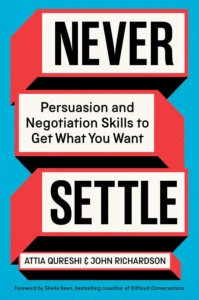
Conflict resolution expert Attia Qureshi, co-author of Never Settle: Persuasion and Negotiation Skills to Get What You Want, has stared down a cartel-connected boss in rural Colombia on behalf of the US State Department and taught negotiation at Harvard, MIT, and Michigan. Here, Attia explains why negotiation is a performance skill built through muscle memory rather than reading, how small gestures of reciprocity can turn an enemy into an ally without tipping into manipulation, and how to uncover what the other side really wants by guessing out loud and inviting correction. She also shares why making two offers reveals more than one and how escalating low-stakes rejection (from off-menu orders to car dealership haggling) builds the confidence you’ll need when it counts. Whether you’re angling for a raise, closing a deal, or just tired of folding under pressure, this is your training plan. Listen, learn, and enjoy!
Please Scroll Down for Featured Resources and Transcript!
Please note that some links on this page (books, movies, music, etc.) lead to affiliate programs for which The Jordan Harbinger Show receives compensation. It’s just one of the ways we keep the lights on around here. We appreciate your support!
- Sign up for Six-Minute Networking — our free networking and relationship development mini-course — at jordanharbinger.com/course!
- Do you even Reddit, bro? Join us at r/JordanHarbinger!
This Episode Is Sponsored By:
- Granola AI: Try for free: granola.ai/jordan
- Cash App: Get $10: Download app, use code Bitcoin10, and send $5 to a friend in the first two weeks.
- SimpliSafe Home Security: 60% off: simplisafe.com/jordan
- AG1: Welcome kit: drinkag1.com/jordan
Thanks, Attia Qureshi!
Click here to let Jordan know about your number one takeaway from this episode!
And if you want us to answer your questions on one of our upcoming weekly Feedback Friday episodes, drop us a line at friday@jordanharbinger.com.
Resources from This Episode:
- Never Settle: Persuasion and Negotiation Skills to Get What You Want by Attia Qureshi and John Richardson | Amazon
- One Conversation Away Worksheet | Attia Qureshi
- Attia Qureshi | Official Website
- Robert Cialdini | A New Look at the Science of Influence | The Jordan Harbinger Show
- Property Easements: Overview | Nolo
- Colombia’s Coca Substitution Program Failing to Help Farmers or Slow Deforestation | Mongabay
- Under the Radar: What Hundreds of Narco-Sub Seizures Tell Us About Global Cocaine Routes | InSight Crime
- Getting to Yes: Negotiating Agreement Without Giving In by Roger Fisher, William Ury, and Bruce Patton | Amazon
- Never Split the Difference: Negotiating as If Your Life Depended on It by Chris Voss and Tahl Raz | Amazon
- Chris Voss | Negotiate as If Your Life Depended on It | The Jordan Harbinger Show
- Chris Voss | Hostage Negotiation Tactics for Everyday Life | The Jordan Harbinger Show
- What Exactly Is Anchoring in Negotiation, and How Does It Play Out at the Bargaining Table? | Program on Negotiation at Harvard Law School
- Brain Response to One’s Own Name in Vegetative State, Minimally Conscious State, and Locked-in Syndrome | Archives of Neurology
- Frontline Workers Deal with Rise in Rudeness, Expert Says | ABC News 4
- Mike Tyson Confronts Cyberbullying and Warns Potential Keyboard Warriors | Sportscasting
- Chris Voss Teaches the Art of Negotiation | MasterClass
- Give and Take: How the Rule of Reciprocation Binds Us | NPR
- Cruise Port Scams and Schemes | The Points Guy
- Rejection Proof: How I Beat Fear and Became Invincible Through 100 Days of Rejection by Jia Jiang | Amazon
- Cunningham’s Law | Wikimedia Meta-Wiki
- How to Use MESOs in Business Negotiations | Program on Negotiation at Harvard Law School
- Body Doubling for ADHD: What It Is and How It Works | Understood
- Focusmate: Virtual Body Doubling for Getting Anything Done | Focusmate
- Nir Eyal | How to Manage Distraction in a Digital Age | The Jordan Harbinger Show
- Nir Eyal | Control Your Attention and Choose Your Life | The Jordan Harbinger Show
- Nudge: The Final Edition by Richard H. Thaler and Cass R. Sunstein | Amazon
- Colombia’s Largest Remaining Rebel Army Shows Its Teeth | Political Violence at a Glance
- What Is BATNA? How to Find Your Best Alternative to a Negotiated Agreement | Program on Negotiation at Harvard Law School
- Offer Your Counterpart a Graceful Retreat | Program on Negotiation at Harvard Law School
1413: Attia Qureshi | Master Big Negotiations by Practicing Small Ones
This transcript is yet untouched by human hands. Please proceed with caution as we sort through what the robots have given us. We appreciate your patience!
Jordan Harbinger: Welcome to the show. I'm Jordan Harbinger. On The Jordan Harbinger Show, we decode the stories, secrets, and skills of the world's most fascinating people.
Our mission is to help you become a better informed, more critical thinker through long-form conversations with a variety of amazing folks, from spies to CEOs, athletes, authors, thinkers, performers, even the occasional nuclear physicist, national security advisor, or hostage rescue specialist. If you're new to the show or you want to tell your friends about the show, I suggest our episode starter packs. These are collections of some of our favorite episodes on topics like persuasion and negotiation, psychology and geopolitics, disinformation, China, North Korea, crime and cults, and more.
That'll help new listeners get a taste of everything we do here on the show. Just visit jordanharbinger.com/start, or search for us in your Spotify app to get started. Today on the show, you can read every negotiation book on the shelf and still fold the second a conversation gets awkward.
Today, Attia Qureshi explains how to practice negotiating before the stakes get high, uncover what the other person actually wants, and recognize when you need another option instead of another argument. Here we go with Attia Qureshi. It's funny because you're—I've told this on the show before—I used to know this cult leader and I mean I use the word cult sort of, it wasn't one of those cults where you have to like cut off your family and or a part of your body to join it.
It was a self-help cult. The leader's name was Carl and he was very transparently a grifter in my opinion. It's funny reading a book about negotiation and persuasion because when you pay attention to this stuff, you totally realize in many cases but not all, where you are just getting worked.
Attia Qureshi: Oh my gosh, yeah.
Jordan Harbinger: And one of the things that this guy tried to do is, he was at a party that I went to once and the woman who was hosting the party had a harp, which is unusual, who has a full-size harp that they know how to play.
Attia Qureshi: Yeah.
Jordan Harbinger: So she has this and I'm like, can I try this? Because this is the only time in my life I'm going to get to play a harp or screw around. I'm like—she's like, go ahead.
You can't break it. The strings are like solid metal. Just don't yank on them, right?
I'm doing this and this guy Carl's like, look at how his fingers naturally blah, blah, blah. And I was like, dude, I've never touched a harp in my life. There's nothing natural happening here.
I don't play the guitar. This is just a kid at, you know, like 20, like screwing around on a harp. Nice try.
And then he's like, girls, go sit next to Jordan and put your hands on his shoulders while you play. And I was like, I see what you are doing. And if I was a desperate, horny 20-something like I am the other six days of the week, this would totally work.
But the fact that I know that you run a self-help cult and you're using persuasion techniques that you read in a book last week makes this so ridiculously transparent. But there's also an element where you're like, you kind of just want to believe it. The subtext is this guy can make women touch me, which is pretty powerful if you want 20-something year old guys to join your dumb group.
Attia Qureshi: Yes. Make it easy and make it so I can understand it quickly.
Jordan Harbinger: Yes.
Attia Qureshi: Right. Give me what I want without having to work at it.
Jordan Harbinger: What it reminded me of, and I'm not calling you a cult leader, but what it made me chuckle a little because after we had our call, I was like, she's really nice. You came recommended through another friend who's a podcaster who was like, I had a really good conversation with her. And then you were like, hey, I can't remember how this came up, but I was like, I love cherries because I guess you own a cherry.
Do you call it an orchard? I guess you would.
Attia Qureshi: Right. Yeah.
Jordan Harbinger: And you're like, I'll send you some cherries. And I was like, this is probably going to be in the book. It's reciprocity.
And I know it's happening, but it's definitely going to work on me because I love cherries.
Attia Qureshi: Yes.
Jordan Harbinger: And the cherries arrived.
And Jen was like, well, now you can't say no. And I was like, no, no, no. I made sure that I was already into it before I accepted the cherries, because otherwise you're right.
I can't be like, hey, read the book, but I got the cherries. The book could live without it. But damn, these cherries were good.
I'd just be like, that book was terrible, but I ate the cherries. Here she is. But for the record, the book was also good.
Attia Qureshi: Oh, I'm so glad to hear it. I mean, it's why the sales industry exists. Why does the sales industry exist with the Internet, especially with AI now?
It really doesn't need to, except it's a billion trillion dollar industry because people know these techniques and they're good at reciprocity and people feel like they owe someone something.
Jordan Harbinger: That's a really good point, because if you just needed logic to sell something, AI would be the best at it. Hey, I know everything about your client because I've consumed 2000 hours of him talking on a podcast. I'm just going to list all of the benefits in a persuasive way.
But when I read that, I'm like, maybe. Right. But then if a person is like, hey, you know what?
Let me just buy you some sushi and answer all your questions. I'm like, well, crap, he paid for the sushi. But AI can never do that.
If AI is like, I'm sending you a gift card for your favorite sushi place, please buy this. I'd be like, nice try, ChatGPT. I'm going to use that gift card and feel zero remorse about ghosting you on this.
Attia Qureshi: What's even wilder is with this idea of reciprocity and you give someone something small. There's this idea of accounting and sensitivity. So I did this a little bit with you, with a box of cherries, and also with my neighbor, where I gave him cherries and some apples and ultimately got a gas line easement worth many thousands of dollars.
Jordan Harbinger: Wow. Hey, can I dig up your entire yard and put a pipe in there that might pollute it? No.
Or here's some cherries.
Attia Qureshi: Also, after he was mad at us for two years about how we already had two easements on his property.
Jordan Harbinger: Wow. And you're like, can I have a third easement that's even more disruptive, potentially? Only if you give me a $12 box of cherries.
Attia Qureshi: Yes. And it works.
Jordan Harbinger: Yeah.
Attia Qureshi: I mean, it's a little bit of a long game and you don't know if it's going to work. You can't do it with the expectation of something in return. Right.
Because then everybody knows, like it's like, oh, you're buying me lunch and then you're making an ask immediately.
Jordan Harbinger: And that's just a trade. I don't like that. MLM people try to do this and they're so clunky with it because their training is bad.
Right.
Attia Qureshi: Yeah, exactly. So that's the version that doesn't work. Or the car salesman who's giving you donuts and coffee and trying to talk you into something that you can't afford.
But what does work is if you actually do it in a way that you're trying to improve the relationship, you don't have an expectation of anything in return. It's kind of like your phrase of digging the well. That's what you're doing.
You're digging the well with the idea of reciprocity and offering something small. And it paves the way if you need something in the future.
Jordan Harbinger: It's interesting because this is one of those things that works on us even when we know it's happening.
Attia Qureshi: Yes, it does.
Jordan Harbinger: But also it doesn't work under all circumstances.
Right. You can't do something where you're like, hey, this is totally against your interest. You really don't like me.
I've done everything else wrong, but here's a donut or here are some cherries. It's like now I just feel like you're manipulating me. So it can actually make it worse.
Right. If somebody's like, let me go get you a fresh cup. I'm like, no, you're giving me a bad finance deal.
You don't have to refill my coffee. I'm obviously stuck on the six percent versus the banks, too. So if you can't beat that, I don't care how good the next cup of coffee you get.
In fact, sit your ass down and stop talking unless you're going to lower this rate. I'm leaving. Don't give me a fresh cup.
Now I'm angry at him for offering that. Right.
Attia Qureshi: Totally. And well, first of all, it must work some of the time. And we should talk about why, because that's really important because they're doing it because it works.
But second of all, this highlights the difference between manipulation and influence, because the way I think about the difference is manipulation is when you're trying to do something that is not to the benefit of the other party. You're trying to get something that harms them. Right.
You're trying to get that six percent. It's going to make them worse off, even if, well, it makes you better off. Influence is really, I am trying to improve the situation.
I'm going to make an ask that ideally keeps the relationship the same or improves things for both of us. So it doesn't harm you at all. And ideally, it helps us in some way, both of us.
Jordan Harbinger: Yeah, the easement thing, it's arguable. Well, oh, man, they had to dig up his property. And it's like, that's a pain.
But you do that for people you like and you do that because you would want somebody else to do it for you. So it's like, I guess I will do it. But then when there's already two and it's like, so you have to do something to improve the relationship.
So it would be different if you did it, they dug up the thing and then you went back to being like, you guys are just like, you know what? Now we can be rude to you every day. It would be like, oh, now I'm going to figure out how to get back at you.
I'm digging this gas line up myself and then making it so you can't. Then you're in like, I will commit a felony to make it to even the scales.
Attia Qureshi: Oh, 100 percent. Our relationship started in a really bad place with my neighbor, because the day we moved in, he marched up our driveway and started lecturing me and my husband as we were moving boxes into the house, didn't ask our names, didn't say anything, lecturing us about how we were standing on his property because our driveway was an easement on his property. And then goes on to talk about how there's this other well easement that is completely unacceptable.
And he didn't know about it when he was buying the property. And it's his property. And I was livid.
I've never had an enemy in my adult life. And this man is my enemy.
Jordan Harbinger: Yes. And also, if you were upset about it when you bought the property because you didn't know about it, just going to go ahead and say, as a former real estate attorney, that might be on you, homeboy.
Attia Qureshi: A hundred percent.
Jordan Harbinger: That's in a paper somewhere that you signed without looking at. So cry me a river.
Attia Qureshi: Exactly. But obviously, if I said that in the moment, it wouldn't make any difference.
Jordan Harbinger: No, that would, no. That makes it worse because he knows that already.
Attia Qureshi: He knows that. And so we go a year of a really tense relationship. I see him out there and my blood boils.
And there's this day that I'm seeing him and he's parked right across from my house, right on the edge of both of our properties on purpose. I know because he just wants to drive me crazy. And my mom is like, stop.
You have to figure this out. He's going to be your neighbor whether you like it or not. Go take him a cold glass of lemonade because it's a really hot day.
I was like, I would never take my enemy a glass of lemonade like that is outrageous. And then I hang up the phone with her and I'm walking around my house and I'm like, oh, shit.
Jordan Harbinger: Yeah, dammit, my mom's right.
Attia Qureshi: And this is also like a decade into me doing this work. And of course, my mom has to remind me that.
Jordan Harbinger: Did you do something with the State Department where you should know better?
Attia Qureshi: I know. Except that when we are irate and angry and have this enemy, we can't remember any of this. Right.
And I take him out the lemonade. He almost doesn't take it because our relationship is so hostile at that point.
Jordan Harbinger: Right. He's like, what laxative did you put in here?
Attia Qureshi: Yeah, he does take it. And we chat. And what I found when I went back inside was I actually felt better about our relationship.
And it provided a little bit of solace for me because I had been so angry and boiling inside on a daily basis. Every time I saw him, I was like, oh, wait, OK, this can cool down. I can work through this situation.
And so it was really a balm for me on the way I was thinking about him, which is what I needed to do in the first place to improve the relationship before I was ever going to get anywhere with an ask.
Jordan Harbinger: Yeah, this is fascinating. I guess I don't understand people like this. I'm angry that you have a water pipe under my property.
It's like, well, is it stopping you from doing anything? No, I just don't like that your pipe goes under my property. And it's like, yeah, you're going to hate knowing what the city puts under your property.
It doesn't have to do anything to tell you about. Or are you mad that there's a power line going over your property? Because that should infuriate you is more so than the thing you can't even see, actually.
Attia Qureshi: Truly.
Jordan Harbinger: And you can't build under that. That's limiting your property. It's just none of it makes any sense.
It's a completely irrational thing on his part. But yeah, I wouldn't want a guy like that to be angry with me because that's the kind of person who's like, yeah, I shot the transformer on the power lines with a rifle because I don't want that in my yard. And it's like, oh, my gosh, OK.
Attia Qureshi: I truly was like, he's just going to destroy our well. We're not going to have water. He's going to just figure out a way.
Jordan Harbinger: Yeah, he's just going to dig by hand for three years until he hits your well. And then, I don't know, pour tar into it or something concrete.
Attia Qureshi: A hundred percent.
Jordan Harbinger: Yeah.
Attia Qureshi: And then after I cooled down a little bit, I was able to actually see he was building his house next door and it was not going well. And what I realized was his frustration at his house project while he could relieve it on the construction workers who would complain to us about him. He also kind of let that spew onto us in regard to the easement because he was like, oh, all of this is crap, right?
All of this is terrible.
Jordan Harbinger: Right.
Attia Qureshi: And so seeing that perspective helped me figure out, OK, how can I just smooth things over? How can I build a better relationship with him? And that's where I started taking the cherries, taking apples.
And when they finally moved in, slowballing the ask around the easement. And this was two and a half years later. But sometimes when a relationship starts in a really bad place, you can improve it and get to a point where you can get something that you need.
But it takes much longer.
Jordan Harbinger: So tell me how you did this with the State Department, because you were doing conflict resolution work in Colombia, where those neighbors might just murder you because there's a drug cartel problem there for people who haven't, who were born under a rock.
Attia Qureshi: In 2020, the State Department sent me to Colombia to work with farmers who were forming cooperatives to try to move away from coca, growing coca for cocaine production and growing other crops. So there was this big government wide initiative to help the farmers transition. Now, coca is great for farmers because they can grow it on their small individual plot of land.
The cartel will come pick it up and just hand them money. You don't have to work with anyone. There are no logistics involved.
You get handed cash, except that every decade or so, they would come around and gun down entire villages to remind everybody that they were in power.
Jordan Harbinger: Wait, just for no reason other than to be like, we need to set an example out of some people. Go kill 20 people over there for no reason.
Attia Qureshi: Pretty much. Or if one person decided to stand up and say, hey, this is not for me. Same thing.
Jordan Harbinger: That's terrible. It makes sense. You can't opt out of it.
But I didn't realize they would just come murder everyone. I thought they would just be like, hey, you're going to grow coca or else. And then you're like, fine.
Not like, oops, everyone's dead.
Attia Qureshi: Yeah, but then they have to show the or else.
Jordan Harbinger: I guess you're right. That's—I would be terrible at the mafia thing. I'd be like, ah, he called my bluff.
Oh, well, let's make things for Chipotle instead.
Attia Qureshi: I know. So the government initiative helped give them some solace around the idea that the government is forcing us to try to move in this direction. Right.
So that was the initiative and the thing that got people together. And I was going around to these cooperatives, helping them figure out how do you work together? Because they had never worked in a cooperative.
They had never had to grow things with other people. And they had never had to figure out after we grow things, how do we make money off of them? So helping them work through a lot of internal conflict and internal dynamics they were facing and setting up a structure that would actually work for them.
So it was one of the last cooperatives I was going to. And it was so hot.
Jordan Harbinger: Really in the jungle of Colombia? I wouldn't imagine.
Attia Qureshi: Oh, my God. It was like 110 degrees in the shade. We're outside in a pavilion.
Jordan Harbinger: Yeah.
Attia Qureshi: And most of the other cooperatives had a mix of men and women. And there were some kids. This cooperative, 40 Colombian men just sitting there staring at me completely unimpressed.
So it's already I'm walking into this room and I'm just like, OK, this is a different vibe. I have to figure out it's a young Indian American woman walking into this situation with older Colombian men. They are really not impressed.
They're like, who is this person and what is she going to say that is actually going to be helpful for us? So I start chatting with them. I stand up and start giving my spiel.
And all of a sudden, this guy in the back of the room opens up this case and starts flying a drone around the room. I kid you not, as I'm speaking.
Jordan Harbinger: First of all, that's a terrible idea indoors with a drone.
Attia Qureshi: Well, we're in a pavilion, so it's like an outdoor but covered area. But yes, he's still like lifting up this drone and starts flying it around. And everyone obviously is instantly distracted.
Jordan Harbinger: Right.
Attia Qureshi: And I'm like, what is happening right now?
Jordan Harbinger: Right. What are you doing?
Attia Qureshi: Yes. What are you doing? I'm talking to you.
I'm trying to kick this off, explain to you who I am and why I'm here. And there is a drone buzzing around. No one can hear me anymore.
And everyone is also just looking at the drone. So I take a break and I step aside and I have a translator with me and I go to my translator. Gabby, what is happening right now?
Jordan Harbinger: Exactly.
Attia Qureshi: And she was like, well, we didn't want to freak you out, but that's the head of the cooperative. And we're pretty sure he has ties to the cartel and he's a mid-level cartel boss. He doesn't want any change here.
And so he has been telling this cooperative for multiple years now that through drones, they will be able to pivot and make more money.
Jordan Harbinger: Drones. Just drones. The whole plan is just drones.
Attia Qureshi: The whole plan is just drones. We're talking about cult leaders, right? It doesn't make any sense.
But he says drones will make us money. And he flies the drone around and they're impressed by the drone. They can see the drone and they're like, cool, let's we'll keep growing coca until the drones make us money.
Jordan Harbinger: OK.
Attia Qureshi: And that's been going on for a couple of years. And so I was like, first of all, you definitely should have told me this.
Jordan Harbinger: Thanks for keeping me totally unprepared for the situation. That's helpful.
Attia Qureshi: And then I'm like, well, what am I going to do now? I'm standing here in front of these cooperative members with this cartel boss sitting in the back with his drone. And I am not sure which way to go here.
Should I just softball this and try to get out of here? Because there's a chance that he's going to come find me in my hotel and shoot me because I'm messing with his supply. What do I do here?
All of these thoughts are running in the back of my head and my heart's racing and I'm already really hot and I'm chugging water. I recognize that I'm pretty scared right now. I'm frustrated that this is the situation.
I'm worried for these farmers. I also have this sense of professional pride and I have all of these things swirling around inside of me. And then I decide to remind myself, why am I here?
If I'm not willing to stand up to this guy, these farmers definitely are not going to. So I decide in that moment I have to stand up to him. And so I look him directly in the eye and I say a firm, flat no.
And everyone freezes.
Jordan Harbinger: Nobody tells this guy no because he's got the cartel muscle behind him and he's probably feeling his oats about that.
Attia Qureshi: He's very angry and he keeps trying to interrupt me. And I'm like, listen, we have norms that we set for this conversation. If you're not willing to participate or follow those, I'm just going to have to ask you to leave.
And ultimately, I just kick him out of the meeting. And all of the other farmers are looking at me like, oh, shit, we didn't even know that was an option.
Jordan Harbinger: Right. We thought we had to put up with this a-hole that everyone hates because he's threatening our families all the time.
Attia Qureshi: Yeah, exactly. And after that, once he was gone, the farmers, like you could feel the sigh of relief in the room. And before, when they had been stoic and not engaging and not paying attention, not willing to say anything, all of a sudden they start chiming in.
And I start talking to them about what they would like, what are they hoping for, for their families, for their community, for themselves. And that gets them really excited about an opportunity to move away from coca production. And so aligning them around this central goal.
And once we did that, everything really fell into place. But there were some really big pieces we had to work through before they were willing to even have the internal negotiation amongst themselves on how they're going to pivot to oranges. And so knowing that I was there with the State Department, super helpful.
Yeah. I still had a totally sleepless night that night.
And every single sound, yeah, I was like, they're coming, they're coming for me.
Jordan Harbinger: Right. Oh, man.
This sounds like the opening of a Narcos episode. Yeah, I'm surprised they sent you down there and they're like, yeah, no, you're going to go to rural Colombia alone. Some translator will meet you there.
We vetted her on the Internet. They just did not prepare you adequately.
Attia Qureshi: No, if we were driving through coca fields and in these mountains and I would look up and I would see a guy in fatigues holding an AK and I was like, let's just keep going. There were times where people tried to stop our car and luckily we had a driver. He wasn't going to stop and open the window and talk to them.
He kind of knew his business and drove around them and got out of the situation. But it was really intense at periods.
Jordan Harbinger: If someone from high school suddenly wants to catch up over quesadillas, your garage is about to become a makeup warehouse. Before rekindling a friendship that comes with a starter kit, let's hear from our sponsors. We'll be right back.
This episode is sponsored in part by Granola. My favorite meeting is the one that doesn't require a second meeting to figure out what happened in the first meeting. Apparently, that's a lot to ask.
That's why I use Granola. Granola is an AI-powered notepad that makes your meeting notes useful, captures what happens in your meetings and turns it into clean, structured notes with decisions and action items pulled out and made easy to find. So for me, the biggest benefit was being able to stay in the conversation.
Somebody says something I want to dig into and I can ask a follow up instead of thinking like, OK, hang on, I've got to type that thing and I'm going to type it out. Write it down and remember not to forget that I jot down the key points. Granola transcribes the conversation to flesh out my notes.
Afterwards, I check what we agreed to, who's handling it, when it's due. These details are all searchable, too. So two weeks later, I'm not trying to decode a note like I do this to myself all the time.
It just says like Thursday. Great work, past Jordan. Super helpful.
It fits into how you already work and gives you useful notes in one central place. Once you try it on a first meeting, it's pretty hard to go without.
You can try it totally free. Head to granola.ai/Jordan. That's granola.ai/Jordan. To get your time back, go to granola.ai/Jordan and try it out on your next call.
This episode is also sponsored by Cash App. Trying to understand Bitcoin can feel like walking into a conversation halfway through. Somebody's hodling.
Somebody's a whale. Somebody lost their seed phrase. Is this finance, marine biology, or a gardening emergency? Cash App makes the getting started part easier. You can buy Bitcoin starting with just a dollar.
You don't have to buy a whole Bitcoin. Well, you can't do that with a dollar, can you? Something gets lost surprisingly often in these conversations.
Anyway, with Auto Invest, you can schedule automatic Bitcoin purchases with zero purchase fees. You choose the amount and schedule and you just adjust how much you buy whenever you want. There's also roundups, which turns spare change from purchases into Bitcoin.
You can actually use it, pay at participating Square businesses that accept Bitcoin or send Bitcoin using the Lightning Network for nearly instant transfers. Cash App holds your Bitcoin one to one and doesn't lend it out. You can also withdraw it to your own wallet anytime, giving you control over where you keep it.
If you've been curious, Cash App gives you a straightforward way to explore Bitcoin. Save decentralized consensus mechanism for when you need to end a conversation at a party. Download Cash App today.
Click the link in the show notes. All right, y'all, don't forget to use our codes. It's usually Jordan, but not always.
So check the deals page at JordanHarbinger.com/deals. It is a win-win. You get a great deal and you help keep the show going strong.
Thank you for your support. Now back to Attia Qureshi. I would love to know what the protocol is.
Hey, if someone tries to stop you with a machine gun, you just keep driving. And he's like, how do I know I'm not going to get shot?
Attia Qureshi: And they're like, well, I mean, I think the answer is that you're definitely going to get shot if you stop. So you might as well keep going.
Jordan Harbinger: Right.
Attia Qureshi: I mean, part of it is really just showing strength to strength and not willing to back down. Because as soon as you show weakness, that's when they know that they've got you. That's in any negotiation.
Yes, with cartel bosses and people holding guns in Colombia. But also the moment that you capitulate, they know that they can take you for a ride.
Jordan Harbinger: Right, right. So what was he trying to do with the drone? Just be like, well, this is how I show that I'm cool and have money.
Is it just obnoxious behavior or is it I'm going to prevent them from organizing by being like I have technology?
Attia Qureshi: It was completely around preventing them from organizing because it was technology that was new enough and different enough and exciting enough to them that they were like, OK, this is something very impressive. We believe him because he has this technology that he'll use it to figure out how to make us money eventually. So it was absolutely getting them to because the government program had been there for years and he had distracted them from making any steps toward change with the drones.
So it was very calculated. Right.
Jordan Harbinger: I mean, in Colombia, I think and look, you tell me isn't the choice, hey, you can keep growing coca, but we're going to napalm that shit and then you're going to have nothing. And oops, we might burn your house down. And that one's on you because we told you it's illegal to grow this.
Attia Qureshi: Yeah. And the problem in Colombia is that the jungles are so intense and people are so separated. You can't find it all.
Jordan Harbinger: Right. Of course. That's why they end up finding like a submarine in a river that's whatever.
And you're like, how did that get in there? Well, they built it and nobody noticed.
Attia Qureshi: And I was talking to my translator one day and I was looking at a map of Colombia because we were going to go to Cartagena after to check it out once we were done. And she was pointing to where the ocean was on the west side of the country. And she's like, nobody ever goes here.
This is complete cartel territory because that's where they have all of their boats and submarines to get the product across the ocean. And I was like, that's wild.
Jordan Harbinger: Yeah. Gosh, that's crazy.
Attia Qureshi: Colombia has so much dense jungle that 90 percent of what's going on, you would never be able to find.
Jordan Harbinger: It would be such a cool place to go hiking and check out if you weren't maybe going to get killed by stumbling across something. What's fascinating is you don't describe winning the room through dominance, right? You start asking the farmers about themselves, their farms, their families and their concerns.
You remember their names. So I can imagine that changed the vibe because the cartel probably does not do that. They send drone guy in there to be like, we're probably going to kill you or something if you don't do this.
Attia Qureshi: I mean, there was a moment where when you're dealing with someone who, you know, isn't going to play nice, what do you do? Right. They're not acting in good faith.
They're just going to mess things up. And so that was a moment of setting some tone of dominance saying, I'm not backing down and I have control of this situation in this room. So there are moments for that.
But most of the time, you can really get what you want. And most of the time, we're not dealing with those types of situations. I'd say 95% of the time we're dealing with situations where we have decent relationships with people who are not super hostile.
And in that case, how do we build the relationship with them? How do we make it so that they want to work with us and help us and getting to know them, getting to know their names, understanding what they care about? All of those make it so we are showcasing that we care about what they need just as much as we are trying to get something that we need.
And that's what we call principled negotiation or what I call relational negotiation. We're bringing both parties to the table and trying to make everybody better off. And with that type of mentality, you're automatically going to win something because they see you're making an effort on their behalf, too.
Jordan Harbinger: It seems like everybody wanted the same two things. They wanted to make a living and they wanted to stop living with cartel violence. So how come 40 people who live near one another already hadn't already figured out that they shared those interests?
Why?
Attia Qureshi: We don't talk about them. When do we have an opportunity to actually bring it up? When are we in the jungle of Colombia with 40 people who want to move away from coca production or with our bosses or our spouses or our colleagues?
When do we actually take a moment to talk about what are the things that I care about and what are the things you care about? We're so busy. We're so focused on our own lives.
And sometimes you just need a break in the system, the pattern, the routine to remind you this is something we can do. And this is something we can talk about and figure out together.
Jordan Harbinger: Here's something I don't totally understand. If they're afraid of cartel violence, why is it that they can avoid cartel violence by not growing coca when the deal is grow coca or else? How is it that the village that grows coca gets machine-gunned because one person doesn't do it, but the village that doesn't grow coca at all because they don't want to deal with the cartel is somehow going to be OK?
I don't understand that.
Attia Qureshi: Yeah, I think it's really the government showcasing if you can make a concentrated push, we will help you and protect you. And at a certain point, it's not worthwhile for the cartel to keep going after an entire village if they come together and they're like, we're not doing this right. It's not worth their efforts there anymore.
And let's go find another area where this makes more sense. And a lot of them were just pushing deeper and deeper into the jungle. So leaving these areas where you had villages and people who were starting to work together and grow something else and going to more rural, going to more deep into the jungle where they wouldn't have to deal with that as much.
So that that government presence and everybody pulling together to do it made it not worthwhile for the cartel to mess with them.
Jordan Harbinger: I just find it so crazy that they had you completely ill prepared for this. It seems like I've done some stuff with the State Department. I don't know.
I kind of figured they had it a little more together by now, but maybe not.
Attia Qureshi: I mean, at that point, we were going through three intermediaries. You're going through all these tiers because that's how they have to have it structured for the government program to accept help from the United States. And so it does get complex.
Jordan Harbinger: That's true. You wouldn't have been able to improve these skills, I assume, in a dangerous room or a dangerous pavilion if you hadn't practiced them in some pretty normal corporate boring rooms first. So I want to back up a little.
How do you train somebody to negotiate? Because we've all read, you know, Never Split the Difference and had Chris Voss on and there's all these negotiating books and they're all good and interesting. But I think where it all falls apart for me and for people who listen and watch the show is, yeah, that's cool.
I remember like one thing from there and I can't remember exactly what it was, but I'd have to read the book again if I wanted to negotiate something. I like small habits where you do one or two things a month and then over years you just kind of naturally get better at whatever the skill set is.
Attia Qureshi: That's exactly right. And we see negotiation as a performance skill. No one is born an amazing negotiator, just like no one is born an amazing athlete or musician.
I think that some people may have a head start because they have good negotiating around them. My son is two and a half and he already knows how to anchor us. And I love anchoring.
Anchoring is when you set the highest or the lowest based on whatever works for you. So for him it's books. He's like, I want 10 books tonight.
Even though they're short, we're not reading 10. And he's like, fine, five. And that sounds so much more reasonable than 10 that we usually end up reading five books.
I'm like, wait a minute. You know what? Usually bedtime is like one or two books.
What are we doing here?
Jordan Harbinger: Right. Yeah, that's funny. I want a hundred new cards.
All right. I'm giving you 10. And he's like, deal.
Wait, shoot.
Attia Qureshi: Your son's going to listen to this and he's going to be like, oh, now I know. Yeah, well, I just have to ask for a hundred.
Jordan Harbinger: I just have to keep these shows away from him until he's 18.
Attia Qureshi: Yeah, there you go.
Jordan Harbinger: Well, actually, that might blow up in my face, too.
Attia Qureshi: You have to train the skill. Like an athlete, like a musician where you are practicing the one thing over and over again until you get it better. Right.
The one chord, the one pitch. And you keep doing that until you get to a point where it becomes muscle memory. Negotiation's the exact same.
We're trying to build your muscle memory. You practice that one thing until you feel comfortable where without thinking about it, it naturally happens. And then you move on to the next one.
I mean, there's amazing negotiation content out there. I think that the content and all of the information around negotiation is fantastic. What we provide is how you build that muscle memory through exercises.
So little exercises that you can do in 30 seconds every day to build that muscle memory to get better at that one skill using someone's name. Right. I just want you to go to your coffee shop every morning and use the barista's name.
And you're going to feel uncomfortable and you're going to hate saying it, except that you'll see a difference on their face when you do. And you'll see an evolution in the relationship with them as you use it and connect with them on a human basis in 10 seconds every day. And that's building the muscle memory.
Jordan Harbinger: It is. And I'm with you. Knowing negotiation, being able to negotiate are two different things.
With the name thing, I'm always on the fence because I remember when I worked at a movie theater and people would be like, hey, Jordan. And I always was like, are you making fun of me right now? And I just I'm not picking up on it.
Granted, I was 16 years old. So maybe there's like an insecurity thing there. But I don't know, man.
Sometimes I go, oh, hey, Tom. And I'm like, this guy didn't like that for some reason. And I can't quite figure out why.
So I actually stopped using their name and I would just go, oh, hey, man, how are you doing today? And then they were like, oh, like way more laid back. At the end, I'd go, thanks, John.
I appreciate your help. And then it was different because I didn't go, oh, hi, Thomas. Right.
I did use their name at the end. And I feel like they just don't take it in the same sort of like, oh, this guy's annoying already. I don't like this guy.
Attia Qureshi: Interesting. Well, a name is really personal. Studies have shown that even when you're in a vegetative state, if you say someone's name, they show a sensory activation in the brain.
Jordan Harbinger: Really? They are in a coma?
Attia Qureshi: Yes. It's like so deep rooted within you.
Jordan Harbinger: Wow. That's really scary because that means the lights are still on somewhere.
Attia Qureshi: What they theorize is that your name is such a deep part of you that it's actually part of your basic existence, just like your heart beating and your breathing, that it's so important and enmeshed in who you are that it keeps functioning. And so it does light up your brain a little bit. And so because the name is so personal, maybe using it at the beginning, to your point, is just too much because you don't know them.
And if when you say their name, it is just such a personal thing that you don't know them, it's like, oh, this feels weird. But at the end of the engagement, because you've had a nice interaction with them afterwards, saying it feels OK and not as invasive.
Jordan Harbinger: Wow. I think that makes more sense. You're right.
It is because I'm like, you don't know me. You're just reading my name tag, you dick. Yeah, that's how I felt about it, actually, when I was younger.
Attia Qureshi: I like that caveat because I hadn't necessarily thought about it in sequence of when you use it. But it does make a lot more sense to use it midway or toward the end of your interaction rather than at the beginning.
Jordan Harbinger: I think some people, it's a vulnerability thing like my employer is making me wear this. It's not here so you can use it, which of course it is. But like I feel like, oh, you're going to use that because you know I have to do this.
And so you're going to like put your thumb on that vulnerability. I don't like that. I'm hiding.
I'm making five dollars and twenty five cents an hour. You don't get to use my name. You know, I get to use your name.
Attia Qureshi: Yeah, it's showcasing something about you that you didn't give it as an option for them to use, which is personal to you. And it's interesting because I've done trainings for customer service centers. What's wild to me is during COVID and afterward, people's behavior toward customer service on phone and chat has been outrageous.
Jordan Harbinger: Just rude.
Attia Qureshi: So much more rude, so much more aggressive, violent, crude, all of these things that you didn't run into, but COVID really made something break in some people's brains where they thought it was acceptable to behave that way.
Jordan Harbinger: I think a lot more people started doing more online and online culture is much more rude because you're anonymous. And then they were like, well, I'm only doing online stuff for two years. And then they went back to real life and they were like, oh, crap, I can't do this where I'm a normal person anymore.
Maybe this is one of those apocryphal things. It was like Mike Tyson said something like social media has made way too many people be totally comfortable saying things and not getting punched in the face.
Attia Qureshi: Totally. Like you can be that worst, mean, nasty part of yourself without any consequence. And that's what these teams were facing.
And a big part of it was not having their name be accessible to these people, because when they did have to interact with this, of course, we were figuring out de-escalation and getting out of it immediately, but making it so that their personal names were not attached to it because that hit so much harder.
Jordan Harbinger: I see. So are they giving me a fake name when I call customer service now?
Attia Qureshi: I mean, a bunch of them definitely are.
Jordan Harbinger: It's like when scammers call from whatever, Pakistan, and they're like, hi, this is Brad with Microsoft. And I'm like, you're not Brad with Microsoft, OK? I get it.
But then someone else calls and they're like, I know you can't pronounce my name because it's very complicated and it's in Pashto or something. So, like, my name is now John. I'm like, all right, John, I'll humor this one because I called you.
Attia Qureshi: Totally. Totally. That's it.
It's not their real name. And so I get it with that using their name, maybe toward the end of an engagement to see how that lands. And of course, if it doesn't land well, you don't keep doing it, but you try somewhere else.
And it's those little ways of hitting 30 seconds a day on a skill out in the world with practice that gets you better at negotiation. Same way, athletes, musicians, anyone who's an expert at something gets better.
Jordan Harbinger: Have you ever taught anybody who could explain all these negotiation theories perfectly and then watch them revert to bad habits the instant they had to actually do anything?
Attia Qureshi: Absolutely. We've taught at Michigan, MIT, at Harvard. You have the smartest people.
They pick up the content, they can read it in their sleep, and then you watch them in a simulation and you're like, you retained nothing.
Jordan Harbinger: Right.
Attia Qureshi: Because while you can learn everything perfectly, you can read the book, memorize the book, know the content, it doesn't make you any better. It just doesn't. You have to practice it.
You have to go out into the world and use the skills to get any better. We learned a lot of the implementation around this from the FBI, because what we saw is that they do 10 percent content, 90 percent practice. That makes sense.
And that is the right balance, because everything's going to fly out of your head anyway. So what's the muscle memory you built over that 90 percent of practice if you do want to get better and become an expert at this that you're using when it counts, when the stakes are high?
Jordan Harbinger: You can read a book about throwing a left hook and still get punched in the face. Right. But that's the moral of the—what's the skill that you see most that people think they possess until you put even just a little bit of social pressure on them?
Attia Qureshi: I think people think they can ask for something, that they can walk into a conversation and make an ask and they think they are doing it confidently and firmly. Right. And they're like, I know exactly what I want.
I'm just going to go in and ask for it. And then there's that little bit of social pressure or something doesn't go exactly how they planned, because negotiations never go exactly how you want. You can't control for the other person or the situation or any of it.
And all of a sudden it falls apart and they don't even make the ask.
Jordan Harbinger: Yes. That sounds familiar.
Attia Qureshi: I think most people truly hate negotiation. And I think it's because they see it as this thing they have to conquer. I call it the conqueror mentality where I have to go in and I have to be really hard.
I have to be the Ari Gold or I have to be the Harvey Specter or the Logan Roy of the situation. And I have to go in and make a really hard demand and I have to dominate the situation. And if I don't do that, I'm not going to get what I want.
But that's really aggressive and it's really confrontational. And it means that there's either a yes or no. Right.
And the no means you're fired. And that's such a hard way to think about negotiation because it's super black and white and either you're good at it or you totally fail.
Jordan Harbinger: Yeah. You get these people who are like, I'm not aggressive like that. And then you get other people that are like, I'm going to psych myself up to do that.
And then it's like, well, I don't want to work with somebody like you. This is a terrible experience. And they're like, well, I'm not usually like that.
But you just were. So you know what? Bye.
Not a fit.
Attia Qureshi: And the biggest mistake I see is people wait because they think that's how they have to be. I had a client who waited 18 months to have a conversation while her job was escalated two times. She became a senior manager and a director in that time frame, but never got the title and never got the raise, but got all of those responsibilities.
And she just kept waiting and waiting because it felt like this really confrontational thing she had to deal with rather than you work through it step by step and you make it a collaboration and a conversation for both parties, which is so much more accessible.
Jordan Harbinger: Man, companies must love that, though, because like we're going to dump responsibilities on her. Oh, yeah. And then she's just going to not ask for anything like let's ride this train as long as we can.
And then finally, when she's got two promotions with double the responsibility and she asked for a raise, that's twice as much. We can go, whoa, whoa, whoa. We can give you half of that.
Attia Qureshi: That's exactly what happened. And so many companies do this because most people hate negotiation and they just won't ask for it. They wait for it.
It's like, OK, they said that they were going to do this for me. So I'm just going to wait until it happens. No one's coming to give it to you.
Jordan Harbinger: Right. Your manager's not in there going, look, we need to pay her twice as much. Take it out of my check.
She's doing so much work.
Attia Qureshi: A hundred percent.
Jordan Harbinger: They're going, wow, how are you getting twice as much productivity without giving anybody a raise?
And the manager's like, I'm just very persuasive. Actually, they're just a bunch of wimps who won't ask for what they want. And I tell them I'm going to bat for them.
But I'm lying because I also am afraid to negotiate for my team. I can't even negotiate for myself. Why would I negotiate for somebody who works for me?
Attia Qureshi: Exactly. But why are we still afraid? This is something that I've been thinking about.
Why are we so afraid? What is stopping us? What do we think is going to happen?
And I think that we have gotten into this really fearful mindset. A lot of people do this worst case scenario projection.
Jordan Harbinger: We're mistaking recognition of a skill for competence in that skill. It's like, yeah, active listening or something. Right.
So what makes a good practice rep? Why should we deliberately practice these skills when nothing is at stake? Is it because it's easier to do when there's nothing at stake?
I mean, that seems logical to me. But how do we do this when nothing is at stake is a better question.
Attia Qureshi: That's exactly right. You want to do this when truly there are no stakes. You do it in your personal life.
You do it with strangers, right? You do it with a friend. So when there is nothing at stake, that's how you build the muscle memory.
That's how you do the practice. So if you're thinking about trying to understand what they care about, we're actually really good at guessing what they care about. And what they care about is one of the silver bullets in a negotiation.
When you know what they need and what their interests are, if you can meet them, you're definitely going to get what you want and probably more of what you want. So do it with a friend. You're planning a trip with a friend.
What do they care about? Guess. Write it down and then ask them how close you were and see how they respond.
Super easy. Takes a couple of minutes. But you're practicing it in a situation where there are no stakes so that when you actually walk into a negotiation with your boss and you're thinking about their interests and you're trying to showcase that you understand them to get more feedback on it, you have the muscle memory built up from that time you did it with your friend.
Jordan Harbinger: Your toddler asks for 10 bedtime books, settles for five, and suddenly you're grateful. You're getting played by somebody who still needs help wiping their butt. We'll be right back.
This episode is sponsored in part by SimpliSafe. When I'm on the road recording interviews for you all, Jen's back home with our two kids. And even when I'm sitting across from a fascinating guest, kind of hard to be fully present if I'm worried about everybody at home.
Knowing they're protected lets me focus on bringing you the best conversations that I can. That's why I trust SimpliSafe. Peace of mind helps me show up and do my best work.
And to me, protecting the people I love is a worthwhile investment. And right now, SimpliSafe is offering 70% off a new system with professional monitoring, their biggest savings of the year. What I appreciate is that it's designed to help stop a break-in before it starts.
If somebody's loitering outside the door, it poses a potential threat. I want that addressed before they try to get inside. SimpliSafe's smart AI-powered cameras alert a live US-based agent who intervenes in under 30 seconds, speaking through the camera to deter the intruder and calling for urgent 911 dispatch when needed.
If home security is one of those things that's been on your I should probably handle that list, this is a good time to check it out.
Go to SimpliSafe.com/Jordan for 70% off your new system with professional monitoring, their biggest savings of the year. That's SimpliSafe.com/Jordan. And when you order, write in The Jordan Harbinger Show at checkout so they know we sent you.
It helps support the show and we really appreciate it. SimpliSafe, ahead of crime in real time.
This episode is also sponsored by AG1. If you want a habit to stick, remove the friction. The more steps it takes, the easier it is to say, I'll do it tomorrow, especially during the holidays when you're juggling work, travel, shopping lists that somehow keeps getting longer.
That's what I appreciate about AG1. One scoop, cold water, shake it up. I drink it in the morning before the day gets away from me.
Simple enough to keep doing when life gets hectic. AG1 Next Gen combines more than 75 ingredients, including vitamins, minerals, adaptogens, prebiotics, probiotics, fewer separate supplement bottles to manage fewer decisions before the coffee kicks in. It's backed by four randomized placebo controlled clinical trials, including a 12 week study showing improvements in key nutrient levels with consistent use.
And AG1 Pro adds five grams of Creavitalis creatine monohydrate plus CaHMB and zinc carnosine for added muscle recovery and gut support.
For a limited time, visit DrinkAG1.com/Jordan and get a free immune support bundle, including omega-3 fish oil and vitamin D3K2 with your first subscription of AG1 Next Gen or AG1 Pro. That's DrinkAG1.com/Jordan.
If you like this episode of the show, I invite you to do what other smart and considerate listeners do. Take a moment, support our sponsors. They do make the show possible.
And all those deals and discount codes are searchable and clickable on the website at JordanHarbinger.com/deals. Thank you for supporting those who support the show. Now back to Attia Qureshi.
Whenever I hear these types of techniques, I always have to go to one thing that I think is a silly, annoying example, which is the mirroring thing. When people do it well, okay, fine. But the badly executed tactical empathy kind of stuff, it really seems like, okay, I watched the Chris Voss MasterClass yesterday and now I'm doing this really clunky mechanical trick.
And I've been on shows where, I won't mention the name because he's passed away, but this guy was like, I'm pacing and leading you. And I'm like, no, you're not. And he's like, well, you straightened your back when I straightened mine.
And I'm like, we're on stools. I'm routinely in the studio. I straightened my back the whole time.
And he's like, yeah, but the timing was, and I was like, okay, you can believe whatever you want. You're not mirroring me in a way that's invisible. And I'm not doing things because you're doing them.
I'm doing them because this is how I always sit here. I know you'd love to pat yourself on the back for this, but it's not real. You're hallucinating this at best.
Attia Qureshi: So you're saying that, is this just clunky? And yes, everything we try the first one, two, three, maybe five times that's new is clunky. It just is because we don't know how to do it properly.
It's like if you are that musician or that baseball player, and you're trying something new for the first time, it's going to be clunky. You just have to own that. And that's why you want to do it in a space where it doesn't matter if it's clunky.
Jordan Harbinger: Mirror the barista, not your manager when you're in a salary negotiation.
Attia Qureshi: Exactly. Or ask questions to get more information with your spouse. Because if you do it in a weird way, they're going to be like, that's weird.
But then they're going to brush it off and keep going.
Jordan Harbinger: The reciprocity thing also can get clunky. Like the way you did it, it was natural. I saw that it was a thing, but I also didn't care because it was already.
But there's those people who do like at airports, they'll be like, take this flower. Oh, I would love a donation. And you're like, no, I'm throwing this in the trash right in front of your face because I know that that was a trick.
And I don't like you anymore. I would never give you any money. Go away.
Attia Qureshi: Yeah. I mean, we talked about this before. There are people who it works on because they're very non-confrontational and they just want to be out of this situation.
So they will take the flower and give the money to get out of the situation. For, you know, every one of us, there are a couple of those types of people too.
Jordan Harbinger: That's what those touts do, right? You go on a cruise and you get off and the guy's like, bracelet, it's free. And then they're like, oh, it's 10 bucks.
And obviously people are like, okay, don't hurt me. Here's 10 bucks. And I'm like, no, you said it was free and I'll either keep it or I will throw it at them and I'm like, do something.
You're a scammer. Please do something. I would love to see you get arrested by the police and slammed on the ground right now.
You're a piece of crap. Sorry, I'm a little triggered by people who do that because I think it's so scummy. I just hate this.
Attia Qureshi: Oh, it's so scummy. But there are so many people that just want to get out of the situation and are like, fine, whatever. Let me just get out of here.
And so I think that however you have the opportunity to practice it before you're in a situation that feels stressful to you, the less stress, because when you add stress to any of these situations, it's going to be so much harder to remember any of it, even with the muscle memory. So low stress situation where the clunkiness doesn't matter and you can practice it with any of these skills, like the reciprocity, like the understanding what they're going for, like the mirroring and any of the active listening ones. Honestly, like most things feel high stakes to us, much more high stakes in our head than they are as well.
A lot of times with my neighbor going and giving him a lemonade, was it high stakes? Not really. But did it feel high stakes to me?
Yes.
Jordan Harbinger: Well, that's like dating, right? Like what's going to happen if I approach this woman and ask her out? And it's like she's going to ruin my life by saying that I'm assaulting her verbally at this coffee shop.
And the worst rejection I've ever gotten was like, I'm sorry, I have a boyfriend, but thank you. I think that's like one of the worst rejections I've probably ever had.
Attia Qureshi: Yeah.
Jordan Harbinger: And I was like, wait a minute, this is a superpower that's undiscovered.
Attia Qureshi: Totally. So I think that when you do it in low stakes environments, first, you don't have the stress, you can practice it and it can be clunky and you realize that it's not that bad. And so when you have to go do it in a higher stakes situation, after you've gotten through all the clunkiness and awkwardness, it feels much more natural.
And when you feel natural, when the stress comes on, you feel more calm. You can make the move in a way that feels better to you. And the more confidence you have with it when you show up in higher stakes, the better it's going to go for you.
And again, confidence is like negotiation. It's performance skill. You have to build up to it.
Jordan Harbinger: Yeah, I know some people are going to say, especially with the reciprocity or the gesture stuff, OK, at what point is building goodwill become deliberately creating psychological debt? And am I being nice or am I just manipulating you? And I'm giving you a five dollar, not even five dollar coffee, because I know it's going to make my fifty dollar request harder to refuse.
Is that manipulative? And if it isn't, why? And if it is, why is this OK?
Attia Qureshi: I think that goes back to what we were talking about earlier. Are you asking for something that's going to make them worse off? Are you trying to build up that debt because you want to get something from them that makes you better, but it really harms them in the end?
Or does it keep it neutral or make both of you better off? And the way we think about it is if they found out what you were doing, are they going to be mad about it? Right.
Jordan Harbinger: Yeah.
Attia Qureshi: Like, can you just tell them at the end of the day, if you just told them what you were doing, being like, hey, I'm bringing you coffees because I want to improve this relationship and one day I might need something. Are they going to be mad about it one day in the future? Maybe I might need something.
But right now I'm just really trying to improve the relationship.
Jordan Harbinger: Yeah, I suppose that makes sense. I mean, my understanding was that I get cherries every year for free now. So tell me if I'm mistaken and we can stop recording.
Attia Qureshi: You threw it out there. So now I have to think about it. You're making a soft ask.
That's going to be in the back of my head.
Jordan Harbinger: That's right.
Attia Qureshi: Also, cherries are not easy to ship to California. So that's true.
Jordan Harbinger: I was shocked when they arrived and they weren't little raisin cherries. I was like, wow, I hope this wasn't like forty two dollars to get cherries to California because I can buy these here.
Attia Qureshi: No, they won't be as good there.
Jordan Harbinger: You're probably right, actually. Michigan cherries are amazing. There's something about them.
So how do we know when to stop giving to somebody who's just a taker? Right. People ask me this all the time, like, oh, we always say don't keep score.
But then, like, I've driven this person to the airport 50 times and they won't even get my mail for me when I'm out of town and they live next door. It's like, well, OK, that person's a dick.
Attia Qureshi: You need to be on your guard about that and know pretty quick. I don't want people to keep giving coffees away for a month and then realize that the person's just happy taking them without giving anything back. You are making a gesture a few times and then you want to see, are they reciprocating it in any way?
You should know pretty quickly whether you're getting any sort of response from them or not, because if you're not and there are people out there who are just so happy to keep taking and they're like, yeah, this person likes doing this for me, I'm just going to keep taking it. I don't need to do anything in return. There are absolutely people out there.
And so I would say three, five times, five is the max. And then you should really reassess. This is probably not a place where you want to look at it as a relational, principled negotiation.
You might have to look at it more of like the bargaining style negotiation, where you're going to have to take a different technique with this type of person.
Jordan Harbinger: How do we steel ourselves for the rejection of not getting something that we want? I mean, I know you say deliberately go get rejected. I was, I mean, I'm a big fan of this.
That's how I learned how to meet the opposite sex when I was younger in my twenties and thirties as well. So give me level one, you know, what's a stupid, harmless request that I can make this week where I probably get a no. But then what is level two, three, four and five for people who are like, I can ask for a discount on my coffee, but I can't ask for a discount on a car or my rent.
Attia Qureshi: Yeah, I think that level one is you can just go ask for something that's not on the menu.
Jordan Harbinger: Literally not on the menu.
Attia Qureshi: Yeah, literally not on the menu. Right. I have some food allergies.
Can I have a quesadilla? Or you don't even need to say food allergies. Hey, would you be willing to make me a quesadilla and see what they say?
You're going to an Italian restaurant or is somewhere that you're walking at some chain and you ask for a quesadilla or something totally off the menu, you're very likely going to get rejected. And then I want you to see how you feel about it.
Jordan Harbinger: Try ordering the spaghetti at Chipotle and see what happens.
Attia Qureshi: Exactly. And they're going to give you this look and they're going to be like, what, are you dumb? We're at Chipotle.
But see how it feels. Is it the worst thing in the world? It's a lot worse before you actually do it.
And the result is not that bad because usually the anxiety of the rejection can often be worse than the rejection itself. So I want people to go through that anxiety.
Jordan Harbinger: Okay. And then what are the levels above that that we can use to escalate? Because some people will do that and then go, great, now what?
And it's like, well, now I'm not going to go ask my C-suite executives for equity in the firm after getting a no from Chipotle for my spaghetti order.
Attia Qureshi: I mean, the next one is you go to Target and you ask for a discount, right? Like go up to customer service and say, hey, are you willing to give me a 10% discount today? See what they say.
Jordan Harbinger: What's funny is when they're like, actually, yeah, I'm the manager. I'll just use my discount. Fine.
I'm in a hurry.
Attia Qureshi: That's actually like what I've found and what I've heard people tell me is it's a lot harder to get rejected than you think. Then the third one I'd say is figure out something that's a little bit bigger. Like you were talking about, you're not planning on buying a car, but go to a dealership and pretend you're buying a car and see how you can negotiate it.
Maybe you're thinking about it, but you're not ready to buy. Go to a dealership and see how much you can negotiate on the price of a new car or a used car, and you'll have that anxiety. You'll be talking with someone about a negotiation, but you already know in your head, I'm probably not going to commit today and see how that feels.
Jordan Harbinger: Yeah. I like this. I suppose go on a day when they're not busy because then you're wasting somebody's prime time selling.
Don't go on Saturday morning or whatever it is.
Attia Qureshi: Exactly.
Jordan Harbinger: How do we find out, this is probably going to sound like a dumb question, but how do we find out what the other party wants? Because I've found when negotiating, I often assume, oh, I know they just want to charge me the most or whatever, and it's like, no, the way this guy, after a while you find out, no, the way I get compensated is how long your contract is. I'm like, wait.
So if I had signed up for six months instead of one month, you could have lowered the price way more than, it's like, yeah, I'm not allowed to lower the price below this, but if you extend this way, and I'm like, oh crap, if I'd known that, and it's like, well, you didn't really ask me, and I'm thinking, well, okay, note to self, how do we elicit their interest? You have an example in the book about Tasha, and she wanted a few things from her CEO.
Attia Qureshi: Tasha was one of my clients, and she was the executive assistant to the CEO of a tech company out West. She wanted a few different things. She was supporting not only the CEO, but a couple of other C-suite members, and she really wanted to be able to work remotely periodically, not all the time, but periodically, and she had asked and been told no, and she was six months into her job, and she was like, I think I need to find a new job.
She was coming to me for advice on career coaching, and I'm like, well, I don't know if we've given this a fair shot yet. The first thing I asked her to do was, what do you think he cares about? We are actually pretty good at guessing what the other person cares about if we can step outside of our own interests for a second.
So this requires a certain level of empathy where you can put yourself in someone else's shoes rather than looking at it from your own, like, cranky eye, because Tasha was like, oh, he's just not going to ever let me do this. He's only focused on himself and his company, so you have to step outside of that. Put yourself in their perspective.
What do they really care about? Can you guess? And she started doing that guessing, and from there, what you can do is ask questions, but you seed that with your guesses.
Hey, I know that you have a lot going on right now. He was trying to do another fundraising round. He was having his investors come in to do an assessment on remote work because at that time, they were really unsure if it was really driving the value they wanted to see or not.
He also had a pregnant partner, and so there were a lot of different things going on for him. And so she started guessing and saying, you know, it sounds like you're pretty stressed about having all of these investors come in, making sure that you have the time for them, that it's entertaining, but also productive conversation, getting the information they want out of it. You have this impending baby, which means that you have a lot of work that you want to be doing now so that you can spend some time when your child comes.
This is what I'm thinking. Are there other things that I'm not noticing that I might be able to help you with? So what you're doing is you're taking your guesses, and you can also say, am I totally off track somewhere?
You're taking your guesses and you're putting them out tentatively, so you're not saying this is what you care about. You're saying, I'm guessing this is what you care about, and you're asking them, where am I right and where am I wrong? Because that gives them a point from which to respond to you.
So it really helps because that's what I said earlier. It's the silver bullet. If you know what they want and you start meeting their needs, you're definitely going to get what you want out of a negotiation if you can meet those needs.
Jordan Harbinger: So getting to that's right is essentially describing the other person's position so accurately that they confirm that you're correct. Is that what we're talking about here?
Attia Qureshi: Exactly. So what you're doing is you're asking for input on their interests, and then when you repeat those, they're like, yes, that's exactly right. Okay.
You've nailed what the things that they care about, and then you can follow up and say, is there anything else I'm missing? So when you're talking about that guy who had that contract for a month versus six months, hey, listen, I know you care about the money that you get out of this deal, but is there any other incentive structure you have, or are there any other things on your end that might be helpful to this conversation?
Jordan Harbinger: One tactic that I love is tell me why I'm wrong. It's one of the more mischievous tactics in the book. It's like somebody that maybe doesn't trust you enough to tell you what they want, and this reminds me of a rule, air quotes, a rule about if you ask a question on the internet, you'll get a million wrong answers or trolls, but if you state something confidently that is completely incorrect, and it's just a guess, someone will take the time to write out all of the reasons why you are wrong, and they'll usually throw in citations. So often in the days before AI could tell me something quickly and also be wrong half the time, I could post on Reddit and go, you know, one thing I thought was interesting is observation, and people are like, oh, you are such an idiot, and here are 27 reasons why, and I'm like, thank you, you just did a ton of work for me, and you're an expert in the field.
So I think this is hysterical, because people might not volunteer their interest, but they absolutely cannot resist correcting you if you are wrong.
Attia Qureshi: Yeah, and what's so fascinating is, first of all, we can guess them pretty well. When you share them, and then you ask for that, you solicit, where am I wrong? They want to correct you.
People absolutely want to start telling you all the areas that you didn't get it right, and then when you repeat that back, that's when you might get that that's right. And all of a sudden you have their list that you can now, it's a puzzle piece, right? You have your interests, they have their interests, how do you pull those puzzle pieces together?
You need their puzzle pieces before you can complete the puzzle.
Jordan Harbinger: What kind of person should not use this? Because I can really imagine an already smug executive turning tell me why I'm wrong into the most punchable sentence in corporate America.
Attia Qureshi: I think that if you're doing it in a way that you're not actually asking why I'm wrong, right, like the CEO is asking it in a smug way where he's like, tell me why I'm wrong. I'm not going to do that. That's just going to get me fired, right?
He's asking for you to set yourself up. That's where you don't necessarily want to do it when the way in which you're doing it, you're actually trying to understand, to solve the puzzle. Because the way that you described it with the CEO is kind of like a screw you mentality.
Jordan Harbinger: Yeah.
Attia Qureshi: That's not what you're going for.
Jordan Harbinger: Tell me why I'm wrong. And it's like, oh, I want to throw you out of your own window right now. Really?
Attia Qureshi: Because they're not going to listen.
Jordan Harbinger: Yes.
Attia Qureshi: This is never going to work for people who aren't actually going to listen.
Jordan Harbinger: One practical exercise that I love from the book was make two offers. I don't know why I don't do this more often because it's so simple. And I think a lot of people go, well, wait a minute, pay me $80 or pay me $70.
That doesn't make any sense. There's a better version of this. It was one of those where I read it and I go, how have I not done this with literally everything in my entire life for the last two decades?
I'm mad at myself now.
Attia Qureshi: I mean, you could even think about this with your son or I think about it with my son too. You make two offers and see what they gravitate toward. First of all, it makes them feel like they have autonomy, even though both of the choices are within your control.
So ideally you're making two offers that you're happy with. So you're already controlling the conversation. So you're saying, hey, we could pay, let's say that it was you're selling your house and you're negotiating with that real estate agent.
Hey, we can do a 2% fee structure with a bonus for above market. Or we could do a 3% fee structure with no bonus. See what they gravitate toward.
They feel like they are in control, that they have the autonomy and you're getting a lot of information from them about what they care about because usually they'll pick one and they'll explain why they're choosing that one.
Jordan Harbinger: So back to making two offers. So how do I frame this, right? How different do the offers have to be to make sense together, right?
Because if I just say either you pay me $100 now or you pay me $90 now, it's like, well, that's not really two offers. That's one bad offer and obviously better offer. How different do they have to be?
What levers am I pulling to make these both interesting?
Attia Qureshi: Well, I think that when you're making two offers, first of all, they have to be two offers that you'd be happy with.
Jordan Harbinger: Yeah. So one's not fake.
Attia Qureshi: Yeah. You can't make a fake offer because you also don't want to make one offer obviously bad and one obviously good.
Jordan Harbinger: Exactly. Yes. You see that right on a website.
It's like one month for $100 or six months for $120. And it's like, well, okay, the price is actually $20 a month.
Attia Qureshi: Yeah, exactly. And so when you're thinking about the offers, you're really thinking back to your interests and how do I meet my interests in a way that both of these offers meet, but might showcase some of what they care about. So that's what I was saying with 2% with bonus or 3% with no bonus for a real estate agent for their fee.
And it's like, okay, I can live with both of those. I prefer the 2% with bonus structure, but if they go for just a flat 3%, I can understand where they're coming from. And if they feel more confident with that structure, where are the other levers that I can start pulling on that?
And so it gives you some information. You can ask why. But you do want both offers to be something that you're happy with and that show variations in what they care about.
Are they willing to be a little bit more risky with a bonus or are they not willing to? And what does that mean for your conversation?
Jordan Harbinger: Two promotions worth of responsibility, no new title, no raise. Congratulations. The company has discovered a renewable resource, your fear of an awkward conversation.
We'll be right back. By the way, y'all, if you can't remember the name of a sponsor or you can't find a code, just email me, jordan@jordanharbinger.com. We're happy to surface codes for you.
It is that important that you support those who support the show. Now for the rest of my conversation with Attia Qureshi. I think the really clever part of this is their choice gives you information, right?
So if I offer A and B and they're like, oh, well B is the only thing. And then it's like, okay, I've just learned that their most important lever is how long I stay with the company. And then it's like, okay, why is a six month engagement better for you than a three month engagement?
And I've done stuff like this before. And I've had answers from, well, it doesn't count towards my performance metrics if somebody cancels before 90 days or something. And then other people are like, well, I get a bonus if I get enough long trials and I don't get the same thing if I get the shorter ones.
And then I've also heard people give me probably a half honest version of that, which is most of our clients that stay with us longer are more successful and they're more likely to renew. And that may be true, but also I highly suspect they're compensated better for the longer engagement. But I guess it doesn't really matter.
The reason I just want to find out what they're more interested in because then I can negotiate things that are not that, that are better for me. Like, okay, if you want me to stay for six months, you have to lower the price per month or something along those lines.
Attia Qureshi: Exactly. I mean, let's say you're thinking about it as a job offer and you're trying to negotiate compensation. You can ask them and say, hey, we could look at a higher compensation package where it's just around salary, or maybe we can look at slightly lower salary, but there's equity, there is a move stipend, there's a signing on bonus, maybe there are performance bonuses that we can put in there and see what they gravitate toward.
Are they, they don't want to deal with all those pieces and they're like, we'll just give you the higher salary. Or are they like, cool, we actually have different buckets where money comes from, which is usually the case. And we can give you a lot more money if we play with these buckets.
Jordan Harbinger: That's really smart. I have a friend who's, him and his wife both have really good tech jobs. He negotiated his salary, this is a few years ago, but he renegotiated and he basically was like, I wish I could get more stock options.
And I was like, why don't you just live off your wife's salary and ask if they'll pay you entirely in stock? And he was like, holy crap, I'm going to ask about this. And they didn't agree to that.
Because I—I don't know, there's probably some law that says you have to pay employees or something, but some crazy law like that, but they basically were like, yeah, we will gladly lower your salary and pay you in the pretend money that our company makes by giving you the option to use more of your money to buy more of our pretend money. Yes. No problem.
So they basically, it was like a little bit, but this is stock in a tech company that everyone's heard of. That's huge in Silicon Valley. And there's almost no chance that stock is just going to take a massive nosedive and ever affect their retirement.
I mean, this is going to be worth three times the money that he would earn now with it, and he doesn't need the money now. He would end up buying index funds or something with it and investing it. So it's like, it was a pretty good move.
And I didn't actually mean to come up with that technique. It's funny because it never occurred to him and it occurred to me, but I would never think of that if it were myself.
Attia Qureshi: Totally. And that's where having a buddy is so helpful when you're going through any of this. I think that they talk about body doubling as a helpful technique for people to sit down and get work done.
Jordan Harbinger: What is that?
Attia Qureshi: I think it's a technique that I specifically heard around ADHD, where people who have ADHD, if they need to sit down and do some piece of work, they just need someone who's sitting next to them, not helping them with the work, not engaging with the work, but they're just there.
Jordan Harbinger: Oh yeah.
Attia Qureshi: As a body presence that helps them concentrate and sit down and get the work done that needs to get done. I know this because my husband's ADHD.
Jordan Harbinger: If you couldn't tell, so am I. There is a service or was, I should say, I don't know if it still exists, but there was a service where you would just sit on the equivalent of a web-based Zoom call with somebody else. And I remember an author told me about the service.
He wrote his whole book doing this and he just sat in silence across from some French guy or whatever it was for like a year and a half.
Attia Qureshi: That's like the exact thing. The body double. They don't do anything.
They're just there.
Jordan Harbinger: I can't remember what this is called. So I advertised it on the show. The episode was with one of the ones I did with Nir Eyal.
It's one of the earlier ones, not the later ones. And what I heard that was really funny for me was these other people were using it because they're like, oh, I need that. ADHD people, et cetera.
They're like, I need that. I need this focus. I think it was called Focusmate or something along those lines.
I remember one guy was like, look, I know we're not really supposed to talk on these, but I'm dying to know, like, who are you? What did you find? And this guy was like European and the other guy was American.
And he goes, actually, this podcast that I love mentioned it. And he's like, wait, was it The Jordan Harbinger Show? And he's like, yeah.
So it turned out these guys had just been sitting there in silence across from each other for months and they both had listened to the podcast and found out about it. I found that to be absolutely hilarious.
Attia Qureshi: See, sometimes we need someone who's just, it's accountability. It's almost you have the accountability, but having someone else there makes it so it's like they're the accountability, even though they're not because they're not doing anything. There are so many other things that take up all of our energy and our resourcing and our self-discipline to do it.
By the time we get to these extra things, like becoming better negotiators, becoming better listeners, working out, sometimes we need an external source that's helping us. And that's where a buddy can be really helpful. Is there someone else who is willing to do this with you?
That you just text each other and say, hey, I did this today. It sucked. Or you go to a restaurant with them.
Or, you know, you have a friend that you go grab coffee with every week and you're like, can we do this together? Can we just practice this for 30 seconds together? Makes it so much easier because then it's not just you having to drive it by yourself.
Jordan Harbinger: There's something slightly back to the choice architecture and the offer thing. There's something slightly manipulative about choice architecture, right? So it's like, if I tell my kid, would you like to clean your room before or after dinner?
I'm not really giving the kid a choice to not clean it. So when is giving choices useful and when are we disguising control as autonomy?
Attia Qureshi: I think that, first of all, in a negotiation, it might not be A or B and that's OK. When you're talking about cleaning the room, you're saying it's either A or B. Those are the two options.
In a negotiation, the way we think about it, it could be A or B or you talk about it and all of a sudden come up and both sides are willing to come up with C together. So that's where I think the difference is. It's not a forced choice between A or B, but it's a conversation where you're starting with A or B and ideally it's leading to C, which meets both your needs in an even better way.
Jordan Harbinger: So this is all fun and good. Again, I love doing episodes about this, but it doesn't help if nobody does it. So why is it that people just don't do this?
We've got the baby steps, but I've done a million episodes on negotiation and I'm not some master negotiator. What made me good at negotiating was actually being in sales for 11 years or whatever it was.
Attia Qureshi: Because you had to go practice it and you had to live it in your daily life.
Jordan Harbinger: Yeah, I had to do it constantly. I would read a book and be like, I'm going to put this into practice on my calls and then I would just never use any of it.
Attia Qureshi: For sure.
Jordan Harbinger: Ever.
Attia Qureshi: I think one big part is we hate negotiating because we think it's going to lead to something horrible, right? Some terrible outcome. So we really are in our head thinking about worst case scenarios.
What's the worst case that is going to happen? I'm going to get fired or I'm going to completely lose this deal. And then also I think there's a deep seated fear within us that if I do enter into this conversation, I'm afraid of something.
And I think a lot of it is I'm afraid of looking bad. I'm afraid of being seen as difficult. I'm afraid that they're going to think less of me.
I'm afraid that I'm not going to get what I want and I'm going to think less of myself. I think there's a lot of deep seated fear for people around negotiation that stops them before they even get started.
Jordan Harbinger: I can relate. Nobody likes to think about all the ways something is going to go wrong if they try a new skill. I mean, that stops us from doing anything.
I guess people don't think of negotiating as a skill. They think of it as a few tactics that they're going to try. Maybe that's part of it.
Like if you go to the gym, of course you can't bench press 300 pounds or 200 pounds for that matter, most of us. So of course you can't do 55 minutes of cardio. That's to be expected.
But nobody thinks about that with negotiating or some sort of social skill. It's like, no, no, no, no. The stakes are too high to not do this well on the first shot.
Attia Qureshi: Exactly. And maybe it's I either am good or bad. It's not a progression.
And the way I would encourage people to think about it is don't even think about using any of these skills in the next six months. Right. If you don't have a negotiation coming up, this is the perfect time to start practicing because you can build that muscle memory now in those low stakes situations we talked about without having to apply them and your confidence will build through that muscle memory.
But I was thinking about it, especially before our conversation, because I went through your Six-Minute Networking. I went through that and I did not scroll to the bottom of my text list and message someone. I've been analyzing myself being like, why didn't I do that?
It's because I'm afraid that people will be like, why are you contacting me out of the blue after so many years? They will think that I'm outrageous. They'll think that I'm asking for something.
They'll think I want something out of them. They'll think I'm just like totally rude and out of line.
Jordan Harbinger: Yeah. Except that never happens with this. Like ever.
Attia Qureshi: Yeah, exactly.
But that's the fear inside of me. It would take me 10 seconds to do it for one person, but I haven't gotten myself going to do it, even though I know that's not what the result is going to be. And you know what?
Someone recently did it to me—I lived in San Francisco. She was a really good friend of mine. I haven't talked to her in a decade and she contacted me out of the blue last week and I was delighted to hear from her.
This is the response that's usually going to happen. And so I think that it's the same thing with negotiation. We have this fear, the worst case scenario that's going to happen and how it's going to make us look and how it's going to impact our reputation and how we feel about ourselves.
Except that that's not what happens.
Jordan Harbinger: It's so hard to not manufacture maximum worst case scenarios in your head and just try something. I guess so that getting over the few initial humps is the key. You have another Colombia story that I think is quite interesting.
You finish your State Department work, you're planning a few days off. I don't know. They announced that maybe you're going to get killed by terrorists or whatever.
Tell us about this. What's going on here?
Attia Qureshi: So I mentioned that my now husband was with me in Colombia and he was doing another project somewhere else in Colombia. We didn't see each other. We were going to get back together and then go to Cartagena to lie on the beach for a week and then get back to the US. So we're talking about our trip to Cartagena, everything's booked. We're chatting and all of a sudden I get an alert on my phone that says there is a terrorist threat for the next three days by the ELN, which is a guerrilla organization in Colombia, saying if anybody uses any major transportation, we will escalate and there will be huge ramifications, violent ramifications. And they made this massive threat across the entire country. And pretty much what they were doing is they were freezing all of Colombia.
No one could move. No one could travel. No one could go anywhere.
Trucks weren't allowed on the road. Everyone just had to be at a standstill because they wanted to make a demand of the government and showcase their power. And it was going into effect the same weekend that we were supposed to fly to Cartagena.
And I was like, oh shit, Isaiah, like you have to take a look at this. And he looks at it and he goes silent. And my husband is very low key and very calm.
And while I may get more nervous about things, he does not get nervous about almost anything. His silence was just an indicator that this was very serious. And I'm like, Isaiah.
And he's like, I'm reading it. I know. I was like, what do we do?
He's like, I don't know. Maybe we should contact our in-country handler. I contact him and I'm like, hey, listen, there is this threat.
I don't think that we're supposed to fly during this period of time. It doesn't seem safe for us, especially as Americans traveling here, doing work here through the State Department. It feels like we might be especially targeted or in trouble if we don't follow through on this.
I think we should maybe leave early. And he was like, absolutely not. That's not an option.
That's not a possibility. Also, I am so offended that you think so poorly of my country. That's what he said to me.
Jordan Harbinger: You mean the one where we had a terrorist threat that you took seriously?
Attia Qureshi: Yeah. He was gaslighting me so hard, being like, you're outrageous for thinking this terrorist threat is something that reflects on Colombia.
Jordan Harbinger: Right. Terrorism in a country that routinely has terrorism. How dare you?
Attia Qureshi: I'm pretty sure that everybody is taking this seriously. And I was like, listen, there has to be a way for us to figure this out. Can you please contact your boss?
We have our flights for a week from now. We could just move them and get out of here tomorrow instead and not have to deal with any of this. He's like, no, that's just not possible.
He didn't contact his boss. He just kept shutting me down, not willing to work with me, not willing to have any sort of conversation to figure this out. So then you really want an alternative.
And my alternative was contacting our travel insurance company and saying, hey, this is the situation. What are my options on getting out of here? And luckily with the travel insurance company, they were like, yes, terrorism is part of our coverage.
Yes. You can change your flight and we will pay for it for you to fly back early. So I go on, I book my flight and I contact Carlos and he's like, livid.
He's like, this is unacceptable. You cannot leave without us giving you the authorization to leave. You had committed to staying here.
You are violating the terms of your time here in Colombia. And I'm like, our entire project is done. We are headed out.
I have booked this flight. We are leaving. I'm just giving you a heads up.
Jordan Harbinger: This is a courtesy call. I'm not asking for your permission.
Attia Qureshi: Exactly. And so we get on the flight and it is the same day that the threat goes into effect. And so we go to the airport super early. It was going into effect Friday.
Jordan Harbinger: What was the plan? The terrorists like to sleep in on the first day of a barrage? Like, what do you—what's the theory?
Attia Qureshi: I was just hoping that they were just like not out at 5 a.m.
Jordan Harbinger: Right, right, right. Like, ah, well, let's start the terrorism after lunch. OK.
Attia Qureshi: Oh, yeah, I know, because my husband had to get back from—he was like deep in the Colombian jungle helping farmers grow a specific type of crop. And he was coming back and he couldn't get back in time to leave the next day. The only time we could leave was Friday morning.
And that's when the effect went into place. So we are driving to the airport and I am just panicked. I'm looking all around.
I am terrified. Out of my mind, we get to the airport. I'm still very scared.
Are they going to bomb the airport? I don't know. I am just hyperventilating pretty much until our plane takes off at 9 a.m. And we are out of there. And I breathe this huge sigh of relief. And then when we get back to the US, I look at the news and there were actually a significant number of incidents that happened. They blew up a bunch of oil tankers on the highway.
I think there was an incident at one of the airports. They had armed guards everywhere. It was really actually a big deal in the country.
And there were a lot of explosions and violence that happened during that weekend.
Jordan Harbinger: I wonder if Carlos was like, oh, OK, I guess she was right. Or if he was still pissed off that his ego got hurt, that he—
Attia Qureshi: I haven't talked to Carlos and I actually have been thinking about if I would reach out to him to be like, hey. Hey, you want a copy of my book? You're in it.
Yeah, yeah, exactly. Jeez. Exactly.
He was the type of guy who his ego would just still be like very upset and holding on to that and being like, I was right, not paying attention to the facts.
Jordan Harbinger: I don't know if somebody wanted to leave the United States because there was a terrorist threat and there was actually a terrorist threat. I don't know. I'd be like, OK, I mean, I guess it's different.
I live with this all the time. If you meet Israelis and you're like, oh, my God, the terrorists might do something. Israelis are kind of like, yeah, that's every day of our lives.
So I guess I'm not as reactive as you. But it would be weird of them to, like, laugh at you for being scared of an explosion. Right.
That would be this is an irrational response. Carlos.
Attia Qureshi: It's true. It's totally different. And honestly, I could have done a better job putting myself in his shoes just the way that you described it.
Like maybe this is something that they do deal with and it's not that big of a deal. Or he had a different perspective on it where I just made him look really bad in front of his boss. And was there a way I could have helped him save some face?
Probably. But I was really scared.
Jordan Harbinger: I guess what you could have done is gone like, hey, Carlos, look, we're freaked out. You're probably laughing at us. I don't want to tell your boss that we're doing this.
Can we say we have a family thing and you just let us go? And he'd be like, OK, you wimps. No problem.
Attia Qureshi: Totally. And I could have helped him.
Yeah, I could have. And I went straight conqueror mentality because I was so scared and I was not thinking with my fully rational mind.
Jordan Harbinger: Sure.
Attia Qureshi: I could have used some of those breathing techniques I talked about. But—
Jordan Harbinger: I suppose so. Isn't it funny how we have to write a book about stuff and then find out how we haven't followed any of our advice?
Attia Qureshi: I know. It's I mean, even you write the book and then you're like, but I still don't do all of it all the time.
Jordan Harbinger: Attia, thank you so much. My big takeaway from Attia, practice the small ask before you need the big yes. Pick one skill and spend 30 seconds using it where a no won't wreck your day.
No book can do the awkward part for you. All things Attia will be on the show notes on the website. Advertisers, deals, discounts, ways to support the show.
Also on the website at jordanharbinger.com/deals. Please consider supporting those who support the show. Don't forget about our Six-Minute Networking course.
Always free over at sixminutenetworking.com. I'm at Jordan Harbinger on Twitter and Instagram. You can also connect with me on LinkedIn.
This show is created in association with PodcastOne. My team is Jen Harbinger, Jase Sanderson, Robert Fogarty, Tadas Sidlauskas, Ian Baird and Gabriel Mizrahi. Remember, we rise by lifting others.
The fee for the show is you share it with friends when you find something useful or interesting. In fact, the greatest compliment you can give us is to share the show with those you care about. So if you know somebody who wants to get better at negotiation or needs to get better at negotiation, definitely share this episode with them.
In the meantime, I hope you apply what you hear on the show so you can live what you learn. And we'll see you next time.
Sign up to receive email updates
Enter your name and email address below and I'll send you periodic updates about the podcast.


 Tiktok
 Spotify
 Apple Podcasts
 Overcast