




You don’t just speak with an accent, you hear with one. Linguist Valerie Fridland reveals how your voice leaks your class, your past, and your biases.
What We Discuss with Valerie Fridland:
- The Pan Am bomb threat that sent the wrong man to prison. How a grumpy cargo handler spent nine months locked up over recorded threats, until legendary linguist Bill Labov proved the real caller was from Boston, not New York, using a single vowel feature the accused could never have known to fake.
- Why nobody is actually accent-free. What separates an accent (sound only) from a dialect (grammar, vocabulary, and sound), why the people who swear they sound normal simply can’t hear themselves, and how you don’t just speak with an accent, you listen through one too, filtering everyone else.
- Why Britain has a different accent every few miles. How a thousand extra years of history, clan rivalries, and geographic separation bred dense regional accents across the UK, while colonial America’s mixing of settlers who had to cooperate to survive flattened everything into one uniform sound.
- How class quietly engineers the way we talk. Why a vahse costs more than a vase, how R-dropping and that posh ‘ah’ vowel migrated from London to New England, why nearly every sound change starts with the working class and creeps upward, and where Hollywood’s fake transatlantic accent came from.
- What your own voice reveals once you start listening. Notice how you talk differently from your parents, the slang you’ve absorbed online, and how you shift speech depending on who’s around. Research shows motivation and exposure, not innate talent, drive accent learning, so accents aren’t mistakes.
- And much more…
Like this show? Please leave us a review here — even one sentence helps! Consider including your Twitter handle so we can thank you personally!
Here’s a humbling little truth: you have an accent. Yes, you, the person currently insisting you sound perfectly normal. Everybody believes they’re the neutral baseline and everyone else is the one doing something exotic with their vowels, which is a bit like every driver convinced they’re the only sane one on the road. But your voice is a dossier you never agreed to hand out, quietly leaking your hometown, your class, your schooling, and the people you grew up wanting to sound like. Stranger still, you don’t just speak with an accent, you hear with one, which means that gorgeous British lilt and that grating call-center drawl may say less about the speaker than about the quiet biases running the projector inside your own head.
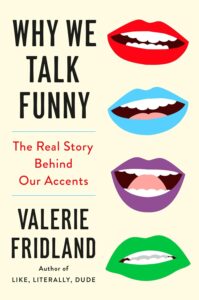
Linguist and Why We Talk Funny: The Real Story Behind Our Accents author Valerie Fridland joins us to reveal the hidden machinery of how we talk. Valerie opens with a genuinely unsettling courtroom drama: a Pan Am cargo handler who did nine months behind bars on a bomb threat charge until a legendary linguist proved the real caller’s Boston vowels could never have come out of his New York mouth. From there she explains why Britain grows a fresh accent every few miles while America blended its settlers into one tidy sound, why a “vaaaahze” somehow costs more than a vase, and how nearly every shift in the way we speak sneaks up from the working class before the fancy folks adopt it and pretend they invented it. She digs into why toddlers soak up languages like tiny sponges while motivated adults armed with flashcards still sound like they’re being waterboarded in Spanish, and why the real secret to a native-like accent isn’t brainpower but raw motivation and early exposure. Whether you’re a language nerd, a parent trying to raise a bilingual kid, a traveler tired of being pegged the second you say hello, or just someone who’s quietly judged a stranger’s voice over the phone, this one will make you hear yourself — and everyone else — completely differently. Listen, learn, and enjoy!
Please Scroll Down for Featured Resources and Transcript!
Please note that some links on this page (books, movies, music, etc.) lead to affiliate programs for which The Jordan Harbinger Show receives compensation. It’s just one of the ways we keep the lights on around here. We appreciate your support!
- Sign up for Six-Minute Networking — our free networking and relationship development mini-course — at jordanharbinger.com/course!
- Subscribe to our once-a-week Wee Bit Wiser newsletter today and start filling your Wednesdays with wisdom!
- Do you even Reddit, bro? Join us at r/JordanHarbinger!
This Episode Is Sponsored By:
- BetterHelp: 10% off first month: betterhelp.com/jordan
- ButcherBox: Free protein for a year + $20 off first box: butcherbox.com/jordan
- Paka: Paka hoodie & crew socks: go.pakaapparel.com/jordan
- Marathon Rewards: Sign up today: marathonrewards.com
Thanks, Valerie Fridland!
Click here to let Jordan know about your number one takeaway from this episode!
And if you want us to answer your questions on one of our upcoming weekly Feedback Friday episodes, drop us a line at friday@jordanharbinger.com.
Resources from This Episode:
- Why We Talk Funny: The Real Story Behind Our Accents by Valerie Fridland | Amazon
- Valerie Fridland, PhD | Website
- What Speech Do We Like Best? William Labov on the Prinzivalli Bomb-Threat Case | PBS: Do You Speak American?
- How Foreign Accents Subconsciously Shape the Way We Interact | The Conversation
- The Difference Between a Language, a Dialect, and an Accent | Babbel Magazine
- How Our Brains Treat Foreign Accents | World Economic Forum
- What Is the General American (GenAm) Accent? (Everyone Has an Accent) | BoldVoice
- Are America’s Distinct Accents Dying Out? | Big Think
- Why Britain Has So Many Regional Accents Compared to the US | IFLScience
- Ope (Interjection): A Midwestern Discourse Marker | Wikipedia
- The Trap–Bath Split (Broad A): History and Prestige | Wikipedia
- Rhoticity in English: The History of R-Dropping | Wikipedia
- Why the R Sound Became a Famous Social Differentiator | Nautilus
- Why There’s No Such Thing as a Brooklyn Accent | Atlas Obscura
- How Do You Say ‘Hello’? Personality Impressions from Brief Novel Voices | PLOS ONE
- Presence of Uncommon Consonants (Including “TH” Sounds) | World Atlas of Language Structures (WALS)
- How a Fake British Accent Took Old Hollywood by Storm | Atlas Obscura
- The World Rushes to Speak and Write ‘American’ English | The Christian Science Monitor
- How Americanisms Are Killing the English Language | BBC
- The Phoenix of Phonaesthetics: The Beauty of Language Sound | Frontiers in Psychology
- Romance Languages: Musicality and Sonority of the Linguistic Characteristics | Encyclopædia Britannica
- Plasticity of the Language System in Children and Adults | PMC
- Perceptual Narrowing: Why We Lose the Ability to Hear Non-Native Sounds | Wikipedia
- Mind the Generation Gap: Heritage Language Often Lost by the Third Generation | University of Alberta
- The Language Pledge: Total-Immersion Language Learning | Middlebury Language Schools
- Phonotactics, or Why Spanish Speakers Drink “Esprite” | All Things Linguistic
- Operation Accent: Why So Few Late Learners Pass as Native Speakers | Language Magazine
- The Hacking Chinese Guide to Mandarin Tones | Hacking Chinese
- The ‘Influencer Accent’ Is All Over TikTok. Here’s What It Sounds Like | NPR
- Study Says Black Twitter Is Driving the Spread of New Words in American English | TheGrio
- Rizz (Internet Slang): Origin and Meaning | Wikipedia
- Code-Switching and “Nah, We Straight”: Analyzing Obama’s Style-Shifting | Language Log (University of Pennsylvania)
1349: Valerie Fridland | Why We Talk Funny and What Our Voices Reveal
This transcript is yet untouched by human hands. Please proceed with caution as we sort through what the robots have given us. We appreciate your patience!
Jordan Harbinger: [00:00:00] Coming up next on The Jordan Harbinger Show.
Valerie Fridland: When we look at what people hear as beautiful languages or beautiful accents, the research is really fascinating because there is some truth to the fact that certain sounds are more appealing to us just intrinsically. There are certain sounds that are more beautiful to us.
But generally speaking, what really is driving our attitudes towards what's a beautiful language and what's not is our familiarity with that language, so the more familiar a language is or an accent is, the more we tend to like it, but also our beliefs about the speakers of those languages
Jordan Harbinger: Welcome to the show. I'm Jordan Harbinger. On The Jordan Harbinger Show, we decode the stories, secrets, and skills of the world's most fascinating people and turn their wisdom into practical advice that you can use to impact your own life and those around you. Our mission is to help you become a better informed, more critical thinker through long-form conversations with a variety of amazing folks, from spies to CEOs, athletes, authors, thinkers, [00:01:00] performers, even the occasional drug trafficker, rocket scientist, or Hollywood filmmaker.
If you're new to the show or you're looking for a handy way to tell your friends about the show, I suggest our episode starter packs. These are collections of some of our favorite episodes on topics like persuasion and negotiation, psychology and geopolitics, disinformation, China, North Korea, crime and cults, and more.
It'll help new listeners get a taste of everything we do here on the show. Just visit jordanharbinger.com/start or search for us in your Spotify app to get started. Today on the show, your accent is not just how you talk. It's a resume, a passport, a class marker, a trust signal, and in one insane case, the difference between you're going to prison and actually, Your Honor, this guy's from Boston.
Our guest today is Valerie Fridland, linguist and author, and we're digging into why every single one of us has an accent, even the people who think they sound normal like me, which usually just means my accent has historically gotten better real estate, better job interviews, and fewer people asking where I'm really from.
We'll talk about the Pan Am bomb threat case where a linguist heard what cops had all missed. We'll get into why babies are [00:02:00] basically tiny accent sponges with no student loans, why adults can practice Spanish for 12 years and still sound like a Roomba choking on a tortilla, and why the letter R is English's most dramatic little diva, and why social media isn't killing accents so much as turning them into identity cosplay with better lighting.
So whether you say water, water, or wash, this episode will make you hear your own voice differently and maybe stop judging everyone else like you're Simon Cowell with a linguistics minor. Here we go with Valerie Fridland. So I read this book, I read the audiobook, and I had to switch speeds when listening to the book with the different accents.
And I realize this always happens to me. It's relevant to what we're going to talk about today because every audiobook I start and then I go, "Gosh, okay, I've got to listen at 1.5," and then after, like, half an hour I can put it at two, and then after two hours I can put it at 2.5 or wherever I end up. With your book, since there's different voice actors and different accents, it was just constantly back down to 1.5, back up to two, back down, back up, back down, because I have to get [00:03:00] used to the accent every time.
Valerie Fridland: Right. And it's great because also what that tells you is there's a difference in not just the accent but the speech rate, which different languages are spoken with different speech rates, and you'll often bring sort of your native language speech rate into whatever language you're speaking. So it's a, a beautiful example of how accents change it up for us and keep us on our toes.
Jordan Harbinger: I think so. Yeah, l- the book starts with this Pan Am bomb threat case. I think this is quite fascinating. Tell us about the case itself. This guy must have been really freaked out being blamed for bomb threats.
Valerie Fridland: Yeah, well, I also think it really speaks to what a bad colleague he was if everybody pointed the finger at him.
Jordan Harbinger: It's got to be Paul. He's the biggest jerk in the office, yeah.
Valerie Fridland: When you've pissed your people off enough that they think you're guilty of a bomb threat because of your accent, I think that speaks really to you as a colleague.
Jordan Harbinger: That's a good point, right? because if you're really nice, they'd go, "It sounds like Paul, but it's not him because he's the nicest guy."
It couldn't possibly. "There's no way." Or like, "I kind of [00:04:00] don't like him, but he's not a bomb threat guy. Like, he's just a little bit
Valerie Fridland: abrasive." Exactly. Like those neighbors they always interview of people that did horrible things, they seem like such a nice person. Right, yeah. So Paul I don't think seemed like a nice person.
So this is really about how linguistics is really a powerful thing in all our lives in ways we don't expect, and the story is about a man named Paul Princevalle, who was a cargo handler at LAX Airport for Pan Am Airlines, and this is of course, you know, when Pan Am existed. And there was a very profitable route for Pan Am that flew from LA to, I think it was the Philippines, and they had repeatedly been receiving a bomb threat on that particular flight.
And then of course they would have to ground the flight and search the plane, determine there was no bomb threat before they could resume the flight. So it was costing them a lot of money, and also no one wants a bomb threat being called in regularly. Now, they had recordings of the bomb threat caller, and he had a very distinctive [00:05:00] East Coast accent.
And, you know, if you've ever heard someone from the East Coast from one of those major cities, you can see that there can be a sort of that working class, very authentic East Coast accent. So that was the one thing they noticed, and there just happened to be Paul hanging out there, who happened to have a very, very strong East Coast accent.
He also had been really grumbling about his current work assignment, and he would really basically bitch about the airlines all the time, and he had actually threatened to get back at Pan Am for something. So here we have this scene set where you have this caller calling this bomb threat in with a very similar accent to Paul.
Paul is not a happy employee, and he's doing a lot of threats. So of course, they put two and two together, and all the fingers get pointed at Paul, probably also because he wasn't a very nice colleague to hang out with, and he didn't do it, right? He kept claiming he was innocent. But he actually was sent to prison awaiting trial because he was considered a flight risk, [00:06:00] and his defense team hired a very well-known linguist.
In fact, he's the father of modern sociolinguist. He was a wonderful man, he passed away last year, but by the name of Bill Labov, who was a, a sociolinguist at the University of Pennsylvania. He actually analyzed recordings of Paul and compared them to the recordings that had been taken from the bomb threat recorder.
And he testified in court, and he pointed to vowels that were different between a speaker of a Boston accent and a speaker of a New York accent. Now, Paul was actually from New York, and the bomb threat caller, Labov knew with 100% certainty, was from Boston, and all of this hinged on one difference in their speech that would've been impossible for Paul to know about as a non-linguist or replicate, and yet the caller on the bomb threats had this particular phenomenon called the low back [00:07:00] vowel merger because he was from Boston, and Bostonians have it, people from Eastern New England have it, but the rest of the East Coast does not have it, and in particular, New York absolutely doesn't have it.
In fact, the differences between vowels in words like on and off are very salient. So in a, in New York accent, you'd say on and off Right? That's a very classic New York. But in Boston, you'd say on and off.
Jordan Harbinger: Okay.
Valerie Fridland: You wouldn't know as a non-linguist that you had to alternate that, and even what vowels, what words would have.
So you wouldn't have been able to do it just unless you were an expert, a PhD in linguistics.
Jordan Harbinger: Yeah. Somebody who's a voice actor could probably do it, but if you're working at an airport throwing bags on planes and breaking guitars, you're probably not also a voice actor.
Valerie Fridland: I doubt the cargo handler was a PhD in linguistics, yes, or a voice actor.
Well, I mean, in LA it's possible, but he wasn't. So needless to say, in court, he played those segments of the tape, and [00:08:00] he said, "It is absolutely impossible for this to be the same person." And the judge actually basically dismissed the case on that measure alone, and the poor guy had actually spent nine months in prison prior to the court proceedings.
But I imagine he probably sued the airline and made a quick buck off of that. I'm not sure ab- about what happened to Paul afterwards, but here's a great piece of evidence as h- how much our speech says about us without us being aware of it.
Jordan Harbinger: I don't even know if you can sue... Well, I guess you can sue for anything, but it's pretty tough to sue somebody for a really reasonable suspicion that you committed a crime, and that you've been fingered by a bunch of your colleagues.
If every time you got it wrong, you got sued into oblivion, that's a problem for all of us. So I don't know. I think
Maybe he did, but it, there's also a pretty good chance it was just tough luck at that point. Just tough luck. Be nice to
your colleagues, Paul. Well, and hopefully they at least offered him a job back, but I don't know. Yeah, well everyone hated him, so it's like, I don't know. Are you going to behave yourself now that you spent nine months in prison with people that really don't like you and that are really hard to get along with?
Yeah, maybe you should [00:09:00] be nicer to Angela, Paul. Yeah, I do feel for him, though. Nine months in prison for something you didn't do is pretty terrible. Jail, anyway.
Valerie Fridland: On the basis of your accent. I mean, a lot of bad things have happened to people on the basis of an accent, but I think that's sort of a topper.
Jordan Harbinger: Right. You're probably right. Okay, so your voice can convict you, acquit you, or maybe fool you. Most people that I know, I think, think of many accents as charming. Some are annoying, some are regional, some are funny. I've got to be careful in this episode because I don't want to list examples, because it almost sounds racist if I say like, "Oh, this accent from this particular country sounds funny to me, and these accents sound charming to me."
I've got to be kind of careful with that. Maybe you can help me do that, because look, an English accent, very charming. I had a professor that had an English accent, a linguistics professor actually, ironically, so coincidentally. So I loved her class because I found it really easy to listen to everything that she said, whereas if people spoke normal American English, I often tuned out in [00:10:00] class, and I think it's because I needed 5 to 10% extra processing power to get through the English accent, and for some reason, that kept me more consciously engaged during the class.
I'm not sure.
Valerie Fridland: Well, there is more cognitive processing power when you hear a foreign accent. You have to recruit more neurons to unpack what you're hearing because it's less familiar, so you are exerting more processing effort. A lot of people actually experience that as something more difficult and unpleasant, but in other contexts like the one you're talking about where paying attention is important, it probably actually does help you.
But you are actually using more processing power.
Jordan Harbinger: If an accent is too strong, and I know that's subjective, but if it's too strong, I get annoyed with it, and I know I'm not alone, because that's why you get all these older people that are like, "I'm canceling my credit card because every time I call, they transfer me to," and it's the Philippines or Sri Lanka or something like that.
And they get pissed off because they have to think extra hard to understand it, and when [00:11:00] you're already old, cranky, and tired, you just don't want to do that. Also, for people like us who are digital natives or whatever they call it, we grew up with accents at some level. Boomers didn't. If they heard a different accent across the coast, it was exotic.
You know, you hear a, a Yonkers accent and you're like, "Oh my gosh, you must be from upstate," right? It's one of those, whereas if you're hearing a Filipino accent, you're basically asking somebody to understand an almost totally different language at that point if they've never heard it before, and it's on some crackly phone line.
So my question would be what are we actually hearing when we hear an accent? Just different vowel processing? There's so much going on when somebody speaks differently.
Valerie Fridland: Right. There's so many different levels. I mean, first let's just clarify a difference between an accent and a dialect, because a lot of times people conflate those.
So when we're talking about someone speaking a different dialect, what we're talking about is that they're using differences at many levels of linguistics, not just sound. So they're saying [00:12:00] syntactic or sentence structure differences. They might be adding different endings or deleting endings. That's morphology.
They might be using different vocabulary. So for example, I grew up in the South, so it's obviously a Coke, not a pop or a soda, right? That would be a dialectal difference, and it can include sounds. So whether I merge my cot and caught and my on and off, like Paul Prince of L.A. did not do. But an accent refers to only differences at the level of sound.
So when we're attending to accents, we're attending to sound differences, and, and what that sort of just general description of the difference it shows you, there are so many different things you have to learn when you're learning a new language. You're not just learning how to pronounce things differently.
You're also having to learn what the words are, how to put them in a sentence, how to conjugate your verbs, and what kinds of endings nouns take, and whether they agree with your adjectives, right? There's so many different ways you can kind of mess that up in terms of what a native speaker might do, but what we tend to attend to the most is [00:13:00] pronunciation problems.
So accents are super salient in a way that some other dialectal features might not be. So if someone perhaps doesn't put in an auxiliary verb because they're from a speaker of a language that doesn't use auxiliary verbs, so they'd say, "He go over there," it's not going to really cause a problem with comprehension.
You might notice it, but you won't have a problem. But if they mess up sounds or even prosody, which is sort of the intonational patterns that a language has, that can really obstruct comprehension in a way that, you know, just deleting an is won't. And so that's why accents are so pivotal in understanding what we do, why we have them, and also where we go wrong in listening to them.
So I think one of the mistakes people make is thinking that accents are all about the speaker, but accents are fundamentally also about the listener. You don't just speak with an accent, you hear with one, too. So every time you hear someone else that sounds different than you, you're actually [00:14:00] filtering what you're hearing through your own accent and the linguistic experience you have.
So sometimes somebody will find one accent beautiful and one accent really hard to understand, and it's their experience with accents that actually determines which way they go.
Jordan Harbinger: That's so interesting, because I get emails all the time from people that listen in foreign count- like countries like Iran, or they're from a country far away especially, not Canada, the US, kind of Mexico, but someplace on the other side of the globe.
And they'll say, "Oh, I just, I love the way that you talk. Your accent is great." And of course I say, "What accent?" Right? But they mean, oh, it sounds clear like the people I see on TV that are also Americans. That's what I gather they mean because I don't speak in any particularly beautiful way, right?
Especially not compared to my linguistics teacher who was like this, had this feminine British accent that was like very cute and charming and also sounded really intelligent. That sounded good to me. But that is less clear [00:15:00] in many ways than somebody who sounds like a newscaster from Ohio who's been on CNN for 12 years, right?
It just-
Valerie Fridland: Well, I think someone in Britain, in London, might actually disagree with you, especially I don't know what accent she had of British English, but if it was like a Received Pronunciation, which tends to be what Americans, you know, sort of think of as that classic British accent, that's the broadcast standard in Britain.
So that's heard as exceptionally clear versus regional accents there. In the same way that the broadcast standard you just referenced for American speech, which is sort of a classic 1940s Midwestern accent, that's really what that accent we think of is based on, that that one would be clear for Americans because that's what they hear on television.
So I mean, I think the really critical thing to get about accents is it is truly all relative. Getting back to something you said earlier, there is nobody who doesn't speak with an accent. Every person has an accent. I think when we say that, like, "I don't have an accent, but of course they do," what we're [00:16:00] really attending to is the fact that we are accustomed to our own accents in such a way that we don't hear that we have one, and we take what we say as the norm, and particularly when no one else has singled us out for what we say, which a lot of non-standard accents do get singled out.
A lot of specific regional accents that have sort of typical pronunciations that are recognizable across the US, for example, a Southern accent, those get pointed out. But when you have a non-salient accent, that doesn't mean you don't have an accent, it just means that you don't notice that you have one.
And so if you travel, when you go abroad, everybody talks about your American accent. So you clearly have one because you can get recognized. When I lived in Istanbul and I would go to the market, you know, the Grand Bazaar, I could say one word. I could say hello to the vendors, and they would know I was American.
Sometimes they'd even know exactly where you were from. So clearly I had an accent, even [00:17:00] if I couldn't hear it in my own speech.
Jordan Harbinger: Yeah. Well, the Southern stuff is hard to shake because you don't have a Southern accent now, but you still say sentence, and you said kin instead of can, right? And I'm like, "Okay, that stuck out right away."
That's dialect, right? That's not accent?
Valerie Fridland: No, that's accent- That is accent ... because it has to do with sound, and those are classic Southern features. So yes, I have a very modern Southern accent. Accents are dying in terms of the regionally recognizable ones we used to talk about. So the classic New York accent, the Philly accent, the Southern accent, all of those are actually dying in large urban areas in those places.
So in the South, for example, if you go to Atlanta, most younger people don't sound Southern there. And so I actually am in the first generation, I'm aging myself here, but I'm in Generation X, which is really the first generation that linguists have found have been losing their regional accents. Also, my parents were French, the, French-speaking, so my father's was Belgian, and my mother was French Canadian, so they [00:18:00] didn't speak English natively.
And so I really never had that kind of social identity of Southernness that's super important to having a Southern accent that you still find in rural areas, which is why the Southern accent really is still strong in rural areas. But I don't sound classically Southern in the way that people think, but just like you picked up on, I do have certain ways I pronounce things that I do say that are still traditionally Southern, but very subtle.
Jordan Harbinger: It's quite interesting. I noticed that in the UK they have way more regional accents, and is that because for hundreds of years people didn't travel very far? Whereas by the time we got to the United States, we were just occupying huge blocks of places, and we were all from that same place, right? You've got the certain type of people from this ship that were all from the Netherlands, all settled this area, and then you have the...
It seems like that would be an e- explanation why. because in the UK it's like, "Oh, they're from across the road," and you're like, "What? Are you kidding me?" "They're from near this church," and you're just like, "How on [00:19:00] earth are people that are within earshot of the bells of this one church, how do those people have a different accent than people who are across this, the little river that has 8,000 bridges going across it that you could get to in 10 minutes?
How are those people, how is there a different accent over there?" I have to travel hundreds of miles in the United States to find a different accent, yet in the UK they're so close by. Actually, all over Europe is probably like this, but it seems to be noticeable for me in the UK. I was at a podcasting event.
A guy that I've met a couple of times goes, "Hey, Jordan, how are you, mate?" And I was like, "Oh, Mark, how are you?" And I said, "I, for a second, I confused you with my engineer, Jason Sanderson." And he goes, "Oh, it's funny, man. I know a guy named Jason Sanderson. I went to school with him." And I go, "Are you from Sheffield?"
And he goes, "Yeah." And it turned out these guys knew each other, went to school together, and they talked so similarly and distinctively that I could pick out that they were from the same place by talking to him while he was taking a leak in the bathroom. I didn't [00:20:00] need a huge sample, right, basically, of his speech to do that.
At that time, I was like, "Wow, what are the odds? These, these people must have a really particular accent." And it's true. Sheffield, to me, to untrained American ears, sounds kind of like Scottish mixed with, I don't know, a standard UK, whatever, British-
Valerie Fridland: Absolutely. There's so many different things to sort of unpack in that, but absolutely, there's much greater dialect density in the UK than in the US, and that has to do with a number of different factors.
First of all, the history of, of Britain is much longer than the history of the US, so you're having hundreds of years, right? So we really start, English started essentially, Old English period started around the 5th century ACE, and so there's obviously been about 1,000 extra years for dialects to develop, and any time you have separation among speakers, whether that's geographic, so you're separated by a small stream that keeps you on one side and the others on the other side more often, or it can be social, so, you know, you have a [00:21:00] clan, which is sort of the Old English form of separation.
You had clans, and so this clan here didn't like that clan there, and we're not going to speak to each other very often. Their language will develop differently. So you have just 1,000 more years of that than we had here in the US. But also there were differences in the sort of the reasons that people came to the colonies compared to how you lived in Britain, and part of that was seeking freedom of various sorts, whether it was religious freedom, economic freedom, political freedom.
And this ideology of the republic of what became the US, of what became America, was very different than the very classist and highly politicized ideology and religious ideology back in Britain. And so you have these people coming from different places, that's absolutely true. So for example, in the Boston area, those settlers tended to come from East Anglia.
That's where the Puritans tended to come from. But [00:22:00] they also came from all over Britain, and so you had a mixing of accents in a way that you didn't in Britain. So if you lived in this little village in Britain, the rural north that had a lot of Scottish and Scandinavian influence, so just like you're talking about, so you would sound a little more Scottish and Scandinavian.
You were not going to ever mix a lot with people from the southern parts, and in fact, the south and the north of Britain have long kind of had a rivalry, and you probably didn't want to hang out with them. But if you were a Puritan that went to Massachusetts, yeah, you might have been with a lot of your folk from East Anglia, but you'd also be exposed to people from all over, particularly the British Isles, because that's really who emigrated earliest.
But then if you were in Pennsylvania, you probably came from the North or North Midlands, because that's where the Quakers tended to come from, and that is actually where... And they had lived in the Netherlands for a while since then, too, and so that's that Dutch influence. But also New York had had a Dutch colony earlier, so you had that influence, and then they were really welcoming to everybody, so the [00:23:00] Scots-Irish and the Palatine Germans ended up there in the late 1700s through the 1800s.
So they had an intense amount of mixing. And same thing in the southern colonies, an intense amount of mixing. Once you mix in that way, and you have to survive, so you're all working together in a way that, you know, you have your little farm in Britain, and it's all working well, and you're getting all your crops, you don't need the guy down the street.
But if you're building a colony, and you're being attacked from, you know, people that really don't want you there and that you've attacked, and you are trying to grow food, and you don't know how the hell to do it, and pestilence keeps coming through, and famine is coming through, and the only thing that you have saving you is these people you're working with, you're going to s- learn to talk in a way that they can understand you.
And so what happens is linguistic leveling So by about 100 years after this first founding of sort of the British colonies in America, you find a lot of commentary from travelers and sort of surveyors about how incredibly uniform the American language had become. And they [00:24:00] would actually comment that if you were back in Britain, you could tell where any man was from from the way he spoke.
But in America, well, at the time, in those colonies, you would not be able to locate someone from the way they spoke. And they also commented on how well they spoke and how articulate and clear they were. So clearly, there were significant differences from the founding of the US in terms of the way they spoke compared back in Britain.
So yeah, there's a lot of stuff that goes into it, but it's essentially a longer time span to develop accents in Britain, and a different reason to land in the United States, and a different way of life that ended up with a more uniform sound. I do want to do a little test with you, though, to see if there's any Michigan left in
Jordan Harbinger: you.
If there's got to be some... But when I hear my family, I go, "What are you doing?" Like, the, yesterday my dad goes, "I'ma go to bathroom." That's what he said at the dinner. "I'ma go to the bathroom," and then he stood up. And they did, well, he did this Midwestern thing, I think Midwestern thing, where you take your hands and you raise them up and you slap your knees, which means you're getting up and/or the [00:25:00] interaction is over.
Like, if you're ever visiting with people from the Midwest, you know that you're done when they go, "Psh, welp." That's it. They go, "Welp." They slap their knees and they go, "Welp," and you know, hey, all right, that's it. It's time to go. You should leave now. That's what that means. That's neither an accent nor a dialect, but just I think that's a very Midwestern
Valerie Fridland: thing.
Hey, gestures count, and actually I'm laughing because that's my father-in-law. I have Ohian in-laws, and I can totally, uh, as you're talking, I can absolutely see my father-in-law saying that when he's done with me. When he's like, "We made enough chitchat."
Jordan Harbinger: Yep, that's what it means. It means I got nothing else. I've got to go do something.
I'm done with you. Yes, exactly. Your accent can get you judged before your sentence even lands. Luckily, our sponsors don't care how you say coupon. We'll be right back.
This episode is also sponsored in part by BetterHelp. Summer's a funny time because it can make life feel really full in the best way, and also in the how the heck are we supposed to do all this kind of way. Maybe your calendar's packed with travel, work deadlines, weddings, family [00:26:00] visits, trying to see friends, trying to actually relax, and somehow feeling guilty that you're not making the most of the season.
For us, it's been especially chaotic. There's school events, getting ready to be away for a month on a long family trip, packing, schedules, work, logistics. We're definitely losing our minds a little bit, and that's why summer can be a really good time to check in with somebody who is trained to help, not because anything has to be wrong, but because life moves fast.
Therapy can help you zoom out, figure out what actually matters, and make choices that line up with the life that you want to be living. Because you only get one of these, and the goal isn't to have a perfect summer, it's to build a life where you feel more present, more grounded, and more connected to what matters.
BetterHelp has over 30,000 fully licensed therapists in the US, has served over six million people globally, and helps match you with a therapist through a short questionnaire. If it's not the right fit, you can switch at any time. You don't have to say yes to everything this summer. Find support in therapy.
Sign up and get 10% off at betterhelp.com/jordan. That's betterH-E-L-P.com/jordan. This episode is sponsored in part by ButcherBox. I'm not somebody who skimps on the quality of what I put in [00:27:00] my body. I'll cut corners on plenty of things: making my bed, folding the laundry, pretending I'm going to organize the garage.
But protein, it's not where I'm trying to save a few cents and roll the dice. That's why I like ButcherBox. They deliver over 100 premium protein options straight to your door, from grass-fed beef to wild-caught seafood. No antibiotics, no added hormones, no fillers, just clean, reliable protein you can feel good serving.
Having ButcherBox on hand makes eating well a lot easier. Gentle syrup, juicy rib eye steaks at home. The kids love ButcherBox chicken nuggies. They're our only recognized food group so far . And we always keep party wings ready for when a few people coming over becomes feeding a small village. You can customize your box based on what you're cooking, and it ships free with recipes, grilling tips, and exclusive deals.
Jen Harbinger: As an exclusive offer, new listeners can get their choice between free sirloin tips, ground beef, or chicken wings in every box for life. Plus $20 off when you go to butcherbox.com/jordan. That's right, your choice of free sirloin tips, ground beef, or chicken wings in every box for life. Plus $20 off your first box and free shipping always.
That's [00:28:00] butcherbox.com/jordan. Don't forget to use our link so they know we sent you.
Jordan Harbinger: Using our promo code doesn't just get you a discount, it helps out the show. We don't get a cut of the sales, but companies see that you're engaging with the ad, and they're more likely to continue their partnerships with us.
So hey, if you decide to buy anything from the show, please use our code. It's usually Jordan, but not always. It's always listed on the deals page. It's a double win. You get a great deal, and you help keep the show thriving. Thank you for your support. Now back to Valerie Fridland Okay, so tell me why is a vase not nearly as valuable as a vase?
because people do say that, right? I, I say it ironically, but it's real. It's a thing that people actually say. Oh, it's
Valerie Fridland: real. It's same thing as when you have an aunt than an ant. An aunt. Oh,
Jordan Harbinger: an aunt, yes. That's a, that's far more valuable.
Valerie Fridland: Don't you have an aunt? Never an aunt. Well, you know, a lot of that depends on where you grew up, which one you'll say, and also your ethnicity.
So depending on where you learned to say vase and aunt, it will determine how you say vase and ant. [00:29:00] And the reason we think it sounds so much classier to have the ah pronunciation is sort of a rub off of that colonial superiority of Britain, because in the 19th century, British English shifted from having the a that we have in English, so ant, to the ah, which is sort of a traditional South L- South British London kind of accent feature.
Really, before that, a was the vowel that everybody had, so this was a new innovation in the 1800s in Britain, along with dropping of R. So ca, neva. But all of those Rs used to be there until the 19th century.
Jordan Harbinger: Why did they drop the R? They thought it sounded classier?
Valerie Fridland: Well, we don't ever do things in language because we think it sounds better.
We pick up things in language someone else is already doing because we think it sounds better. And R is a whole other story, but R has something classic about it that causes weakening, or as linguists would say, in [00:30:00] fancy linguist lingo, it's lenition. The articulatory process to create an R is actually quite complex, and historically, it always weakens over time.
So generally, you'd reduce the amount of gestures used to make an R. As we follow any language and its R use, we typically find that to happen. English used to have a trilled R most likely, kind of like we hear in Spanish or Italian. And then French used to actually probably have a more similar to English R, but it backed up and became a purr-like R, you know, so the rrr.
Jordan Harbinger: Uh-huh.
Valerie Fridland: Because that's actually a weaker form of R as well, so it can go different ways. But one of the solutions to R's problems is to just drop it altogether, and usually that happens over centuries of weakening, and that's what happened in Britain. And so actually, really interestingly, when we say ass, it's actually an R-less version of
Jordan Harbinger: arse.
Okay, I wondered why they say arse. Like, why are you adding [00:31:00] an R where there's no R? And the answer is we just took it out. Histo- there
Valerie Fridland: was a R. Historically, there was an R. But think about in colonial days, no one really wrote too much stuff, right? No one was worried about it. Most people weren't literate.
So if someone wa- came over and said oss- It sounded like ass.
Jordan Harbinger: Mm-hmm.
Valerie Fridland: Right? And it would've been more a like at the time because ah is a late vowel, so it would've been more like ass. And then it gets heard as ass because no one's writing th- anything about their asses down, and so we heard it. Because one of the earliest forms of R-dropping is before S.
So in the 15th and 16th century, the only place we see R get dropped is before S. So you have, like, cuss from curse, bust from burst. Those are all R-dropped words, so. But that doesn't tell us anything about why vases are more expensive, so let's get back to that really quick. So R-dropping and a backing to ah was happening in the 1800s.
In New England, they maintained a lot of close ties with [00:32:00] Britain pretty much up to the early 20th century. It was their cultural model. And New Englanders, the Puritan were the force behind this, but they were basically the cultural touchstone of the colonies. They were considered the intellectuals. They founded Harvard in the 1600s.
That was the first colonial college. Most of the people there were literate because they really wanted to read the Bible, so they became the intellectuals and the cultural sort of models that everybody else looked to in the colonies. They maintained really close contact with their cultural model of London, and so when a moved to ah in London, ah came over to the United States in New England.
And since New Englanders were considered posh, and the model that ah was associated with sort of the elitism of that part of colonial life. Well, at that time it was the, actually America at that time. But it became Associated with sort of fancy folks, and when sounds start to [00:33:00] be a- associated with fancy folks, then people hear them as wealthier and better off.
Jordan Harbinger: Mm-hmm.
Valerie Fridland: And that's why vases are so much more expensive than vases.
Jordan Harbinger: Yeah. But also, when somebody says, "Park my car next to Harvard," they don't sound fancy to me at all, right? Okay,
Valerie Fridland: it's got to be happening. Well, that, that's interesting because almost all sound changes start with the working class or the lower classes.
Really? And then they progress unconsciously up the social chain.
Jordan Harbinger: Hmm.
Valerie Fridland: And that's how R-dropping actually started. So that type of R-dropping that we have in the United States where it's typically associated with sort of working class dialects in, like, New York and Boston, that's actually... hearkens back to the original associations with R-dropping that we hear in London.
So in the 1700s, there were elocution experts, because that was sort of when proper elocution was very posh there as well, and they comment on how that's a no-no not to drop your R. Don't do that. You need your Rs. And in fact, Ben Johnson [00:34:00] wrote in the 1600s about R-dropping kind of being more and more common in a negative way.
And then by the 1800s, you hear people basically calling it vulgar and crass, because only the lower classes in Britain did it. Only the lower classes in London did it. Somehow, it got picked up, though, and a lot of times these mechanisms are because what sounds cool is not the same thing as what sounds correct, and any kid has ever gone to high school absolutely knows this is true, right?
Jordan Harbinger: Yes. It's still true, yeah.
Valerie Fridland: It's still true. So this is really how linguistic features that are associated with, you know, the cooler people get picked up by those that are less cool and stodgy, but by the time they realize they picked it up, it's too late. It's already in their speech, and then it becomes posh, and that's...
So that's Probably how R dropping started. But really in New York, R dropping was considered prestigious until World War II, and it's only with the rise of American culture and American speech over that of Britain in after [00:35:00] World War II that R dropping actually became sort of the non-American view of what was good and posh.
So up to that point, R dropping was, which is where you get that transatlantic accent, right, because there's R dropping in that.
Jordan Harbinger: Yeah, I want to talk about that in a second. I just got back from New York, and I love New York for accents because you get somebody, you get an old white guy cab driver, which is super rare, and you go, "Wow, a white cabbie."
And the guy goes, "Yeah, you're never going to get another white cabbie. I'm from Brooklyn. I was born in Brooklyn." You know, he's talking all about Brooklyn, blah, blah, blah. And the guy was, like, 85, and I'm like, "Am I going to survive this cab ride to JFK?" But I was on the train and there were a bunch of tourists, it was raining, and this woman was trying to get off the train.
And I said, "Hey, let her off the train." And they didn't move because they were not paying attention, or they didn't know I was talking to them, or they didn't know where to go because it's New York and- Probably
Valerie Fridland: ignoring you because they were New Yorkers, and that's
Jordan Harbinger: how they go. Well, they, they were tourists, I think.
And I was like, "Let her off the train." And then the kid sort of, like, looks over at me and decides whether he wants to do anything about it. And then this girl behind him goes, [00:36:00] "Let me you off the train." And then he got scared and jumped off the train. And I thought, "Oh, I've got to remember that. If I say it with a New York accent, I'm far scarier than if I'm polite with my not New York accent if I need to get off the train."
So I filed that up here, right? Like, okay, if they're not letting me off the train, they're going to let me off the damn train. I'm, I'm stepping it up a couple of notches and getting away with it.
Valerie Fridland: The funny thing about the New York accent is same thing. You know, if you meet a true New Yorker, and I do love the New York accent, they tell you that they can recognize, just like in Britain, where someone's from in New York.
But from a linguistic standpoint, it's been really hard for linguists to isolate what it is that sort of is different among the boroughs. They will say, "I can tell you where someone's from," and I think they're absolutely right. But whether it's from maybe an intonational pattern or certain words That's harder to measure.
When we look at New York accent features, it does t- tend to seem like most of them share the accent features. [00:37:00] But they can absolutely point to, I have a lot of New York friends, and they're like, "Oh my God, yeah, I can absolutely tell you where someone's from from the way they talk."
Jordan Harbinger: I mean, correct me if I'm wrong.
In you, it's conscious, because you're a linguist, but I'm not. If someone says, "Yeah, you, first you go to Manhattan, and then you go, and," and I'm like, "Oh, you're from Manhattan," right? Because the way you said that. But also because you're a white Jewish girl, and you probably don't live in the Bronx. But you might.
It's an educated guess. And oh, my, how did you know? But if somebody says, "Metro North," then I'm like, "Are you from the Bronx?" And I might get it right. Maybe they're from Brooklyn. But usually I get it right, they're from the Bronx. And Brooklyn, I don't know, older, you know, Jewish guy who was born in 1930s, '40s, '50s, good chance they're from Brooklyn.
But I don't go, "Hmm, it's an older Jewish man who was probably born in 1950, and he talks this way." I just guess Brooklyn, i- air quotes, based on the way he talks, and I get it right a lot of the time. But if it were the voice, and there was a curtain there, I wouldn't necessarily have all the same information, and I probably wouldn't be able to get it right as often.
Does that
Valerie Fridland: make sense? That's true. Although, I mean, we [00:38:00] are really, really quick to make social evaluations based on accent alone. So if we do tests where we just play people voices, people are actually really remarkably quick at hazarding guesses, not always correct, but often more than chance correct, at- social facts about those people.
So we, we do really seem to recognize patterns very well, and as you mentioned, a lot of it's subconscious, but it's also socially conditioned. So there's nothing about being Jewish or Black or white that makes you talk any way. There's nothing biological about the differences in the way we speak, but we learn the patterns of the people we grow up with, and the people we want to identify with, and the people who we spend time with.
And often observers then put those patterns together, so people that talk like this look like this, right? Or are from here. And so we are using pattern recognition very, very adeptly, and then associating [00:39:00] speakers and their accent. So if you look at how long it takes someone to make evaluations like this, it is stunning.
When we do experiments on foreign accents, sometimes people can tell whether they're listening to a foreign-accented speaker within a single sound. So, you know, for a T or a oo sound, you can tell it's a French speaker versus an English speaker. Or if you play speech backwards, people are really good, in one word, at telling whether someone is foreign or not.
But we can tell gender within about 50 milliseconds. Now, we're hazarding a guess. We're not always right, but gender's very quick. Ethnicity, within about 400 milliseconds. That's about the time it takes to say hello. So yes, you are putting it all together when you have those visual pieces as well, and also the location, so where you are, you're going to obviously use that as a clue.
But we are also really, really amazing at recognizing patterns in solely the way people talk, without any visual information.
Jordan Harbinger: It's so hard to hide, too. I was watching a movie, I, [00:40:00] I think it was with Bob Odenkirk, and I think he's, like, an assassin or something like that, and his wife is also American, and she does a really good job.
But she said this one word early in the movie, and I went, "That was weird." So I looked her up, and she was Danish. Ah. And she just said, she said T weird. Not the word T, the letter T was just weird. It was, like, a little too pronounced for an American of any kind that I've ever heard. And I thought, "She's an actress-" They wouldn't have done that on purpose because it would've been a we- like, where am I supposed to place her based on this accent?
And it was just a flub that the, whoever was listening to it liked that take even though she said the b- letter T weird, and they let it go, or they didn't notice. Somebody probably noticed and they went, "Who cares," right?
Valerie Fridland: It's too much trouble to redo it. That or she might not be able to make that sound. If you ever listen to actors, voice actors are amazing.
You know, they're really, really good at replicating accents, but sometimes there are certain sounds put in certain contexts, so it's not [00:41:00] just saying a sound, but every time we say a sound, we say it connected to other sounds or in particular positions of a sentence. And certain positions of a sentence, it's really harder for a voice actor to change the way they say it there, and so it might have just been this conflation of a variety of things that made that particular sound in that context just so hard it wasn't worth redoing it.
But if you ever listen to people putting on accents in movies, it's often just like one word here or there that's the giveaway to them not being native speakers in that, and they're very good. But I think the other thing we forget is that they've had 50 takes of that, so it's not like you and I deciding, oh, let's just go around our day speaking British English today, where we would sound horrible all the time.
Jordan Harbinger: I don't have a coach standing next to me going, "Actually, it's cot."
Valerie Fridland: Exactly. You don't get to retake your life, right? There's no retakes. Not usually. If only there were. So it's a very different thing to do it in that case.
Jordan Harbinger: I do the voice acting mostly for video games, and they'll be like, "Can you f- be from Brooklyn?"
And I'm like, "You [00:42:00] know I have to hire somebody to help me with this, right? I, I could just talk funny." And they're like, if it's really a cartoonish mafia game, they don't care. They're like, "Make it sort of sound Brooklyn-ish, whatever." But if they want it to be accurate, I have to hire a coach that specializes in accents, which I love actually.
I will literally lose money on a voice acting job by paying coaches because I want to get it right, because it's a, well, mostly one, it's a hobby, but two, it's fun to be like, now I can talk this totally random way at least for a week before I forget everything, right? I can perfectly mimic an Irish accent.
So i- it's pretty neat to be able to do that. I think I remember the line she said. I didn't write it down, and I wish I did. There was a phone call. Instead of saying, "Are you going to get that?" She said, "Are you going to get that?" And I was like, that was weird, man. She couldn't lighten the T up enough At the end of that word and the, or that then the sound that came before it and the sound after it, it was just, like, impossible for her probably to do.
Valerie Fridland: Right, because a native English speaker would actually not pronounce that T. It would flow directly, and that's when I said, right, at the end of a word, it's often more difficult than the beginning of a word, [00:43:00] and then depending on what comes next to it. So that would've been okay had it been a vowel next to it, because an American English speaker would actually pronounce that T if a word with a vowel followed.
Because of s- syllabification rules, which is a fancy way to say how syllables are broken up in English, we would not say the T on that. So that's sort of the dead giveaway there.
Jordan Harbinger: The other thing she did was her that sounded a little bit like dat, but not so strong that it sounded like she was from Chicago, you know, like the Polish roots.
The people say, like, de- the dese, dose, and dems. It wasn't that hard, but I could just tell she had trouble with the T and then putting the next sound after it. So I looked her up on IMDb and it was like, yeah, sure enough, born in Denmark.
Valerie Fridland: And you d- you got her on that. Well, because THs are rare, right? English is a weird s- language to have them.
Only 8% of languages worldwide have a TH sound. So you're destined to have problems coming from another language with English's TH. So few languages have it.
Jordan Harbinger: Now, I would love to talk about this transatlantic accent that you mentioned, because you mentioned earlier something about [00:44:00] American accents were popular in post-1940s.
But when I think 1940s, I think guy with the, I don't know, is it a fedora? And he's leaning into his ribbon microphone and he's like, "Storm coming in on the west side. Da, da, da, da, da." And you're look- it's like, are you announcing a horse race? Why, what are you- Why are you talking like that? Or you have Audrey Hepburn.
She's like, "Why, I never thought that much." And you're like, n- what is that? It's not a British accent. You're in America, but no American talks like this. What is this Hollywood accent that everyone has suddenly? There's an actor, there's a movie, Lolita, and the guy says, "Well, that's what started this whole row."
I'm like, wh- where are you supposed to be from, man?
Valerie Fridland: Exactly, yeah. What the hell are you saying? Yes, that's called either the Mid-Atlantic or the Transatlantic- Oh, the Mid-Atlantic ... accent.
Jordan Harbinger: Yeah.
Valerie Fridland: They're the same thing. It's really interesting because it's a fabricated accent. There is no one who is born into that accent and learns it as a child because they have cool friends that say it, because nobody cool at five would sound that way.
It's actually an accent that was really popular in the East Coast boarding school [00:45:00] set, and that's where it was actually taught. But it was, the reason we hear it in so many movies and, and broadcasts is the 1940s is when the Sort of NBC handbook on pronunciation that started being based on Midwestern models came around.
But really it was through the '60s where we have the transatlantic accent as sort of the idealized Hollywood broadcast accent, sort of that FDR kind of accent, and that's because it was really popularized in broadcast schools on the East Coast as well as boarding schools. And it was actually an elocution coach that started that accent, and she became very popular as essentially an accent coach or an elocution coach in Hollywood.
And it was the model of the speech she had put together, which was based on a mix of New England English and British English- That's
Jordan Harbinger: exactly
Valerie Fridland: what it sounds like. Yeah ... as this idealized accent that would be clear and crisp and universally understood, and that's why it [00:46:00] was set up for this broadcast area.
And then of course, boarding schools wanted to be elitist, and that, they thought of that as the same thing. But it was all because of broadcast journalism schools, or broadcasting schools, and sort of accent coaching in acting schools that kind of glamorized this particular woman's voice acting coaching.
And so that was all basically the heart of the transatlantic accent. The really fascinating thing is why we don't do it anymore.
Jordan Harbinger: I was going to ask. Personally, I lo- I'm making fun of it, but I love it. I would love to talk like that and get
Valerie Fridland: away with it. Oh, who doesn't love it? I mean, that's part of what that classic old movie appeal is, is because they sound so beautiful.
Jordan Harbinger: I belong on film dating Audrey Hepburn if I can talk like that. But it's ridiculous. I can't do it.
Valerie Fridland: But it's because it's this idealized vision of what it was to be an American, right? I mean, that's what, sort of what makes it beautiful. It's this posh, lovely lifestyle, and yeah, they, you know, things, bad things were happening because you wouldn't have a good movie without it, but essentially the [00:47:00] people, we wanted to be those people.
We wanted to be Cary Grant or Audrey Hepburn. But in the 1960s, gritty realism and directorship became very important, so you started to see people like you on the screen. You started to see sort of the heartland of America, gritty cab drivers and things like that represented, and those became popular with directors, those kinds of movies.
You cannot have the transatlantic accent. You can't have the cabbie with the transatlantic accent. No,
Jordan Harbinger: that would be a bit much. Yeah. It does break the
realism if your gangster villain is like, "Why, you'd better give me all your money." Like, it's not it's like it's not going to work.
Valerie Fridland: I love it. That's who I want to be robbed by.
Jordan Harbinger: Yeah, no kidding.
Valerie Fridland: Right? You can't, you can't
Jordan Harbinger: have- "Tip your money over right now, mate." No, thank you. You can't
Valerie Fridland: have Audrey Hepburn doing those roles, right?
She can't be the down on her luck person that never makes
Jordan Harbinger: it. Well, some people just want to watch the world burn. Yeah.
Valerie Fridland: Exactly. So that really switched from the movies sort of with [00:48:00] this Hollywood glamour to the non-transatlantic, the sort of regional accents that you see in movies like Taxi Driver and things like that.
Jordan Harbinger: Yeah. Oh, Taxi Dri- That's funny, I was thinking of, of that when you said cab driver. I was like, yeah, like De Niro in Taxi Driver.
Valerie Fridland: Exactly.
Jordan Harbinger: I will admit, the movie thing now, when you see an interview with them and it's like, I don't know, Inside the Actor's Studio or where- say even just a media junket, and you go, "Oh my God, Christian Bale's British?
He's so good at not sounding British at all." Or the, I was watching Sons of Anarchy, and then I had caught an interview with this main character who's like this biker guy, and I'm like, man, he's, you know, really rough around the edges. Where'd they find this guy? And he's talking in, with this hardcore Irish accent in the interview, and I was like, oh my God, you really must have spent a lot of time mastering the American sort of working class biker guy California accent, because I would never have guessed he was Irish, and very, very Irish sounding to the point where you're like, "Wait, what's happening?
I've got to rewind this 'because I [00:49:00] don't understand what you're saying." Very, very good.
Valerie Fridland: Absolutely. I'm sure it takes a lot of work, and as you said, they hire accent coaches. And one thing I think you also don't think about is how the American accent is so widespread in the sort of public imagination. So in the media, right, the California accent and that sort of idealized American sound that you were talking about other people saying you have, that's been sent all over the world.
So there is the advantage of that. So if you ask them to put on, you know, a Welsh accent, well, maybe if they were Irish they were able to do that, or an accent that's less familiar to people, or Tagalog accent or something like that, they probably would have more problems with it. But the familiarity of the American accent certainly helps, because most people grew up with American movies and television, so there is a sense of familiarity.
One thing that actually research finds that's really fascinating is exposure to a different language or an accent as a child actually makes you better at [00:50:00] hearing it and better at producing it later in life, even if, for example, you weren't a native speaker. So just the predominance of the American accent in the world at large, it probably helps with that.
But I mean, I'm a linguist and I'm really bad at accents, so you know, they're amazing that they can do it. But again, it's also they have many, many takes. It's in a very specific environment they're doing it. It's with someone coaching them. So it's not like you and I just deciding to live our life for five months speaking with a certain accent.
It's them working very hard at something they're getting paid a lot of money to do, and so it comes across really impressive, and it is, but it's probably not quite as impressive as what we're thinking it is just on the surface.
Jordan Harbinger: Babies learn accents for free. Adults pay for apps and still sound like they're being waterboarded in Spanish.
Ads This episode is sponsored in part by Paka. The Paka hoodie was one of those upgrades I did not know I needed until I put it on. Now it's easily my [00:51:00] current favorite hoodie. I love this thing. The quality is the first thing you notice. It's made from alpaca fiber, one of the world's most sustainable natural fibers, so it's insanely soft, softer than cashmere, but also lightweight, warmer than wool, breathable, thermo-regulating, odor-resistant, built to last.
Somehow it checks all the boxes at once. It's kind of a conversation starter. People always ask about it because it doesn't really look or feel like a standard hoodie. I've definitely caught myself saying, "Oh, yeah, this? It's made in Peru by artisans, no big deal," while trying to sound, you know, cooler than I actually am.
It also makes a great gift because it's the kind of thing most people would probably not buy for themselves, but once they have it, they're totally obsessed with it. Fair warning: once you get one, you're going to want the other colors. That's exactly what happened to me.
Jen Harbinger: To grab your Paka hoodie, go to www.pakaapparel.com.
That's www.P-A-K-Aapparel.com.
Cory Doctorow: This episode is sponsored in part by Marathon.
Jordan Harbinger: At Marathon gas stations, every stop is the start of fun, like the awesome fuel savings you can get with Marathon Rewards. Join Marathon Rewards today and start earning rewards on every gallon of [00:52:00] gas. You can redeem rewards at any time, saving up to $1 per gallon.
And don't forget, Marathon stations are packed with all the conveniences you need to stock up and live life on the go. Marathon: where fun runs on full. Available at participating Marathon locations. Terms and conditions apply. See marathonrewards.com for details. If you liked this episode of the show, I invite you to do what smart and considerate listeners do: take a moment and support the sponsors.
All of the deals, discount codes, and ways to support the show are searchable and clickable on the website at jordanharbinger.com/deals. If you can't remember the name of a sponsor or you can't find a code, something's not working for you, email us: Jordan@jordanharbinger.com. We're happy to surface codes for you.
It's that important that you support those who support the show. Now, back to Valerie Fridland. I do think the American accent having so much good press, especially in the '90s, was really good for me. because when I started traveling abroad, I remember talking with people and they were just like, "Oh my God, you're from the United States.
This is, uh, incredible." You know, it was sort of before the internet was everywhere, so most [00:53:00] people had seen and heard the American accent, but only in movies that they loved, by the way, and music that they loved. So I remember people who had bands were like, "Can you come and sing with my band?" And I would be like, "Oh, I don't really think so."
And they're like, "No." I'm like, "I'm not that good." And they'll go, "No, you're going to be really good because you can speak English natively and we're trying to sing Paint It Black, and we can't really say all of the words as fast as we need to say them because it-" The- so they're say, you know, they're German and they're saying, "I see a red door and I want it."
And they're like, "Oh, it doesn't sound right." And I'm like, "No, it does not," right? It does not sound right. So then I just say the words in roughly the right way with the right pitch, and they're just, like, blown away. I remember really enjoying that. I remember people being like, "Can you rap?" And I was like, "Sure," because I could just recite rap lyrics that they thought I was making up on the fly, and they thought it was absolutely incredible.
Oh my gosh, I love it. Right? They were like, uh, blown away that I was... "You're as good as Tupac." "No, no, no, that's actually just stolen from Tupac and I have the CD in my car and I can just repeat it." [00:54:00] No one is impressed by
Cory Doctorow: this
Jordan Harbinger: in America. But you keep believing that, right? Yeah, you keep believing that espe- You keep
Cory Doctorow: going with
Jordan Harbinger: that
especially if you're going to keep introducing me to your girlfriends. You believe it all you want. There was so much of that, and I remember thinking to myself that this is a time-limited advantage that eventually is going to go away. And now that there's internet everywhere, I don't know, I guess you'd have to go to China for people to be like, "Wow, a white person."
I mean, you really have to get to rural China for anybody to care about that these days.
Valerie Fridland: I think it's true, and also I do think the American accent has faded from glory a little bit, right? I'm not sure it's quite as exciting as it was in the '80s and '90s. But I do think still people really like American accents abroad.
I've had a lot of people tell me, "Oh, I watched a lot of American television to learn the American pronunciation of things," because that's really what they wanted to hear. And they still get excited when they hear a lot- an actual American. I think you're right, not in a big city, but in some smaller places.
I lived in Istanbul many, many years ago, in the '90s actually, and people would love it when I would come and [00:55:00] they wanted to practice their English with me, not because I was so great at English, but because I had an American accent, and they would always want to practice with American accent speakers because that's what they really wanted to sound like.
And I have not had that happen lately. You know, no one comes up to me and says, "Hey, let's just talk because you're, sound American." That's true. But when I was in Japan, I was like, "Let's find something to do." We sang karaoke, and all the Japanese were so excited when I got up and sang, not because I can sing.
I am horrible at singing, but they were all like, "Good English, good English," which I thought was not a great compliment considering I spoke English as a native language. But I'm going to take it, man. I'm going to take it.
Jordan Harbinger: You know, one thing that I thought I'd found this really cool hack. So when I lived in Serbia, so former Yugoslavia It was actually still called Yugoslavia at the time, and then Serbia and Montenegro.
So it was a while ago. But I remember I'd be lost somewhere and I would j- I spoke Serbian, so I was like, "Excuse me, can you help me?" And people would ignore me or they'd be like, "What? No." And then I would get desperate and I'd go, "Let me try this," and I would speak in English and I'd say, "Excuse [00:56:00] me, I'm lost."
And they would go, "Oh, oh, oh, oh s- uh, sure. Hold on. Let me try to speak English." And I'd go, "I understand a little Serbian," which is not true. I understood a ton of Serbian, but I wanted them to speak English because they would actually help me. And people would be like, "Get in my car, I'll drive you there," right?
Whereas before they wouldn't even engage with me-
Valerie Fridland: So
Jordan Harbinger: interesting ... in their native language. So I was-- I told my friend, Diptesh, who was an Indian guy, I said, who also spoke Serbian, I was like, "Hey man, the trick is if you ever get lost or you need help, speak English." And he's like, "Great." He tried it, did not work for him at all.
And I, I hate to say it, I think it's because he was like a dark-skinned Indian dude and they were like, "No, this is not an American." And he s- he sounded very Indian. I remember we used to kind of like drink and be like, "Say this," because it sounded like Apu from The Simpsons, and he'd get really mad. He's like, "I don't sound like Apu from The Simpsons."
And we're like-- And then we would laugh even harder, you know, and because he really did, but he couldn't hear his own accent, so, so to your earlier point, and it was just hilarious. But for him, that trick didn't work at all. And I thought, 'Wow, okay, so [00:57:00] it's not just English, it's not just my accent. There's some other thing going on here.'
And to your earlier point, it's all the cultural and baggage or whatever you want to call it that go along with talking a certain way And also looking a certain way while you do it.
Valerie Fridland: Absolutely. So if he'd spoken with sort of, remember how you were mentioning you love that British accent, the high class British accent, same thing, right?
You have this ideology of accent. You were laughing at your friend's English, right? Indian English is a completely valid variety of English, but you are admiring of British English, and that has nothing to do with the sounds of that variety and everything to do with your ideas about the speakers of those varieties and sort of the cultural ideologies that get attached.
And in fact, when we look at what people hear as beautiful languages or beautiful accents, the research is really fascinating because there is some truth to the fact that certain sounds are more appealing to us just intrinsically. It's called phonaesthetics, which is sort of the [00:58:00] intrinsic beauty of sounds.
There are certain sounds that are more beautiful to us, but generally speaking, that is such a minor component of what we like about languages, and almost all languages tend to have those beautiful sounds, even though it's true some languages have a few more of them, and English is not one of the beautiful languages in that regard.
But what really is driving our attitudes towards what's a beautiful language and what's not is our familiarity with that language. So the more familiar a language is or an accent is, the more we tend to like it, but also our beliefs about the speakers of those languages, and that is, like, 50% of what drives our attitudes towards language.
Jordan Harbinger: Here's an interesting little anecdote for you. French is a really beautiful language for most Americans, right? Italian, a really beautiful language for most Americans, right? When I was in Germany, I remember people saying English is the best language for music, and I was like, "Whoa, whoa, whoa, what about Italian and French?"
And they would go, "No." And I thought that was so interesting. One, they're German, so they're hearing it with a different accent, like you said, that you hear with your accent. But two, [00:59:00] there's got to be something there. They were at war with France, and then Italy was, is also a neighbor that they have complicated relations with sometimes.
But the United States, I was in East Germany, so they were really infatuated with the West because they were blocked off with a literal wall and a bunch of landmines and an Iron Curtain for the entire lifetime of the older generation, right? If they were born after 1940, '45, their first exposure to the West was underground Pink Floyd records in the '70s and '80s And, you know, listening in Berlin over the wall at music concerts and stuff like that while the police tried to shoo them away.
Imagine how appealing that is for a teenager that the police are trying to get you to move away from the Berlin Wall because they don't want you to hear rock music from The Rolling Stones. You love The Rolling Stones for life after that.
Valerie Fridland: Oh, absolutely. And most music, think about it, really most of the music that was really popular is American.
So I think a lot of this idea of it being a better singing language is because of the popularity of pop and rock with an American accent. And in fact, when we look at what [01:00:00] accent people not from America put on when they sing rock music, it's almost always an American accent. And I think that is what's driving this sort of, this idea of association with singing, because if you look at the phonetics of it, French and Italian are way better in terms of having a good melody and being able to be sung because they have what's called sonority.
So those two languages are actually languages that have a very high percentage of the sounds and the rhythm that people seem to intrinsically find more beautiful. So that's why, I mean, Italian also because there's sort of this cultural aesthetic with it, and same thing with French, that makes the speakers of French and Italian attractive.
But if you actually just look at sort of English and German, which are related, right? English is a Germanic language, which also might be driving Germans' attraction to English, because it has a sort of rhythm and sound system more like German. But if you actually compare German and English, which are Germanic languages To French, Italian, and Spanish, which are Romance languages from [01:01:00] Latin basically, those languages actually have more inherent singability because they are highly sonorant, meaning they have more L, M, R, N-type sounds and higher proportions of vowels to consonants, and they're also more open syllable languages, which are easier to sing.
So from a purely linguistic standpoint, I have to say neither German or English are very singable.
Jordan Harbinger: Yeah, that's interesting. I also think it's probably easier to rhyme some Romance languages like Italian because the endings are, like, I's, O's, or A's a l- lot of the time, and in English it's, it's a, you know, it's a dice roll.
You could get anything at the end of a word. Any kind of sound could happen.
Valerie Fridland: And however many of them you want to stick on there. Like, whoever decided strengths is a good word, right? Yeah. I mean, seriously.
Jordan Harbinger: I... Yeah, that's a good point. I bet you most people on earth can't say strengths.
Valerie Fridland: And what can you really rhyme with it other than maybe lengths?
Jordan Harbinger: Length, yeah.
Valerie Fridland: That doesn't make for a good poem.
Jordan Harbinger: If you're rapping, you have to take liberties with it, right? You have to either pull a Kanye and rhyme strengths with [01:02:00] strengths, which is annoying and kind of cheating, or, you know, lengths, strengths like you said, or you've got to do something weird and be like, "Planks," and say it a little bit awkwardly in order to get it to work.
Valerie Fridland: Or delete a few consonants off the end to get it to work, right? I mean, we're all pretty good at rhyming. Luckily, that just seems to be inherent human tendency, but definitely I would say that Romance languages are probably easier to rhyme in the sense that mo- they do tend to have more open syllables, so they end with vowels more often.
Jordan Harbinger: How come toddlers can learn accents effortlessly while a motivated adult with Duolingo flashcards and a strong sense of shame still sounds foreign- ... after a year of being somewhere?
Valerie Fridland: Because of the way that we're wired. So when you think about how quickly children acquire language, anybody who's had a kid or has met a kid knows that by three they're pretty eloquent.
You know, they are actually speaking in sentences, and none of us as parents have the time to be sitting down and teaching them, "Here are the sounds of your language. Oh, and here's how you construct verb paradigms." I mean, none of us do that. We couldn't even do it if we wanted to, [01:03:00] and yet they pick it up effortlessly, and that's in part because that's their main job as children.
So, you know, in those first two years of life, they're just absorbing things. But we think they actually have sort of neurobiological aspects that atrophy by around 12 or 13, partially related to the way the brain isn't lateralized yet, that actually helps them do that. What does lateralized
Jordan Harbinger: mean?
Valerie Fridland: So they have...
Lateralized, so your brain basically gets sides, like a right side/left side division as you get older, but you don't have that as a child. The whole neural network is kind of connected in a way it isn't later on. And also, you know, if you get brain damage as a child, you're also better able to recover from it, so other parts of your brain can be recruited because of this lack of lateralization.
But as you get older, your brain has sort of... Each part of your brain has its job. And so just like, you know, it's hard to switch jobs at 50 and learn a new task- It's the same thing with language. We've been doing it for so long as an adult, it makes it harder to break out of the patterns [01:04:00] you have. And, but children are really good at pattern recognition.
They seem to be able to mimic and kind of understand the inherent patterns to language that we need to know to learn language, and they do it unconsciously. But when we do it as an adult, that unconscious knowledge is no longer accessible to us, so we have to do it consciously. Plus, we have jobs, we have families, we have, uh, ties and attachment to another language.
Our tongues and our motor memory is used to the sounds we used to make. And so it's really hard to wrap our tongues around new sounds because we haven't been practicing them, and we've lost the ability to pick up any sound of any language. But up to the age of two, you can pretty much learn any sound in any language with no problem.
Jordan Harbinger: You know, it's interesting. I had a really tough time with the umlauts, the dots over letters in German, and I finally got it. I mean, it took me months and months and months to get it, and I, I still probably say them weird unless I'm well-practiced. B- you know, if I just busted one out right now, I could probably do a singular sound.
Or had a few
Valerie Fridland: things to drink [01:05:00] beforehand so your tongue's all loose.
Jordan Harbinger: Exactly, yes. So when I was taking Chinese and we were learning the sounds in class, I was the only person who could make certain sounds that you need for Chinese because the teacher was like, "I've never seen a student on the first day be able to do this."
And I said, "Well, in German, yeah, there's actually this sound." And she was like, "Oh, okay, so you've heard this before." because no- everyone's like, "Ew, that's weird. Wait, you mean ooh? No, ew." And it's not just ew, it's ew. And it's like How did you do that? You know, how did you... And for me, I remember I couldn't say fruit in German.
It's really actually still hard for me. I couldn't say five in German, because it has the ü, the d- the U with the dots over it. And I went to, like, one of those, I don't know what you would call it in, in English, but it was a class where immigrants go to learn German. And there were people from Africa, Iraq, all over the place who were, had been moved to Germany.
Most of them were refugees, actually, and then I was in this class, right? So it's kind of funny, because we would all be laughing at ourselves because the teacher would go, "Fünf," you know, five. And then this woman from Africa would go, "Fiumf." And then we would all just die [01:06:00] laughing because none of us could do it.
And the guy from Iraq would skip the U entirely and say, "Fmf," or whatever. And I would say, "Fünf." And she, you know, the teacher would laugh because I'm screaming it to get it right, and I still can't do it. And it's just, it was just a, such a comedic... Meanwhile, we're trying to learn how to count to 10, and we can't do it.
And we were just looking at each other like, "We're screwed. We're never going to make it here." And this is
Valerie Fridland: why it took two hours for you to count to 10, right? Everybody had to be corrected. That is exactly it. You know, when I said it's really important to think that we're not just speaking with an accent, we're listening with one as well.
And children aren't, so this is the difference. At one and two, you're not listening with an accent. You're listening with a blank slate in many ways, right? So you're learning and absorbing this language and these sounds without the interference from a native language system, and that's crucial because you're not listening through the filter of your own accent.
But as an adult, you are. So a sound that doesn't exist in your language, you can't hear. So the one you were talking about, like the rounded front vowels is what you're referring [01:07:00] to. So my parents were French, and my mother used to make a bûche de Noël, which is a Yule log, every Christmas. And she literally cannot stand me to say that word because I say it so wrong.
Jordan Harbinger: Yeah, that didn't sound like French.
Valerie Fridland: No, it's-
Jordan Harbinger: Just saying ...
Valerie Fridland: bûche de Noël, right? Bûche. The word bûche, I, she d- she would sit there and, and make me repeat it 12 times, and then we would end up just agreeing to disagree on that one because I can't do it. It's because what you're referring to is a rounded front vowel, essentially, that we don't have in English as our closest approximation, which is completely wrong still.
So we can't hear it un- until you have someone like, "Okay, here's where you put your tongue, and here's how," right? You have to have someone actually, like, physically force your mouth into that position, and then you're all of a sudden like . All right. I can hear it. I can hear it, right? The cloud has lifted, and then you still can't do it the next time you try,
Jordan Harbinger: so- Right.
No, exact- there... So I, I, when I was in Serbia, I dated this girl from France for a short time, and she really liked me, but one [01:08:00] of the things that would annoy her was I could not say her name. It was like Maëlle, M-A-I-L-L-E, but there was like a two dots over the... And I couldn't do it. So I remember one day we had a couple drinks, and she was like, "I'm going to make you say this."
She, she was like pulling on my tongue and, like, pushing my cheeks in, and it was so dang funny. But I got it right like three times in a row, and she was like, "Finally." And then she was like, "What's my name?" And I said it completely
Valerie Fridland: wrong. All wrong. Yeah. Yeah, yeah. I know. You have to be easy on yourself.
Jordan Harbinger: Yeah.
Valerie Fridland: It's not you, it's your mouth.
Jordan Harbinger: I was like, "You couldn't be named something more simple?" Like, I can't get the two Ls. You don't say L. They're, like, almost silent, and then there's the letter we don't have with an accent, and, uh, it's just, it was impossible. I felt bad for her, because she thought I wasn't trying, right?
And I was just like... And then eventually I think she just realized, "Oh, I'm dating a m- an idiot who can't, who can't talk."
Valerie Fridland: No, you're just dating someone with a different language system. I mean, this is what I think we, we all have those experiences where we haven't been able to pronounce someone's name [01:09:00] correctly, or we travel and we can never say the word correctly.
But we're still so hard on other people that come from a different language background than English, and we judge them for their lack of being able to be native-like when it's already impressive they're speaking more than one language, which is more than most Americans can do. And so sometimes I think we forget what it's like to be that person that's trying so hard to be someone who a native speaker would want to talk to, but yet unable to pronounce it, right?
And then we are judgy about it.
Jordan Harbinger: Your voice tells people where you're from, and our sponsors tell you where your money should go. Clean your system, honestly. We'll be right back. Don't forget about our newsletter, Wee Bit Wiser. It is specific, actionable, practical, and it's an under two-minute read just about every Wednesday.
A little gem from a past episode from us to you. If you haven't signed up yet, come check it out. It's a great companion to the show. Jordanharbinger.com/news is where you can find it. Now for the rest of my conversation with Valerie Fridland [01:10:00] You know who has it rough is Asian people in the United States or abroad that don't speak Chinese because they're expected...
So my wife's cousin is dating this guy. He's awesome. He's a dentist. He's like a successful, fun guy that everyone loves, and he said that when they met, her mother was like, "You speak a little bit of Chinese?" And he was like, "No, my grandparents moved here, great-grand," whatever, "were born here, and then my parents, so I don't speak any Chinese."
And for just weeks, she was like, "No Chinese at all? Like, not even just a d- little bit of Chinese?" And he's like, "Nope, sorry. Can't do it." And we kept talking and joking about the fact that if a Chinese person in the United States, so an Asian man, for example, speaks a little bit of Chinese, everyone's like, "Eh, you don't really speak Chinese that well."
But if I say something like, "Thank you," in Chinese, everyone's like, "Wow, oh my- Great job ... he speaks Chinese. What a good j- that's amazing. Look at that. He can speak Chinese." Even though that guy might speak 100 times more Chinese than me at [01:11:00] that time, the fact that I knew five words just blew everyone away, and it's, it's because the expectations are basically that white people never speak Chinese, but that all Chinese people kind of have to.
And people who live in China have it especially rough, because people just start talking to them in Chinese, and when they're like, "Wait, wait, wait, sorry, I don't really speak Chinese," they're just like, "Ugh, what an idiot," right? But I can go and be like, "Oh, can you speak a little bit slower? My Chinese isn't that good."
And they're like, "No, what are you talking about? Your Chinese is amazing. Unbelievable." It's so unfair, so I- y- you have a major crutch.
Valerie Fridland: Americans don't know how good they have it, because also, people don't expect you to be able to speak another language, and they don't expect Americans ever to speak other languages, so it's like we get extra kudos when we do.
But, you know, it is really funny because what you're talking about is called the three generation pattern, and this is absolutely 100% typical when immigrant groups come into a new country. We almost always find the three generation pattern where the grandparents, the original immigrants, will speak the native language, and that's their [01:12:00] dominant language.
They have children who are born in that place, and those children become dominant in the new language, like English, and still speak their heritage language, so they're bilingual, but usually bilingual dominant in the new language. And by the third generation, which is their children, there's no retention of the heritage language at all, and that is absolutely, like, 80% of what we find when immigrant groups move to a new country is exactly that pattern.
So the grandchildren are always in that bind, right, where they might look like they're supposed to speak the language, but they absolutely don't know any of it at all.
Jordan Harbinger: So that's my kids, right? Their first languages were supposed to be Chinese, and they spoke with their auntie all day in Chinese, and my daughter just refuses.
She'll listen in Chinese and answer in English, never speaks Chinese. My son's first language was Chinese because he was with grandma and grandpa all the time on my wife's side, spoke Chinese all the time. They took care of him all the time. He went to a Chinese preschool. He goes to an American school, won't speak a word of Chinese, so we put him in Chinese lessons.
[01:13:00] They thankfully are down for that, and I'm taking them to China for a month this summer and putting them in camps where they don't speak English because it's all Chinese kids, because we're like, "Oh, we really are swimming upstream with trying to get them to speak Chinese." This is not, like, just going to happen 'because my wife can speak Chinese, and her mom's around and her aunt's around taking care...
It's just not happening. They have to be immersed in it just like I did when I was an exchange student, or it's just not going to happen. They're not interested enough without having to make friends and do stuff. Chinese is not as easy to pick up, I guess, as another... They can't just read it, right? It's not like Spanish where they can just start reading the words and learning them.
Valerie Fridland: Not easily, right.
Jordan Harbinger: They've got to learn all these symbols and stuff, I mean, like I did. They have to memorize all these symbols of words, or they're never going to be able to read them or write them. It's really a heavy lift, and to expect a kid to do it, you really have to just put them in that environment. I didn't realize there was a three-generation thing that was a rule.
It's just something I observed here. That's interesting. That's a thing.
Valerie Fridland: Yeah, it absolutely is consistent with the research of what we tend [01:14:00] to find when people immigrate, that their grandchildren no longer speak the language. Now, what you're talking about is actually quite interesting because we often find those third-generation children might be able to passively understand The language, but they don't themselves speak it.
And actually, there is good evidence that if you're exposed to another language as a child, you'll actually do better at learning it as an adult. So even if, for whatever reason, your children don't end up picking up Chinese very well in these classes that you've put them in, if they decided as adults to learn it, that will give them an advantage.
Even just having heard it, uh, in their childhood consistently seems to actually make a big difference in not only how well they understand it later on, but how well they'll be able to speak it if they decide to learn it later. But it's really, it's a tricky situation you're in because research is not on your side.
Most children with immersion into a new culture don't want to speak the heritage language. They want to speak the new language, and that's because for the same reason that if your [01:15:00] parents have an accent, you don't have one, you're learning the speech of your peer group, you're not learning the speech of your parents.
And that peer group is so important to accent and identity that that is foundational in what we become sounding like as adults. So to sort of encourage a child to pick up a heritage language, you also have to immerse them in sort of sociocultural reasons for wanting to learn that, and without that part, they won't pick it up.
You have to give them reason to want to learn it.
Jordan Harbinger: Yeah. It's really tough to create that. There's actually a school here in Cupertino, all the teachers speak Chinese, all the kids are supposed to speak Chinese. It's mostly, of course, Chinese kids and, who are born in America, so ABC, American-born Chinese, in this school.
They still find that a bunch of the kids don't learn Chinese that well, even though the work is in Chinese, the curriculum's in Chinese, because when they go to play at recess and they go to each other's houses, they're like, "I'm not going to speak Chinese, it's hard." So they just start speaking English, and it's like they have their secret language.
It's not really a [01:16:00] secret, but they speak English. They're texting in English. They're hanging out in English. They just don't do the immersion thing It just doesn't really work. And this is a school- It's hard to
Valerie Fridland: get a life outside of English here, yes ...
Jordan Harbinger: in fact, if you go to, uh, the Defense Language Institute or you go to, what's that college?
Is it Middlebury out in the East Coast where they basically make you use the target language, and they will kick you out if you don't. It takes so little to pop that bubble, balloon, whatever, of immersion that you basically only need one person to say, "Hey, what time is it?" And everybody is just immediately screwed on staying in the head space of speaking a foreign language.
Valerie Fridland: Absolutely. That's why those immersion programs are more successful because they get you to speak it more often. But it's not lost in the sense that, you know, if your kid speaks Chinese even less dominantly than English, they'll still speak Chinese. They just might not do it as native-like or as often as you like.
But to get them to the point where that's something they want to [01:17:00] do, that's sort of the trick, right? And I think you're doing all the right things, sending them back with family that speaks that language and that language only. That's, uh, actually the reason most of my students who are Spanish speakers, n- you know, say that they even speak Spanish at all is because otherwise they wouldn't be able to communicate with their grandparents.
Jordan Harbinger: Speaking of Spanish speakers, how come people with Spanish accents, they say things like Espanish, estudent? Why are they adding a sound? What's the, what's the answer here?
Valerie Fridland: That's something called phonotactic constraint. So when we learn our language, we're not just learning what sounds it has, we also learn the patterns of how sounds combine.
So if, for example, my language can have an SP cluster at the beginning of words, then I can say Spanish. But if my language doesn't allow that, I'm going to have to do something to break up that cluster. And so Spanish speakers actually don't have clusters in Spanish that start SP or ST, which is why they might say something like estudent, Espanish, because that is the way that [01:18:00] they adjust that phonology that they don't have in their language to something they can say in English.
Otherwise, in a Spanish situation, they would never have that type of cluster occur. We as English speakers have that same sort of thing happen when we go to a country that has sounds like if you're learning a language, an, an African language, for example. There are a lot of times sounds that we can't produce, and so you'll produce what you can, either because you adapt that sound, or if it's a cluster of sounds that we can't have start words in English, we'll stick a vowel in the middle, and that's exactly what Spanish speakers are doing there.
Jordan Harbinger: I see. You cite this research where only 1 out of 24 English speakers that were studying German, only one guy passed as a native. So what did that one person have that the other people didn't have?
Valerie Fridland: Yeah, so there was a, a bunch of students that were studying in German. They were all fluent German speakers, but they weren't native, like, in their patterns necessarily.
But so they wanted to test, here are people that they can speak the language, people can understand them, and they're actually immersed in [01:19:00] that culture, and they all really want to sound German. How could they fool judges that are German? Would they be able to? And when they looked at whether they were, in fact, able to be passed for native speakers, only one of them actually fooled the judges, and the only difference between him and the other 23 was not that his German was better in the sense of being more fluent, but that his motivation was intense.
Like, he idolized the German language, German culture, and really immersed himself so completely in that, that that's really all he did. He lived German culture. But even with that It would've been likely that somebody else in the other 23 had that kind of motivation. It also seems that research on what makes us better at speaking with a sort of native-like accent tends to suggest that we have different brain resources, and sometimes certain speakers seem to be able to allocate more of their brain processing power to it, and it's probably [01:20:00] not anything to do with they're smarter or better.
It's just that they have more access to certain parts of their brain to do that processing. So when we put them in MRIs, for example, and we have them speak, it seems like there's more neural resources that are promoted to helping them speak, and they also tend to be better at music. So they have greater music aptitude.
So there are certain traits that seem sort of innate to people that are really good at being native-like in their pronunciation, but they're rare. The truth is most of us will have an accent the rest of our life if we learn another language.
Jordan Harbinger: There are people that I know that have lived in different countries, including the United States, let's say for 20 years, and they still have an accent, and it's like, "Are you just not trying?"
But that's not really the case. It's funny you mention the MRI thing. I did a study where I was in an MRI. It was for people who had learned a language to near fluency after the age of 18, and- Oh,
Valerie Fridland: interesting ...
Jordan Harbinger: it was specifically that. So I was like, "Yeah, I can speak German." And then they tested my German, and they were like, "Yeah, can you sit in this MRI machine for h- like $100 an hour?"
Which was crazy money in 1998, [01:21:00] right, or whatever, and 1999, whatever it was. And so I did that, and it was like they would show me pictures, and they would say, "Think of the word in German, think of the word in English," you know, over and over and over and over again. And I remember saying, "What are the results?"
And they're like, "Well, we have to analyze all this, but it looks like..." It was basically what you said. It, a lot of the control group, which was people who didn't speak German and were just thinking of it in English, and then they had to read it in German, their brain did something completely different than what mine did when I looked at it in German.
Like, mine was located in some other part. The German was, like, living in another part of the brain that was not where it would've been, I guess, for, with other people. I didn't fully understand it at the time, but I think it's, it's what you had said. It's amazing, the music thing, because I definitely don't do anything musical.
But I do, when I went out with this professional flute player, she said that I... A flautist. She said that I had perfect pitch when I sang, which I don't understand still to this day fully what that is. She couldn't imitate a note that she heard. She had to see it written down. Which I thought was weird Right.
Valerie Fridland: And, and so it's probably not so [01:22:00] much that people that are really good at music, you know, I'm a great singer, that makes me great at accents. It's probably more people that are perceptually better at hearing different tones and pitches. They seem to be able to pick up on those subtle clues because it's not just learning to produce sounds that we have to do, it's also learning to produce the proper pitch and intonation patterns of another language.
And oftentimes we can get the sounds down roughly, and we can get the syntax and the grammar down, but we are never able to quite get the right pitch or intonational structure. And so it, you know, that if you're better at language, if, I mean, you're better at music and you can hear that in different musical notes, you can improve on it.
And actually, we do find there was some interesting research that suggested if you train people to hear pitch better, they actually can do better at more native-like accents.
Jordan Harbinger: That totally makes sense, especially with a language like Chinese has tones, right? Four tones.
Valerie Fridland: Chinese is so hard to learn for an English speaker because it has both intonation, which is sentence pitch, and [01:23:00] tones, which is word pitch, that English does not have.
So I took Chinese in college, and my Chinese drill master kept telling me I sound like I sing Chinese opera, and that was not a compliment.
Jordan Harbinger: Not a compliment. Yeah. Oh, that's a bummer. Yeah, you're right, because there's no written alphabet, so you, you have that. You have Pinyin, but it's not the same. You can't read- Right
if you only know that. Then you have tones, then you have pitch or intonation or whatever. Basically, if you tried to make Chinese harder, it would be difficult to do. You know, I can't
Valerie Fridland: think- Yeah, pretty much ... Like- You could... And, and right. Yes. I mean, there are some languages with more tone patterns, right? So Mandarin has four tones, which is actually a fairly small tone pattern.
Some languages
Jordan Harbinger: have- Cantonese has way more. Way more.
Valerie Fridland: Yeah, way more. So you could make it harder by, uh, throwing some more tones on there, but it's pretty freaking hard.
Jordan Harbinger: Yeah, you could basically put the Vietnamese tones and then take away their alphabet, and then you would have harder Chinese. Right.
Exactly. Which thankfully does not exist. Thank
Valerie Fridland: God. We, we could, we could create a really hard language between the two of us.
Jordan Harbinger: Oh, my gosh. No thank you. Yeah, Chinese is hard enough. It's giving me a run for my money. Tell me about the [01:24:00] TikTok accent. I've heard of this. Is this real, or is this just a cluster of annoying things that people do when they're on social media all the time?
You know, there's talking on the fry and uptalk. That's just a, to me, somebody who is using a lot of social media and making videos on it. They all sound like this.
Valerie Fridland: Right. I mean, I think depends on what you mean by real. Is it something people seem to notice? Yes. Is it a specific- Accent? No. Right? So it's more, there's certain stylistic features that include vocal fry and uptalk, and more of an American style accent, a pronunciation of vowels that seems to typify what people recognize as the TikTok accent.
But it's really a performative style, so, you know, if you met those people in their everyday lives, hopefully that's not what they actually sound like, not if they have real interactions with the people around them. So the, it's more of a performative style, and it's sort of done to get attention, so a lot of [01:25:00] those features are things that draw attention.
Uptalk, for example, signals, "I'm planning to continue," but tries to hold interest, so it's kind of, right, we find that people with more intonational variability are more charismatic. So you don't want to be talking like this on TikTok, because no one will stay tuned. But the more intonational variability, and the clues you give to like, "Look, I have more to say.
It's going to be really interesting. Come listen to me," right? That's sort of why we do that intonational variability, and then that gets picked up as a style because it's actually also functional. So that's really how that TikTok performative accent has come about.
Jordan Harbinger: I wonder if, do you think 21st century accents might be less about where we live and more about, I don't know, what we do, or how we see ourselves, or what tribe we think we belong to?
Do you think that might start to become the case with the internet and everything?
Valerie Fridland: Oh, absolutely. I mean, it's not just the internet. There are a lot of sort of things related to the economy, right, the more global sort of system that [01:26:00] we have now, and migration patterns, and just the fact that we travel a lot, that we often don't stay where we grew up.
All of those factors, on top of this idea now that our social lives are on this little screen that can connect us anywhere at any time, all of that is decreasing the rootedness we have to our local accent. So we are finding, and not just in the United States, but elsewhere as well, for example, there was a really interesting study in Britain that also traced the loss of regional accents, that it is absolutely true that regional accents in urban areas are tending to atrophy.
I don't know that that doesn't mean they'll not come back, because we see this as a cyclic pattern depending on what's important to people at any time, but what is becoming more important is sort of social groups we see ourselves as. And I think, you know, with the internet, we see subcultures that we might not have had access to otherwise, and those subcultures, like for example, African American English is coming out of a sort of Black [01:27:00] subculture on Twitter and things like that, those are becoming more visible outside of their originating groups.
And so features of those varieties are being picked up by speakers who would never have access to them before. So it's not that we're talking more alike in the general scheme of things, but that what's important to us socially has changed, and region and place are no longer the priority. Rural areas are different.
What we're actually seeing is a bigger divide between rural America and urban America in the way they talk.
Jordan Harbinger: I would love for people who are listening to notice how they say things differently from their parents. I found the last week or two I've been listening for things that my- like I said, my dad, "I'ma go to bathroom."
I would never say that, right? But he talks like that all the time. I also want to notice what words I've picked up from online communities, because there are a ton that I feel like I've picked up. I, and I don't mean, you know, skibidi or whatever, but I said rizz the other day and my cousin laughed and then she said, "Where did you learn that?"
And I was like, "I don't know." The answer has to be the [01:28:00] internet, right?
Valerie Fridland: It is. CatSinaat, African American Twitch streamer, is the man that is credited with originating rizz.
Jordan Harbinger: It's a great word. It's super useful, because charisma is a little bit clumsy, and it also isn't exactly the same thing, right? Rizz is charisma and razzle-dazzle kind of at the same time.
You get a little bit of game, right? W- it doesn't-- charisma is just like, I don't know. And it's kind of like, "Ah, the old CEO of this company, he's charismatic, but the other guy, that guy has rizz." It's like a cooler layer on top of
Valerie Fridland: the whole thing. Like an almost unspoken form of coolness, whereas charisma just means, right, you're sort of vibrant and kind of appealing at a larger level.
But rizz is way cooler than charisma. And in fact, the originators of that term claim that it meant that you, like, don't look like you should have rizz, but you do. That's really the key there, is it was fundamentally like, "I don't look like someone that might be considered appealing, but I have it. I have it."
And it's sort of this intangible quality.
Jordan Harbinger: Yeah. That's quite interesting, because I do [01:29:00] see it used mostly... In fact, the first time I saw it used was, there's actually a language guy who speaks a bunch of different languages. Have you seen this guy on YouTube? What is his name? It's like Xiaoma NYC, and he'll pick up an African language, and then he'll go to the market where the African people from this part of Uganda sell vegetables, and he'll just use that language.
And it's something you would love if you haven't seen this guy. He can speak bits of dozens and dozens of languages, and he talks about how he learns them. He'll pick up, like, a regional or city accent where he knows that the people run a restaurant nearby, and he'll work for weeks on it, and he'll just go in and start ordering, and they'll be like, "How do you know Fujian, Fujian Chinese?
This is very peculiar. How on earth did that happen?" And he'll go and order something at a drive-through, for example, and he'll speak, like, the Tagalog that they use in the Philippine part where the people who work there. And they'll come out with his food and go Huh? because they'll look at him and go, "That can't be the guy who ordered this."
That
Valerie Fridland: can't be coming out of you. That's the guy I want to travel [01:30:00] with. Next time on my vacation, I'm taking him along.
Jordan Harbinger: Yeah. He's amazing. Anyway, someone said, "Oh, look at this guy. He has rizz." because he's like this, you know, normal looking kind of dorky
Valerie Fridland: YouTuber guy. That's exactly right. And they're like, "What rizz?"
That's a perfect example of rizz. That's a perfect example, right? And you probably wouldn't use charismatic in the same way with him, but the rizz, it totally fits.
Jordan Harbinger: Yes, exactly. The last thing I would love for people to notice is what pronunciation do you change depending on who's in the room? This, I think, is called code switching, although code switching has more factors involved than just the way you pronounce things, right?
Valerie Fridland: Well, it's often style shift, so when it's sort of just slight variations in your own accent or dialect, a linguist would call that style shifting. Code switching is often more significant. So if you have two different languages and you switch between Spanish and English when you're saying something, like you're talking and you stick a Spanish word in there as a Spanish speaker because it better captures the gist of what you're trying to get across, that's sort of traditional code switching.
But when we talk about two accents that are kind [01:31:00] of different, so a lot of African Americans, for example, talk about code switching between African American English and sort of white English, and that probably is a pretty accurate term because it's sort of invoking not just the sounds that are different, but also the whole cultural sort of stuff, the cultural rizz that has to do with those different accents.
So either style shift or code switching would work in that case. But I think a great example that we all do that we don't even think about is sort of the I-N-G ending. If you ever want to do a study and see how language works in such a patterned way, analyze your use of the I-N-G ending because all of us shift in exactly the same way in the exact same context, but we do it at different percentages depending on who we are.
So if I'm young and maybe a male, I'm going to drop my Gs at a much higher rate than if I'm older and female because our st- But each of them will still drop that G in cases where [01:32:00] they're trying to be informal, casual, and friendly, because that's sort of what that connectedness of dropping the G tells us.
So walkin', "I'm walkin' down the street and my friend said," right, is very different than, "I'm walking down the street and my acquaintance said..." And so that's actually a really good example of what you're talking about with style shift.
Jordan Harbinger: Yeah, I did find it interesting. I was, again, I stayed in New York, and you got these guys from Dominican Republic and Puerto Rico who are working at the front desk.
And there's other people there, too, but when those are the only guys there, they're, like, loud and joking and really fun. And I remember it was late at night, and I came down the stairs, so they didn't hear the elevator ding. They didn't get the, there was no warning, and I just go, "Hey, guys." And they f- they stopped, and they stood straight up, and they were like, "Oh, good evening, sir."
And I was like, "Yeah, don't, you can knock it off, Sebastian." And he starts laughing because he's like, "Oh, he caught us," you know? There's, and we were just laughing and joking with each other because they were probably not supposed to be yelling and screaming and high-fiving and talking about comics at a super loud volume at [01:33:00] 2:00 in the morning.
But what else are you going to do in a hotel on a Tuesday night? Right, why not? Why not? That's what I thought. Why not? But they probably have to be wary of, like, I don't know, some business travelers like, "I, the young men at the front desk were carousing at 2:00 in the morning." You know, you have to be wary of that.
They probably have something in the Marriott training manual that says that they're not supposed to do that.
Valerie Fridland: Well, I also think there's this idea of overhearing. So that is a private language, right? That's private communication. When you're having that kind of intimate kind of style of speaking, it's because it's marking you As an in group.
It's your solidarity, it's your comradery, it's fellowship. But then if you have an over here, it violates that kind of closeness, and so it's not meant for outsiders, it's meant for insiders. I, I have great examples. I have teenagers, and they'd be talking to their friends, with their friends in the car, and then I'd open the door and get in, and it's like total shift.
But if they ever didn't know... One time my husband came down and my daughter didn't know he was down there, and she and her [01:34:00] friends were just chatting, chatting, chatting, and then they started dancing, and they were just being very free, and they were talking to each other in their kind of, you know, teenage slang.
And then they realized my husband was there, and they just started laughing and dying. They're like, "Oh my God, Dad," right? "I can't believe you're there." Because he violated this sort of world of intimacy they had built through using that language, and of course, wildly dancing with abandon.
Jordan Harbinger: I feel like there's a way you can almost get away with it.
Not, look, if you're a 46-year-old dad and you try and sort of vibe with your teenage daughter and her friends, not going to happen, not going to work. But if you are with a bunch of, and I, this has happened to me a bunch of times in my life. If you're with a bunch of people and they're, I don't know, yelling and having fun and doing, you know, talking with an East Coast accent and their local accent and they're talking about comics, if you can match the energy, I feel like sometimes, especially if you're the same, they kind of go, "Oh, okay.
We can talk about Batman comics with this guy- Right ... and yell and scream." It connects
Valerie Fridland: you.
Jordan Harbinger: It connects you, yeah.
Valerie Fridland: Yes. It, because this is it. You're recognized as part of that in group. Yes. But you have to be believable [01:35:00] as part of that in group.
Jordan Harbinger: Exactly.
Valerie Fridland: Right?
Jordan Harbinger: Yeah. None of this, "Hello, fellow kids." That's not going to work, right?
Valerie Fridland: No, no. And Barack Obama actually did this really, really well, where if he walked into a situation where there were a lot of African Americans using African American English and interacting, he could slip into African American English in a way that was so natural and connection oriented that if I, you know, if I did it, it would absolutely not work.
So it's just, you know, he one time, there was a really famous example where he was getting some change from a cashier, and he's like, "Nah, we straight." And it's just this beauti- it was... No, this is the President of the United States, but then this is such a beautiful example of connection, and that is exactly it.
If you are an outsider but also an insider, you can use language to tell those people, "Hey, we're together. We're connected. We're one and the same."
Jordan Harbinger: Valerie, thank you so much. This is really interesting. I think there's going to be a lot more that we can discuss. I want you to send me your other book, and, uh, I'll digest that, and we'll, we'll come up with another [01:36:00] show.
Valerie Fridland: Absolutely. It was great to be here. Thanks for having me on.
Jordan Harbinger: Remember when Google actually gave you useful results, Facebook felt fun, and Amazon didn't feel like a scam-filled maze? Cory Doctorow explains how tech platforms slowly trap users, squeeze businesses, and eventually cannibalize themselves, a process he calls enshittification.
Cory Doctorow: It's not just that companies become too big to fail and we bail them out, although that's happening. It's not just they become too big to jail, but they become too big to care. These companies, they eliminated the competition and, you know, they and their advisors, you know, the economists who said monopolies are good and efficient, they're today just absolved of all responsibility.
You tell an economist the 40 years you spent briefing for the efficiency of monopolies are the reason that we're all getting screwed today, and they're like, "How can you be so sure my pro-monopoly policies are in some way connected to the monopolies that are destroying our lives?" The enshittogenic policy environment is what created this.
We warned them at the time. They did it anyway. So you have Amazon that has done some admirable things, as has Facebook, right? [01:37:00] Facebook was fun. Google was a great search engine. Apple made very, uh, beautiful and well-behaved devices, right? But they want you to think that there is no way you could get the benefit without enduring the costs, that those costs are, are intrinsic.
So I think we have to lay the blame at the feet of people who worked for us, who were warned at the time that their pet theories were going to create this enshitta scene where everything turns to shit, who did it anyway, and who today a lot of these guys are collecting six-figure consulting fees and polishing their fake Nobel Prizes in economics and being lauded as great figures of history.
Like, we have to remember that it's them, not just so that we can take it out of their hide, but so that we can make sure that in the future, no one like them ever gets their hands near the levers of power. They do evil for the same reason your dog licks its balls, because they can.
Jordan Harbinger: To hear why the internet keeps getting worse, check out episode 1280 of The Jordan Harbinger Show. Big thank you to Valerie Fridland.
Today we learned that nobody is accentless. [01:38:00] Standard speech is often just power wearing a blazer, and the voice in your head telling you somebody sounds smart, dumb, trustworthy, foreign, fancy, or suspicious might actually be your bias doing a little community theater. We've also learned that babies are elite language athletes, adults are mostly trying to rewire a mouth that's already been unionized, and that R, just one letter, has caused more class warfare, regional confusion, and fake British villain energy than any sound really has a right to do.
The big takeaway here, accents are not mistakes. They're history, they're identity, they're muscle memory, they're family, geography, class, exposure, aspiration, rebellion, belonging, and sometimes forensic evidence. So the next time you hear someone talk funny, maybe pause before your brain files a lazy little police report.
The accent might not be telling you they're wrong. It might just be telling you where they've been. All things Valerie Fridland will be in the show notes on the website. Advertisers, deals, discount codes, and ways to support the show all at jordanharbinger.com/deals. Please consider supporting those who support the show.
Don't forget about Six Minute Networking, of course, at sixminutenetworking.com. I'm @JordanHarbinger [01:39:00] on Twitter and Instagram. You can also connect with me on LinkedIn. And this show is created in association with PodcastOne. My team is Jen Harbinger, Jase Sanderson, Robert Fogarty, Tadas Sidlauskas, Ian Baird, and Gabriel Mizrahi.
Remember, we rise by lifting others. The fee for the show is you share it with friends when you find something useful or interesting. In fact, the greatest compliment you can give us is to share the show with those you care about. So if you know somebody who's interested in voices, accents, or just a little social psychology, definitely share this episode with them.
And hey, in the meantime, I hope you apply what you hear on the show so you can live what you learn, and we'll see you next time.
Sign up to receive email updates
Enter your name and email address below and I'll send you periodic updates about the podcast.


 Tiktok
 Spotify
 Apple Podcasts
 Overcast