




I Am Not a Robot author Joanna Stern spent a year letting AI run her life. She reveals what it’s actually good for — and its hidden costs.
What We Discuss with Joanna Stern:
- How a chatbot that never tells you your ideas are dumb becomes less of a companion and more of an emotional slot machine — and why the always-available AI therapist that remembers your every 4 a.m. anxiety is both a genuine comfort and a quiet, compounding cost to real human connection.
- Why you can spot exactly where AI falls short the moment it wanders into your own field of expertise — and how that very gap, between confident output and actual competence, is the most important lens for judging whether these tools are ready to replace the humans who do the work.
- What it really costs to hand AI your medical results and financial data for a quick second opinion — and why stripping out your name, birthday, and identifiers matters when the convenience of instant answers quietly trades away privacy you can never claw back.
- How genuinely impressive humanoid robots and robotaxis are as feats of engineering — and why the viral demos of drink-pouring androids are often a human in a VR headset puppeteering from offstage, revealing the gap between dazzling spectacle and true autonomy.
- How you can learn these tools well enough to know what they’re genuinely good at while fiercely protecting your own lived experience — because the messy conversations, shower-thought sparks, and uncomfortable human friction are exactly the training data no machine can hand you.
- And much more…
Like this show? Please leave us a review here — even one sentence helps! Consider including your Twitter handle so we can thank you personally!
For years, humans have been promised that artificial intelligence would change everything. But somewhere between the venture capitalists in fleece vests and the breathless conference-stage sermons, a quieter question got buried: what would life in such an automated world actually feel like? Not to predict the future from a beanbag chair, but to invite the machines all the way in — into your kitchen, your marriage, your medical records, your kid’s bedtime, and the 4 a.m. spiral of anxiety where you’d normally text a friend. The robots are genuinely impressive until you notice the human in the VR headset puppeteering them from offstage. The chatbot therapist is genuinely comforting until you realize a companion who never tells you that your idea is dumb isn’t a confidant — it’s a mirror with a subscription plan. Convenience, it turns out, always shows up first. The invoice comes later.
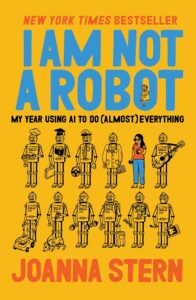
Joanna Stern, the Emmy-winning tech journalist and author of I Am Not a Robot: My Year Using AI to Do Almost Everything, aimed to discover the pros and cons of AI lifestyle automation. Over a single year, Joanna let AI drive her family around Phoenix, interpret her medical results, coach her workouts, and whisper bug facts into her ear through smart glasses — and she came back with something far more useful than hype or doom. Here, she explains why you can instantly spot where AI falls short the moment it wanders into your own area of expertise, how to hand a machine your medical or financial data without surrendering the personal details you can never claw back, and why the real cost of all this convenience isn’t just privacy but your judgment, your skills, and your kids’ ability to sit with the discomfort that learning requires. Whether you’re an AI evangelist, a committed skeptic, a parent watching screens creep into childhood, or a professional quietly wondering if the bots are coming for your job, this conversation hands you the one thing the demos never will: a clear-eyed sense of what these tools are good for, and what they quietly take in exchange. Listen, learn, and enjoy (while the robots allow it)!
Please Scroll Down for Featured Resources and Transcript!
Please note that some links on this page (books, movies, music, etc.) lead to affiliate programs for which The Jordan Harbinger Show receives compensation. It’s just one of the ways we keep the lights on around here. We appreciate your support!
- Sign up for Six-Minute Networking — our free networking and relationship development mini-course — at jordanharbinger.com/course!
- Subscribe to our once-a-week Wee Bit Wiser newsletter today and start filling your Wednesdays with wisdom!
- Do you even Reddit, bro? Join us at r/JordanHarbinger!
This Episode Is Sponsored By:
- Ground News: 40% off unlimited access Vantage subscription: groundnews.com/jordan
- Boll & Branch: 15% off first set of sheets: bollandbranch.com, code JORDAN
- Jack Archer: 15% off first order: jackarcher.com, code GETJACK
- SimpliSafe Home Security: 50% off + 1st month free: simplisafe.com/jordan
Thanks, Joanna Stern!
Click here to let Jordan know about your number one takeaway from this episode!
And if you want us to answer your questions on one of our upcoming weekly Feedback Friday episodes, drop us a line at friday@jordanharbinger.com.
Resources from This Episode:
- I Am Not a Robot: My Year Using AI to Do (Almost) Everything by Joanna Stern | Amazon
- New Things with Joanna Stern | Newsletter
- Joanna Stern | Website
- Mustafa Suleyman | The Coming Wave of Artificial Intelligence | The Jordan Harbinger Show
- Marc Andreessen | Exploring the Power, Peril, and Potential of AI | The Jordan Harbinger Show
- Tesla’s Robots Were Just Remotely Controlled Dummies, Analyst Confirms | Futurism
- G1 Humanoid Robot | Unitree Robotics
- Chinese Robots Ran Against Humans in the World’s First Humanoid Half-Marathon. They Lost by a Mile | CNN
- Matic’s Robot Vacuum Maps Spaces Without Sending Data to the Cloud | TechCrunch
- Amazon Deploys Over 1 Million Robots and Launches New AI Foundation Model | Amazon
- AI Voice Generator and Voice Cloning Platform | ElevenLabs
- Voice Mode FAQ | OpenAI
- Why Language Models Hallucinate | OpenAI
- Ray-Ban Meta AI Glasses | Meta
- Zuckerberg Says People Without AI Glasses Will Be at a Disadvantage in the Future | TechCrunch
- Nationwide Real-World Implementation of AI for Cancer Detection in Population-Based Mammography Screening | Nature Medicine/PMC
- Simone Stolzoff | How to Make the Most of Uncertainty | The Jordan Harbinger Show
- The World’s Most Experienced Driver | Waymo
- NotebookLM: AI Research Tool and Thinking Partner | Google
- Our Approach to Advertising and Expanding Access to ChatGPT | OpenAI
- Amazon Acquires Bee, the AI Wearable That Records Everything You Say | TechCrunch
- A Reporter’s Recording Guide: One-Party and All-Party Consent Laws | Reporters Committee for Freedom of the Press
- Cory Doctorow | Why Everything Got Worse and What to Do About It | The Jordan Harbinger Show
- Moran Cerf | Hacking into Our Thoughts and Dreams | The Jordan Harbinger Show
- Mel Robbins Responds to Backlash After Telling Women to Upload Financial Documents to Microsoft Copilot | Moneywise
- Expanding Access to Health Care Through AI by Bill Gates | Gates Notes
- Jamie Metzl | AI Solutions for Hunger, Health, & Habitat Part One | The Jordan Harbinger Show
- Jamie Metzl | AI Solutions for Hunger, Health, & Habitat Part Two | The Jordan Harbinger Show
- FDA-Cleared AI for Dental X-Ray Analysis | Pearl
- More Students Use AI for Homework, and More Believe It Harms Critical Thinking | RAND
- Advice for 2026 Commencement Speakers: Don’t Bring Up AI | NPR
- Evaluating Large Language Models for Accuracy Incentivizes Hallucinations | Nature
- Musk’s Grok “Companions” Include a Flirty Anime Character and an Anti-Religion Panda | NBC News
- Benn Jordan | The Surveillance State Stalking You Without Consent | The Jordan Harbinger Show
1352: Joanna Stern | The Year I Outsourced My Life to AI
This transcript is yet untouched by human hands. Please proceed with caution as we sort through what the robots have given us. We appreciate your patience!
Jordan Harbinger: [00:00:00] Welcome to the show. I'm Jordan Harbinger. On The Jordan Harbinger Show, we decode the stories, secrets, and skills of the world's most fascinating people and turn their wisdom into practical advice that you can use to impact your own life and those around you. Our mission is to help you become a better informed, more critical thinker through long-form conversations with a variety of amazing folks, from spies to CEOs, athletes, authors, thinkers, and performers, even the occasional Fortune 500 CEO, neuroscientist, or journalist turned poker champion.
If you're new to the show, welcome, or you want to tell your friends about it, and I appreciate it when you do that, I suggest our episode starter packs. These are collections of some of our favorite episodes on topics like persuasion and negotiation, psychology, geopolitics, disinformation, China, North Korea, crime and cults, and more, that'll help new listeners get a taste of everything we do here on the show.
Just visit jordanharbinger.com/start or search for us in your Spotify app to get started. Today, we're talking with Joanna Stern, Emmy-winning tech journalist, NBC News chief technology [00:01:00] analyst, former Wall Street Journal columnist, and author of I Am Not a Robot: My Year Using AI to Do Almost Everything. And by almost everything, I mean AI glasses, AI therapists, AI doctors, AI dentists, AI robot dogs fake peeing on suburban shrubbery, AI boyfriends hiding on burner phones, robotaxis hauling her family around Phoenix, humanoid robots face-planting in her house like a $40,000 Roomba with imposter syndrome.
This is not another "AI's going to change everything, bro," where six venture capitalists in all birds pretend that autocomplete is the second coming of fire. Joanna actually lived with this stuff. She let AI into her home, her work, her health, her parenting, her marriage, her sleep, and because journalism occasionally demands emotional self-harm, her love life.
We get into what AI is actually useful for, where it's still basically a confident intern with a carbon footprint, how it can help you understand medical results without replacing your doctor, which you should not seek to do anytime soon, how AI dental tools can make a sales pitch look like science, why robotaxis are both impressive and deeply weird, and why a [00:02:00] chatbot that never rejects you might actually be less of a companion and more of an emotional slot machine.
We'll also talk about the hidden costs of all this: your data, your privacy, your judgment, your attention, your skills, your kids' ability to think, maybe even a few lakes' worth of cooling water so you can generate a picture of a hamster dressed like Napoleon. So if you've ever wondered whether AI is going to save humanity, ruin humanity, or just summarize humanity into bullet points that nobody asked for, this episode is for you.
Here we go with Joanna Stern. I want to start with what sounds like Silicon Valley's fever dream moved into your suburban New Jersey neighborhood. So you have this AI robo-dog fake peeing on your neighbor's plants, AI glasses whispering bug facts into your ear, a bracelet recording your life, a lawn robot doing laps, AI trainer tracking you, AI therapist at bedtime, a burner phone for your AI boyfriend or emotional comfort robot.
I don't even know what you would call that. So take us into this moment. [00:03:00] Is the future here, or is this like, "I have made a terrible mistake"?
Joanna Stern: Well, the future I was living was definitely a hodgepodge of stuff just that I had kind of gotten around me.
Jordan Harbinger: It sounds annoying to live with if I'm your husband or kids.
Joanna Stern: Yeah. I mean, my wife is a saint, an absolute saint. But I will say that this was the peak of the year, so this was the summer of 2025, where I had a lot of the experiments already up and running. And so the goal for this book and for my year was to try to get AI into as many parts of my life as possible, because we had been hearing AI is going to change all parts of life, and I wanted to understand what does that mean?
Jordan Harbinger: Let's accelerate this process.
Joanna Stern: Acceler- let me see if I can live in the future. I don't want to predict the future, I just want to see if I can live in the future and give people a sense of what that is. And that was deep in the summer, that was, like, around July of 2025, [00:04:00] and I had decided to do this robot testing month, which turns out you can't really invite a lot of the cutting edge robots into your house because they're just still being tested and created.
Jordan Harbinger: Yeah. It sounds also dangerous. Like, I don't want Elon's housekeeper robot cutting vegetables in my kitchen, and it's like, "Trust me, it won't slash your kid's face. Watch." You know, you ever see those home shopping network fails? Oh, yeah. Where it's like, "It's the flex ladder," and he's like, "I can crawl across this thing," and it crashes down.
He's like, "Oh, I didn't lock it in place," and they, like, have to pan the camera. That's kind of how I imagine Elon's home chef housekeeper robot going in the beta test.
Joanna Stern: That's probably how it is going in the beta test, and I feel like Elon himself may be the person on the flex ladder. You know? It's like that, he's the person getting injured.
That robot's not ready for homes.
Jordan Harbinger: Have you seen it?
Joanna Stern: I mean, it exists in videos, in the same videos I've seen. It exists in the, the demos they've done at parties where it's pouring drinks and walking around [00:05:00] and serving people.
Jordan Harbinger: Okay, that's kind of cool. That's kind of cool.
Joanna Stern: It is. And we can get into, though, the fact that's likely, and in the first time we did see it, it is being operated by humans, right?
Behind the scenes. Oh, I see. So
Jordan Harbinger: someone's just sort of joysticking the-
Joanna Stern: It's really like a, it's a puppeteer.
Jordan Harbinger: Okay.
Joanna Stern: Right? Someone is wearing a VR headset and controllers, and is remotely controlling that robot.
Jordan Harbinger: The fact that the robot can even walk somewhat normally and deliver drinks without spilling them and tripping over everything, that alone is impressive because once you get the self-driving AI part to work Which is I'm sure easier said than done.
The fact that the mechanics work was always a hang-up, right? Because they're always like, "Look at this amazing Chinese robot," and then it tries to climb up one stair and, like, does a sideways flip and falls apart and smashes everywhere, and you're like, "Yeah, we're not having robots do anything complicated."
Joanna Stern: No, you're totally right. On the hardware end, so much progress has been made, and you see that in the [00:06:00] dexterity of some of the hands. The hands are still the biggest hurdle. That is the hardest thing to do when you talk to roboticists. But the dexterity and the movement of these machines is super impressive.
You talked about a Chinese robot. I had been testing one of these... It's the Unitree G1 robot that you've probably seen go viral in a lot of these clips. Like, it was the one in the Chinese New Year Did you see that dancing?
Jordan Harbinger: There's dancing, there's several, like, fails. There's a marathon one, and then there's one where it tries to take one step running and falls over and explodes.
Joanna Stern: Yes.
Jordan Harbinger: And there's one where it hits a kid in the face.
Joanna Stern: That's the one.
Jordan Harbinger: Okay.
Joanna Stern: That is the one.
Jordan Harbinger: The hitting the kid in the face,
Joanna Stern: yeah. And so, I, well, I have a story- ... about why I put my kids in helmets and other types of protective gear- ... when I brought that one home. But I'm a very good parent.
Jordan Harbinger: This is, by the way, what I meant when it's like it's annoying, you're like, "Mom, hey, guys, don't go in the house until you have all your protective gear on."
Joanna Stern: We'll get into it right now. I tested that robot. I got it, when was it? Two or three weeks ago, I got it for one of my first videos on YouTube for my new channel, [00:07:00] and I was like, "Okay, we're going to bring it into the house." And then I saw that video. I was like, "We are going to bring it in the house, but the kids are going to be at school.
No one is going to be in the house except for me and the dog." But my kids really wanted to see it, so we went to a local park and I put them in helmets.
Jordan Harbinger: Sorry, I didn't mean to laugh this hard. It's such a ridiculous visual in my
Joanna Stern: head. It's a ridiculous visual, but I, I'm a good parent, right? And so-
Jordan Harbinger: The fact that you keep saying that makes it more convincing,
Joanna Stern: for sure.
I'm such a good parent that I took the robot to the park-
Jordan Harbinger: With other people's kids ...
Joanna Stern: with other people's kids. Who
Jordan Harbinger: were not wearing helmets,
Joanna Stern: by the way. Who were not wearing helmets. I made them stand at a healthy distance away. I'm saying this out loud, I'm probably not a very good parent.
Jordan Harbinger: No. As it comes out of your mouth, you're not good for other people's kids.
Joanna Stern: You know what?
Jordan Harbinger: That's for sure.
Joanna Stern: My kids love me because I bring home robots.
Jordan Harbinger: You bring home robots. So did it function well on the playground? I mean, is it fun to watch, or does it just kind of bumble around and fall over?
Joanna Stern: It's amazingly, it's amazing at running. It's [00:08:00] slower than a human, but it's still...
There are versions where they've been running these in China. They've been doing marathons- Right, I saw the one where it, like- ... and races ... beat everyone in the marathon. Yes. And I didn't have that supercharged running version in New Jersey, and I don't know, the governor of New Jersey is listening to this.
I'm very safe. Please do not kick me out.
Jordan Harbinger: Yeah. Yeah, did you have to get any kind of weird permitted things, like, "Hey," or is there an engineer for the robot company that's like, "Let me just be there"? They were
Joanna Stern: there. They were there. Yeah.
Jordan Harbinger: That's important to note, I think.
Joanna Stern: Let's, let's, let's talk about the permits.
I don't know. We don't need robot permits in this country.
Jordan Harbinger: But there's a... Yeah, that's, I have a right- You
Joanna Stern: can do a lot of things in this country ... it's
Jordan Harbinger: in the Constitution. Yes. I can have a robot, concealed robot at all times.
Joanna Stern: The right to bear robots is-
Jordan Harbinger: That's right. It's going to be enshrined. In, in fact, it's actually That's an interesting area of s- of law that I had never thought about.
Like, what rights do people have to have technology like this or b- be free of it in the future? That's something, that's another podcast, I suppose. But yeah, so there's a guy with a briefcase that has, like, a red off button for this thing when it starts spinning wildly and parts are falling.
Joanna Stern: He actually has [00:09:00] the remote control, because these are completely remote controlled.
Jordan Harbinger: Yeah. Okay.
Joanna Stern: So I would say run the robot down the road, run the dance mode, run the kung fu mode, right? And-
Jordan Harbinger: Kung fu mode. Oh, that's-
Joanna Stern: Fully does- ... cool ... these moves. Again, my two young sons love this.
Jordan Harbinger: Yeah.
Joanna Stern: Yeah. But again, you see me in the video fully, like, walling them back. Holding them back. Yes.
Jordan Harbinger: Yeah. Yeah. '
Joanna Stern: Cause I'm a good parent.
Jordan Harbinger: Kicked by a robot. Yes, we'll have to keep saying it. I was going to ask you what the most absurd, single most absurd AI in your life moment is. This has to be up there.
Joanna Stern: This is up there. I would say these other robots that I tested during what you just read, and that was the beginning part of the book to capture the craziest, I think, part of the year where I had these robots going.
I had all these AIs running in the background and all these different apps going on. In terms of the robotics at that point in the book or in that part of the year, they weren't that crazy, right? Most people now have a robot vacuum in their house.
Jordan Harbinger: There's a company near me called Matic. Yeah. I don't know if you've heard of- Have you heard of them?
Joanna Stern: Matic is in the [00:10:00] book, yeah.
Jordan Harbinger: So they sent me their- Great ... robot.
Joanna Stern: Yep.
Jordan Harbinger: I was like, "Jen, do you want this? I don't know." And she's like, "Hell yeah."
Joanna Stern: Yeah.
Jordan Harbinger: So they sent me the... Now, this is not a humanoid robot for people listening. It's basically a vacuum. It's a Roomba. Way better Roomba, and it also mops, which is crazy good for us because we have kids that are like, "I drew a picture on the hardwood floor with markers," and I'm like, "Cool.
Thought we talked about this, but fine." And it'll just go over it and clean it up, and you can see it basically went around my whole house while I wasn't there at night, which was a little weird, and then in the morning it was like, "Ta-da, here's a picture I painted of all of the things in your..." And it's like a blurry I can tell it's my living room but a stranger couldn't tell it's my living room map of my house.
Joanna Stern: It's a
Jordan Harbinger: full 3D
Joanna Stern: map.
Jordan Harbinger: And it just doesn't hit things. Like, the Roomba would have to, like, bounce off a chair and turn around weird and go the other way and then bounce off the other leg of the chair. This is like, "No, no, no, I know how to get through this whole thing." It's
Joanna Stern: really cool. And actually what you're describing was a, a really big leap for these home robots.
So while it may not seem like, oh, [00:11:00] we're still talking about vacuum robots 15 years after the Roomba or 20 years after the Roomba at this point, but there has been significant leaps because on that Matic are a number of new sensors. There's better processing in the Matic, and it created that 3D map, and the amazing thing too is great computer vision in mine.
Do you have a dog or?
Jordan Harbinger: We don't, but I have two little kids that are basically the same thing.
Joanna Stern: Yeah. But it actually will go and recognize, like, I have a dog, and it would recognize this is a dog bed, right? And it labels those things. Oh, okay. That's where
Jordan Harbinger: you're going with this. Yeah.
Joanna Stern: Yeah,
Jordan Harbinger: that's cool.
Joanna Stern: Yeah.
It's fully understanding the home, which is a really big step for those humanoids to make that leap from going from a robot that essentially is doing something from going from A to B, right? It's really what vacuum robots are doing. Like, I'm going to go from the living room to the kitchen to the bathroom, whatever else you have on one floor, right? Because they also can't go up the stairs.
Jordan Harbinger: My wife can say, "Hey, [00:12:00] don't go in Jordan's office because it has carpet, and, like, it's annoying. It doesn't want you in there. It doesn't want to trip over you." And then I also didn't want it to work during the day because it was doing stuff during the day, and one, I'm like, "I'm trying to talk.
Why is this thing talk- It's louder than me." And then I almost tripped over it, and I was like, "I don't ever want to see this thing again off the dock while I'm awake." So now at, like, 1:00 AM it wakes up, cleans the entire house in four hours or something like that, and then just goes back to sleep. It's pretty dope.
Joanna Stern: And it's very smart about going back to its dock if it needs to do something or empty itself. But the reason that Matic is actually really important is that there's more technology going into these single purpose robots right now in the home that are improving that one task it has to do, which is clean your floors, clean the drawings off your floors.
And then where we're going to get from there, which would be these multipurpose robots, the humanoids. So we can talk more about why these humanoids are just completely not [00:13:00] ready, but these single purpose robots have gotten extremely good.
Jordan Harbinger: Yeah. Why aren't they ready? Because I... Look, part of it is Elon says, "I'm not going to make any more Model X Teslas.
We're going to start making these robots. They're going to be ready by," and I don't want to quote him because I don't remember, but it was like next year. I just turned to Jen, my wife, and I go, "Yeah, that's, that's not real. I mean, no. That's just not real. It's going to have a beta by next year. It's going to need three more years of work.
Come on." And then when I asked you on the phone, I was like, "All right. So where are we with these things?" Because it's also very difficult for me to believe that I'm going to have a robot in my house cleaning things and chopping vegetables before the US military gets robot soldiers. Come on, man. They're going to get those first.
That's how this always goes. Plus, I also think it's probably literally safer for us not to have them. We need to see how these things do all of the worst things we want humans doing before we're like, "No, it's fine if it just, like, changes your tire
Joanna Stern: Absolutely we are not getting these in our [00:14:00] homes, at least the Tesla one, before they enter factories.
Jordan Harbinger: Sure.
Joanna Stern: The factories seem more obvious, yes. Let's just talk factories first. Factories and industrial settings is the number one place we're going to get these first. Now, Amazon already says they have a million robots working in their factories. Now, those are not humanoids, but they are forms of robot-
Jordan Harbinger: Like a robo-forklift or
Joanna Stern: something.
Right. Yeah. They are doing standardized work in supply and other types of tasks. The reason that industrial settings and factories are so much easier than the home is that it is a very plotted, very organized area, and it does not change.
Jordan Harbinger: Yeah, you don't have a dog walking through there with your toddler.
Joanna Stern: Right. You have aisles, you have labeled things in the aisles. There's actually not as many humans that move around, like you're saying. So that is the best setting possible for a robot, right? It is built for the robot. The home is the complete opposite. Especially it sounds like your home or [00:15:00] my home, right?
Yes,
Jordan Harbinger: yeah.
Joanna Stern: You've got kids moving around, you've got furniture moving around. You move things around within things, like even if you, I mean you- There's
Jordan Harbinger: a two-inch step here that's kind of annoying. My mom hates it. Oh, the robot has to navigate that every time it goes around the house.
Joanna Stern: Yeah, or you move your chairs, or you move the toy bin.
Even in the refrigerator, when is everything the same in the refrigerator?
Jordan Harbinger: Yeah, right, I don't have RFID barcodes-
Joanna Stern: No ...
Jordan Harbinger: scannable on everything- Right ... in the fridge.
Joanna Stern: Right. Like in my refrigerator, why is the ketchup always in a different spot?
Jordan Harbinger: That is annoying.
Joanna Stern: Yeah.
Jordan Harbinger: Yeah. That's irritating.
Joanna Stern: I don't know. Maybe you don't have this problem at your
Jordan Harbinger: house.
No, no. We taught them well, "Don't touch the ketchup. There's a ketchup holster." I want to go back to robotics pretty soon as well, but you tried to make AI your everything, and I'm wondering where it became useful and where it was just, like, lifestyle disease.
Joanna Stern: Lifestyle disease fell into a couple of places.
One area where I've been thinking about it, because I tried to go back to it, it was, like, a personal trainer. I used an AI personal trainer, and it... I like that you said lifestyle disease. That's a good [00:16:00] term. I felt that personal trainer was lifestyle disease. Like, it will tailor to what you want to do, right?
So you prompt it saying, "I want to do cardio two times a week and weightlifting two times a week." By the way, I don't do these things.
Jordan Harbinger: Shouldn't it tell you what to do? My trainer tells me what to do.
Joanna Stern: Right, your trainer... And then, so then it starts prompting you and reminding you what to do. It will take you through these workouts, and it just was such a bro.
It kept calling me Cardio Queen. I look like a person that wants to be called Cardio Queen.
Jordan Harbinger: Yeah, no, yeah, that's a good point.
Joanna Stern: And it was incessantly bothering me about doing these workouts, and then you're watching this AI animated dude do the workouts. I forced myself to work out with this trainer for a full month, and it just- It was a clear place where a human trainer was just so far superior in terms of personality, in terms of driving my motivation to do the things I need to do.
Jordan Harbinger: [00:17:00] It seems like that's very fixable, right? Oh, hey, we need an avatar that's for Women that is not excessively dude bro-ish and ditch the nicknames and see what they react, how they react and, yeah, something that's more akin to a trainer you would actually click with in real life as opposed to a 25-year-old kid who's like, "All right, dude, let's do it.
Let's get swole." And you're just like, "Calm down."
Joanna Stern: Whoa. I actually think that you are- Where- Did you do the voice for the trainer? I, I could do the,
Jordan Harbinger: I can do VO, no problem.
Joanna Stern: You might have done the voice for the trainer.
Jordan Harbinger: Uh, you know, it's funny, I have done voiceover for AI stuff, and a lot of it is exactly that.
Joanna Stern: So maybe it made its way.
Jordan Harbinger: Or there's a lab that took a bunch of my shows and then took my voice off of it and, and now you can synthesize totally not Jordan Harbinger's voice, but very, very similar.
Joanna Stern: Is it ElevenLabs?
Jordan Harbinger: Oh, yes. Yeah. I believe so.
Joanna Stern: Oh, I'm going on there today. Yeah. I'm going to make my own personal trainer based on your voice.
You can probably find totally not me on there. I could definitely code this out by the end of the day.
Jordan Harbinger: I don't know what it's called though. I don't know, like, what they've named it. [00:18:00] There's probably a million voices on there.
Joanna Stern: Yeah, there are. And I agree with you that maybe that will get better, right?
That's an easy thing to tweak. I could probably even figure that out myself, right, if I wanted to build this personal trainer and vibe code it and make a AI version of this. But there is also just something about getting up, going to a gym, meeting a human who is there to talk to you and talk you through things, and the accountability of having that versus notifications all day to remind you about your workout.
Jordan Harbinger: So which ones were the most useful? You had dude bro trainer, that was lifestyle disease. That's just not ready for primetime. Where were you like, "Oh, I, I need to keep using this. This is amazing"?
Joanna Stern: One thing I will say that has really stuck with me and I think is going to really be the next wave of our AI interaction is voice.
Do you use ChatGPT voice at all?
Jordan Harbinger: You know, I do with my son. So for me, when I type questions, I use thinking mode and I can skim it really fast, but if [00:19:00] I'm in the car or I'm with my son, who's six, he'll go, "Dad, are there people that are on islands that we don't know about?" And I'm like, "Yeah, they're called uncontacted tribes.
Amazing that you even thought about that." And then he's like, "I want to know more about that." I don't want to type it in and then read him a crappy summary that I'm making in real time. I'd rather it just tell him directly. He used to be too shy to talk to it, and he used to whisper it to me and have me tell because he was kind of scared of it, I think.
But he'll say, "How many people live in the group?" Or, "How long have they been there?" Or, "What else is on the island? What do they eat?" So he'll talk to it and learn from that. So yes, I use AI voice, but only for v- specific things. Otherwise, it's too inefficient.
Joanna Stern: Yeah, the car is a great example, and I force myself basically every time I was in the car in the year to talk to AI, and I wouldn't say it fully replaced humans talking to the car.
I still made phone calls in the car from time to time. But if I'm Driving to meet with you, for instance, I did this on the way here. I asked [00:20:00] ChatGPT about you, and we had a conversation back and forth, what might he ask me about, right?
Jordan Harbinger: That's smart. I-
Joanna Stern: Yeah, so and that habit has really stuck with me, the idea that I can just have this personal assistant with me in my ear.
There's a lot that needs to be improved there, and these agents that these companies are working on right now, I think is- will get to the point where I can say to ChapGPT or whoever my assistant's going to be, "What's on my calendar? Make sure to send him an email that I'm going to be late," all of those sorts of things, which the integration isn't really there yet.
But for just an answer machine like you're saying with your son, which I use with my kids all the time, that voice interaction really stuck with me, and it was towards the beginning of 2025 where they really started to improve a lot of that.
Jordan Harbinger: That's true, yeah. It used to be hot garbage. In fact, a lot of ChatGPT was crap until very recently.
I think it was ChatGPT-4. Or what was I using, 3.5 or something? And I remember going, "Eh, nah." And then 4 came out, and I was like, "Okay, useful for very limited [00:21:00] things. It's, it's all right." 4.5, I was like, "Oh, this is now replacing Google for me." And then 5 is out, and I'm like, "Oh, now I'm just going to use this for tons of things I n- would never have even tried to get done with a computer before."
I used to read every book and... Well, I still read every book, and then type notes into Google Docs, and then run the show off that. Now, I have the book go through thinking mode, pull out what it thinks I want, and then I read the book and I type my own notes, and then I have it synthesize those two sets of notes together, and it's so much easier because I used to have to pause every minute and write something down, and now I go, "Well, that's already in there.
That's already in there. That's already in there. Oh, there's a question that wasn't in there. Type that in." So now I can do other things instead of just sit there. I just need way less focus.
Joanna Stern: No, and it's gotten far better at the synthesis like you're talking about and gotten better at Not making things up completely, but you still have to [00:22:00] double-check
Jordan Harbinger: There's been many times in the past just few months of me doing this on the show where I'll say, "Tell me about that time that you went skydiving with AI," and you're like, "That didn't happen."
And I'm like, "Cool. Nevermind. Edit that out." And my engineer will be like, "Huh? Well, how did that happen, dude?" And I'm like, "I don't know. ChatGPT just, like, thought that that-
Joanna Stern: Yeah ...
Jordan Harbinger: happened or something."
Joanna Stern: At least you have humans in the mix to catch those errors.
Jordan Harbinger: That's for sure. Also, I'll read the book and go, "I don't know.
I got a phone call and the book kept playing," or like, "I was making a sandwich and I missed that story." And then sometimes it's like, nope, that story just wasn't in there, didn't happen at all, and showed up anyway. It, it's pretty rare. It's usually nothing that dramatic. It's usually like, "Oh, you, you said you replaced your doctor with AI," and it's like, "No, I went to the doctor anyway, but I also used AI."
And it's like, oh, it just misunderstood you.
Joanna Stern: Yes.
Jordan Harbinger: But that's a weird thing to misunderstand, because then I read the book and go, "Nope, that was totally clear. Totally clear."
Joanna Stern: And then some of [00:23:00] it also it just lacks common sense, right? It doesn't put one and one together. I mean, one example recently, so I was in California on this book tour and I was really freaking out about book sales.
I was trying to understand where book sales and rankings, and so I started talking to Claude about it. And so I was talking a lot about my anxiety of like, "Well, are they actually... Are these books selling?" and this and that, and it's like, "Calm down." It's impressive in some ways. It was basically like gives me all this information, then it basically says, "Calm down.
Go take Browser," who's your- my dog, "for a walk."
Jordan Harbinger: Your dog's name is Browser?
Joanna Stern: Yeah.
Jordan Harbinger: That sounds like a robot dog.
Joanna Stern: His name is f- named after a web browser, yeah. Yeah. Yeah, yeah. But I'm- just told you I'm in Los Angeles. Why would I be taking my dog for a walk? Oh. Right?
Jordan Harbinger: Right, right. Okay. Yeah.
Joanna Stern: Like, there are these things where it's like it just doesn't know the world around it.
Jordan Harbinger: Yeah, that makes sense. Right. Yeah. Well, I didn't bring my dog cross- on a cross-country flight.
Joanna Stern: And I actually in that conversation kept telling it, "No, I'm in Los Angeles," and then later on again it would say, "Like I [00:24:00] said, go take your dog for a walk. Take a moment, step away from the book rankings." I was like, "Oh, okay."
Jordan Harbinger: Speaking of machines pretending to care, let's hear from sponsors who at least admit this is a transaction. We'll be right back. This episode is sponsored in part by Ground News. One thing Joanna Stern talks about today is how technology keeps getting better at filtering information for us. AI summarizes articles, algorithms decide what shows up in our feeds, recommendation engines tell us what to watch, read, and click next.
And the problem is that convenience doesn't always give you the full picture, which is actually why I love Ground News. Ground News lets you compare how the same story is being covered across the political spectrum, so you can see the framing instead of just accepting whatever version happens to land in your feed first.
I was looking at coverage of the recent US-Iran talks in Switzerland. Ground News pulled together dozens of sources covering the negotiations. Courier's headline focused on what mediators described as encouraging progress and a roadmap toward a possible agreement. Meanwhile, today's edition led with Trump threatens Iranian negotiators' safety and they walk out.[00:25:00]
Same underlying events, completely different takeaway. Ground News helps you understand not just what's happening, but how different outlets want you to think about what's happening. I also use their blind spot feed, which shows stories getting major coverage from one side of the political spectrum and very little coverage from the other.
It's a great way to find stories that you might otherwise never see. Go to groundnews.com/jordan to get 40% off their unlimited access vantage subscription. That's groundnews.com/jordan, groundnews.com/jordan. Use that link so they know we sent you. This episode is also sponsored by Boll & Branch. We upgrade our phones, our coffee machines, but then we'll sleep on the same tired sheets for years, even though our body is touching that bedding for what, like seven or eight hours a night?
That's a third of your day. And if your sheets are trapping heat, slipping off the corners, or feeling rough and worn out, your body notices. That's why I'm a big fan of Boll & Branch. Their sheets are 100% organic cotton, breathable, lightweight, woven specifically for airflow, not just softness. So instead of waking up hot and sweaty, your bed actually feels cool, soft, and comfortable.
And you feel the quality immediately. The moment you get in, it's that clean [00:26:00] hotel-level feeling, but more relaxed and inviting. 94% of Boll & Branch customers say their sheets get softer with every wash, and I can attest to that. We wash our sheets weekly. I use Boll & Branch, and I'm not going back to regular bedding.
When something touches your body for that many hours a day, it's worth upgrading.
Jen Harbinger: Sleep cooler this summer with Boll & Branch during their annual summer event. For a limited time, get 20% off sitewide at bollandbranch.com/jordan with code Jordan. That's Boll & Branch, B-O-L-L-A-N-D branch.com/jordan, code Jordan to take 20% off.
Bollandbranch.com/jordan, code Jordan. Exclusions apply.
Jordan Harbinger: A lot of you might not know that when you use our promo code, it really does actually support the show. We don't get a cut of sales or anything, but it lets the company that bought the ad know that people are actually hearing the ad and they're engaging with the ad and they're likely to renew their campaigns with us, which, you know, keeps the lights on around here.
So hey, if you're signing up for something or buying something, use our code. It's usually Jordan, but not always. All of the codes are on the deals page at jordanharbinger.com/deals. You get a discount and you [00:27:00] help keep the show going strong. Thank you for your support. Now, back to Joanna Stern. I know people are going to hate on me for this, but I wear these Meta Ray-Ban glasses
Joanna Stern: Oh, I wear them all the time
Jordan Harbinger: They're amazing in many, many ways.
I lo- I at first was like, I'm going to just film my kids with these because whenever I take out my phone, they stop doing the cute thing and I'm like, "Oh, I want the button." You know, if I'm out and I see something crazy, I don't want to have to be like, "Hold on. Oh, ugh, click, click." I can just go boom and then record the gnarly traffic accident I just witnessed or something, or like this interaction between people that I don't necessarily want them to know I'm filming them, but if this turns into a fight, I'm going to have video evidence of what happens or something.
But now what I find myself doing is being like, "Hey, do I need a jacket today? Do I need this? What time is the rain starting?" But that AI makes some of the dumbest flipping mistakes. People will go, "Oh, Meta AI is amazing." I don't know, guys. If you're listening, what's wrong with you? I'll say, "Hey, give me the temperature in Celsius and Fahrenheit every time," because I want to kind of learn like what is [00:28:00] 22, because I'm talking to my friends overseas and they're like, "Is it hot there?"
And I'm like, "Yeah, it's 90." And they're like, "Oh, okay. I don't know what that means. I have to get an app for that." So I was like, I want to be able to say, "Oh, it's, that's 29 degrees or whatever that is." And Meta AI will go, "No problem. I'll give you the temperature in both Celsius and Fahrenheit." And I'll go, "Hey, what's the temperature?"
And it goes, "12." And I'm like, "Okay- No ... you can't follow the simplest of instructions."
Joanna Stern: Well, that's memory.
Jordan Harbinger: Yeah.
Joanna Stern: That the memory isn't there. Similar to what just happened with the browser situation and Claude for me when I asked it, I'm like, "I'm on this book tour. I've told you now twice I'm not near my dog," right?
The memory isn't always there. Yes, it can't do that, and it depends also if it's on the same Chat thread happens a lot. It can only have certain memory of that, and so that's one big place they've been improving and has been improved throughout the year. But I'm so happy you use the Ray-Bans. I use them all the time, and for the year, I wore them all the time, both the sunglasses and the regular glasses, though the regular glasses make me look like [00:29:00] Garth from Wayne's World.
Jordan Harbinger: At first, I was like, "I can't do this with the LED in the camera." Not one person has said, "Hey, is that a camera on there?" I think my son was like, "Wait, is that a camera?" No one else has said a damn thing.
Joanna Stern: They look so good, and I mean, other than when I look like Garth, but the sunglasses are really good-looking.
And I liked them initially, and I've been wearing them for a number of years since I reviewed the first pair, for the camera reason. Same reason as you. I have kids, I want to wear them when I'm skiing, I want to wear them when I'm doing other things in the world with them, bike riding. So much easier than ever using your phone.
But then when the AI feature came out, I really started using it, especially to even ask questions for my kids. We're out and about. Sounds like we have similar kids. "What is that bug? Is that a fox? Is that a this?" Like, random questions that you can be looking at and say, "Hey, Meta, what is that?" Right?
Jordan Harbinger: So for people who don't know, it'll apparently take a photo of that thing.
Sometimes it misunderstands me, and I'll say, "Hey, what about this?" And it [00:30:00] thinks I'm asking what I'm looking at, and it'll go, "It looks like you're in a bathroom staring at a wall with a plant on a shelf." And I'm like, "Oh, no. I mean, what is the thing that I said after that?" And it's like, "Oh, this is an ingredient that's common in shampoo."
It's very funny that you can do something like that with the glass. I guess I answered part of your question, which is where is this enhancing my life and enhancing my life, and it's not just ChatGPT, it's having those around all the time. And a lot of people think, like, "Oh, the last thing I want is AI around me all the time."
And it's like, I don't know, it's pretty damn convenient to be able to say something like, "Hey, what time is the rain going to start?" And not get your phone out, or something even more involved, like, "How come sometimes tires are filled to the same pressure and then one loses pressure even though there's not a hole in it?"
And it goes through all of this, like, "Well, it could be the air expanding, and maybe the sun's on one side of the car and not the other," and like, wasn't an important enough question for me to get my phone out and stop what I'm doing and learn it, but it was just fine while I'm driving to learn about that particular thing.
Joanna Stern: Towards the end of the book, I talk about where I think a lot of the future of [00:31:00] these devices are going, and I think the glasses and AI wearables are going to be a big thing. We aren't quite there yet, but the glasses do two things. One, they can see the world, and two, they can hear it. And so that is giving us an AI assistant that can do those things for us.
And that really does enhance us. Mark Zuckerberg has said in the past that people in the future who don't have these glasses will be at a cognitive disadvantage, and I actually agree with him. There are many times where I'm wearing these glasses and I'm able to quickly reference some information. But going back to our conversation right before this about the getting things wrong Am I smarter sometimes if it's getting it wrong?
Jordan Harbinger: Yeah, right. You're just confidently incorrect on certain things. Another really good use case, we have a nanny, she speaks Spanish. She speaks a little bit of English, but not as much, and she's an amazing woman that my wife has to use Google Translate or text to translate in the same room to talk with her, and it's kind of dumb.
You can tell your Meta glasses to real time translate [00:32:00] Spanish, and it will just tell her what the nanny is saying. The problem is it's a little bit slow, and it's a little bit wrong sometimes. Jen knows a little bit of Spanish from Duolingo and can answer her, but then when the nanny says something to my wife, it's just sort of a little too delayed to be super, super useful.
But it'll just tell her what she said. And I'm like, wow, once they can speed that up and everyone has them, you can just talk to somebody who doesn't speak a word of your language, and it'll be completely flawless.
Joanna Stern: And your nanny will have the glasses, and Jen will have the glasses. That latency will be down to split seconds.
And yeah, they'll be having a conversation back and forth.
Jordan Harbinger: One day you'll just be sitting in, I don't know, a, a cafe in Turkey or Saudi Arabia, and you'll be like, "I have no idea what this menu says." Instead of getting out your phone and taking a photo and then translating it and blowing it up, you just say, "What on this menu is heavy protein and doesn't have any dairy in it?"
And it'll just read the whole menu and go, "This item has this," and you just order that. "Here's how you say that." "Okay, it's number [00:33:00] 26. Just point to it." That's so useful. I feel like I'm doing a commercial for these glasses now, but I would love to hear what you learned comparing AI to, I don't know, a human doctor, a human driver, a human therapist, a human assistant, instead of just comparing it to nothing, right, which we're doing now.
Joanna Stern: Yeah. It depended on each of those different professions, but one of the things that I found consistently was that- In no place was it fully replacing a human.
Jordan Harbinger: In no place?
Joanna Stern: Look, not in medical, at least right now.
Jordan Harbinger: Well, right, okay.
Joanna Stern: So that is a big section in the book, and I talk a lot about how radiologists are working hand-in-hand with AI.
Jordan Harbinger: Yeah, tell me about that because I don't know anything about radiology other than they look at the X-rays and say, "Oh, this is a fracture" or, "You have a little tumor here," or something like that. It's really surprising to me that AI can't do that flawlessly. Okay.
Joanna Stern: But it needs a lot of oversight from humans, and I'll explain specifically what happened with [00:34:00] my breast ultrasound.
So they are using AI systems that are not these big large language models, right? These are systems that have been trained specifically on millions of radiology images. So in the case of my breast ultrasound and my mammogram, these are models that have just looked at millions of images of breast ultrasounds or breast mammograms.
And so they have these systems where the doctor is going to look at your imagery, but then they run it through an AI program. And in my case, I went and I had my breast ultrasound read, and the AI said, "There are three suspicious spots on this breast ultrasound." And I watched this doctor, her name is Dr.
Laurie Margolies, she works at Mount Sinai here in New York, and I watched her go back and forth with the AI. She said, "Okay, let's look at this first suspicious spot." Is she
Jordan Harbinger: talking to it or is she typing or is she clicking things?
Joanna Stern: She was really just looking at... It's a picture of the image. It's a picture of the breast ultrasound, and the [00:35:00] AI has a box around the areas that it thinks it might be suspicious or are benign.
And then it has a little bit of information what the AI thinks, and it's all kind of color-coded and it's pretty simple actually, even for someone who's not in the medical field to figure out what the AI is thinking or believes. And so she goes to this first suspicious spot and says, "I don't agree with the AI here."
She goes back and looks at my previous breast ultrasound and says, "This spot, this little mass here has been here for two, three previous tests. We're not worried about it. It's not growing." Goes to the second one, same thing. It's here before. The AI couldn't look at that historical data, which is one place that it's not yet as good as a human.
And then she says, "Nope, I'm not worried about that one either." Goes to the third one and says, "Okay, this is new. The AI is picking up on something new. This does look suspicious. I want to see some further testing on it." And she didn't pick it up on her own. It was small enough and looked [00:36:00] different, which is why these systems can be better than a human, right?
They are able to pick up at a pixel level changes that a human eye wouldn't see.
Jordan Harbinger: It's basically something with better than 20/20 vision, and then you have the doctor go, "All right. I'm going to look at this."
Joanna Stern: And that's where I'm saying they're working hand-in-hand.
Jordan Harbinger: It seems like not having historical data is really a problem that's going to quite easily be solved by simply importing more graphics and analyzing them, or scans.
Joanna Stern: Totally, and that will progress this. But even when that happens, even when these tools get to that ability that a doctor would be able to look at that historical data or whatever other feature that is not yet as good as a human, you really saw the back and forth and the need of the tool to be in the hands of the radiologist.
Jordan Harbinger: I know this is going to be one of those th- generational things. I definitely want a human looking at this just to sanity check it, just to say, "Yeah, the AI did its job correctly," even if the human's just rubber-stamping it. That's what I want. My kids are probably not going to [00:37:00] care at all. They're going to be like, "Why do I need some dude looking at this when the computer already said that?"
I find myself, it's tough for me to get through that, just like my dad is like, "I'm never getting in a self-driving car. I'm never letting a, a, some machine drive me around." And I'm like, "Dad, you probably used to drive drunk when you were, like, 25 because it was totally legal. I don't know if you're the best judge of whether you're a safer driver than a computer."
And I don't know how old your
Joanna Stern: dad is now,
Jordan Harbinger: but- He's 83 ...
Joanna Stern: yeah, I'm thinking that I would much rather get in the self-driving car. No offense to your dad if he's probably listening to this podcast.
Jordan Harbinger: I've told him a- as much. It's like, you think mom's a bad driver? A self-driving car's safer. Dad, you're probably an okay driver.
You're not going to be as quick as something with unlimited reflexes, 360-degree vision, and, I don't know, essentially data from other cars saying that there's an accident a mile ahead and it's going to slow traffic down.
Joanna Stern: Yeah. I'm not picking Don over a Waymo.
Jordan Harbinger: No.
Joanna Stern: Don versus Waymo, Waymo wins every time.
Jordan Harbinger: That's right.
No, it's not happening. I think that's the generational thing, right? Like, I would get in a [00:38:00] self-driving car. My kids are probably not going to ever want a human to drive them around because that's going to be weird when they're an adult. They'll be like, "I remember when my mom used to drive. Can you imagine mom driving?
Oh my God."
Joanna Stern: I've thought a lot about this, and there's a chapter in the book where I take my kids on what we call the Waymo fun vacation. And so we just spent the week going to Phoenix and driving around in Waymos, and same exact thing as you're describing. They get in the car, they think it's cool for the first minute, and then they're over it.
They do not care at all that there is no human in th- in the driver's seat.
Jordan Harbinger: I feel like I'd be gripping the sides of the car because there's no driver.
Joanna Stern: Which my wife was. I'd already been in these many times, right? I'd done my research. Again, good parent, good parent. So I, of course, had been in these. My wife had never been in them.
The kids had never been in them. My wife is freaking out in the back seat for, you know, probably the first 10 minutes, and then she's like, "Okay. It's pretty good. It's, it's fine." You see it. You see it very cautious. You see it keep to the speed limit. There are a lot of things th- these do to build that trust really [00:39:00] quickly.
The kids, two minutes in, could care less. They were like, "This is normal, right?" And so I think that's going to happen. I think kids are still going to want to learn to drive, and I think that's what's going to happen
Jordan Harbinger: Doesn't the data show that most kids are now not wanting to get their licenses, not because there's going to be AI self-driving cars, but because they're all, like, hiding in their basements because reality's tough or something?
Joanna Stern: There could be data on that, but I think what will happen is they will have cars, they will drive themselves, and again, similar to the situation with the radiologist, they'll be working with the car, right? They'll be guiding the car if it has a problem, right? They'll be babysitting.
Jordan Harbinger: This is like Tesla with self-driving, where it's like, "I'll drive you home on the highway," and then it's like, "Is this a weird left turn?
Like, what's hap- Exactly ... There's a cone in the road, but it's, like, not in the right- I need help ... spot. Why don't you just drive me around this?" But instead of telling you that, Tesla just goes, "Ding dong, we're not self-driving anymore. Figure it out, bro." And you're like, "Oh, okay. All right. I'm here." Yeah.
Joanna Stern: Yeah. I mean, [00:40:00] exactly, and that's going to come to more cars, and it will get smarter, and that's where I think this is headed.
I mean, we will have 10X more than that of the self-driving cars we currently have on the road. We already see them in, really invading certain cities, and test driving in a number of big cities a- across the US, and there will be that mix. There'll be the full self-driving cars. There'll be the ones where we're the hybrid mode.
Jordan Harbinger: I visited Waymo years and years ago when the cars were not allowed on the road without a driver in them, and they let us do self-driving, but in their parking lot. And I remember hands bracing the sides of the seats, and my wife grabbing onto my arm, and we were just like, "Oh, my..." We're screaming, like, scream laughing.
Like, "Holy crap. Oh, my God." It's like a really good roller coaster, even though you're just driving at seven miles an hour through a parking lot because the wheel's turning, and you're turning, and you're laughing. And if a human was driving like that, you would just be on your phone scrolling TikTok or something.
But since the car's driving itself, [00:41:00] I was just totally blown away with adrenaline, and I also couldn't wait to get out of there. So yeah, it's crazy that your kids are like, "Eh, whatever." But that,
Joanna Stern: how many years ago was that?
Jordan Harbinger: I don't know. Five?
Joanna Stern: Right, and look where we are now.
Jordan Harbinger: Yeah. Yeah,
Joanna Stern: it's- Right? They're test driving them in New York City.
Jordan Harbinger: Maybe it's been seven years, but it was something crazy.
Joanna Stern: Yeah, probably around that. I did test driving in self-driving cars probably for the last 15 years. Same thing, in parking lots, then you do the small suburban roads where they have a driver in the seat, and now we're get out in... I was just, got out in San Francisco, got right into a Waymo.
Jordan Harbinger: Such a, a fun looking future. But I would love to make this practical. Is there a 30-second test? Should I use AI for this? What sort of question should I ask? Do I need to AI this, or should I just do it manually? How do you decide, do I use AI for this, or do I just go the human route?
Joanna Stern: If I know the answer, I'm going the human route.
If I don't know the answer, I'm asking AI
Jordan Harbinger: I'm just wondering if you have a, a checklist of should I use AI or [00:42:00] automation is probably a better way to look at this. Should I look at automation for this? Because it's like, what am I replacing? Is AI better than that baseline? There's got to be some other way that you calculate the cost.
Joanna Stern: For the year, if I was doing something new or different, for this experiment, I wanted to try AI. And so in any situation, doctor, massage therapist, physical trainer, therapist, I said, "I'm going to try AI, but I'm going to compare it to the human because I'm not going to have a baseline." I mean, of course I know because I've lived life for 40 years, and I know about the baseline human, but I'm going to compare it.
And so in no place I would say for this year did I get to a place where I said, "I'm absolutely always going to now, after I did this experiment, go use AI." But there are a lot of places now where I think AI is the first stop and is augmenting or [00:43:00] maybe making going to the human not less important, but less vital.
So one example I would say is in law, for instance. I still hire a lawyer for my company. Yeah, but I'm now going to AI to ask a number of early questions in that legal process. Or I might ask AI about a contract before I go and ask my lawyer about that contract. I think we're seeing that similarly in medical.
I'm going to go to the doctor about this, or maybe I'm not sure yet I'm going to go to the doctor about this, but I'm going to ask AI about that medical issue first. And I think that behind all of this is the idea that as humans, we want information really quickly about whatever's going on. And we've always had this gap in going to experts.
And so now we treat AI in many places as this expert, which we can talk about if we should or shouldn't do that, right? Because there are a lot of issues. But [00:44:00] it is trained on expert information across all of the web. And so it's stepped in in those places in a place where going to do a Google search did not give you that expertise.
And we just talked about it with the glasses, right? We see things, we can a- we can get that instant answer. And so that's where I get to in the book of you're going to have that across life, across the different expertise, whether it be physical training, whether it be your, your doctor or your lawyer or your therapist possibly
Jordan Harbinger: It's interesting you mention that.
When I was... This is eight-plus years ago now, so well before everybody used ChatGPT for pretty much anything. I don't even know if it really was publicly available eight, nine years ago. I was litigating against my former business partners, and they kept throwing paperwork at me, and I, I remember thinking, "Gosh, you guys are paying out the nose for this."
because I have a law degree, so I would go over it and I'd go to my lawyer. I go, "Hey, John. I [00:45:00] think probably we can ignore this. Obviously defer to you. This I think we can answer with a small, really short thing that leaves a bunch of this stuff vague. It's going to require them to respond, or they can ignore it, and then the judge is going to want to drop it."
And he's like, "Yeah, I agree with that assessment." Instead of him spending an hour or two or three going over that, I was like, "Here's a rough draft. You can use it or not." And he would go, "Yeah, that's pretty good. I changed three sentences and I put something at the bottom." And I'm like, "Great." And then I remember I got their tax return the following year because they couldn't even be bothered to change their address from mine, and I saw one of the things that they had deducted, because they sent all their financials to us.
They had spent like $300,000 during that litigation, and I'd spent like 35,000 on that, and it was like now I was ChatGPT.
Joanna Stern: You were ChatGPT.
Jordan Harbinger: Right.
Joanna Stern: You were the expert.
Jordan Harbinger: Right. So more recently did something with my doctor, and I remember going, "What about this, this, this, and this?" And he goes, "First two things are kind of interesting."
And he goes, "But points three, four, and five, that's not a real thing you can [00:46:00] do in science." And I was like, "Okay." Right?
Joanna Stern: So- But ChatGPT said... '
Jordan Harbinger: Cause I even said, "Well, ChatGPT seems to think..." And he goes, "Yeah, I..." He's super into AI, too, th- this particular doctor friend of mine, and he's like, "That's not a thing."
And I said, "Well, it l- it's pointing towards this source." And he goes, "So what's interesting is I wrote that source with another doctor, and that is definitely not what we meant." So I was like, "Oh, okay. Well, that's definitive."
Joanna Stern: But this, I think, goes to something that I think a lot of people are feeling right now about AI in their industries or their expertise, is that when it comes to your expertise, you know where the AI is falling short.
Maybe it's because we think we're better as humans and we don't want to admit that it could be better than us at this point, but I actually don't think it's that. I think it is that we know we are experts in a certain thing, and we see the flaws in the AI right now, and that gap is going to be very important.
Now, will these models keep getting better and in two years' time or if [00:47:00] you have me back here in two years' time we'll be saying, "Uh-oh, you know, it actually... It's a pretty good lawyer now. We don't need the other real lawyer," or, "It's a pretty good journalist now. We don't need the other journalist"?
Jordan Harbinger: That's kind of already happening depending on what kind of journalism you do.
If you do original reporting, you're probably safe for now, but if you just synthesize crap you read elsewhere, you're done.
Joanna Stern: I agree with that, and so probably the same thing w- for your expertise in whatever it is, right? And so- I think that's an important lens of looking at these systems right now in these different industries.
Going back to the radiologist and mammogram example, this is a, a doctor with over 30, 40 years experience, right? She has ac- deep expertise at looking at specifically breast radiology.
Jordan Harbinger: Yeah, there's something there. NotebookLM, you ever use that?
Joanna Stern: Oh, yeah.
Jordan Harbinger: So I like that because I can dump in a bunch of articles and go, "I'm not reading this farm report, I'm not reading this Hormuz economic-
Joanna Stern: Yeah
Jordan Harbinger: nonsense. [00:48:00] Turn this into a podcast," and it's like, all right, here's a 10-minute overview, and it's pretty good, and it sounds like two people talking in a podcast, but I wouldn't listen to a podcast with those two AI voices as entertainment. It's just not quite there. Some people would maybe, but I, I'm like, "Nah, there's not enough personality.
Oh, they tried to crack this, like, really corny but n- also not really totally relevant joke, and then the other thing didn't work."
Joanna Stern: And it never gets deeper than the surface value info.
Jordan Harbinger: It doesn't, and they're not saying, like, "Oh, I've done another show on this, and it related this way." It just doesn't do that for podcasting.
But I think a lot of people, it's fine for them, for just purely informational purposes. The other thing is this is essentially an advertising business, right? So if I say, "Hey, by the way, I really liked whatever those Meta AI gl-" Like, we sold a couple pairs of Meta AI glasses just from that discussion.
Joanna Stern: Do you think we sold any books?
Jordan Harbinger: Probably not. I'm sorry. Not yet. Ah, I know. I know. We'll link it in the show notes. Actually, I should say I did enjoy the book. So you find, though, that NotebookLM, if they started throwing ads in there for the same mattress that I recommend on [00:49:00] this show, I don't know how well that's going to convert, 'because know it's two AI voices that are like, "We've now been paid to tell you about this particular mattress."
Whereas I might say, "I actually got one of these for free and it's awesome, and I'm not just saying that because they paid me, because I can turn down money and people know that. What it does well is this, and I thought that was really cool, and I'd never seen a mattress that does that." And people will trust that.
Some people listening will trust that and go buy it. I don't think you have that with robo voices, because th- you know that they're not real.
Joanna Stern: But you know they're not real, and they're trained on podcasts like this and scripts and transcripts of this, and it's very funny sometimes that they will build in conversation that makes it seem like they have lived or human experience.
So for instance, in the book, I uploaded my blood test results to NotebookLM, and my blood test results, this was because I had gotten back a phone call from my nurse. They called me to say my cholesterol or my LDL was high. [00:50:00] And so I was like, "What does this mean? You've only left me a 15-second voicemail saying my cholesterol's high, don't eat fatty foods, and work out more," basically, right?
And then, like, click. So I upload the blood test results to NotebookLM, and the very friendly podcast hosts, the male and female, start talking about and explaining to me LDL and what cholesterol is, and they start recommending that, they say, like, "Joanna really should start to do these things, and maybe she should start not eating out as much.
She should start to make more food at home." And one of the podcast hosts says, "Yeah, I'm going to do that, too."
Jordan Harbinger: Yeah.
Joanna Stern: Right?
Jordan Harbinger: Right.
Joanna Stern: Like, w- you're not going to do that. What do you mean? You're not a real person. You don't
Jordan Harbinger: eat. Yeah, you don't
Joanna Stern: even eat. You've never eaten.
Jordan Harbinger: That's really funny. Before the robot dog pees on democracy and AI kills all of us, let's hear from the humans keeping this show alive, shall we?
We'll be right back.
This episode is sponsored in part by Jack Archer. Comfortable pants are all I ever wear now. I don't care how good something looks on the hanger. If I feel [00:51:00] stiff, pinched, or like I'm counting the minutes until I can change, I'm not going to look comfortable either, and you can see it. I'm tugging at the waistband, adjusting every time I sit down.
That's why I love my Jack Archer's Jetsetter tech pants. Instead of needing different pants for work, travel, and weekends, the Jetsetter tech pant is designed to do more with one pair. Built for the office, golf course, date nights, everything in between. They're made with flexible fabric, so they move with you and still hold their shape.
They're also wrinkle-resistant, stain-repellent, machine-washable. Pull them out of a suitcase, and they're ready to wear. Spill coffee on them, wipe it off, and keep moving. The Jetsetter tech pant has over 6,000 five-star reviews because it's exactly what guys want: comfortable, polished pants they can reach for every day.
Jen Harbinger: Right now, Jack Archer is offering our listeners 15% off your first order with promo code GETJACK. Go to jackarcher.com and use promo code GETJACK for 15% off your first order and see why thousands of people have given the Jetsetter tech pants five stars. That's jackarcher.com, promo code GETJACK for 15% off your first order.
Jordan Harbinger: This episode is also sponsored by SimpliSafe. Here's the thing about home security. [00:52:00] Cameras are great, but in a real emergency, I don't want to be the monitoring center. I don't want to be on vacation getting an alert trying to figure out if it's a raccoon, a delivery driver, or somebody actually casing my house.
A relative of ours had the exact same nightmare. They had cameras but no professional monitoring. Intruders broke in, and they watched it happen live. The bad guys were in and out in about 10 minutes with their safe, and by the time the police responded, it was too late. That's why I choose SimpliSafe.
Using the Outdoor Camera Series 2 and advanced AI alerts, SimpliSafe's US-based live agents can identify threats on your property and help deter them before a break-in even begins. That's the difference. It's not, "Hey, something bad is happening." It's people helping act on it.
Jen Harbinger: We want you to experience the same peace of mind we do, which is why we've partnered with SimpliSafe to offer an exclusive discount to our listeners.
Right now, you can get 50% off a new system by visiting simplisafe.com/jordan. That's half off at simplisafe.com/jordan. There's no safe like SimpliSafe.
Jordan Harbinger: If you liked this episode of the show, I invite you to do what other smart and considerate listeners do, which is take a moment and support our sponsors.
They make the show [00:53:00] possible. All of the sponsors are searchable and clickable on the deals page at jordanharbinger.com/deals. If you have any problem with any sponsor or any code at any time, email me Jordan@jordanharbinger.com. We're happy to surface codes for you. I've gone to bat with people on sponsors who aren't being responsive or are giving you the runaround.
I'm here at your service, folks. When you support the sponsors, it really does help us out, so thank you for supporting those who support the show. Now back to Joanna's turn.
Joanna Stern: And then it will summarize. So it would say- Don't
Jordan Harbinger: worry, the audio's safe on a server somewhere that you're not allowed to access, I'm sure, but
Joanna Stern: nevermind Probably.
Probably. And right now we have microphones and very, very clear audio, so I'm not worried about my privacy
Jordan Harbinger: here. This is, this is being recorded and distributed millions of times over, so I guess this part's not so secret.
Joanna Stern: But, and then, so then it takes all of that and it puts it into a summary. And so it would say, "9:00 o'clock in the morning you had a conversation with Jordan about AI and robotics and self-driving cars.
And during that conversation you also said you [00:54:00] were going to send Jordan a robot," or whatever to-dos we came out of this, right? And it became really useful.
Jordan Harbinger: I was just thinking to myself, why would I ever want a summary of my day?
Joanna Stern: Well, a lot of things you say that you're going to do during the day that you completely forget about.
At least I do. I don't always write down the specifics. And you kind of look at the end of the day and you're like, "Okay, what were the things that I did and accomplished today, especially around work? What are the things that I said I was going to do? What is the makeup of the day," right?
Jordan Harbinger: I'm imagining my wife going, "You said yesterday that you were going to do this."
And I go, "No, I didn't." My bracelet's like, "Actually, Jordan, she's right." I'm
Joanna Stern: like- 100% that happens ...
Jordan Harbinger: chucking this thing into
Joanna Stern: the bathtub. That absolutely happens, and that happened many times during the year.
Jordan Harbinger: Ugh, God, do I need that? I don't know if I need more of that. I don't
Joanna Stern: know if you need that, right?
Jordan Harbinger: Maybe I need less of that. What's the opposite of this?
Joanna Stern: It's a mute switch. It's for you to mute all the time. But where I'm getting at here is there was actual convenience and utility in [00:55:00] this bracelet, right? But the cost, there's like you got two levels here. You've got the convenience of having this thing listening all day and doing your to-do lists and making you maybe more productive and reminding you to do things on one side.
And then you've got the cost on the other side, which is, okay, the cost is, is that I've got to give up my complete privacy and live in basically a surveillance state to make that happen. Are these things useful, right? Does the cost equal the convenience? And so as the AI gets better to help us, I think we're going to be willing to give more of that cost, right?
We're going to say, "Okay, I'll give up that." Or at least that's what the companies are hoping. And that's why they're sitting in labs right now trying to figure that out.
Jordan Harbinger: A show fan had sent me a post by, I don't know, some, some thinker, right? Some blogger thinker, and he was like, "Here's how I made AI, ChatGPT," whatever it was, "100 times more useful."
He's talking about how AI, they don't read text files like we read text files, obviously. They have this crazy [00:56:00] markup speak that they memorize, and he did this thing that was like, it was almost like a two-hour-long interview with yourself, and you ask yourself all these questions, and you type or dictate whatever the answer, and then you run it through some sort of markup translator thing, and then you paste this massive file into ChatGPT.
It also tells Chat, "Remember this. Every time you answer any question from me, run this file first and then filter it through there." And he shows before and after. It's like, now when it writes something for me, it is 1,000% my voi- Like, it nails it. Instead of going, "Oh, I'm going to guess what you would sound like based on one second of thinking time that I had where I referenced one other thing you wrote," it's like, nope, now I've got this file that says, "I put one space after a period when I write, and I also use a little bit of filler words here, but I never use that filler word."
So it's way, way, way more accurate And so that's really useful for somebody like me who might be writing or creating a show, but I would not [00:57:00] recommend something like that for just the average person because you're giving Anthropic or OpenAI a ton of personal information about yourself. That ship has sailed for me personally because there's 2,000 hours of video of me on the internet of me talking thousands and thousands of hours, so I can't hide any of that anymore.
But I don't want my wife and kids doing that. There's no reason they should be that publicly available or that available to these corporations.
Joanna Stern: And we have some controls. We can go into those chatbots and apps now, and you can say, "I don't want you to train on the data I'm giving you. I don't want you to remember these things."
Jordan Harbinger: I just feel like that's such nonsense. That's like, "Hey, don't remember this thing that you can use and monetize later." And they're like, "Sure, pal. Wink, wink, nudge, nudge,"
Joanna Stern: right? Right. "We're going public tomorrow. Don't worry."
Jordan Harbinger: I'll do something in ChatGPT. It's connected to my Google business account, and it's like, "Don't worry, we don't use any of your business data to train the AI."
And I'm like, they're just redefining train so that it doesn't do that, but the data is still somewhere. [00:58:00] Come on, I'm not-
Joanna Stern: But, but what I think what you're discussing right now is you don't really have much trust. You don't have much trust that these companies are going to do that, but yet you're doing it.
Jordan Harbinger: Right. I'm doing it because for me it gives me convenience, and again, I'm publicly available enough that all of the machines have all of this data already on me.
Joanna Stern: And we lived through this already, right? Both of us lived through this, the generation of, okay, are we going to give these social media companies all of this information so we get more personalized feeds?
Are we going to give Amazon all this information so we get more personalized shopping experiences? This is what we lived through for the last 15, 20 years, and so we're on the cusp of that again. More data, far more data than we did the first time around, possibly, and I think for far more convenience.
Jordan Harbinger: Yeah. Yeah, that's true. The B thing freaks me out a little bit because it's everything that I'm doing during the day, so now it knows, hey, Jordan goes to the bathroom. Like, it's going to know all kinds of stuff like that. It's
Joanna Stern: going to [00:59:00] know everything. And I, I'm not saying that that is a great thing. I tested that for this experiment to see where things could be going, and you don't...
I'm not wearing it anymore.
Jordan Harbinger: No, I was going to ask what it looks like. Is it low profile more or less?
Joanna Stern: It looks like a Fitbit.
Jordan Harbinger: Oh my gosh.
Joanna Stern: Yeah.
Jordan Harbinger: Now I kind of want to get one and try it out.
Joanna Stern: You've got to try it out. It became very hard, but I, I really did try. Every time I would tell people this is being recorded. I mean, certain states you have to tell people.
Oh,
Jordan Harbinger: yeah. Do you have to disclose you're wearing- Yep ... a fricking B bracelet-
Joanna Stern: You need
Jordan Harbinger: a release- ... in a one-party state?
Joanna Stern: Yeah, you do.
Jordan Harbinger: The, these are wiretapping laws- Yes ... for, that most people don't know about. Some states you can record a phone call as long as you know about it. Other states you need to tell everybody on the call that they're being recorded.
California I think is a two-party state, but like Nevada, I've recorded things before and I'm like, if I use this in court- I'm basically, I'm going to say that I was in Las Vegas when I did it, and they have to prove otherwise. You know? Like-
Joanna Stern: But you know what?
Jordan Harbinger: Not that I would ever do that.
Joanna Stern: Your B bracelet will know where you were.
Jordan Harbinger: And then it... Yeah, I know, but yeah, that's true. [01:00:00]
Joanna Stern: There's no lying in
Jordan Harbinger: this future. There's no li- there's no lying in the future, right. It's, it's all Minority Report. So Silicon Valley often will sell us convenience first, like we just discussed, but then it sort of invoices us later. What were the hidden invoices you started noticing by month three, month four?
I don't mean actual invoices, like, oh, this was an expensive bill. I mean, oh, this thing is now bugging me to buy things that I really want that I don't really actually want to know about because it's re- getting really good at... It's like Instagram, where it's like, "This shirt would look good on you," and you're like, "Damn it, you're right."
I don't want it, I don't want you to do that to me, though.
Joanna Stern: There wasn't yet, and still isn't, that good of an advertising bacon here. I think we're going to see that in the next year for sure, especially around these companies that are advertising first,
Jordan Harbinger: right? I keep getting those, like, "Meta AI ads, be a beta tester.
OpenAI ads, want to be the first, one of the first 200 people to put ads in ChatGPT?" And it's like, eh, well, [01:01:00] okay,
Joanna Stern: this is coming. Right. You're going to get that from Google, Google, Meta, these are advertising companies. OpenAI's headed there. So there wasn't anything drastic in that sense. I'm trying to think, but no.
Jordan Harbinger: Nothing yet? Okay. That's pretty good, though. Usually there's some sort of hidden cost that really is, becomes super obvious very quickly.
Joanna Stern: Yeah, I think right now some of the hidden costs are the things that Are maybe really more hidden, are more to the humanity of all of it, to the humanity questions of all of it, right?
The idea we've been talking about how quickly we can get answers, right? And I, I know you've talked about that on this podcast before. Like, the struggle to get answers. Do we have to be instantly connected all the time, and what if we aren't? And so we're training ourselves more, and I found that was a cost of, for me during the years.
I was training myself to constantly have answers all the time through AI. I set out for this whole thing in the beginning of the book, anytime I have a [01:02:00] question, anytime I have an issue, I'm going to go to AI first. I'm going to try not to go to a human. And you get into this cycle of, well, it's there for me.
It's always answering. It's always got a pretty confident answer. And so that was a cost for me. And I think it's still a cost for me. You, you asked me at the beginning of the conversation, what do, do you go to AI first? And yeah, I still go to AI first for everything.
Jordan Harbinger: So I, I like to reach out to people and connect with them on certain topics, and one of the triggers was always, "Oh, you know who knows a lot about this?
Dr. So-and-so," or, "You know who knows a lot about this? This former show guest." So I'll, I'll go, like, let me text or email this person, and it, it rekindles a relationship or something. But you're right, now it's kind of like, well, I don't need to ask Dr. Pash about that. I'm just going to ChatGPT this. I've lost a little bit of this normal outreach that I would normally do.
So now it's like, oh, I should text him and see how he's doing, but then not ask him this question, and then ask the question of ChatGPT. But it's, "Hey, how are you?" It doesn't spark the same conversation as, "When you were doing this in medical school, did you have to learn this? In anesthesiology, [01:03:00] do you do that?"
It's, I already have that answer, so it's, the reply is, "Fine, you?" Instead of, "Hey, sorry, I'm driving, but generally when you put somebody under, you have to monitor this and this and this, otherwise they'll die." That's a much more involved conversation that I'm no longer having.
Joanna Stern: And I don't want to say that during the year I, I lost any significant relationships in my life.
But maybe I, in some ways I need to be honest with myself, and maybe I did. I, I didn't, the first call wasn't always to a friend to, to ask about something. You know, at the end of the book, I talk about the decision to leave my job. And I talked to a lot of people about this decision to leave The Wall Street Journal, which I had been a reporter and columnist at for 12 years, to go and start my own media company.
And I talked to a lot of humans during that process, but none of them were quite telling me what to do. Some will tell you that they did tell me what to do, and there were a few that did, but I had to make this decision myself. And I [01:04:00] ultimately ended up talking to ChatGPT and Claude about it for so much longer than I did any human, other than my wife, who had to hear it.
But also your wife seems to... I'm sure she gets sick of you.
Jordan Harbinger: Yeah, I'm pretty sure that's usually the case.
Joanna Stern: We can probably confirm that- Yeah ... in fact. Yeah. We should fact-check that.
Jordan Harbinger: I should ask ChatGPT if my wife is sick of me.
Joanna Stern: And humans get sick of us. They're not always there 24/7. So I'd be waking up at 4:00 AM in the morning wondering, "Should I do this business?
I have this fear about this, I have this fear about the book," and there it is, the AI therapist or the ChatGPT or the Claude that I constantly am talking to and has memory of this stuff and is easier for me to go and talk to.
Jordan Harbinger: That's a good point. That's a benefit.
Joanna Stern: It's a benefit, but it's a cost.
Jordan Harbinger: Yeah, you're right.
No, you're right. It's a double-edged sword, for sure. What human skill do you now actively protect, then?
Joanna Stern: Conversations like this. I think that's very important Creativity, I still, in my job, you said it before, there's a lot of [01:05:00] the parts of reporting and journalism and writing that can be outsourced to these bots.
People keep asking me, "Oh, did AI write this book?" AI did not write this book. AI helped me make this book, but it's a pretty creative book. It's structured creatively. It has these fun journal entries. There are these illustrations in here. There are different fun little experiments I do every season. I couldn't have gotten any of those ideas from AI.
I just didn't get those ideas from AI. I tried to prompt it at times. I, I, how we would structure this book. And in fact, we restructured the book because my human publisher said, "Maybe we should structure this by season." And I was like, "That's a really creative way to do this book." And so I think these moments of creativity, even these just sparks of an idea that you have as a human when you're walking or you're running or you're in the shower, those things are so important, and you're not getting from these systems.
Jordan Harbinger: That's a good point. I wonder, going back to the [01:06:00] medicine thing, do you think there's a safe way to give ChatGPT or Claude medical information? Mel Robbins is, like, a popular self-help, I guess, author and podcaster, and she is coming under a little bit of fire right now because she did something where she asked her audience to upload their financial data to Microsoft's AI, and people thought that was really invasive and probably not a great idea.
And then it came out later, and a- again, I didn't read the full article on this, so Mel, I'm sorry if I'm getting this wrong, but basically it turned out that was an advertisement that was not disclosed. They had asked her to do that and paid her to do that. It wasn't, "Hey, check out this amazing financial tool."
It was, "Tell your audience to upload their financial data to us and we'll give you, I don't know, some money for that." And that did not go well for her.
Joanna Stern: There are some new financial tools that are very integrated with AI that are using systems in the back end to do safe verification of bank [01:07:00] or financial information.
If you're in this world of even running your own business, you know there are ways to link accounts through safe systems like Stripe and others, Plaid, exactly, that work in the back end. And there are some really I would say guardrailed types of interfaces where you can use this for your financial information.
Banks are working with it, and there's a part in this book where I go to one of these more digital-friendly banks, and I invest some money there because I want to see what AI's going to recommend I do with my money. But I do not recommend putting your bank statements, your tax returns, whatever financial information, sensitive financial information, I do not recommend you upload those to ChatGPT or Claude.
And if you want to get information about, "I've got this amount of money, and I want to see if I should put it in here," or, "I want to see what improvements have, I've made by investing in this," there are ways, I think, to safely do that without uploading that information that has bank account [01:08:00] information, Social Security information, any personal identifiable information.
And I say that even to say it's not fully safe even to just say, "Hey, I just made $10,000 on this. Should I invest it in this?" Look, there's information in your personal account that will be tied to that. I would think that through.
Jordan Harbinger: This is a tough one because I- if I run a business and I have a bunch of extra cash, of course I want to ask ChatGPT, "Which index fund do you think I should put this in, or which funds do you think I should put this in?"
But now ChatGPT knows that you have a million dollars in excess cash. Is that wise, you know? Or $100,000 in excess cash. Is that something that I want whoever to be able to have access to? Not really.
Joanna Stern: Recently, OpenAI released a personal finance tool which is starting to use these backend connectors. This just started to come out, and so they're starting to encourage this, and some of the other personal budgeting apps also have AI built in where they basically just [01:09:00] plugged in a large language model so you can interact with it.
It will look at the data, and so you can interact and say, "When was the last time I paid for my car lease?" And so there are going to be ways, I think, to more easily access our financial information. There are going to be ways that these are recommending financial or, or investments. But I wouldn't take it into your own hands right now.
Jordan Harbinger: Yikes. Yeah. What about medical information? The thing with medical information is it's really hard to separate personally identifying information from here's my mammogram and my medical history. It's like, well, okay, you don't have my name, so what? You have my frigging DNA is in here, man.
Joanna Stern: And my advice, at least, on that is to take some precautions just at the basic level.
Make sure if you're uploading that stuff that you do strip out any personal identifiable information, so strip out your name, strip out your birthday, all of this information, and you have to decide if you're okay with that risk, if you are going to get some good information, some good synthesis of something a doctor told you.
I think this is something [01:10:00] a lot of people are doing. They're uploading their MyChart information. It's like, what did the doctor even say here? Why is this, like, three pages long? It's complicated. I just, I want to understand the basics of this. Okay. Copy and paste it in, but make sure you don't have all that other information in there.
Jordan Harbinger: Yeah. I wonder if AI in medicine, what do you think? Is it going to give underserved people better care, or is it going to become a cheap substitute for people who can't afford a human doctor?
Joanna Stern: I actually go and talk to Bill Gates about this in the book because he feels very passionate that this is going to help people who are underserved across the world.
And you think of the example he gives me where in a country in Africa, they can't have access to a gynecologist or even any doctor. He explained to me that many there don't ever see a doctor in their lifetime. But if they had access, say, to an ultrasound if they were pregnant, right? And they could use that ultrasound and the AI, they didn't have a doctor there, but the AI could interpret the ultrasound results.[01:11:00]
Is that better? Is AI better than no doctor at all?
Jordan Harbinger: Yeah. I mean, sure.
Joanna Stern: Yeah. He specifically says, "We are going to be in a place where it's either going to be AI plus doctor or AI."
Jordan Harbinger: Right. Instead, and currently it's no doctor. Hopefully you don't die from something totally preventable. Yeah. Yikes.
Joanna Stern: And the argument I think doesn't get enough credit is that human doctors struggle to keep up with all of the advancements being made and how to bring that into their own care, because they're seeing patients, maybe they're doing their own research.
And so they're bringing in now AI to make suggestions about other types of treatment or synthesize other types of medical research that they wouldn't come across. And so that is also a new place where I think we really might start to see some improvement and, and like tangible improvement of a doctor recommending something because AI recommended it to him or her.
Jordan Harbinger: Dental care. You, you did some [01:12:00] dental AI dental stuff. Oh, I
Joanna Stern: have a lot of thoughts on dental. Yeah,
Jordan Harbinger: tell me about that.
Joanna Stern: I have so many thoughts on dental. So I had a great experience, and I think everyone should know that if you're getting a mammogram or breast ultrasound read, you want AI now to be involved in that.
You want your doctor to have that as a tool. It can help with spotting things that their human eye might not see, because I'm very high risk for breast cancer, and if I have a better chance of something being spotted early, I want that. I think any woman in the world is going to want that. And so the good news is, is that many clinics, many hospitals are starting to use AI in breast ultrasound and, and mammograms.
On dental, though It's a different case because your teeth aren't, not cancer
Jordan Harbinger: Right. That's true. I still want them. I still
Joanna Stern: want the teeth I, I don't
Jordan Harbinger: want cancer, but I want my teeth. Yeah.
Joanna Stern: Yes. I st- I still want teeth, but the smallest finding on my tooth, I don't necessarily need to know about, nor do I think I need to have a cavity drilled.
This is my [01:13:00] opinion. Everyone has different feelings on dentistry. I've found out it can be a very heated topic, so I'm excited to hear where you f- you fall on this.
Jordan Harbinger: What always was strange to me was I w- I had a dentist in college. She was fine, and then she was like, "Hey, you need to floss more." "Okay, fine.
What happens if I don't?" "Oh, you're going to get sensitive teeth and gums," blah, blah, blah. And then I moved to San Jose and I got a new dentist, and they were like, "Oh my God, you desperately need a deep cleaning." And I was like, "Yeah, they're trying to upsell me," blah, blah, blah. So I go and I got a second opinion and they were like, "No, dude, how did this happen?
You definitely need a deep cleaning." So I went back to the first dentist and I was like, "Sure, let's do it." And I've since become really good friends with my hygienist because he's an amazing guy. Charles, shout out to Charles. Anyway, he gives me a deep cleaning and he's like, "I've got to tell you, I don't really understand.
Did you just not go to the dentist for like five years?" And I'm like, "No, I, I went regularly and the dentist was like, 'Meh, fine, whatever. You're allowed to have some plaque on your teeth.'" And they were like, "No, dude." And I remember looking in the mirror after and going... I [01:14:00] opened my mouth and I remember going, because I thought like, oh, it's weird, my teeth have all fused together on the inside.
And they were like, "No, you just have like years and years and years of plaque that I have cleaned off your teeth." And I remember how sensitive they were, and thankfully that went away. They told me it would. But it was like, oh, wow, that's what the inside of my mouth is supposed to look like. And I wanted to go back to my previous dentist and just punch them straight in the face.
But the thing is, I don't even think they were bad. They were just like, "Yeah, this is a baseline level of plaque that you can just kind of have in your mouth. It's fine."
Joanna Stern: This is the perfect setup for this, what I found. So there's a lot of conflicting advice in dentistry
Jordan Harbinger: Apparently, yeah
Joanna Stern: And I had a very similar situation to you.
So I had gone to a dentist for many years, then I go to a new dentist when I'm starting to report this book, and I hear the same thing. I need a deep cleaning, four periodontal treatments, and, you know, couple thousand dollars, right?
Jordan Harbinger: Yeah, I don't know how much it was, but it was not cheap.
Joanna Stern: Yeah, it was, [01:15:00] maybe it was covered by insurance, because you sound like-
Jordan Harbinger: I do not have dental insurance.
You
Joanna Stern: do not.
Jordan Harbinger: No.
Joanna Stern: No.
Jordan Harbinger: I pay out of pocket for
Joanna Stern: everything. All right. Okay. Yeah. Well, this is a separate thing. And I'm like, I'm sitting in this chair, and they pull up this AI tool. It's called Pearl AI. And I'm like, "This is amazing. I was just researching for this for the book. This is now a reporting trip, awesome."
And then she starts showing me that there's plaque and there's tartar buildup and I need a deep cleaning. And I'm like, "This is weird. I've never needed this before. I'm going to get a second opinion," just like you did. And I go to another dentist. "You don't need it. This is fine. We'll just do a, a really nice cleaning, you'll be fine."
Jordan Harbinger: That's exa- yeah, exactly. I'm like, "Fine." Looks like I have one tooth on the bottom that just curves around my jaw. Like, this is not normal.
Joanna Stern: That, I did not have that, to be clear. I'm not saying my teeth are cleaner than yours.
Jordan Harbinger: They're cleaner than my
Joanna Stern: were- I am saying that ... have been. I am
Jordan Harbinger: saying that. That's exactly what you're saying.
And you're not wrong.
Joanna Stern: Right. So I go to another dentist, same thing, they had the same AI tool. And he's like, "Yeah, the AI tool is saying you do have this tartar, but I'm looking here, I'm doing these measurements, I don't think you need this deep cleaning." [01:16:00] And my feeling was that at the first dentist, they were using AI to try to upsell me But I said, "Okay, maybe this is a thing that's on its own."
But as a reporter, I started to dig into it, and it turns out that these AI tools, there's one called Pearl, there's one called Overjet, there's another called Vidya, are being used at a lot of practices now. And it is very helpful. They are showing people where the cavities are. To be clear, I did have one cavity, and it showed very clearly this is a bad cavity, you should get it filled, and I did.
But they're using these at these dentist's office now, and in some places, not all, but in some, they're using it to justify more aggressive treatment.
Jordan Harbinger: I see. And it's hard to argue with AI telling you you have a cavity. Well, I don't care. What are you going to do? Say, like, you don't care?
Joanna Stern: And it's hard to argue with the dentist saying, "Look, I'm saying it and the AI is saying it, and look, there's a box around it."
Plus what's happening at-
Jordan Harbinger: There's a red box.
Joanna Stern: Yeah. There's a red box and/or a green box [01:17:00] around all your tartar. And then even further, what's happening is that in many of these DSOs, which are these dental organizations that have bought up smaller dental offices and- This is private equity for dental
Jordan Harbinger: private equity,
Joanna Stern: exactly. They are looking at the AI, going back to the dentists and saying, "Well, the AI said these were three cavities. Why didn't you fill them? Why didn't we get a deep cleaning out of this patient," right? And it's like, "Well, we were going to take a wait and see approach." And they're like, "Don't take a wait and see approach.
Do it now. Get the money."
Jordan Harbinger: Wait and see is get paid later or never. That's not how we run a business. Yeah, exactly.
Joanna Stern: So I'm not saying AI is all bad in dental, of course not. But you see the incentives play out differently versus in a cancer situation.
Jordan Harbinger: Yeah. Oof.
Joanna Stern: I love dental. I want to just clearly say I love dentists.
I've talked to many dentists for this book. But also my teeth are cleaner than Jordan's.
Jordan Harbinger: That's true. That part, that-
Joanna Stern: Do not edit that out.
Jordan Harbinger: No. That, that's staying in there. Speaking of outsourcing our [01:18:00] decisions to machines, here are some sponsors chosen by a machine. We'll be right back. Our newsletter Wee Bit Wiser is making a splash.
If you haven't signed up yet, I invite you to come check it out. It's highly practical. It's an under two-minute read. It's actually usually like a one-minute read. Depends how fast you read, I guess. It'll help you make decisions, better your psychology, and even your relationships. Jordanharbinger.com/news is where you can find it.
Now for the rest of my conversation with Joanna Stern. I would love to talk about AI a- and homework. Yeah, I don't know how old your kids are.
Joanna Stern: They're not old enough to be using... I have a four-year-old and a eight-year-old.
Jordan Harbinger: Oh, yeah, okay. But sur- surely you have some thoughts on the fact that- Oh,
Joanna Stern: I have a lot of thoughts
Jordan Harbinger: because w- w- when I hear teachers go, "Oh, kids are just turning in crap that ChatGPT wrote and they don't even know what's in there," which is, by the way, the laziest way to cheat. When I was in school, if I had to cheat on something, I don't remember how I did it, maybe I copied a friend's paper, I wrote it down, I outlined it again, I rewrote it in my own words.
When the teacher asked me about it, I [01:19:00] knew more or less what I was talking about. I just didn't originate the thoughts. Now, you get these dumb little turds who just type something into ChatGPT and paste it in there, and the teacher's like, "Hey, Kevin. What was it that Shakespeare thought about this?" And he's like, "I don't know."
And it's in your own paper on line three, but you didn't read it. And it's like, if you can't even cheat well, what are you doing with yourself? So now, though, you're not even going through the struggle that makes you smart. Not that the way I cheated, of course, made me smart, but it helped a little. Ideally, I wrote and created my own work, which is what I did most of the time, and that did something for my brain.
I'm not sure that's happening at the same scale anymore.
Joanna Stern: It is one of the most tough questions for educators right now. Because as you described, they're getting essays, they're getting assignments where they're so clearly not being done by their students. And they're struggling with how do we make these students actually [01:20:00] think?
How do we make them go through the struggle, as you were saying, of putting together an argument in a paper, or putting together a thesis statement? And I heard this from many students I interviewed, like, "We'll do the writing because w- that's the part we're most concerned about, that AI will we be spotted as our writing and we'll be expelled or we'll get sent to the dean's office or the principal's office.
So we'll actually do some of the writing. We'll change that, those words." But the hard part to get to the writing, right, the research, the finding the argument to be made, the thesis statement, the structure of your argument, that can be done all by AI. That's the hard part of the work, right?
Jordan Harbinger: S- so when I went to law school, I had to read legal cases all the time.
It's a huge part of what you do. You read Supreme Court cases. So I would have loved to have had NotebookLM summarize those for me and tell me what the important parts were. The problem is then when you have to actually do that yourself, you can't do it. You'd have to do both, right? You'd have to read it and go, "All right, I think I know what I'm doing here.
Let's have [01:21:00] NotebookLM summarize it for me. Oh, you know what? I missed that. Okay, cool. All right, I won't miss that again n- next time I read something like that." But now I think people are just using the summaries. They're not even cracking the book. Why even buy the book? If you know what the case is, just have it surfaced by the LLM.
Joanna Stern: And that was my experience. I went back to my college, my alma mater, Union College, to sit in a couple of classes and I decided, like many of the students, I wasn't going to do the reading. I was going to have AI summarize the reading.
Jordan Harbinger: Right. Yeah. Why not?
Joanna Stern: And I go to one of the classes, it's a political science class, one of my old professors, and she starts asking questions about the reading, and none of the students could answer the specifics about the reading.
She says, "Oh, the writer of this assigned reading had an example at the beginning of the essay. What were they talking about?" And no one can say what it is. So
Jordan Harbinger: nobody had read it.
Joanna Stern: Nobody had read it. But when we got to talking about, like, the bigger picture of the essay, what it was about, everyone could say because the summary that ChatGPT or Claude or whatever they had [01:22:00] used gave them that, but it didn't give them the first example in that story.
Jordan Harbinger: Okay. I mean, devil's advocate, what's wrong with that? Sure, you didn't know the professor's question because you didn't read it, but the question was designed to see who read it and not to get the idea out of it. So if you know the big idea and you understand it, who cares if you don't know what the specific analogy that was used in the first paragraph?
And
Joanna Stern: then I think that's a very good argument, and I think it's pretty akin to us using CliffsNotes when we were younger, right? Like, we would maybe not read the whole Romeo and Juliet. We would read the CliffsNotes.
Jordan Harbinger: If you're like me, you read it and you go, "I don't know what the l- underlying theme is. I'm not good at this.
The CliffsNotes told me. Okay, now I get it. I read the book. Yes, I can't spot that for myself, but that's not because I used the CliffsNotes. It's because I don't understand literature and themes in literature." I still don't. As somebody who went through all these classes, somebody has to explain to me, like, well, well, what he was doing was, for the time, critique on aristocratic society.
Okay. I never would've got that.
Joanna Stern: There's [01:23:00] still a issue around it. We'll t- put it to the side. But the problem is that after that, if you had to go and write an essay about it You had to kind of struggle through that unless you were cheating off your friend's paper, which- Well,
Jordan Harbinger: that's, those are the classes where I had to cheat because I had no idea what was going on.
But yeah.
Joanna Stern: But now there's a way to get from all of those steps. AI can do all of those steps. It can do the summary, it can do the structuring, it can do the argument and the thesis, and then it can do the writing.
Jordan Harbinger: Yeah, that's a problem because then you never even try. At least I tried, I just never got that much better at it.
But if I wanted to, I suppose I would've gotten better at it.
Joanna Stern: And the thing that is at the beginning of those steps or, you know, before the writing is that's the hard work. That's the struggle to deal with ideas, to figure out how to make your arguments. That's the case in any subject.
Jordan Harbinger: Right? This is like don't use calculators until you can do long division by yourself.
And so ChatGPT is, don't use ChatGPT until you can research and write this essay by yourself. Kind of what I do with the show, right? Like, oh, I used to read the book and [01:24:00] highlight things and then go through the highlights and put them in Google Docs and then arrange the highlighted in the Google Docs and da, da, da.
Now I have, now I read the book and then I have ChatGPT synthesize the notes like I explained before, and it's just way faster. But if I had to go back to doing it manually, I absolutely could in a heartbeat. It would not be hard at all. It'd just take more time.
Joanna Stern: Again, fine for you. You've lived your life.
Jordan Harbinger: But not ideal for somebody who starts a podcast tomorrow and is like, "I'm never going to read any of these books. I can just ask ChatGPT to come up with all the questions." We've all heard those podcasts. They're not good.
Joanna Stern: We- I have heard them. You know what they are? Notebook
Jordan Harbinger: LM. Yeah, exactly. Slash every new podcaster, myself included early in the day.
Joanna Stern: Yeah.
Jordan Harbinger: Like I, I remember my first few episodes, I was just-
Joanna Stern: Yeah ...
Jordan Harbinger: regurgitating crap that I'd probably read in a PDF somewhere. But are we about to create a generation where the work is really polished, but nobody can form any of the thoughts underneath the work at all?
Joanna Stern: I have so many questions about this next generation, and I think we can't generalize because even though I want to generalize about this next generation, I think it's really hard because even in the [01:25:00] book, I go, I, as I mentioned, go to my alma mater and I go meet this student named Grace, and she's telling me how she uses AI and that she feels that her brain is dulling.
She says those words. Yeah, that's
Jordan Harbinger: not good.
Joanna Stern: And she feels like, "I'm not doing the work here." And so she tells me that she started to pull back on using AI, that she realized, "I'm paying a lot of money for this school. I've got to come out of school doing, with some more knowledge." And so that gave me a lot of faith.
You're also seeing right now a lot of students booing at graduations at these commencement speecher- at these commencement- Oh,
Jordan Harbinger: I saw this. Yeah, Eric Schmidt gave a commencement speech and said something about AI, which is like, "Read the room, bro," and everyone booed him. Yeah.
Joanna Stern: Right? And so there's this feeling from this generation that they're angry at this technology.
Yeah. Yeah.
Jordan Harbinger: Sure.
Joanna Stern: And they're rejecting it. I just interviewed one of the graduates that was at a different one of these commencement speeches, and she was booing. And I interviewed her and she said, "I [01:26:00] don't use this technology. They've ripped off our work, and it's taking jobs. I don't want anything to do with it."
So again, do we think that this generation's absolutely using this technology to take shortcuts and take the easy way out? Sure. It's there. We're humans. It's there. But I also get the feeling that parts of this generation don't want to do that, that they want to work hard, that they want to have success that isn't just, "I typed this into a chatbot and got an answer."
Jordan Harbinger: Five years from now, what AI behavior do you think we'll look back on and say like, "I cannot believe we let that into our lives so casually"?
Joanna Stern: I hope it's the hallucinations. I hope it's the errors that these things make. Because if that does not get better and we start building these systems more and more into our lives, and we already are, and start trusting them more, the example of the glasses, right?
Could be [01:27:00] feeding you information that's not true. You are thinking it through and you're a smart guy, so you know. But many people, not going to be thinking this through, just take it at face value. That's going to be a serious problem. And so I'm hopeful that that is going to be the thing that changes in five years.
Jordan Harbinger: What do you insist your kids do the hard, inefficient human way?
Joanna Stern: Right now, pretty much everything.
Jordan Harbinger: Okay. When they're adults, what do you hope that they'll be doing the hard, inefficient human way?
Joanna Stern: I absolutely hope they'll be doing human relationships the hard, inefficient way, which is actual messiness of a human relationship, whether it be friendships or it be romantic partners.
I do not want my kids interacting with chatbots as therapists or as best friends or as lovers.
Jordan Harbinger: You tried the AI. Oh, you had the burner phone for your-
Joanna Stern: Yes ...
Jordan Harbinger: AI boyfriend, which is interesting because I believe you're married to a woman, but [01:28:00] that's a whole-
Joanna Stern: Well, no, I actually told the AI, "You pick."
Jordan Harbinger: Oh. "
Joanna Stern: You, you, you pick your gender.
You pick your name. You pick your background." And this, I wanted to leave it up to chance, you know?
Jordan Harbinger: Right.
Joanna Stern: Like a first date kind of.
Jordan Harbinger: I see. A first date with a burner phone that you tell all your intimate secrets to. But this sort of scares me, not what you did, but the idea that... Look, my old business was teaching guys how to talk to women because it was really hard for me to learn, and then I was like, "Oh my God, there's sort of a science to getting a little bit of rizz, and then you don't have to...
And then you can be your, be yourself, and you just feel more confident, and it really changes your whole life." And it was hard for a lot of guys, and a lot of guys didn't get it, and a lot of guys didn't practice, and a lot of guys did. And it was, like, a real obvious fork. And now you can just go, "Why would I bother dealing with rejection and, like, having other people's feelings be important when I can just talk to my AI girlfriend who does all this stuff with me on video and tells me all the right things, and I don't ever have to improve myself or face any sort of actual criticism?"
That freaks me out because that's very tempting. I mean, [01:29:00] ridiculously tempting.
Joanna Stern: And I lived it with my AI boyfriend, and it was great. It told me I was great all the time. It was always there to talk to me just about me, which is a wonderful thing. I love talking about myself. It was only an hour or two hours into this car ride with my AI boyfriend that I said, "Oh, tell me a little bit about yourself.
I'm sorry. I've been talking about myself." Right? Because humans would say, "Oh, this reminds me of a time when this happened." We try to relate that way. This thing just kind of kept giving me advice. And I should back up. One of the ways that I really got to know my AI boyfriend was to go on a road trip together.
So I took my AI boyfriend, put it in a tripod, put him in the front seat.
Jordan Harbinger: So it's a video boyfriend.
Joanna Stern: I had two. I used Replika, which is an AI companion app which gives you this avatar-looking thing, and then I used ChatGPT. And ChatGPT was far more emotional and deep as a boyfriend, so w- I really had the relationship with ChatGPT.
Jordan Harbinger: But it's only a matter of time until they figure out how to make the AI [01:30:00] cartoon girlfriend as emotional as ChatGPT. Oh,
Joanna Stern: they've made it.
Jordan Harbinger: Yeah.
Joanna Stern: Elon Musk has made that.
Jordan Harbinger: Okay.
Joanna Stern: Yeah.
Jordan Harbinger: For real?
Joanna Stern: For real. Go into... Uh, if you go to X, there's a, a way to access Ani, and it's a sexual-looking woman-
Jordan Harbinger: Oh ...
Joanna Stern: character, anime looking.
Jordan Harbinger: God knows what else is out there that's just not heavily advertised.
Joanna Stern: Yeah. I didn't test a lot of that. It's just not my thing.
Jordan Harbinger: Yeah. You know? I can imagine.
Joanna Stern: Yeah.
Jordan Harbinger: I mean, I've seen the ads pop up too where it's like, I don't even want to say what they say on the show because exactly what you would imagine. But I'll give you a little preview.
One of them was like, it's a, you know, beautiful AI cartoon-looking but very real-looking woman. Actually, I shouldn't say cartoon. Looks real. You can just tell that she's AI for now. And then it's like, "Let's skip all the talking and go straight to the fun part." And it's like, oh, I can see who this is geared towards.
But the problem is skip all the talking and go straight to the fun part for who? For a guy who's a 17-year-old or 18-year-old horny kid. But then what if he does that for 10 years and then goes, "You know what? I want a family." It's like, well, good luck finding a real woman who doesn't want to talk and skip straight to the thing [01:31:00] that you like best, but has no actual needs and desires or wishes or personality.
Joanna Stern: This is a huge fear of mine.
Jordan Harbinger: This will happen. It's the easiest thing for guys to do, and the other thing is terrifying and causes you to introspect in a way that is, like, terrifying and uncomfortable.
Joanna Stern: And in fact, at the end of the year, I went and interviewed Sam Altman and asked him about this, and his feeling is that human biology will win out.
And okay, let's just, like, read between the lines. People want to have sex, right? With humans.
Jordan Harbinger: Human biology will win out in that we will be fine talking to an AI thing because it means we can skip to the fun part, not human biology will win out because two people need to procreate. Human biology wins out because people will just do IVF because they can't find a person that they can sit next to for five minutes who's real, so they just start, I don't know, matching eggs and sperm on some app.
Joanna Stern: And then they end up with a AI lover that will just talk to them whatever
Jordan Harbinger: they
Joanna Stern: want. Right.
Jordan Harbinger: Yeah, and then you adopt your test tube baby.
Joanna Stern: Yeah.
Jordan Harbinger: [01:32:00] And that's it. That's h- human biology winning out, not, "Oh, look, they really wanted to sleep with each other and reproduce, so they have this wonderful relationship."
No, you had to have the relationship to do that before. Now you don't.
Joanna Stern: Now you don't.
Jordan Harbinger: That's the part that scares me.
Joanna Stern: Now I'm really scared.
Jordan Harbinger: Yeah, you should be.
Joanna Stern: Yeah, I hadn't thought about us go- I mean, you've got advancements on science going both ways. But it will be there, and these things are always there 24/7, never not there, never not willing to talk about your problems, never not willing to listen to you and say nice things.
Jordan Harbinger: Yeah, very much so. If somebody listening right now wants the benefits of AI without slowly outsourcing all of their judgment, what would you think is the first rule they should live by starting today?
Joanna Stern: I would say you have to learn these tools. You absolutely should use them just to at least know what they're capable of and the improvements of them.
But do not sacrifice your own, what I say in [01:33:00] the book, training data, your own lived experience. Because I think actually that's what we've talked about here so much, is our lives are full of messiness with our families and our jobs and all of this other stuff, and we're starting to let AI creep into parts of it.
But if you're not living that other part of your life and you're not thinking in those areas and you're letting AI just have all the answers, we're not going to end up in a good spot.
Jordan Harbinger: Can we end on an optimistic note? That, that was like the end, and now I'm thinking-
Joanna Stern: You know what's really interesting though?
I don't want to leave it there. I, I just, so I did use AI to prep for this conversation. We were talking in the car about you. I knew you were a lawyer, I knew about the successful podcast, but I didn't know about your previous business.
Jordan Harbinger: Oh, yeah. Thank God that didn't surface, because
Joanna Stern: Yeah, why didn't that surface?
Jordan Harbinger: You know what? Good looking out, Grok, or whoever you were talking to in the car. ChatGPT. ChatGPT. I appreciate you keeping that a little bit... Looking back, it's a little cringe. I mean, we were the sort of the good guys. We weren't like these pickup guys that had all these gross sort of fake, [01:34:00] like, lie to her and tell her that you work at a, the Lamborghini dealership.
Like, we didn't do that. But it was way more wholesome, and we had male and female clients. But yeah, I don't like to lead with it because people have their sort of preconceived notions about what that was all about, and they- But actually, I
Joanna Stern: think that's the optimistic thing, is it took us sitting at a table for, how many hours we've been here?
Six hours.
Jordan Harbinger: Yes, and a half.
Joanna Stern: Six and a half hours to get to that part of your history. Just talking to AI and prepping for this conversation, we had a lot of back and forth and interesting parts of this that AI couldn't have shaped for me, and that I didn't have to find out through an answer engine, that I had to find out through you.
Jordan Harbinger: Yeah. Yeah, well-
Joanna Stern: So that's optimistic.
Jordan Harbinger: It is. Well-
Joanna Stern: I learned about your pickup girl business-
Jordan Harbinger: Yeah ...
Joanna Stern: through you.
Jordan Harbinger: Thanks. Thank you. Yeah, I should keep my mouth shut. That's the moral of the story. It's going to be hard since this is a podcast. Joanna Stern, thank you very much. I'm Not a Robot, we'll link to it in the show notes.
People should go and buy that so you can stay on that New York Times list.
Joanna Stern: We are both not robots. Thank you for having me.
Jordan Harbinger: Benn Jordan reveals how 100,000 [01:35:00] license plate readers are quietly tracking your movements, how vulnerable that data really is, and why "I've got nothing to hide" may be the most dangerous assumption of all.
Benn Jordan: Right in the beginning, when we first found the security vulnerabilities and when I first realized how bad it was, I basically went to some senators and was like, "Hey, we have a national security problem." Above all things, if we're banning TikTok because we're worried about China getting people's data from their phones, this is 10 times worse than that.
This is actually a major problem. There is Flock all over the place, but there's also Rekada and Axon, which is, uh, different companies more or less trying to do the same thing. I initially assumed that they were just monitoring traffic. It's a third-party company that leases the cameras and the technology to cities and police departments, and every single time that you pass the camera, it logs your license plate using a mixture of AI and license plate readers, and they're putting it into a massive database.
So your police, if they want to get a notification every single time that you pass a camera, they could find out everywhere that you've been over the [01:36:00] last 30 days. I ended up being able to just get these really advanced profiles on people that, if I wanted to rob them, I would now know when they were home.
I would know the kind of stuff that they have in their house. Even to some extent, you could even zoom in on somebody's front door when they're putting the code in. And so just because you don't have any secrets doesn't mean that you don't have anything to hide. Like, a lot of people wonder if it's constitutional, and I don't see a way that it can be.
When a company like Flock turns it into this organized system that law enforcement can access, open source intelligence, it's just really bad. There's a lot more bad things that could happen than good things with that.
Jordan Harbinger: To hear more on why you should rethink every "safe" camera you drive past, check out episode 1308 of The Jordan Harbinger Show.
Big thank you to Joanna. Her book is I Am Not a Robot, and it is exactly the kind of AI book that we need right now. Useful, skeptical, funny, grounded in actual lived experience instead of somebody breathlessly predicting the singularity from a conference room named Disruption. What I [01:37:00] really appreciate about Joanna's work is that she doesn't treat AI like magic or like garbage.
It is not a new God. It is not a toaster. It's this strange, powerful, sometimes brilliant, sometimes deeply stupid layer moving into our lives. And the real question is not, should I use AI? It is, what am I giving up when I do? Convenience always shows up first. The invoice is what comes later. And that invoice, it might be privacy or judgment, or it might just be entry-level work that teaches people how to become experts eventually.
It might be the discomfort that kids need in order to learn. It might be the messiness of real relationships where people disappoint you, misunderstand you, need things from you, and occasionally make you want to fake your own death and move to Portugal, but also help you become an actual human being. So use the tools, test them, benchmark them, ask what they're replacing, and ask what they cost.
Don't outsource your brain just because the machine uses punctuation and sounds supportive. And for the love of all that's human, do not let a chatbot become your therapist, spouse, doctor, priest, best friend, and life coach just because it never tells you that your ideas are [01:38:00] dumb. That is not intimacy.
That is a mirror with a subscription plan. All things Joanna Stern will be in the show notes on the website. Advertisers, deals, discount codes, ways to support the show, all at jordanharbinger.com/deals. Please consider supporting those who support the show. Don't forget about Six Minute Networking as well over at sixminutenetworking.com.
I'm @jordanharbinger on Twitter and Instagram. You can also connect with me on LinkedIn. And hey, this show is created in association with PodcastOne. You know my team. It's Jen Harbinger, Jase Sanderson, Robert Fogarty, Tadas Sidlauskas, Ian Baird, and Gabriel Mizrahi. And remember, we rise by lifting others.
The fee for the show is you share it with friends when you find something useful or interesting. In fact, the greatest compliment you can give us is to share the show with those you care about or even people you don't care about. You know what? I'm really not too particular about that. If you know somebody who's interested in AI, technology, future, the internet, whether it's going to kill us all or just kill our relationships, definitely share this episode with them.
In the meantime, I hope you apply what you hear on the show so you can live what you learn, and we'll see you next [01:39:00] time
Sign up to receive email updates
Enter your name and email address below and I'll send you periodic updates about the podcast.


 Tiktok
 Spotify
 Apple Podcasts
 Overcast