




Our alphabet is history’s junk drawer. Why Q Needs U author Danny Bate traces letters back through 4,000 years of pictures, invasions, and happy accidents.
What We Discuss with Danny Bate:
- How the alphabet became civilization’s 4,000-year-old junk drawer of borrowed symbols, stitched together from Egyptian pictures, Greek tweaks, and Roman branding: not a language at all, but a wildly successful technology shared across English, Spanish, and dozens of unrelated tongues.
- Why a capital A is secretly an upside-down ox, and Q is a monkey that kept its tail to this day, O began as a lashed human eye, and R traces back to an ancient word for “head” that still lives inside the Hebrew rosh.
- How dropping the vowels turned writing into an MP3 file. Semitic workers in Egypt around 1900 BC repurposed hieroglyphs into one symbol per consonant, trading the beauty of pictograms for something fast, portable, and simple enough to spread across the ancient world.
- Why English spelling looks broken at first glance. Letters sit frozen while sounds quietly drift, so Caxton’s 15th-century printing press locked in words whose silent K’s and GH’s were once fully pronounced, leaving competing rules that only look like anarchy.
- What a gloriously messy alphabet can teach us about each other. Because our spelling fits no single accent perfectly, it clunkily serves everyone at once. Noticing that gap between speech and spelling is a standing invitation to be more curious and generous about how other people talk.
- And much more…
Like this show? Please leave us a review here — even one sentence helps! Consider including your Twitter handle so we can thank you personally!
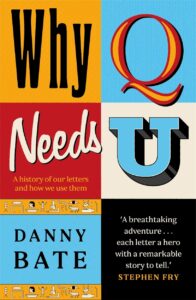
Look at the 26 shapes you’re reading right now. You learned them at four years old and never questioned them again — which is precisely how a good technology behaves, quietly, without ever asking for credit. But the alphabet isn’t a clean, logical system handed down by some ancient committee of engineers. It’s civilization’s junk drawer: Egyptian pictures, Greek modifications, Roman branding, Norman vandalism, and a few linguistic cables nobody dares throw away. Hiding inside your capital A is an upside-down ox. The tail on your Q is the last surviving scrap of a 4,000-year-old drawing of a monkey. And English spelling — the thing we tell our kids to just accept because it “makes no sense” — turns out to make far too much sense, in a dozen competing ways at once.
Linguist Danny Bate, author of Why Q Needs U: A History of Our Letters and How We Use Them, has spent years tracing these symbols back along their improbable family tree. Danny takes us to the alphabet’s birth around 1900 BC, when Semitic workers in Egypt did something radical: they took gorgeous, laborious hieroglyphs and stripped them down to one quick symbol per sound — the MP3 file of writing, less rich but infinitely easier to carry, copy, and pass along. From there he explains why letters stand frozen while the sounds behind them quietly drift, how a 15th-century London printing press fossilized our spelling, and why the silent K in “knee” was once said right out loud. He also makes an oddly comforting case that our messy alphabet, precisely because it fits no single accent perfectly, ends up serving all of us in its clunky, democratic way. Whether you’re coaching a kid through a stubborn silent E or just wondering why W is called “double U” when it plainly looks like two V’s, this conversation will change what you notice every time you pick up a pen — or a phone. Listen, learn, and enjoy!
Please Scroll Down for Featured Resources and Transcript!
Please note that some links on this page (books, movies, music, etc.) lead to affiliate programs for which The Jordan Harbinger Show receives compensation. It’s just one of the ways we keep the lights on around here. We appreciate your support!
- Sign up for Six-Minute Networking — our free networking and relationship development mini-course — at jordanharbinger.com/course!
- Subscribe to our once-a-week Wee Bit Wiser newsletter today and start filling your Wednesdays with wisdom!
- Do you even Reddit, bro? Join us at r/JordanHarbinger!
This Episode Is Sponsored By:
- Boll & Branch: 15% off first set of sheets: bollandbranch.com, code JORDAN
- Chime: Open an account in two minutes: chime.com/jhs
- Factor: 50% off first box: factormeals.com/jordan50off, code JORDAN50OFF
- Hims Weightloss: Get a personalized, affordable plan that gets you: hims.com/harbinger
Thanks, Danny Bate!
Click here to let Jordan know about your number one takeaway from this episode!
And if you want us to answer your questions on one of our upcoming weekly Feedback Friday episodes, drop us a line at friday@jordanharbinger.com.
Resources from This Episode:
- Why Q Needs U: A History of Our Letters and How We Use Them by Danny Bate | Amazon
- A Language I Love Is… | Podcast
- Danny L. Bate | Website
- History of the Alphabet | Wikipedia
- Cyrillic Script | Wikipedia
- Diacritic | Wikipedia
- Roman Square Capitals | Wikipedia
- Letter Case | Wikipedia
- Roman Cursive | Wikipedia
- Cursive | Wikipedia
- Neuralink | Wikipedia
- Phaedrus (Dialogue) | Wikipedia
- Plato, Phaedrus 275 (Theuth and Thamus on Writing) | Perseus Digital Library, Tufts University
- Quipu | Wikipedia
- Egyptian Hieroglyphs | Wikipedia
- Hieratic | Wikipedia
- Coptic Language | Wikipedia
- Acrophony | Wikipedia
- Abjad | Wikipedia
- Proto-Sinaitic Script | Wikipedia
- Niqqud | Wikipedia
- Phonemic Orthography | Wikipedia
- Phoenician Alphabet | Wikipedia
- Greek Alphabet | Wikipedia
- Cuneiform | Wikipedia
- Boustrophedon | Wikipedia
- Chinese Characters | Wikipedia
- Simplified Chinese Characters | Wikipedia
- The History of the Alphabet: Interview with Danny Bate | Words for Granted
- Wadi el-Hol Inscriptions | Wikipedia
- Johns Hopkins Researcher Finds Evidence of Earliest Known Alphabetic Writing | The Hub at Johns Hopkins University
- W | Wikipedia
- William Caxton | Wikipedia
- How the Printing Press Froze English Spelling in Time | Dictionary.com
- English-Language Spelling Reform | Wikipedia
- Duden | Wikipedia
- Qoph (the Letter Q as a Hieroglyphic Monkey) | Wikipedia
- Resh (the Letter R from the Semitic Word for Head) | Wikipedia
- Valerie Fridland | Why We Talk Funny and What Our Voices Reveal | The Jordan Harbinger Show
- Kashmir Hill | Is AI Manipulating Your Mental Health? | The Jordan Harbinger Show
1362: Danny Bate | Why English Spelling Is a Beautiful Mess
This transcript is yet untouched by human hands. Please proceed with caution as we sort through what the robots have given us. We appreciate your patience!
Jordan Harbinger: [00:00:00] Coming up next on The Jordan Harbinger Show.
Danny Bate: It's pretty certain based on the way that the image looks and also the name of the letter Qop, that it's basically the letter Q started out as a kind of hieroglyphic monkey or baboon. And the capital letter Q has its tail to this day, which I love.
Jordan Harbinger: Welcome to the show. I'm Jordan Harbinger. On The Jordan Harbinger Show, we decode the stories, secrets, and skills of the world's most fascinating people and turn their wisdom into practical advice that you can use to impact your own life and those around you. Our mission is to help you become a better informed, more critical thinker through long-form conversations with a variety of amazing folks, from spies to CEOs, athletes, authors, thinkers, and performers, even the occasional neuroscientist, drug trafficker, astronaut, or special operator.
And if you're new to the show or you want to tell your friends about the show, I suggest our episode starter packs. These are collections of some of our favorite episodes on topics like persuasion and negotiation, psychology, [00:01:00] geopolitics, disinformation, China, North Korea, crime and cults, and more, that'll help new listeners get a taste of everything we do here on the show.
Just visit jordanharbinger.com/start or search for us in your Spotify app to get started. Today on the show, the letter A may be an upside down ox head, the tail on Q may be the last surviving piece of a 4,000-year-old drawing of a monkey, and W is called double U, looks like a double V, and exists because generations of scribes just kept duct-taping new sounds onto an alphabet that was never actually designed for English.
So the alphabet is not a clean, logical system. It's more like civilization's junk drawer: ancient Egyptian pictures, Greek modifications, Roman branding, Norman vandalism, and a few linguistic USB cables nobody dares throw away. Today, linguist Danny Bate explains what these 26 symbols really are, why English spelling is such a disaster, and why fixing it might actually make everything worse.
This one is a great companion to the episode we did on accents a few weeks back. If you like this sort of nerdy language [00:02:00] stuff, we've got your number again today here with this episode. So here we go with Danny Bate. All right, so what are we looking at every day when we look at the alphabet? Because I guess learning it as an adult, you just fail to notice that these shapes are maybe anything but the alphabet, right?
Because when you're learning it when you're four years old, three years old, I don't know, you don't question any of this stuff. Is the alphabet a language? Is it a technology? Is it a collection of pictures? Or the, uh, just the wreckage of a bunch of other systems that have made it this far somehow?
Danny Bate: Yeah, it's very nicely put.
It's all of those things and none of them entirely as well. I think, first and foremost, I can't call the alphabet a language, for one reason being it's shared between multiple languages. You and I use English. We read and write in English, but you go across to, I don't know, across the border into Mexico, where Spanish is a dominant language, same alphabet.
So quite quickly, we unpick this tapestry of writing and [00:03:00] see it's a kind of technology that has been very successful, and consequently has been spread among sometimes very different languages of the world.
Jordan Harbinger: I remember learning a little bit about alphabets in general because when I went to Serbia, I had to learn Cyrillic, and I was like, "Why do they call it that?
And wow, some of these look like Greek characters. Oh, that's very obviously because of where it comes from." And then I thought, "Oh, okay, that's really cool. There's a lot of history here." For some reason, it never occurred to me that, what are we using, the Latin alphabet? Is that what we call it?
Danny Bate: Latin. Yeah, we
Jordan Harbinger: call it Latin.
It never really occurred to me to look into my own because I hadn't learned it fresh at age 22 or however old I was when I started learning Serbian and Russian and stuff like that. So I just find this stuff fascinating, but why should other people who are not dorks like me/you, sorry, why should they care beyond winning a pub trivia quiz or something like that?
Danny Bate: Well, I'm a very proud dork, so I'm very happy to, to fly the flag for dorks and dorkdom everywhere. But yes, I get it, and firstly, let me put my cards on the table. You don't [00:04:00] have to. You don't have to need this stuff. In fact, if the alphabet occupied our minds more often, if we really had to think about it, wouldn't be a good technology.
Wouldn't be good. The thing is the alphabet is the victim of its own success. It fits very easily and comfortably into our lives and our brains as well, and we wield it with great ease. I can't make the definitive case that everybody needs to go and study the full history of the alphabet, all 4,000 years of it.
No, leave that for dorks like me who like writing books about this stuff. But I would say that firstly it's a joy to reacquaint yourself with these symbols, where do they come from? Perhaps also to make connections to other languages, as you have already been doing yourself, Jordan. Because basically the alphabet that we know, as we know it, is part of a kind of big family tree of scripts that you can, among its branches, you can find Hebrew and Arabic writing there as well.
So that's useful if you're learning other languages and breaks down walls across the world to learn about these connections. But let's not go too [00:05:00] far from home. Let's stick with English. I think it does English readers, writers, and learners a great deal of help to realize that this system is not fixed.
It's very human. It's very historical, and if there are quirks and oddities that we may struggle with, there's a reason for that, and it's part of the history. So I think it can reassure English writers at home to learn about where these symbols come from.
Jordan Harbinger: I am getting way, way ahead of where I wanted to be right now, but I'm going to ask anyway.
How come when I read something in German, there'll be a letter that we don't use in the English alphabet? There's this thing that looks like a B, it's called an Eszett, and it's essentially two S's. Or you'll be reading something, someone will be like, "Oh, there's this word in Icelandic." And then they'll write it in Icelandic, and it's all these letters you're familiar with, and then some sort of weird B-looking thing.
And you're like, "So that's the Latin alphabet with an asterisk, because there's just this extra thing in there that you don't use." And Spanish has this too, right? There'll be, like, occasional words, also French, where there's two dots over this letter, the I or [00:06:00] the E, and you're like, "What is this nonsense?"
And it's like, "Ah, we don't really use that. It's in a few words that you see commonly, and a bunch that you would never use." But English doesn't have that. So even the Latin alphabet has, like, little asterisks next to it that's like, yeah, but it's not that everybody's using the same Latin characters.
There's this random thing in here from Germanic languages, or I don't know where they come from. But there's these other little symbols that we've just gotten rid of in English.
Danny Bate: Of course, yeah. Th- the borders of the Latin alphabet are kind of, uh, fuzzy.
Jordan Harbinger: Yeah.
Danny Bate: If you want to take it up another level, you could take it over to something like Vietnamese, where Vietnamese has taken it via French influence, has taken the Latin letters and seriously augmented them to be able to write down Vietnamese speech.
You've exactly hit the nail on the head, that we have a kind of definitive set of basic letters, unaugmented, unmodified letters, and these are the ones that basically the Romans would have recognized. One or two modifications that post-date the days of Caesar and Cicero. Things like [00:07:00] J they wouldn't have recognized.
W they wouldn't have recognized as well. Things like Y and Z would've been on the kind of borders of acceptability for someone like Cicero, because that's really a Greek letter, man. We just really, we need that for Greek words. But nonetheless, there's a kind of core. And English, written English, by a weird kind of accident of history, has preserved that core fairly faithfully.
That's not a kind of mark in its favor or something ag- to the detriment of English. English has just decided not to modify them, whereas other languages of Europe absolutely have. Some of these marks occurred very organically. They're like additional kind of medieval marks. Perhaps when you want to abbreviate something, you add a mark above it.
So abbreviating a double N to an N with a little line above it is where Spanish gets the eñe letter from. It's a kind of an original abbreviation. And then going further afield, you have the things like, as you very correctly say, in Icelandic, the letters thorn looks like a P and a B combined, [00:08:00] and eth looks like a curvy lowercase D with a line through it.
Icelandic, basically these ultimately, at least thorn comes from the world of runes. So arguably it's not too surprising that the Icelanders and the Vikings and the Norse, they've taken this from runic writing. But actually those letters more immediately come from English. They got these letters from Britain, but the British and British writers and languages have dropped them.
So basically what am I getting at here? There's a core kind of basic version of the alphabet that was really ruthlessly designed and pruned for Latin. And since then, languages that aren't Latin have had a free hand to just add to it.
Jordan Harbinger: I heard that the reason a lot of our Latin letters have a bunch of straight lines and things like that is because essentially the only way to write things was to chip them into stone and put them on the top of a building or something like that back in the day.
And so they just went, "Okay, we need some angular stuff that's really easy." And you see this even in other letters we don't use. There's a Polish city, and I don't [00:09:00] know how to pronounce this, but it's like Lodz or something, but the L has a line through it. And it's always a straight line. If you notice, there's very rarely are there curvy little fancy things outside of cursive in the Latin alphabet.
There's just a lot of straight lines. Is that because they had to chip things into stone and it doesn't work when you need to make a curve in stone? It's too hard?
Danny Bate: I am very happy not to disappoint your pre-internet self. That's exactly how it is. So the alphabet's really old. I should clarify, very importantly, the Romans didn't invent it.
They got it from the Greeks, who got it from somebody else, who got it from somebody else in a kind of big game of pass the parcel. Actually, pass the parcel's not really right to say, because it didn't go anywhere. The Greeks still use it to this day. But absolutely, the letters, when they arrive in ancient Italy, when Rome is a nobody, Rome is yet to emerge, it's just a collection of villages beside the River Tiber, roundabout the year, let's say, 700 BC, the letters are very angular.
They're very joined up. They're very limited in space. And [00:10:00] what we definitely see when the alphabet lands in the hands of the Romans and the Romans are able to shake off other powers in the region and really establish themselves, they establish their alphabet as well, we get what are straightforwardly called square capitals.
They are the capital letters that we would recognize today, and they're spacious and curvaceous, and they're absolutely designed for being written into grand public inscriptions. It looks like all caps to us today. I should stress that the Romans aren't shouting at each other. There are no lowercase letters yet at this point.
It's all capital letters. That came later, very subtly, very gradually, but I think safe to say the Romans just would not have recognized the difference between lower and uppercase letters. They're all the same letters, but crucially they're being used in different formats. So whereas you might use your very spacious grand square capitals for something like the Arch of Constantine beside the Colosseum, huge thing, big public inscription, needs to be read over a long distance to, to show off how [00:11:00] generous the emperor is and how victorious usually.
But in private correspondence, in little letters to be read between, I don't know, two, three people, you get more bunched up letters that are simpler, more joined up, more fluid, cursive in a word, and it's from these that the lowercase letters will eventually emerge. But yeah, I think y- your intuition did you credit because the medium of writing is going to affect the letters, not just what they're being used for, but what they're being written on and who they're being written for.
Jordan Harbinger: So that makes sense, and I was thinking about this the other day because my kids are learning lowercase, uppercase letters, right? They're in kindergarten and first- going into first grade. Or preschool and they're learning some of this in pre-K. And I think it was my mom, sorry mom, she listens to every episode, but her and her friends on Facebook were like, "Kids can't even do cursive anymore.
It's a shame. What are they learning?" And I'm like, I'm thinking to myself, this from the people who took 20 minutes to write this complaint on Facebook because they type with one finger and they have to look at the keyboard. [00:12:00] And I was thinking to myself, I should reply to this, but I don't want to start a fight with my mom's 80-year-old friends.
But the thing is, we don't use cursive because when is the last time you wrote something on paper and you're like, "Gosh, taking my pencil up off of the paper for each letter, it wastes so much time"? I think I wrote a Post-It note the other day that, to remind myself not to eat before a blood test, and I had to write fast and put it on the refrigerator so I don't slam a protein shake half asleep at 7:00 in the morning.
And I printed it. I didn't write cursive. I didn't write flowery language. I can afford to spend the extra half a second printing it instead of writing it in cursive. And I realized I don't use cursive anymore. And the reason they don't teach it anymore is because kids aren't really using pencils to write stuff that much anymore.
Sure, in school they do because they make errors, but adults, we type everything. In fact, like I said, the complaint was on Facebook where you cannot use cursive. So to your point, if you're no longer like, "Oh gosh, I've got to figure out a way to connect all these letters without taking my pen off the paper," [00:13:00] then you need cursive.
But if you're not doing that, then you literally don't even need that whole set of letters that we spent all this time learning. And it's funny because I know cursive in English and I know cursive in Cyrillic, and I was showing some friends from Russia that I could still write in cursive Cyrillic, and one of the younger guys was like, "I can't read that.
I haven't seen that for like 20 years. Wow. How do you know how to do..." It was like I might as well have been writing in Biblical Hebrew for this guy. He was blown away that I could do this, and I realized, wow, they don't bother with this either because why would you? You're using the internet. You're on your iPad or whatever.
So yeah, you're right. I'm wondering where else this is going to show up, like when we stop typing altogether and we're just dictating, are letters going to change again?
Danny Bate: Wow. Great question. I suppose ultimately if everything is then taken back into the medium of speech, if we speak, we dictate, this is encoded into writing, sent to somebody else, and that thing then speech speaks back to our recipient, then we've weirdly come full circle.
We've come back to a time where there's [00:14:00] only speech, which was, which is historically or prehistorically, that's been the norm for humans, is just speech for people who of course can indeed speak and hear.
Jordan Harbinger: In 100 years people will be like, "Can you believe my grandpa knew the alphabet just by heart? Didn't have to look at a reference or anything, just knew it, could write it with his hand.
He knew different types of letters." And people are like, "Wow, those old people really had it. They had some crazy skills." Because they're just dictating and everybody's talking. I don't know. That seems like a step backwards still.
Danny Bate: Yeah, it, it could happen, but of course it's always messy. I make a lot of predictions in my job as a kind of writer of nonfiction.
As soon as I make one, I feel like it's not going to happen. It's not going to come true by the act of saying it. But nonetheless, I would say that, yeah, it may well retreat, that perhaps with the technology, so long as the technology is there, that's always a big factor. Is it actually available? Is it all working?
Is the power on? That sort of thing. That yeah, writing could retreat because the technology allows it to be, to be speech only. I would only say that in general, [00:15:00] we humans, it's not a burden. We like writing. We like reading in general. It does come very naturally to us, even though I think historically speaking and also personally in our personal development in terms of that, writing does follow.
It postdates speech. We speak first as a species and also as individuals. So nonetheless, w- what I'm getting at there is really that I think writing will stick around. It could become some sort of prestige activity.
Jordan Harbinger: Mm-hmm. Like being a scribe.
Danny Bate: Yeah, exactly. In the same way that cursive is getting by on outdated prestige.
Like, it's not my place to define good or bad or usefulness in writing. It's my place just to describe what these uses could be. And cursive, arguably, it no longer i- is immediately a practicable way of writing, but I think it's kind of coasting on former glory in that it's very much a product of, like, the 19th century.
Everybody's writing letters. You want your letter to look as beautiful as possible, and so the system gets set up. That is a valid use. [00:16:00] But how much that is a use for us today is fading away and wow, all of writing in general? That's, uh... I've contemplated weirder things in this job.
Jordan Harbinger: I guess it would have to go to sort of a sci-fi level, right?
Because I'm thinking let's say in 100 years we're all hooked up to the equivalent of Neuralink, unless you're born in a rural developing country, you don't have it, right? But everybody pretty much gets this. It's how you're productive and how you connect to the modern world. It would be like not having running water, let's say, or electricity.
It would be the equivalent of that if you don't have one of these. At that point, there's no books that you're reading. Why would you do that when you can download all of the knowledge into your Neuralink and it encodes in a specific way in your brain? Why would you bother doing anything like that? And why would you bother reading anything?
If you can do that, why would you bother writing anything if you can just have your brain encode something in Neuralink and upload it to the database of knowledge and you go, "Hey, look, I figured out a better way to irrigate raspberries," and it's now in a whatever file on the whatever the equivalent of the [00:17:00] internet is.
No one has to read that. No one has to be able to then turn around and articulate that. You're just passing this along non-verbally using your brain internet thing. And this sounds ridiculous and totally sci-fi a million years from now, but it kind of isn't, right? Because we already have Neuralink, it's just brains are rejecting it and it requires brain surgery, which is not something people do casually.
That is all going to change
Danny Bate: Yes, absolutely, and that sense of it. I like this thought experiment or hypothetical situation because it does capture a way in which new technology will seem odd and strange and take some getting used to. I can't comment on current technology. Nobody wants that kind of comment from me.
What I could maybe hesitantly say is that once upon a time, writing as a rule, as a new activity, could have been strange and a little bit disquieting for people. Like this information, which is so important to me that I store and I speak and I control, you're taking it out of my mind and leaving it in some other medium, and that [00:18:00] medium will outlive my sentence.
It'll outlive maybe my current day and age. It might outlive me altogether. Some of our findings, of course, are impossibly old. They far outlived the people who originally wrote them, and speculating fruitlessly, I can't prove this, but it might have been quite odd to begin with. And we do see that perhaps closer in time, moving out to, say, antiquity of Europe and the Middle East and Africa and things like that.
We do see cultures encountering writing afresh closer to our modern day and age and thinking-- and being pretty weirded out by it, thinking this is quite an odd thing, and why do you do this?
Jordan Harbinger: Wasn't it Socrates or somebody along those lines that said, "Oh, writing, this is going to be bad for everybody because you're not going to have the knowledge in your brain so readily available if it's just in a book and you can forget about it"?
I could be butchering this, but do you know what I'm talking about? People back in the, like, ancient Greece were complaining that books were just going to ruin the youth.
Danny Bate: Sure. They were always complaining that something or other was [00:19:00] going to ruin the youth, usually Socrates, to be honest. That didn't work out too well for him.
But yeah, there are these reactions. There are cultures or bards, for example, incredible people from Iron Age societies encountering writing and they're being like, "This is precious knowledge that we store in our brains." That's a little bit hazy what's actually going on as, say, the Gauls are meeting the alphabet and Roman letters.
But much closer to our day and age, you have an extraordinarily impressive empire, which is the Incan Empire in South America. No writing system. It's almost stretching the length of South America, and the information storage system they had involved strings and knots, and it's all quite complicated. But something that represents speech they didn't have, and they are clearly, from our Spanish sources, pretty bemused by these books and documents and things, and they were getting on fine without it.
So to speculate about Neuralink and speculate about the future, things that might seem very uncomfortable for us today, it has historical [00:20:00] precedence.
Jordan Harbinger: English spelling isn't broken. It's been renovated by 40 different owners, none of whom checked the permits. Let's step outside while the inspector takes a bribe.
We'll be right back. This episode is sponsored in part by Boll & Branch. Summer sleep can get uncomfortable fast. You're flipping the pillow every 20 minutes, sticking one leg out from under the covers. You're blasting the AC until you wake up with a dry throat. But sometimes sleeping cooler is as simple as changing the sheets.
Boll & Branch makes lightweight breathable bedding designed to help you stay cool throughout the night. Their sheets are made from 100% organic cotton and woven specifically for airflow, so the cooling comes from the way the fabric is constructed, not synthetic fibers or chemical treatments. Their percale sheets have that crisp, cool hotel bed feeling the moment you climb in.
They don't cling, they don't trap heat, and they get softer with every wash. We use Boll & Branch on every bed in our house, and regular sheets just don't feel the same anymore.
Jen Harbinger: Sleep cooler this summer with Boll & Branch. Get 15% off your first order, plus free shipping at bollandbranch.com/jordan with code Jordan.
That's Boll & Branch, [00:21:00] B-O-L-L-A-N-D branch.com/jordan, code Jordan to unlock 15% off. Bollandbranch.com/jordan, code Jordan. Exclusions apply.
Jordan Harbinger: This episode is also sponsored by Chime. Here's something my younger self definitely could have used: a bank that didn't charge me money for the privilege of not having much money.
Most of us opened a bank account when we were teenagers, never really questioned whether it was still working for us. So I want to tell you about Chime. Chime is changing the way people bank. They're not like a traditional bank that piles on fees or save the best perks for people with massive balances.
Chime offers rewarding fee-free banking with no overdraft fees, no monthly fees, no minimum balance fees. You can earn 5% cashback with a Chime card in a category that you choose, like gas or groceries, while building credit through everyday spending with no credit check. You can also grow your money faster with a savings rate that's nine times the national average.
And if you're ever in a pinch, SpotMe lets you overdraft up to 200 bucks fee-free.
Jen Harbinger: Join the millions who are already banking fee-free with America's number one choice for banking. Head to chime.com/jhs. That's [00:22:00] chime.com/jhs. Sign up now. It only takes a few minutes.
Disclaimer: Chime is a fintech, not a bank. Banking services for MyPay and Chime Card provided by Chime's bank partners.
Optional products and services may have fees or charges. Stated annual percentage yield and cashback for Chime Prime only. No minimum balance required. Checking account ranking based on a J.D. Power survey published October 20th, 2025. For more information on APY rates, MyPay, SpotMe, and travel perks, go to chime.com/disclosures.
Jordan Harbinger: AI may eventually translate everyone's personal spelling and dialect automatically. At last, humanity will communicate perfectly through software owned by three companies and trained on Reddit. We'll be right back. It does seem bizarre to me that an advanced civilization was like, "I don't need to ever write anything down.
I don't need to transmit something I'm going to say over a long distance without just sending somebody to do it for me." That just seems so bizarre to anybody in our day and age that you could possibly get along with doing this. Meanwhile, you have tens of thousands or whatever of square, or millions, whatever, of square miles of territory, and it's like, "Nah, writing, who needs it?"
Ancient Egypt, take us back [00:23:00] 4,000 years ago, because hieroglyphics, this to me is bizarre. I always assumed that these were merely decorative and that they were ceremonial or poetic or something, but you didn't read them. But I learned later that they actually have sounds. It's basically just a really complicated alphabet that took forever to etch in and color.
Danny Bate: Yeah, that's fair. Hieroglyphs, back in the day of ancient Egypt, existed on a kind of spectrum. So you absolutely had the hieroglyphs that were members of the system that were art. They were high art. They were fit for inscribing on the walls of the pharaoh's tomb and on pharaoh's monuments, and they are clearly meant to be beautiful.
But nonetheless, they do exist as part of a system and on one end of a spectrum of writing down of language. And at the other end of that spectrum, we have very humble kinds of hieroglyphs that are still really the same symbols, but the way that they're being used, the way that they're being written, is intended for quick [00:24:00] comprehension and easy scribbling.
The first of these is called hieratic. Later, this develops into something called demotic, which is, like, the last stage of developmental stage of hieroglyphs before it gives way to Greek letters and writing down Coptic. It's all writing down one particular spoken language, which is Egyptian. Very handily, we call it the Egyptian language.
But the thing is, hieroglyphs are extremely old. Forget about those two kind of developments that I mentioned. In their basic system of looking like things, little pictograms, this is a system that goes back from our day and age maybe 5,000 years. I think I hesitantly date it to about 1,000 years before our alphabet is born as an offshoot.
It's a very radical offshoot. Or for all those thousand years beforehand, hieroglyphs are being used to transmit information in the Egyptian language. It's complicated, though. Some In this system, let's say by the year 2000 BC, [00:25:00] some are absolutely still representing objects and things, the things that they happen to look like.
But through a kind of game of association, some of those symbols are now standing not for the object or for the word that that object is known by, but rather a sound or two sounds or three sounds in that word. And once you've got a symbol associated with a sound, you can use it for other words that contain that sound, and you can also use hieroglyphs as a sort of marker of category.
You put a little figure of a man or a woman or a god next to the name of a man or woman or a god or something like that. These are called determinatives. And you get a system Which absolutely, in its highest, most elevated, most artistic form, it's very complicated, and it is absolutely preserves, or the preserve of professionals to write this down.
But lower down in Egyptian society, absolutely, people are using these symbols and writing down speech.
Jordan Harbinger: So you might have a crate of, I don't know, [00:26:00] clay pots, and you're like, "Oh, okay, I've got to put a bird, a cat, a guy wearing a big hat, and an ankh on here. This is going to take a while. Let me get my intern to handle this."
I m- because it seems like you a- you have to have artistic talent to do that, right? Whereas I don't need artistic talent to have pretty messy but still legible handwriting.
Danny Bate: Exactly that, and that's what we see. I, I mentioned those sort of developments, the later developments, hieratic, demotic. They are not artistic.
I don't want to call them scribbles. They're still quite nice to read, but they're absolutely m- something much more recognizably ... They're an alphabet. They're an alphabet of abstract symbols. They don't look like things, to be honest, by this point in time. They look like symbols which you know how to read.
And yeah, it's something that could spread through the population at large, and did indeed spread through the population. But absolutely, the symbols that people would be much more familiar with, you might leave that to your main scribe or one of many interns. It was a profession back in those days.
Jordan Harbinger: Right, writing and probably also reading most, most things that weren't super simple.
[00:27:00] Who invented hieroglyphics? Do we even know, or is that just lost to the sands of time?
Danny Bate: Ooh, very nicely put.
Jordan Harbinger: Oh, yeah, a cool pun in there. No big deal.
Danny Bate: I, I do appreciate that. Sands of time, very nice, very appropriate. And of course, the earliest stuff comes from the sands of Egypt. Egypt is not just actually important, it is also important because its climate preserves lots of things for us, which is really helpful for doing the business of history and archeology.
I can't really put it any more clearly or precisely than the Egyptians, which is a bit disappointing.
Jordan Harbinger: Yeah. That's a dead language too, right? Because they speak Arabic there, last I checked.
Danny Bate: Exactly. It's a dead language, or perhaps you might say it's a, here's a niche bit of jargon for you, it's a sacralized language, that it's not commonly spoken.
You will absolutely not hear it on the streets of Egypt. But the final form of the Egyptian language, which we call Coptic, which is, comes from Aegyptos, Coptic, it's a Copt. These are Egyptian Christians, and they still use it as their language of religion. But they'll use it in, say, a [00:28:00] church service, but they won't turn, then turn to each other and speak Coptic.
No, they'll probably speak Arabic instead.
Jordan Harbinger: So it's, it's the Latin of the Middle Eastern Christian, Coptic Christians, I guess?
Danny Bate: Yeah, the Latin of Egypt- Yeah ... if you like. Although, I, I'm sure Egyptians would call Latin the Coptic of
Jordan Harbinger: Europe. That's fine. I'm just trying to give people something, because pe- most people are like, "I've never heard of this, but I've heard of Coptic Christians maybe."
Yeah, so it's just some- it's like Chaldean. Do you know Chaldean? Does that ring any bells?
Danny Bate: It absolutely rings a bell, yes.
Jordan Harbinger: Most people don't know what this is, but I'm from Michigan, so I know what this is. And correct me if I'm wrong, but they're basically, they're Christian Iraqis That for some reason we just have a ton of them in Michigan, and they tend to run things like gyms and convenience stores and small businesses.
Very successful. But they have their own language. I just can't remember if it's only used in church services also and they speak Arabic. I actually don't know the answer to that now that I think about it. Do you?
Danny Bate: I do believe that is the case because Arabic is the default language or the lingua franca of Iraq.
Maybe not in the northern regions where you get Kurdish, but yeah, sure. It's ... I think it has retreated. It's [00:29:00] been sacralized again.
Jordan Harbinger: Sacralized, yes. Okay, so a picture that comes from the word sacrament or something similar root of the word sacrament, I assume.
Danny Bate: Absolutely.
Jordan Harbinger: So I want to go back to the symbols having, being like an object, but really we're using them for the sounds of the name of that object.
Is an ex- example of this, I'm trying to wrap my head around this. A picture of an ox stops meaning ox and starts meaning ah or something like that because you're just showing an ox. It doesn't mean there's an ox there. It just means I want the ah sound in whatever language, so I draw an ox on the wall.
Danny Bate: That is the beginning of the alphabet. That's the way it all gets started, to be honest. It's all about taking symbols and assigning them to sounds in a way that just wasn't done before. To be clear, this is part of hieroglyphs. I did mention already that a hieroglyph could stand for one sound, two sound, three sound, specifically a consonant sound.
This, I appreciate, but there's a little bit of unlearning you have to do. I'm talking about phonetics, the production of sounds. You can have consonant sounds and vowel sounds, and these are the basis for [00:30:00] consonant and vowel letters. Vowel sounds, uninterrupted airstream, very loud sounds, A, E, O. Consonant sounds tend to be quieter.
They're restricting or impeding the airflow in more ways, like P and T, stopping the airflow. And to begin with, in Egyptian writing and also in the early alphabet, it's all consonants. It was all about Allocating a single consonant to a particular symbol in this new system. For various reasons, one reason being that you could just do without the vowel symbols.
So you just didn't need them. You knew what the words were from speech. Maybe your language actually had quite few vowel symbols, sorry, vowel sounds, and you could just do without them. This is the true, this is the case of Egyptian writing, and it's absolutely true of the alphabet's original inventors.
And these are people, again, their identity is fairly mysterious, but we can know it linguistically, at least, who they were. It's a group of people speaking a Semitic [00:31:00] dialect. People may know Semitic, the word, obviously a negative term, antisemitic, but it also is used in Semitic to refer to a group of languages.
It includes Arabic, Hebrew, Amharic, great languages like those. And there's clearly, way, way back, long before Arabic and Hebrew are fully a thing, there's a kind of dialect of Semitic being spoken in ancient Egypt, and these are the people who get our alphabet up and running. They are clearly embedded into Egyptian society.
They are clearly getting along just fine as a population of immigrants. But nonetheless, in terms of writing, they want their own system, and they take existing Egyptian symbols, hieroglyphs, that already exist in the medium of writing, but radically overhaul them, taking about 30 and pairing them up with a single consonant of their spoken language.
So you give the example of the ox's head. The word for ox in their language starts with, like, a glottal stop in your larynx. It's an alp. That's the word. And now, a picture of an alp [00:32:00] is standing for the sound. And an alp, you've ... This all sounds, may sound very strange. This may sound like ancient and irrelevant prehistory, but you already know this word because this becomes the name of the new letter for that sound.
They called it alp. The ancient Greeks, they receive this letter, they call it something like alpa. Later Greek, alpha. It's still there in alphabet. You know this ancient Semitic word for an ox and also a house. Alphabet, it's a house. And when you have that radical redesign of hieroglyphs, one symbol for one Semitic consonant, hey presto, we have an alphabet.
Jordan Harbinger: Yeah, I noticed that the alphabet in Hebrew is called the aleph bet, and I meant to ask you about that because that's clearly not a coincidence. It just means AB in, in Hebrew.
Danny Bate: It would be as strange as us calling our alphabet AB, or we might call it ABCD for longer. As you may know as well, in the Cyrillic world, you have the azbuka.
Azbuka, two words, two names put [00:33:00] together, alphabet.
Jordan Harbinger: Yeah, I forgot about that one, actually. And it's interesting that the ... You mentioned before you have this picture of the whole ox, or you have the whole cat, or you have the whole, I don't know, man. You have to get rid of the complexity of those. Otherwise, it's going to be so tedious and cumbersome to use.
Hebrew has a little bit of that too, right? Because if you write Hebrew really well, you don't have to use the little dots that go over all of the characters and that go in and under them because you already know that it says b'vakasha, which means please or something like that, right? You already know that.
But if you don't know that and you're just learning it and you're in your, like, class in Israel or in your Hebrew school, Sunday school, whatever, without the dots you're just looking at this word that you basically have to know what it is. It's like Chinese, where you just, you have this symbol and if you don't know what it is you can't pronounce it or say it.
I assume Egyptian was the same way. "Oh, crap, I've got man, ox, cat, ankh." I forget how you say that. And if you don't know the word, you're just out of luck.
Danny Bate: Yeah, it's hard. And I've heard these kind of additional systems like the dots, the Hebrew niqqud, [00:34:00] I've heard them lovingly referred to as the stabilizers or the training wheels of the script.
And the thing is, when you have a script, a writing system, there are many in the world, but many belong to this family tree that our own alphabet belongs to as well. Many of them don't encode all the sounds of the spoken word. They just don't. The sounds are missing, such as the vowels. And this system is absolutely viable.
It completely works, but it relies on the writer and reader knowing a lot of the spoken words already. When you're born into this language, if you're an infant and you're hearing a lot of Hebrew, you're hearing a lot of Arabic, you've got a massive heads-up over, let's say, take myself, 20-something-year-old native English speaker coming to Hebrew and Arabic afresh.
I haven't heard that many words, so it's going to be hard.
Jordan Harbinger: Yeah, it's a huge pain. It almost sounds like the alphabet is a compression technology. Since this is already a nerdy episode, I'm going to lean into it. The alphabet is, it's like an MP3 file of writing. It's less rich, [00:35:00] you lose some stuff, but some of the stuff you arguably can't really hear unless you're listening to high fidelity.
But it's so much easier to learn and reproduce and distribute and put on the internet and move it around and carry it in a little pocket device. Look, yes, the ox looks nicer. The ankh looks nicer when it's got the colors in it, the bird and the guy. This looks great. I can't be fussing with that. I've got to put that on 100 egg crates tomorrow.
So what is the easiest, most basic version where this is still legible? That seems like what the alphabet is.
Danny Bate: I love that. Exactly, and you're putting yourself directly into the heads of the people who are taking the parcel and passing it on. Let's kind of give the alphabet a birthdate, 1900 BC-ish, and Egypt as its birthplace.
And in the subsequent centuries, as the alphabet is leaving Egypt and being adopted by more and more people in what we know as the Middle East, and eventually will make its way to Greece, we see exactly what you describe. In a few centuries, the [00:36:00] symbols lose their complexity. The letter O, to begin with, is an eye.
It's a pictographic human eye, and it has, like, eyelashes, and it has the edges of the iris, and it has a pupil in the middle as well, because it stands for the first sound of the Semitic word for the eye, which is, the word is ayin. It begins with a sound that I can't replicate very well. A kind of hayin.
Jordan Harbinger: Oh. That's like Arabic, I think. Ayun is eye, right?
Danny Bate: It's Arabic, yeah. It's still there- Yeah ... to this day. And the, this is the joy of the alphabetic history. You just meet words which are just regular Arabic and Hebrew words to this day. But very quickly, we see that simplification taking place. If we wind the clock forward to, let's say, the year 1000 BC- And we reach kind of landmark people in the history of the alphabet who are the Phoenicians based in Lebanon, very impressive ancient civilization.
Their version of this system, still the same system. They've made not many modifications to it, but [00:37:00] clearly within the space of around 900 years, this is an alphabet as we would recognize it. The letters are abstract. They're brief to write. The old ox's head that will become our A has by this point in time just become three lines.
It's very quick to write. I love that metaphor of a compression file because that's exactly what it is. There are so many elements of the alphabet where it's all about maximum communication with minimum effort.
Jordan Harbinger: It seems like the alphabet wins and travels around the world, or parts of the world anyway, because it throws away enough information that it's still really useful, but it's way faster.
I mean, there's a reason that hieroglyphics exist in Egypt and we don't see them in Germany, even in Greece. It's like, man, look, if we're going to tote this stuff around the world with merchant trade, which why, is why I assume it went to Greece and then spread out from there, we can't spend all of our time coloring in birds and whatnot.
Danny Bate: No, exactly. Which may, [00:38:00] emphasis on the may, explain its success as a script and its longevity as well, where it's triumphed and, and, uh, taken the place of other ancient writing systems. Massive proviso on that, some of the writing systems it replaced are very impressive and clearly were very successful in their day and age, but ultimately have given way to this new family tree of writing that, that comes from that single source in Egypt.
The big one, hieroglyphs. Hieroglyphs have basically faded away. They've now been replaced by the Arabic script, which is a member of this family tree, a distant cousin of the, uh, Latin script, but also say cuneiform. People who love the ancient world may be familiar with cuneiform. It's like wedges pressed into clay.
Very sophisticated script.
Jordan Harbinger: My son asked me about this because he's like, "What was the first writing?" And I had to look it up. I was like, "I think it's Sumer or something, but I forget what it was called." And yeah, I think we called it cuneiform, but you're right, cuneiform sounds very fancy. And yeah, it was like [00:39:00] these little half moons of clay that they placed and pressed into things, right?
Danny Bate: Exactly, yeah It's this alternative writing system. It has its origins in what is today Iraq, and it is super successful. I really need to stress that. But I think its success and its, uh, utility for people back then over thousands of years, well, actually more hundreds of years, I think it's 2,000, it's dependent on experts, on a widespread group of people who know this system, who are very adept at this system.
They're professional. They're probably paid to be the local scribe. You have a, a message for your brother or your sister in a faraway land. You go to your local scribe. You tell him, probably him, the message. He writes it down. It gets sent off to a fellow scribe who can decipher it and relay the message.
And if you have some sort of upset in your local kingdom and the scribal class is not being replenished, if this [00:40:00] is becoming archaic, non-self-replicating knowledge, then your writing system is going to suffer. Whereas our alphabet, what we call phonemic, it's based on the sounds of your language, which arguably everybody has much better access to, I would put money on it doing much better.
And so far, history has borne that out.
Jordan Harbinger: W is called double U, shaped like two Vs and descended from people desperately improvising a symbol English didn't even have. So basically, W's the Cybertruck of letters. We'll be right back. This episode is sponsored in part by Factor. The question, what are we having for dinner?
It sounds minor until you had to answer it every day for years. And it's not just dinner. It's feeding yourself between meetings, making sure the kids have something decent, and worrying about whether your elderly parents are eating well. That's where Factor has been incredibly useful for our family. My elderly parents, they don't cook.
I know, sorry, elderly. They're in their 80s. That's fair. They don't cook, so having a few healthy, fully prepared meals in their fridge each week has been a great option for them and kind of a huge relief for us. The [00:41:00] meals are designed by dieticians, crafted by chefs, and delivered right to the door. You just open the fridge, you choose one, it's ready in two minutes.
And unlike the old school TV dinners that you are probably picturing, Factor meals actually taste fresh and delicious, like smoky Gouda chicken and ginger teriyaki salmon. Those are a couple of my favorites. Factor has options built around different goals, whether that's more protein, overall nutrition, weight loss, or GLP-1 support.
I like the protein-forward meals. They easily fit into my workout routine. And with more than 100 rotating choices each week, it never feels repetitive. Factor saves us time, but just as importantly, it takes a lot of the mental load out of feeding ourselves and the people we care about.
Jen Harbinger: Head to factormeals.com/jordan50off and use code jordan50off to get 50% off and free daily greens per box with new subscription only while supplies last until September 27, 2026.
See website for more details.
Jordan Harbinger: This episode is also sponsored by Hims Weight Loss. If weight loss has felt like a cycle of starting strong, losing momentum, and wondering why nothing seems to stick, you are definitely not alone. The hard part is usually not knowing what to do. It's finding an approach you can realistically keep [00:42:00] doing.
Weight Loss by Hims offers access to affordable FDA-approved GLP-1 medications, including Wegovy pill and Wegovy pen for people who qualify. And when combined with diet and exercise, Wegovy can help people lose up to 20% of their body weight by helping regulate appetite, eat less, keep the weight off. The process all happens online.
You'll connect with a licensed provider who determines whether treatment is right for you. If prescribed, your medication is delivered to your door, no insurance necessary. You also get 24/7 messaging with your care team and in-app support, including meal plans, recipes, fitness videos, and sleep content. The plan is personalized to you with dosage changes available as needed.
Jen Harbinger: Ready to reach your goals? Visit hims.com/harbinger to get a personalized, affordable plan that gets you. That's H-I-M-S .com/harbinger, hims.com/harbinger. Weight Loss by Hims is not available in all 50 states. Wegovy is the registered trademark of Novo Nordisk A S. To get started and learn more, including important safety information, Wegovy clinical study information, and restrictions, visit hims.com.
Jordan Harbinger: Want to let you in a [00:43:00] little inside baseball. Many people don't actually know when you use our promo code, it helps support the show. I've said that before. But we don't get a cut of the sale. It just lets the company know that people are hearing the ad and they are more likely to renew their ad campaigns with us.
So if you're signing up, please use the code jordan. It's a win-win. You get the discount and you help keep the show going strong. Thank you for your support. Now back to Danny Bate. I'm learning Chinese, right? And so I was curious how they came up with some of these characters. And there's traditional Chinese, which is super complicated graphics writing, and then there's simplified Chinese where basically Mao and the communists were like, "Hey man, we want a bunch of farmers to learn.
We need tens of millions, hundreds of millions of people to learn this. We can't be adding all these extra lines in here. We've got to make this as fast as possible." So they simplified it. It's actually quite nice. But the old, really old Chinese that you see on, not even just classical Chinese, but even before that, it's very curvy and it's carved into wood or something like that.
Some of those are pictographs, right? So it's like [00:44:00] hand and it looks a little bit like a hand drawing at a basic level You mentioned before that our alphabet has some of that. So the letter A is an ox's head? Did I imagine you saying that and that's not right?
Danny Bate: Absolutely to begin with. It has the same origin, yeah.
And which seems very intuitive that our earliest ways of writing down language actually doesn't necessarily need to involve speech at all. We just write down the thing that looks like a thing in the world. This very kind of obvious or natural step for us humans to have taken, where we depict the thing itself on the wall of our cave or our tomb, whatever it happens to be, this is a very natural step to have taken.
It does make it quite hard to talk about when writing actually first started. If you're just depicting stuff, firstly from our perspective, is this communicative or is this artistic, what you're doing here? Do we call those gorgeous cave paintings from Neolithic France, the ones with the hand paintings and the bison and [00:45:00] things like that, is this writing?
Arguably not, but it's quite hard to say. And it is difficult when we have these ancient writing systems, not just Chinese or very early hieroglyphs, to talk about actually when do we have writing up and running? Because very often it's just counting things, it's tallies of objects, it's images of the object itself.
Arguably, we experts, using that term loosely, we might prefer to call that proto-writing or pre-writing or something like that. We love throwing around the word proto, it's great.
Jordan Harbinger: Yeah, it sounds
Danny Bate: fancy. But it's complicated.
Jordan Harbinger: You guys love that.
Danny Bate: I'm fully guilty of this, but I just want to say that I do appreciate the mention of Chinese writing.
This entirely separate tradition of writing. It has no connection to anything that I've mentioned so far, and it is kind of the counterexample or the objection to things that I've said. This phonemic system based, comes out of Egypt, super important, so many languages are written down by it today. I might make a claim it was always going to be [00:46:00] successful because it writes down sounds.
But here's Chinese writing, where the phonetic component is secondary. It's about meaning and objects and things. So it's a clear counterexample, and I would hesitantly connect that to the success of China and to the success of the Chinese state in people buying into this alternative way of writing. But I'm speculating here.
Jordan Harbinger: I think it had to be like that, because you mentioned the phonetic element, and I'm not an expert here, but you can look at a Chinese character and if you don't know what it is, you can't sound it out. It's not possible. You can't look at it and go, "Oh, okay, this is a man symbol and this is a woman symbol, so it must sound like this."
That's not how it works at all. In fact, if you take the man symbol and the woman symbol and you put them together, it's the symbol for good So it just doesn't mean anything. And you can add like a fire to the bottom of something, and sure, if it's cooking or heat, that's obvious. But you could add water to something and it just, it doesn't necessarily mean anything sometimes.
It's just that's what the symbol is. And maybe it did a thousand years ago. Maybe they [00:47:00] called this something else and it was like that, but I don't know. I, so if I'm trying to see an ox head in a modern capital A, it seems like it should be upside down, because the horns would be the other way. It is
Danny Bate: upside down.
Jordan Harbinger: So the A that we use is actually upside down.
Danny Bate: Yeah, exactly. Uh, because, you know, by the time, as I said, fast-forward a few centuries from when it is clearly an ox's head, and we do have plenty of examples of evidence o- of this. But fast-forward to the Phoenicians or the Greeks, people have forgotten this, or people, it doesn't matter to them that it was originally a thing, an object in the world.
So actually, the letters are very fluid, and we see this the way that the letters are placed on your instrument of writing, whatever it happens to be, the way that they're oriented, the way that they flow across the page. We get right to left to right. We even get this glorious direction of writing called boustrophedon, where writing goes in one direction, let's say left to right, reaches the end of the line, and then immediately drops down.
Rather than going back to where it began, it drops down immediately and then [00:48:00] goes in the opposite direction.
Jordan Harbinger: Wait, so you write left to right, then right to left, then left to right, then right to- Yeah. That is such a pain.
Danny Bate: Well, why not? One thing you save is your pen doesn't need to move as far back. You just drop
Jordan Harbinger: down immediately.
Oh, saving so much time. Yeah, I mean- Yeah,
Danny Bate: okay, fine ...
Jordan Harbinger: I don't know. But then you have to know to switch directions. But then everybody just did. I don't know. Whatever. That's weird to me.
Danny Bate: They did, yeah. It's an alternative way.
Jordan Harbinger: That I suppose we still have some stuff. Like, a- again, in Chinese, they don't space the words out, so you just read a, a really long Chinese sentence, and if you don't know what the words are and where they begin and end, it could just be anything.
But then again, that's the story with Chinese in general. And then they used to write it up and down, right? Not left to right. I don't know when they changed that, but it was just like, "Hey, let's make this even more complicated by writing it up and down." But yeah, if you don't know where the words begin and end, because a word might be one symbol, two symbols, three symbols, could even be, like, five if you're talking about China Airlines.
That's maybe four or five symbols. I'd have f- or even six. Sure. You just have to know that that's a unit. That's what it means, because if you don't... And when I read Chinese with [00:49:00] my teacher, sometimes I mistake where the word ends and I'll say something else, and she's like, "Oh, no, no, no, that word ends there, and it's this."
And it's like, "Oh yeah, that's really obvious now that you mention it, native speaker." So this kind of thing, it just all seems so arbitrary. Now most writing is left to right, including Chinese, unless you're talking about, what, Arabic and Hebrew? Are those the only ones that go the other way?
Danny Bate: Ooh, now you're testing me there.
There are other ones in the neighborhood. You have something like Syriac writing. That's going in a direction. Most of the scripts of India go from left to right, so that's another one. I'm trying to think off the top of my head. There's a lot of different writing systems in the world. But yeah, I think as a planet now, we have more or less settled on left to right.
Jordan Harbinger: I appreciate the right to left because I'm left-handed and I was, I spent my entire youth with pencil covering my entire hand and forearm. So I'm like, oh man, if I, if Arabic were my native language, I just wouldn't have had this problem at all.
Danny Bate: There you go.
Jordan Harbinger: I guess nobody has to worry about that anymore because nobody's writing with a pencil.
But man, [00:50:00] how much of this origin story is firm evidence and how much is reconstruction and we're just placing a really neat story over something that's not quite as cut and dry?
Danny Bate: A very fair question, one that I am happy to answer, and it's never a question that I shy away from. In my writing, in my book, for example, I very much invite the reader into this active debate.
So my answer to your question would be, it's a pretty solid story based on not much evidence.
Jordan Harbinger: Yeah. You don't know who invented it. You don't know what they did. You don't know what their motivations were. And it's like, oh, this is a compelling narrative. Really easier for that to harden into a false certainty because it sounds good and is easy to teach.
Danny Bate: Of course, yes.
Jordan Harbinger: Not that you're doing that, but some people might.
Danny Bate: No, thank you. I appreciate that, and it could be done. I would say, though, the people who are really at the coal face of this subject, though, they know full well how this is, it's a story in flux, and it's a matter of the best theory that we've got, but also a matter of the other theories just don't stack [00:51:00] up.
So let's say something outlandish, the alphabet came from Mars. That is a theory. It's just not as good as the one that says the alphabet came from ancient Egypt, because we have a bunch of evidence that shows its slow development.
Jordan Harbinger: Those poor ancient Egyptians, man, everybody's like, "Aliens built the pyramids.
Aliens built the alphabet." And they're like, "Guys, we are smart, too. Give us some freaking credit here."
Danny Bate: The Egyptians were extremely smart. So yeah, I don't buy into any of that.
Jordan Harbinger: Those people couldn't have done this. Nah, it's got to be aliens, bro.
Danny Bate: It's
I'm doing the hand gesture already.
It's just
Jordan Harbinger: aliens, man. But- Aliens, man
Danny Bate: But I would absolutely say that it is kind of in flux. It is helped by the fact that, yeah, okay, in the absolute earliest origins of the alphabet where we clearly have the first few generations of alphabetic pioneers, we don't have much. Our sources are in the decades rather than the hundreds.
It's scraps of fragments of things. We have a lot of inscriptions that come from the Sinai Peninsula, where it seems this, these kind of innovators were working, [00:52:00] mining, actually mining for minerals. But as the years go by, our sources expand. So by the time you reach the Phoenicians, the kind of next important leg in the journey, we've got loads of Phoenician writing.
And by the time we reach the Greeks, early, let's say, Hebrew writing, early Arabic writing, or let's call it Arabian writing, we've got way more. So it's not as if it is a very thin thread that we're desperately trying to kind of knot up and secure. But I'll give you a great example of this. I will admit, writing about the absolute earliest history of the alphabet, which I did in chapter A, not chapter one, but chapter A of my book, was daunting.
It's a big field. No one can agree on anything, and I have to make this accurate, true, and accessible, and entertaining to my reader because I write for a general audience. And I really struggle and sweat over getting everything right. I send it off to an expert friend of mine who says, "This is good. This is good to go."
And I kid you not, two weeks later, I get one of those Google alerts That says [00:53:00] something like a, a scientific magazine that says, "Find that upsets early alphabetic history discovered in Syria." And it's an absolute gut punch. I've been running home
Jordan Harbinger: Like, "I just turned in my manuscript. Come on."
Danny Bate: Exactly.
Basically on a count- stop press, everything's wrong. It was bothers to me because it mattered to me enormously that the right information needed to be correct. I am pleased, very pleased, purely because of the horse I have in this race, that it did not turn out to be such a stick of dynamite in the end.
As the, the author of a book, yes, it was a gut punch. It was very concerning that I might have said something wrong. But I will say, as a scholar, as somebody who just loves this, let's say the alphabet turns out to have been designed in Syria rather than Egypt, great. That's just great. That's brilliant.
That's the story in flux.
Jordan Harbinger: There, it's funny. You should try being a podcaster. Apparently none of us care if w- if anything we say is accurate. According to my inbox, we just don't try at all. I'd like to think we're a little different, but I can't speak for all podcasters. You know, it's funny. I was thinking of something.
You mentioned the Greeks. [00:54:00] When you say something was invented in China, you think, "Wow, was it 2,000 years ago? Is it ancient? Is it modern? Is it a drone?" When you say something was invented in Greece, you know it's ancient Greece. Nobody thinks you mean something was invented in Greece in 2008. Sorry, Greeks, your food is amazing.
Your people are lovely. The country is beautiful. But yeah, nobody is talking about things invented in Greece, and they mean anything that's less than 2,000 years old or so. I just noticed that as you were talking. I should probably change the subject. I'm just getting myself in trouble.
Danny Bate: No comment. I love the Greeks.
I love Greece. They're a passionate people. Why wouldn't they be? And I'm going to leave it at that.
Jordan Harbinger: Yeah, exactly. It just, it seems like every alphabet begins its life as this weird, badly fitted hand-me-down, and it just changes as it goes. I want to talk about some specific letters because I know, I don't know if we have unlimited time here, but I've got all kinds of questions about why things are the way they are.
Like W for [00:55:00] example. Okay, what the heck? Germanic names and words, when you say W in German it's ve, okay? And but we already have ve in English, but in German the V is fe. But you also have F. Anyway, that, and now I'm just complaining about German, but is it double U? Because it looks like double V, and in German it's called double V by the way, which is strange because it's not actually called V in German.
I don't, the whole thing is annoyingly confusing. But I don't really understand why English calls W double U even though it actually resembles two Vs, and in German that's what they call it, double V. What's going on here?
Danny Bate: What's going on here is the natural flow of language and history, which is a wishy-washy answer- Yeah
I will give you- You
Jordan Harbinger: better do better than that.
Danny Bate: All right. Okay. I, I promise I will. But what I mean by that is, I think, a interesting and perhaps also comforting rule in the study of language is that when you go further back in time, things that are more separate today look [00:56:00] more similar. So as a general rule, let's go wind back the clock to the earliest period of the German language, or the period we know as Old High German.
Looks a lot like English or Old English at the time. The words are much closer to each other in the two languages, and they're using fundamentally the same letters as one another because they've just got these letters from the Romans. They've taken them usually along with the package deal of Christianity and Latin in church and said, "Thanks very much."
So what's basically happened, like a kind of river or like a river delta spreading out and flowing out, things divide, things multiply, and things get more complicated over time. And sounds which are caught up in the alphabet, or arguably letters and are caught up in sounds, sounds change. Sounds very naturally change in a way that could happen in one spoken language but doesn't happen in another spoken language, and they'll naturally diverge.
From this we get accents originally, initially, then we get dialects, and then eventually we get full-blown [00:57:00] languages, and this is a very natural process. So let's take your concerns about the German language. I get it. I hear you. Because understandably, you're taking the German language as it is today. But if we are to wind back the clock, we've got all sorts of evidence that allow us to say that a W is once a w.
It's a w to begin with. It's a double U because that is a sound of their language, and they need a letter for it. Latin has given them a kind of V letter. It's a V That they can use for V and a W they can use for W. But then there's two sounds behind those two letters that go and change, as keeps happening over and over again.
The W becomes a V sound, W to V, very common sound change. It happened in the history of Latin. It happened in the history of German as well. It just hasn't happened in the history of English. And the V sound, the V, then becomes a F, just as the S becomes a Z sound in German. You say Zee rather than See. So very natural sound [00:58:00] changes going on behind an alphabet and letters that aren't being updated, that can just stand still through all of this.
It's happening in German, but it's not happening in its cousin English. Hence, you get two languages that increasingly look quite different That's a lot of information, a lot of concepts, but the takeaway points are letters don't often change, sounds really do.
Jordan Harbinger: Yeah, but what you're telling me, at this point, the English alphabet, it reminds me of, I have a drawer in my kitchen that has a iPhone charger.
It's got a USB-C. There's a USB-C to USB-A cable. There's a micro USB to USB-A cable. It's got all these chargers from my random Chinese toys that my kids get, AC adapters. That's the English alphabet to me. It's this drawer in my kitchen where once a year I go through it and I go, "Do we even own the thing that this goes to?
Can we replace this with a USB-C? Does this even plug in and then go to the other thing, and why does it have two plastic connectors?" That's what I'm dealing with in my kitchen, and that's what this [00:59:00] alphabet now looks like to me. It's a junk drawer that you just go, "Why is this like that? If you want to know, I've got half an hour and I'll tell you, but otherwise just accept it. Just use it until it falls apart." That's what we're dealing with.
Danny Bate: Jordan, you, you have a gift for metaphors- ... I have to say. Yeah, that's absolutely glorious, and I would hope that in that drawer as well, at least in mine, there's money, money that's not in circulation anymore. Like, I have a bag of Croatian kuna- That's right
which is useless now because they took the euro. I would argue that maybe our alphabet is not just the wires, but it's also the coins for old money of things that are just precious that we can't bear to get rid of. I cannot stress this enough. We are much more okay for the sounds of our speech to change, with some grumbles, grumbles about young people not talking properly and things like that, or accents sounding old-fashioned among the elderly and things like that, but we're much happier and much more blasé about sounds changing than we are letters.
Jordan Harbinger: It makes sense, right? Because you got the printing press, [01:00:00] so that's got to be, like, standardi- you've got to standardize spellings and stuff like that, at least across countries in some ways. Now you've got color with a U in it that you guys use. I kind of like that. You got little bit of British, Canadian, American stuff going on here, but the speech continues changing, and then it just maybe doesn't even make sense.
You'd look at acc- I did a show about accents, and it's like, where's the R in all this British stuff? And it's like they dropped it because it was posh, and then the Americans kept it, and here we are with this weird-sounding R difference that we've got here, the, I forget what they call it, the hidden R or something like that, or the dark R.
So we often say, and when I'm teaching my kids especially, English spelling makes no sense. You just have to accept it. But it seems more accurate that it made sense at several different moments in time, and if you take a snapshot of the language, then it totally made sense why we spelled this thing that way.
We just kept all of them, again, in this giant junk drawer in the kitchen that is our alphabet, and that's why my kid's like, "Why is there an E on the end of this?" And I'm like, "I don't know, but there [01:01:00] is, and if you don't use it, you spelled it wrong. Sorry, bro." That's what he's going through right now. Poor guy.
Danny Bate: I do get it. I understand. I do sympathize, but I absolutely love your kind of, your twist there, the change of, the different way of looking at the alphabet. I have to admit, as somebody who thinks about this, who loves the alphabet as this ancient piece of technology, it really does break my heart when people say it makes no sense.
It makes loads of sense. Problem is, it makes too much sense in all sorts of competing ways. There are too many rules in competition with one another. There could be historical rules, there could be current rules, there could be things that are, haven't been tidied up where they're in competition for the same kind of sound job in spelling the same sound.
And that will altogether look like anarchy, but it's not. It's the junctural. All of these cables made sense on their own once upon a time, and we have just not taken that step. We've not tidied it up. I love that you mentioned the printing press there. Printing press takes off in Europe in the 15th [01:02:00] century, arrives in Britain, meets the English language around about the year, what is that?
1415, Mr. William Caxton in London. And English spelling is basically what he printed. It's 15th century English of London, and it really worked. He printed according to how he spoke. That ancient principle, you should write how you speak. And the thing is, speech has just drifted and drifted. Letters have fallen silent because the sounds have disappeared, like your silent K at the beginning of knee or your G-H in light and bright and things like that.
They were all once pronounced. They were for Caxton, so they're in his system. So
Jordan Harbinger: you used to say, "Ouch, my knee"?
Danny Bate: Yeah.
Jordan Harbinger: Really? That's hilarious somehow.
Danny Bate: Remember my rule about going back in time and languages seeming a bit more similar? If you put silent K back into these words, they sound like German and Dutch.
Jordan Harbinger: They do, yeah.
Danny Bate: Light. Licht
Jordan Harbinger: and knee. Meine Knie.
Danny Bate: But I would say, here's the big thing. Your lovely listeners might say, "Okay, this British guy is defending the alphabet. [01:03:00] Nonetheless, we've got all these competing rules. Why are they all in competition? He hasn't explained why." This then gets to the heart of something then specific to English and English speakers, unlike other countries.
Maybe smaller countries or smaller languages with fewer speakers or just whatever reason, English does not have the central bodies that could tidy the spelling up, very undemocratically decide.
Jordan Harbinger: If you like this episode of the show, I invite you to do what other smart and considerate listeners do. Take a moment, support our amazing sponsors.
They make the show possible. All of the deals, discount codes, and ways to support the podcast are searchable and clickable over at jordanharbinger.com/deals. If you can't remember the name of a sponsor or you can't find the code, email me Jordan@jordanharbinger.com. I'm happy to surface that code for you. It is that important that you support those who support the show.
Now, back to Danny Bate. Check out our newsletter, Wee Bit Wiser. It is specific and practical. It'll have an immediate impact on your decisions, psychology, relationships in under two [01:04:00] minutes just about every Wednesday. It's a great companion to the show. Jordanharbinger.com/news is where you can find it. Now for the rest of my conversation with Danny Bay.
German has this. They make this thing called a Duden, which is like a grammar book. And I remember when I lived there in the ni- late '90s, everyone knew this. It was like, "By the way, starting next year, if you've got a word, if you put those two..." Because you combine words in German, so like Schiff is S-C-H-I-F-F.
Fahrt means like voyage, F-A-H-R-T. But if you got a schifffahrt, you used to drop one of the Fs. They were like, "We're not doing that anymore. You're just going to write three Fs in a row." And I think they still do that. I don't know why they would've changed it back, but they could do that. They could be like, "This is German now."
And everyone's like, "All right. Fine." But yeah, you don't have that with English. You don't have, I don't know, the Queen or something being like, "Hey, Indians and Americans, listen up. You've got to put a U in the word color or you're in trouble. You're going to hear about it from me." It's, nobody can do that with us.
Danny Bate: There's two ingredients [01:05:00] missing that together produce the situation. Not only do we not have that particular body, that definitive thing, even if we did, people have to listen to them. People have to agree. Because of general German-ness, people in Germany to this day buy into the Duden, and they buy into its updates and say, "Yeah, great.
We'll go along with this." Where I live, for example, which is the Czech Republic, same system. We have exactly the same system. There is an institution, and its updates are more or less listened to or taken as gospel. It works. You could say it's efficient. It roughly keeps on top of changing sounds. It is also quite undemocratic.
Who gave these guys power? The English situation is not awful, but what it is is different. If you are going to update spelling, let's say you're going to reform English spelling, going to tidy up all of these competing principles, get rid of all these silent letters, it's going to look weird, whatever the result is, because it would be a major update.
I think the alphabet would look very strange. But you have to satisfactorily answer two big questions. [01:06:00] Firstly, who are you? Who gives you the right? And secondly, do you have the power for then people to listen to you?
Jordan Harbinger: Yeah. Good luck telling Americans, "You thought we made a big deal- Good luck ... about no taxation without representation.
Holy smokes, you're going to get us to put a, a U in the word color? You better be well-armed, sir."
Danny Bate: Yeah. That's exactly it.
Jordan Harbinger: That is never happening.
Danny Bate: It'd be, uh, 1776 all over again, and I wouldn't blame you. I would not blame you if people were in upper arms about this. Let's flip the script. Let's say it's an American standard spelling.
Why wouldn't it be? American, the most prestigious form of English today. It's the most dominant. Just
Jordan Harbinger: have to get all Americans to agree on something. How hard can it be?
Danny Bate: Of course, yes, with due deference to the Bostonians as well and whether they agree with putting the Rs in and stuff like that. Okay, let's say you do that.
You've got good reasons for doing it. You will annoy the rest of the English-speaking, writing, and reading world.
Jordan Harbinger: Yeah. We're joking, but it's literally, it just sounds impossible. Right. Oh yeah. N- get New York, Boston, Texas, California, and everybody in [01:07:00] between to agree on something. Tell Canada to get on board, and then somebody notify the English and the Indians and every other place that speaks English as one of their major languages that they now have to do this.
Good luck with that. Ludicrous to even think about something like that ever happening in the 21st century.
Danny Bate: And if I may, and I hope people won't think I'm overreaching here, but this is the ultimate irony. If we're pursuing this thought experiment, we have this big committee of people from all the different English-speaking countries.
The list grows longer by the day. A lot of English where I live, in Prague, for example, increasingly. So it's getting bigger and bigger, but let's say we have our committee and everybody's on board, and people are going to listen to them. This is the ultimate irony. The debates will go on. I honestly think the debates will push this writing system back in time.
People are accepting more archaisms because it's a way of unifying the different dialects. Some dialects pronounce this letter, others pronounce this letter, so let's take it back in time. I think ultimately this [01:08:00] hypothetical committee will keep searching for common ground, a kind of form of writing that we could all agree on, and we'll end up where we started.
We'll end up with 15th century written English, because it is, with some, but not many exceptions, it's the kind of departure point for all the different kinds of English that we have today. We may end up agreeing, "I guess we're stuck with this kind of common denominator for all English today."
Jordan Harbinger: I think you're giving us way too much credit, and we're going to end up speaking entirely in emojis, and then you're going to be like, "Aha, hieroglyphics all over again."
We're going to have to, or you're going to have to etch a person shrugging and giving themselves a manicure or whatever that one is on the top of your paper. I want to hear about this alleged monkey in the letter Q. What's that all about? That sounds hokey.
Danny Bate: Oh, so pleased. I do appreciate the opportunity to talk about that.
Uh, yeah, I've got to take it right back to the beginning. So as I mentioned, our letters look like things when the alphabet gets up and running, and some are [01:09:00] body parts, some are household objects, some are m- members of the animal kingdom. And the letter Q is, with due provisos about what exactly specific hieroglyphic prototype inspired the letter, because some of our earliest versions are a little sketchy, a little hard to read.
I think it is pretty certain based on the way that the image looks and also the name of the letter, qop- That basically the letter Q started out as a kind of hieroglyphic monkey or baboon, and the capital letter Q has its tail to this day, which I love.
Jordan Harbinger: Why would we need a monkey pictograph? Because if the alphabet was invented, there's no monkeys in the Middle East, are there?
Danny Bate: Sure, yeah. There were monkeys in Egypt at least.
Jordan Harbinger: I did not know that.
Danny Bate: A, a different species. Perhaps not the monkeys that may immediately come to mind. Certainly not orangutans or anything like that, but yeah, primates basically.
Jordan Harbinger: Huh. It's just cute thinking about the letter Q being a monkey, but a- also, we [01:10:00] barely use that letter.
Is it one of the least used letters? It feels like it is, anyways.
Danny Bate: Yeah, it's Q and X, hence their high Scrabble score.
Jordan Harbinger: Yes. Good point. I didn't think about X. Whenever you see X in a child's book, it's always xylophone, because that's the only example that you can come by. Xylophone and x-ray, and then it's like, "We're kind of out of ideas here."
Danny Bate: Actually, weirdly, you are out of innocent ideas, then you get into the dodgy words, and I will give all full credit to the brilliant Irish comedian, Dara Ó Briain. He has a great stand-up routine on this. My favorite stand-up comedian. Basically, you're, that's it for the safe ideas. Very quickly, the third word he puts this out, the audience shout back, "xenophobia."
Oh,
Jordan Harbinger: yeah.
Danny Bate: Not great for a children's picture book.
Jordan Harbinger: No. That's true. Are there other ones? I can't even... Because I'm coming up super dry on xylitol, which is, like, a sugar, I think, that goes in some kinds of gum. I mean, I really can't think of things that aren't chemicals.
Danny Bate: Xerox.
Jordan Harbinger: Xerox.
Danny Bate: Xerox, but then you're into, uh, copyright-
Jordan Harbinger: Yeah
Danny Bate: areas as well. Yeah. That's a [01:11:00] whole other chapter, but the few words that we do have that start with an X, with the exception of the name Xavier with an, with an X, that's actually Spanish. It's just Javier spelled differently, before the Spanish decided no, it's going to be a J. So again, see how you have these institutions that are able to rule on these things.
But basically everything else i- is from Greek, the X initial words.
Jordan Harbinger: So if you're dictator of English for the next 60 seconds, what are you going to change? What couple things are you like, "Okay, we're not using this any" ... Like, are you getting rid of a letter? Are you getting rid of the C and the K kind of problem that we have here, or that kids have?
Are we adding Us, removing Us, Es? What's going on?
Danny Bate: Wow. I think, frankly, as I hope I've got across, the first thing I'm doing is resigning immediately because this task is massive. I really have written the book on this subject, or a book on the subject, and I am daunted by the whole prospect of reform and remain firmly on the fence.
But okay, I'm speculating here. Do you know what? Day one, I'm getting [01:12:00] rid of Q.
Jordan Harbinger: Wow. And it's even in your title. You're getting rid of your title letter.
Danny Bate: Yep. And my book goes from Why Q Needs You to Why Q Needed You, which is not too bad, but we could spell it with C or K. In fact, old English writers, so that's not Shakespeare, that's, like, Beowulf times, pre the year 1100 AD, they didn't use it.
They didn't use Q, they used C. So could we.
Jordan Harbinger: That's a really good point. I hadn't thought about that. What letter do you think has the best origin story? Q's pretty good, right? A little monkey. And the ox head is cool. What else is there where you're like, "Wow, this is pretty badass as far as letters are concerned"?
Danny Bate: Ooh, that's nice. I have a real soft spot for, I like W. I like that it is invented as a kind of response to the fall of Rome, putting it quite grandly. But what I'm getting at is that, uh, the so-called fall of, fall of Rome, where everything sort of disintegrates in Western Europe, it has in- these so-called barbarians, and these barbarians speak Germanic [01:13:00] languages.
And eventually, their languages and their names have the sound wuh, and the Latin alphabet is not equipped to spell this sound at this time, so the letter W slowly emerges. And I like that. It's a product of a specific time. Far earlier than that, I like R. R, if people know their Greek, it's a rho. And the difference between Greek rho, which is the ancestor of capital R, there's a key difference, which is that a rho in Greek is missing that little leg.
It's missing the additional kind of forward-facing leg. And that makes Greek rho look like our P, rather confusingly. But basically, the, the leg is an addition of, addition to the letter when the alphabet lands in the hands of the Romans, prior to which there is no leg. It looks like a rho, and it's closer to what it originally was, which is a head.
It's a man's head, and it would've been called something, maybe it, it's hard to reconstruct the exact pronunciation, but something like raash or [01:14:00] raas, meaning head. And if people know Hebrew, where you have rosh, that is still the word for head- Huh ... to this day. So letter R comes from a head. It's named that because the first letter or the first sound of the word for head is a ruh, and the word for head is something like raash, which is what it still is in Hebrew.
So echoes of really ancient history in a language like Hebrew to this day.
Jordan Harbinger: Yeah, it's crazy how much this stuff carries through history, and I just never thought each letter had a history book behind it. Just really is kind of amazing. And it, again, deep geek stuff, which is what this show is about, at, at least today.
I wonder what you think the English alphabet will look like in 1,000 years. I know we talked about maybe it won't exist or something like that, but maybe you have some ideas. What do you think?
Danny Bate: I love this kind of speculation. I intend to be around for a little of it to see whether it comes true in the end.
Jordan Harbinger: Part of the next thousand years, yeah, I mean, technically you will be.
Danny Bate: Linguistics is so interesting. I don't think I ever [01:15:00] would get bored. But nonetheless, I think in the near future- I will say that standard English is here to stay for, okay, I'll put a number on it. I won't put any money on it, but I will give it a number, the next hundred years.
I really think that through its prestige, through our familiarity with it, through, of course, the technology that upholds this spelling system like spellchecker, predictive text, AI. Every time you type something out incorrectly, quote-unquote incorrectly, in your phone and your phone changes it to the approved spelling, you are maintaining this out-of-date 15th century spelling system.
And I think that so many factors are propping it up, not least geopolitics. English language countries are very powerful, the US of course being the obvious one. And it would, I would say that beyond 100 years, it would take a serious [01:16:00] shift to knock standard English and our version of the alphabet off its perch and to turn it into something new, th- to allow the floodgates to open and for people to embrace something new, something reformed, something very different.
A thousand years, though, I want to speculate because the circumstances of the alphabet are entirely bound up in the circumstances of the present day, our day being no exception. 100 years from now is maybe guessable. 1,000 years, not at all. What I can say, at least it would be unrecognizable. That's what I'd say.
It'd be something completely different.
Jordan Harbinger: The next time somebody opens a book, sends a text, or looks at a keyboard, what is the one thing you want them to notice that before this show they probably never would have seen before?
Danny Bate: Yes. Oh, what a lovely question. I really do appreciate that because I never want to have the final word on these things.
I actually want to have the, somebody's first word rather than final word as they open their eyes to these things. And I would [01:17:00] suppose it would be how different, in many ways, speech is from spelling, how the two diverge, just as a general principle. I mean nothing by that. I don't mean to sort of rock people's world and let people fall into some deep ab- abyss of arbitrary language and linguistics.
Rather, just appreciate that we have this extremely ancient writing system that is really being pulled apart in so many directions. It's being pulled apart by the different ways that a country can speak, the different ways a region or a family or even an individual can speak. I don't speak the same in every single situation or social context.
In relaxed speech, I use a lot more glottal Ts in British English, saying something like it rather than it. But in talking to you, Jordan, I use, of course, my best.
Jordan Harbinger: Oh, yeah, good. The most pretentious version of your accent. I appreciate that, yeah.
Danny Bate: Of course. I save this only for, uh, uh, interviews with American stars.
But nonetheless, there is [01:18:00] so much speech, a cacophony of speech, of different sounds hiding behind our alphabet, and we just muddle the two up in so many different ways that I think maybe, and here maybe I am reaching a bit, I would hope it makes people a bit more sympathetic to other people's ways of speaking, to how the youth speak and how different regions speak, whether you're from the north, from the south, from East Coast, West Coast, whether you're from Boston.
Because the alphabet doesn't work especially well for anybody. Our speech is so divergent from that kind of standard spelling that it doesn't work well, particularly well for any one accent, so it can kind of work well for us all in a very democratic and clunky kind of way. And I'd hope people would bear that in mind when they're reading and also listening to their fellow English speakers.
Jordan Harbinger: Danny Bate, thank you so much. Thank you for nerding out with me. This is right on the edge for me of like, okay, is this too geeky for the show? I don't know. I'm doing it. We'll see. I guess we'll [01:19:00] find out when the listeners write in and go, "You lost me halfway through. Who cares about Q?" Nah, we'll see. We'll see.
I've got a pretty funny audience. I think that a lot of people will really like this. I really enjoyed this. I just find this stuff to be so nerd-tastic, and I can't get enough of it. So thank you for coming on the show and scratching that itch.
Danny Bate: Thank you so much for having me, and thank you for everything that you brought to the conversation too.
Really, really enjoyed this. And thanks to your team as well for what they will do.
Jordan Harbinger: An AI chatbot will listen without judgment, agree without hesitation, and stay with you all night. But for some users, that comforting loop has ended in obsession, delusion, and tragedy.
JHS Trailer: Tell me, how do you use ChatGPT, and how often do you use it?
These chatbots have very serious psychological effects on their users. Men tend to have STEM delusions. They believe that they've invented something like a mathematical theory or solved climate change, and women tend to have spiritual delusions. They believe that they have met [01:20:00] an entity through this or that spirits are real.
There's these really extreme cases. Suicide is extreme. These kind of mental breakdowns are extreme, like believing that spirits are real or that you live in the Matrix. I've now written about two people who have died after getting really addicted, involved with AI chatbots. OpenAI has built safeguards into these products, like there's certain things they're not supposed to do.
But what we have discovered is that in a long conversation, when you're talking to it for a really long time, the kind of wheels come off of these chatbots and they start doing really unpredictable things. These companies can't actually control what it says. It's just word associating to you, and sometimes that is really messing with people's brains.
I think that we need to be a lot more skeptical of what's coming out of these chatbots, and people need to understand they're not oracles. They're not telling you superhuman, intelligent thoughts. They [01:21:00] are word prediction machines, and they're really good at that. Please don't trust them too much. They'll betray you.
Jordan Harbinger: To hear more about how easily the spiral of AI psychosis can begin, check out episode 1227 of The Jordan Harbinger Show. The alphabet wasn't designed, it survived. It crossed borders, outlived empires, absorbed invasions, and accumulated thousands of years of patches from people who were just trying to make the damn thing work, which is probably why it tells us so much about humanity.
Civilization is not built from perfect systems. It's built from flawed systems that generations of strangers reluctantly agree not to replace. And somewhere inside every capital A, there's still an ox staring back at us. All things Danny Bate will be in the show notes on the website. Advertisers, deals, discount codes, and ways to support the show, all at jordanharbinger.com/deals.
Please consider supporting those who support the show. Don't forget about Six Minute Networking over at sixminutenetworking.com. I'm @JordanHarbinger on Twitter and Instagram. You can also [01:22:00] connect with me on LinkedIn, and the show is created in association with PodcastOne. My team is Jen Harbinger, Jase Sanderson, Robert Fogarty, Tadas Sidlauskas, Ian Baird, and Gabriel Mizrahi.
Remember, we rise by lifting others. The fee for the show is you share it with friends when you find something useful or interesting. In fact, the greatest compliment you can give us is to share the show with those you care about. If you know somebody who's interested in these sort of peak nerd linguistics episodes, accents, the alphabet, languages, definitely share this episode with them.
In the meantime, I hope you apply what you hear on the show so you can live what you learn, and we'll see you next time.
Sign up to receive email updates
Enter your name and email address below and I'll send you periodic updates about the podcast.


 Tiktok
 Spotify
 Apple Podcasts
 Overcast