




Is ruthlessness the secret to success? Psychologist Leanne ten Brinke shares why the research says no — and how to handle the poisonous people around you.
What We Discuss with Leanne ten Brinke:
- Why psychopathy isn’t just for serial killers. callous, manipulative traits exist on a continuum, more like cholesterol than a virus, and depending on the cutoff used, roughly 10 to 20 percent of people show elevated levels without meeting any clinical diagnosis.
- How poisonous people reveal their priorities. In a point allocation game, those highest in psychopathy chose $500 for themselves and $100 for a stranger over $550 and $300 — sacrificing their own gain just to beat someone else by a wider margin.
- Why ruthlessness isn’t the secret to success. Leanne’s study of hedge fund managers linked higher psychopathy to making less money year over year, and senators high in dark traits proved less influential — yet under threat, we still mistake confidence for competence.
- How the poison spreads. People high in these traits deceive us, escalate dominance contests, and pass a zero-sum mindset to those beneath them, turning coworkers into competitors — while HR often stalls on behavior that’s cruel but not explicitly against policy.
- How to protect yourself when cutting someone off isn’t an option: put boundaries in writing and share them with friends, reward good behavior rather than punishing bad, negotiate by text or email instead of face to face, and remember the 90% who are genuinely decent.
- And much more…
Like this show? Please leave us a review here — even one sentence helps! Consider including your Twitter handle so we can thank you personally!
Say the word “psychopath” and most of us picture a serial killer with a crawl space we’d rather not ask about. But the person doing the most damage in your life is far more likely to have a corner office, glowing references, and a talent for making you feel unreasonable for noticing. Worse, we keep handing these people more power, more money, and more people to manage because we mistake their swagger for skill — and quietly assume that’s just what it takes to get ahead.
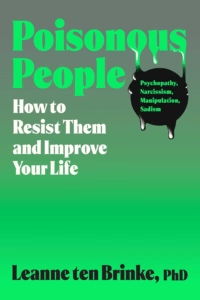
On this episode, we’re joined by Leanne ten Brinke, a psychologist at at the University of British Columbia who studies deception and dark personality traits, and author of Poisonous People: How to Resist Them and Improve Your Life. Here, Leanne explains why callousness and manipulation exist on a continuum rather than in a tidy diagnostic box, why some people will gladly take less money if it means you get even less, what her research on hedge fund managers and senators reveals about whether ruthlessness actually pays off, how a single toxic person can spread a zero-sum mindset through an entire team, and why negotiating with them by email beats sitting across the table. Whether you’re dealing with a tyrannical boss, co-parenting with a difficult ex, or wondering if your organization keeps promoting the wrong people, this conversation will help you protect yourself from the malevolent few — and remember that the decent majority still has them outnumbered. Listen, learn, and enjoy!
Please Scroll Down for Featured Resources and Transcript!
Please note that some links on this page (books, movies, music, etc.) lead to affiliate programs for which The Jordan Harbinger Show receives compensation. It’s just one of the ways we keep the lights on around here. We appreciate your support!
- Sign up for Six-Minute Networking — our free networking and relationship development mini-course — at jordanharbinger.com/course!
- Do you even Reddit, bro? Join us at r/JordanHarbinger!
This Episode Is Sponsored By:
- BetterHelp: 10% off first month: betterhelp.com/jordan
- Pendulum: Up to 48% off first order: pendulumlife.com/jordan
- Boll & Branch: 15% off first set of sheets: bollandbranch.com, code JORDAN
- Hims Weightloss: Get a personalized, affordable plan that gets you: hims.com/harbinger
Thanks, Leanne ten Brinke!
Click here to let Jordan know about your number one takeaway from this episode!
And if you want us to answer your questions on one of our upcoming weekly Feedback Friday episodes, drop us a line at friday@jordanharbinger.com.
Resources from This Episode:
- Poisonous People: How to Resist Them and Improve Your Life by Leanne ten Brinke | Amazon
- Leanne ten Brinke | UBC Okanagan Department of Psychology
- Boutilier v. INS, 387 U.S. 118 (1967) | Justia
- The Tragedy of William O. Douglas | The Nation
- James Fallon | How to Spot a Psychopath | The Jordan Harbinger Show
- Screening for Dark Personalities: The Short Dark Tetrad (SD4) | European Journal of Psychological Assessment
- A Dark Side of Leadership: Corporate Psychopathy and Its Influence on Employee Well-Being and Job Satisfaction | Personality and Individual Differences
- Psychopathic, Not Psychopath: Taxometric Evidence for the Dimensional Structure of Psychopathy | Journal of Abnormal Psychology
- Hedge Fund Managers with Psychopathic Tendencies Make for Worse Investors | Personality and Social Psychology Bulletin
- Kevin Dutton | The Wisdom of Psychopaths Part One | The Jordan Harbinger Show
- Kevin Dutton | The Wisdom of Psychopaths Part Two | The Jordan Harbinger Show
- When the Appeal of a Dominant Leader Is Greater Than a Prestige Leader | Proceedings of the National Academy of Sciences
- Virtues, Vices, and Political Influence in the U.S. Senate | Psychological Science
- Are Psychopaths and Heroes Twigs off the Same Branch? Evidence from College, Community, and Presidential Samples | Journal of Research in Personality
- Abigail Marsh | How Fear Separates Saints from Psychopaths Part One | The Jordan Harbinger Show
- Abigail Marsh | How Fear Separates Saints from Psychopaths Part Two | The Jordan Harbinger Show
- Gradients of Physiological Arousal in Parachutists as a Function of an Approaching Jump | Psychosomatic Medicine
- Hazard Warning: The Unacceptable Cost of Toxic Workers | Harvard Business School Working Knowledge
- Measuring Social Value Orientation | Judgment and Decision Making
- Negotiating with Difficult Personalities and Dark Personality Traits | Program on Negotiation at Harvard Law School
- Responses to Dominance Challenge Are a Function of Psychopathy Level: A Multimethod Study | Personality Disorders: Theory, Research, and Treatment
- The Impact of Leader Dominance on Employees’ Zero-Sum Mindset and Helping Behavior | Journal of Applied Psychology
- Peer Effects in Academic Cheating | Journal of Human Resources
- Cry Me a River: Identifying the Behavioral Consequences of Extremely High-Stakes Interpersonal Deception | Law and Human Behavior
- The Prevalence of Lying in America: Three Studies of Self-Reported Lies | Human Communication Research
- Civic Honesty Around the Globe | Science
- Risk Reduction Treatment of Psychopathy and Applications to Mentally Disordered Offenders | CNS Spectrums
- Group Discussion Improves Lie Detection | Proceedings of the National Academy of Sciences
- Mesolimbic Dopamine Reward System Hypersensitivity in Individuals with Psychopathic Traits | Nature Neuroscience
- Thomas Erikson | How to Protect Yourself from Psychopaths | The Jordan Harbinger Show
- Antisocial Personality as a Hostage-Taker | Journal of Police Science and Administration
- Aguirre, the Wrath of God | Turner Classic Movies
- Aguirre, the Wrath of God | Prime Video
- Passive Avoidance Learning in Psychopathic and Nonpsychopathic Offenders | Journal of Abnormal Psychology
- Behavior Therapy and Callous-Unemotional Traits: Effects of a Pilot Study Examining Modified Behavioral Contingencies on Child Behavior | Behavior Therapy
- Study Shows Why Speaking Beats Writing for Contentious Conversation | Berkeley Haas
- The Dark Side of Negotiation: Examining the Outcomes of Face-to-Face and Computer-Mediated Negotiations among Dark Personalities | Personality and Individual Differences
- OpenAI and Hugging Face Partner to Address Security Incident During Model Evaluation | OpenAI
- Annie Jacobsen | The Genes and Germs of Biological Warfare | The Jordan Harbinger Show
1415: Leanne ten Brinke | The Surprising Antidote to Poisonous People
This transcript is yet untouched by human hands. Please proceed with caution as we sort through what the robots have given us. We appreciate your patience!
Jordan Harbinger: Welcome to the show, I'm Jordan Harbinger. On The Jordan Harbinger Show, we decode the stories, secrets, and skills of the world's most fascinating people. Our mission is to help you become a better informed, more critical thinker through long-form conversations with a variety of amazing folks, from spies to CEOs, athletes, authors, thinkers, performers, even the occasional prison escapee, forensic genealogist, or intelligence analyst.
If you're new to the show or you want to tell your friends about the show, I suggest our episode starter packs, these are collections of some of our favorite episodes on topics like persuasion and negotiation, psychology, geopolitics, disinformation, China, North Korea, crime and cults, and more, that'll help new listeners get a taste of everything we do here on the show. Just visit jordanharbinger.com/start or search for us in your Spotify app to get started. Today on the show, when you hear psychopath, you probably picture a serial killer, somebody with a basement you don't want to visit, but the person doing the most damage to your life might actually have a corner office, excellent references, and a LinkedIn post about servant leadership.
Today, psychologist Leanne ten Brinke, author of Poisonous People, joins us to explore how callous, manipulative folks operate in everyday life, and why we keep mistaking their confidence for competence. We'll discuss why some people would rather make less money themselves if it means you get screwed even harder, what her research on hedge fund managers revealed about the supposed benefits of being ruthless, and how to protect yourself when just cut them out of your life isn't a realistic option. Here we go with Leanne ten Brinke.
Most of us hear psychopath and we picture somebody like Ted Bundy, or I guess more famously these days Jeffrey Dahmer, and your book makes a more, frankly, much more unsettling argument, which is the person who does the most damage to your life could actually be your boss, your partner, or somebody that society at large just keeps rewarding with more power and more money and more everything. And one of the classic examples that you give is 1968. Tell me about Peter Westen and the Supreme Court justice that he worked for.
Leanne ten Brinke: So I opened the book with a story of Clive Boutilier, and he had moved to New York City, and he was a Canadian. He was trying to get US citizenship. And things seemed to be going well until the immigration interview, at which time it came up that he had a previous sodomy charge that had been dropped.
Jordan Harbinger: Sodomy charge?
Leanne ten Brinke: Yeah. Yes.
Jordan Harbinger: Okay. Yeah, right. That's how they used to tell the gay people they were doing something wrong.
Leanne ten Brinke: Exactly. We're in the 60s. He was a gay man.
He had a sexual history of having sex with men and women. And he was classified because of that as having, they called it, psychopathy-sexual deviant, and therefore denied his citizenship application and deported him.
Jordan Harbinger: Wait, so was the psychopathy thing just because he was gay, or was it like, oh, hey, he's got a psychopathy thing. Oh, and also we're hitting him with sodomy because he's gay. Or is it like, if you're gay, you're a sodomizing psychopath, and we're going to diagnose you as...
Because that's actually crazy and way more, way worse.
Leanne ten Brinke: Yeah, it's much more the latter. So he was not clinically assessed for psychopathy, as far as we know. It was not like a psychologist assessed him and gave him this diagnosis of psychopathy as a personality trait.
It was like, if you are gay, then you have this psychopathy-sexual deviant label attached to you. It was the immigration system that attached this label to him. So having gay sex is unrelated to psychopathy in any modern or even past definition.
So it was really much more of a kind of political label that was put on him. I mean, I thought that was a really interesting story, but I dug further into this case and looked at the Supreme Court decision that had upheld his deportation. And there was one individual who wrote a dissent, and that was Justice William Douglas.
He essentially said that this psychopathy was a term of art, and it was too vague. It was just used to describe a disliked person, which essentially, in this case, it kind of was, and it should not be criteria for deporting an individual. And I dug more into William Douglas because, you know, this seemed like quite a reasonable dissent that he had given.
And interestingly, it seemed really much more like William Douglas had some of these psychopathic personality traits, much more than the person that he was talking about.
Jordan Harbinger: So he's like, let's save the psycho label for real psychopaths, kind of like me. And don't just throw it around. You're watering it down, people.
Leanne ten Brinke: He did have quite a reputation. There's been quite a lot written about him. There's multiple volumes of biographies about him, and he wrote a lot about himself.
Jordan Harbinger: Surprise, surprise.
Leanne ten Brinke: Exactly. But he tended to bully staff in pretty egregious ways, in ways that other justices said was that they could not stand that kind of treatment of the people who worked for him. His children described him as, quote, scary.
He was quite impulsive, and he easily got bored. You might imagine being a Supreme Court justice, this would be very engaging and would take up a lot of your time. It seemed like he has kind of a reputation for having pretty, like, slapdash decisions, writing pretty slapdash decisions, and really just waiting for the time when he could leave Washington and go ride his horse west.
And he was divorced three times. There were several attempts to impeach him from his position for various reasons.
Jordan Harbinger: Sounds like he might fit in pretty well in the court today as well. I don't know. Just looking at some of the personality types on there.
OK, maybe this is not new.
Leanne ten Brinke: It was really interesting for me to see, essentially to get an illustration of someone who's in a really huge position of power and one that is tasked with administering justice, but who seems to have a lot of these personality traits that actually lead people to often violate the rules and hurt and harm other people. And so that's kind of where I started the book anyway, but also where I discuss that psychopathy is not just something that you see in prison systems, that you see in the serial killers or Hannibal Lecter in the movies. It's a personality trait that exists out there in the world.
And so we all need to, or it would be helpful to all of us, I think, to be able to understand what it is to identify and to be able to manage it when we need to.
Jordan Harbinger: Yeah. Right. Because it's not like, oh, yeah, my uncle's a corrections officer.
He needs to listen to this episode. It's like, no, no, no. You work at a school.
You're dealing with parents. You're dealing with administrators who might actually be firmly in this spectrum that we're talking about today. I guess what is psychologically interesting about somebody who's tormenting an employee like that?
He showed up at this guy's wedding kind of behaving like nothing happened. I've got to get the story right because I read this a while ago, but it was like he fired him basically. And then that weekend was the guy's wedding and he was invited.
And it was like at the Supreme Court. And he's like, oh, forget about that whole thing that happened 48 hours ago where I ruined your life. Have a great day.
Leanne ten Brinke: He kind of pretended as though it never happened, even though, of course, this staffer was like, do I still have a job? Can I still have my wedding at the Supreme Court? Is Justice Douglas going to show up?
And he did show up and acted like nothing had happened the day before. And so you can just imagine like the kind of stress that Westen would have been under. This is supposed to be the happiest day of my life, but maybe I'm married and maybe I'm not even supposed to be on the premises.
And maybe he's going to show up and blow up our wedding reception or whatever. And they're like, uh, it didn't seem like he really thought about or cared about the impact that he was having on this person's life. And of course, that's just one kind of dramatic situation.
But personality is a pattern of behavior that occurs across time and space and context. And so that's certainly not the only instance of bullying or firing people and then rehiring them.
Jordan Harbinger: What's strange is Douglas has he's highly accomplished. I remember reading a lot of his decisions in law school. He's got a pretty admirable civil liberties record.
But in private, he just behaves monstrously towards people close to him, even his own children. It's like, well, OK, so what do you make of that? Did he just do the civil liberties and rights thing because it made him look good?
But then when people are close to him, he doesn't care about them. I don't get it. He cares about strangers that he will never meet and that aren't even born yet.
But God forbid you should be nice to your own kids and clerks.
Leanne ten Brinke: Yeah, it's an interesting question, and I can't really get into his head in that way, whether he was really faking concern for civil liberties. I think it's possible for both things to exist where he didn't want the government to encroach on people's lives. He didn't want anyone to tell him what to do.
And so some of those decisions may have been made in earnest. It's just not out of care and concern and compassion, more about like a you should leave me alone for who I am type of approach.
Jordan Harbinger: Why is Douglas more useful for understanding psychopathy than a story about a serial killer?
Leanne ten Brinke: I think it's because we tend to have these stereotypes. When you say psychopathy, it's the Hannibal Lecters. It's the Ted Bundy that jumps to mind.
And that seems so foreign. I mean, for most of us, very fortunately, we tend not to interact with those people or people like that very often or if at all in our lives. But they have personality traits that are extreme, but not rare per se.
And so I'm trying to illustrate how the people in our own lives can have tamped down versions of those traits and can be causing great amounts of harm. They can be incredibly callous. They can be incredibly manipulative and not necessarily be these caricatures of evil serial killers that we often see in the media.
Jordan Harbinger: Right.
OK. So before everybody starts diagnosing their boss, what does this story not allow us to conclude about Douglas clinically, for example?
Leanne ten Brinke: So it doesn't allow us to make any kind of assessment as to whether he fits like clinical criteria for psychopathy or any other kind of disorder. It allows us to see a situation that a lot of people might be familiar with. You know, it might be their own boss who repeatedly demeans other people, who flies off the handle and then is super sweet the next moment, maybe when someone else walks in the room, who like takes credit for your work, who's very entitled, power and status seeking.
These are all things that we see in our own daily lives and which seem to come across in the memoirs and accounts of people who have worked with William Douglas. But they're not uncommon. And so I think people can identify those kinds of things in their daily life.
And I think what we're not trying to do is diagnose anybody. If you meet a diagnosis for some reason, that's a job for psychologists, psychiatrists who are well-trained in identifying those behavioral cues and determining whether they meet the criteria for a diagnosis or not. What we're doing here is just kind of like pattern detection.
And we do that all the time with other types of personality traits like extroversion or like openness. And so it's just applying that same kind of pattern detection, but to these more callous and manipulative traits.
Jordan Harbinger: So poisonous person is maybe a less clinical term. That's what makes the book most useful, in my opinion. So that the important conceptual move in the book is kind of away from binary psychopath, not psychopath, and more towards traits on a continuum that you don't necessarily have to have all of those in order to fall into the purview of this book and the tactics that we might use to manage these people's personalities back at them, I suppose.
And what was kind of scary to me is the book, it seems like it estimates a much larger minority with elevated dark traits. And I think isn't the story to sort of stand like, oh, one percent of the population is a clinical psychopath. And you're like, oh, one in a hundred.
Well, all right. That's a lot, but it's not so many. I can't manage it.
And you're kind of like, well, OK, but those are the ones where we're like, oh, yeah, circle that guy in red. What about the people that have just a little bit of shades of pink here and there and a red mark on here? What percentage is that?
And it's just a lot more people.
Leanne ten Brinke: Yeah, it is. So because these traits exist on a continuum, as you mentioned, we've got these clinical cutoffs, which is incredibly high. So you're going to meet like a very high bar to be considered having psychopathy by clinical standards.
But because it exists on a continuum, you can move that bar around and then you get more people who would meet the criteria for simply having elevated but not necessarily clinical levels of these traits. It's difficult to assess what proportion of the public has those elevated levels because it really depends on how you define what is elevated. One version that I quite like is sometimes we use this measure called the short dark triad or dark tetrad.
And you just look at the proportion of people who on average agree on this self-report measure with the item. If you get items that are something like, I have exceptional qualities, or I tend to fight against authorities, or some people deserve to suffer. These are items that tap some of those callous and manipulative traits.
And if you just look at the proportion of people who are like, yeah, that sounds like me, that turns out to be about 10 percent of the population.
Jordan Harbinger: That's a lot. That's 10 times more than I want. I don't even want that 1 percent.
Never mind. That's a lot of times more than what most of us want floating around in society. Although if it's just someone agreeing with I have exceptional qualities, maybe you're an arrogant, annoying prick, but are you poisonous?
I don't know. I guess it depends on how bad that attitude gets. But it sounds like they have to agree with, what, the majority of these things?
Leanne ten Brinke: Yeah, they would have to, on average, agree with there's something like 28 items tapping this thing. So they've got to, like, very consistently be like, I'm exceptional. I'm better than everyone else.
I am also out of control. I am also enjoy seeing other people suffer, etc., etc.
Jordan Harbinger: Oh, my gosh. These are terrible things that apparently don't meet the bar for psychopathy still. Oof.
Leanne ten Brinke: I mean, the clinical cutoff is quite high. And that's why I think people will recognize that there are people who will not meet that clinical cutoff, but who are still causing problems in your life. That might be your boss, your romantic partner, maybe your ex, who you still have to deal with in a child custody arrangement or parent or child, whatever the case may be.
And so if we only think about psychopathy and narcissistic personality disorder and some of these related traits, if we only think of them as a problem, if they're diagnosable, I think we're missing a huge proportion of people who have lower but still levels of these traits that we might need to take a different tactic to manage our interactions with them.
Jordan Harbinger: So when you call somebody a poisonous person, what are you actually describing in scientific terms rather than them just being an asshole?
Leanne ten Brinke: So that is someone who has elevated levels of these so-called dark personality traits. It's psychopathy, narcissism, Machiavellianism, and sadism. And so these are all kind of flavors of callous and manipulative personality traits.
And I think poisonous is like an appropriate word because if someone is callous and manipulative, there's always someone else on the receiving end.
Jordan Harbinger: Yeah, you can't do that in a vacuum.
Leanne ten Brinke: Exactly. And in addition to that, it doesn't kind of stay put. The impact of these personalities tends to spread.
They create conflict in groups. Like one bad apple really can ruin a barrel. You might see this at work or on a sports team or something where you see the impact of one of these personalities kind of radiating out.
Even if you're not taking on the same cheating or callous behaviors as they are, you might take home that stress with you. So there's some really good research to suggest that if you have a boss who has elevated levels of psychopathic traits, you tend to experience more stress at work. And you also tend to experience more conflict at home.
And I think a good explanation for that is that you don't leave the stress at the door at work. You get on the train, you get in your car or whatever, and you're still a little wired when you get home and on edge and you take that stuff with you. And so I think that illustrates that radiating type of poison that someone with these high levels of these traits can impact.
Jordan Harbinger: Yeah. You compare psychopathy more to cholesterol than to a virus. And I think that's an interesting metaphor.
Can you tell me more about that?
Leanne ten Brinke: Yeah. So, I mean, with a virus, we're probably all very well aware of COVID at this point where like if you have COVID inside of you, like you either have it or you don't.
Jordan Harbinger: Right.
Leanne ten Brinke: Whereas cholesterol is like we all have some of these lipids coursing through our veins. Maybe you don't have enough to have a full-blown heart attack in the next week or something, but there's some amount of it. And so it's equivalent to this dichotomy.
You are or you aren't versus the continuum type of analogy. And it's really hard. We just kind of think in these dichotomies.
You're in this bucket or you're in a different bucket. We even see this like, I'm an introvert or I'm an extrovert. In reality, that is also a continuum.
And some people score really high. Some people score really low. A lot of people are somewhere in the middle.
And so if we say these are just two completely separate things, we're just creating these arbitrary distinctions between people.
Jordan Harbinger: So the number that you brought up was like 1 in 10 or so, or was it 1 in 5? I'm already, I don't know. The continuum of my memory is not doing that well today.
That number is extremely high. So if listeners hear that number and conclude, I don't know, 10 to 20 percent of humanity is basically psychopathic. They've misunderstood you.
So what does that number actually mean? By the way, was it 1 in 10 or 1 in 20? I'm already foggy.
Leanne ten Brinke: It totally depends on like what criteria you use to identify that cutoff. So if it's people who agree with those items, like we talked about earlier, that's about 10 percent. If you just look at psychopathy specifically and look at people who have, quote, elevated levels, I think it's one standard deviation or two standard deviations above the mean.
That will give you about 20.
Jordan Harbinger: Wow. 20 percent. Oh, my gosh.
Leanne ten Brinke: Let me flip this for you.
Jordan Harbinger: Sure.
Leanne ten Brinke: Yes. Because that also means that, let's say, 90 percent of people are not this way. 10 percent. That's absolutely terrifying.
I think that's a great argument for why people should understand how to interact, how to identify these personalities and how to manage working with them because you won't always be able to avoid them. But it's also totally worth remembering that that 10 percent is relative to 90 percent of people who do not meet that criteria for being elevated. They don't agree that they're exceptional and they don't enjoy seeing other people in pain and they don't like to manipulate other people.
And so that's a huge, relatively benevolent majority relative to this more malevolent minority of people.
Jordan Harbinger: There is that. We've got that going for us. What's the difference between somebody who's just incredibly selfish and difficult, emotionally immature, or occasionally awful and somebody whose personality should genuinely worry us?
Leanne ten Brinke: So I think what I'm picking up on there is occasionally awful. And so personality is a consistent pattern of thinking, feeling and behaving across time and context. And so we might get really frustrated one day and like yell at our partner or something and then we really regret it.
And we wouldn't normally have done that. There's impacts of both the situation and our personalities on our behavior. And so sometimes you might behave in a way that is pretty callous or pretty manipulative, but it's not your personality.
It's the situation that you're in. So we need to be pretty careful about what's called the fundamental attribution error. And that is when we see someone behaving in a way, we tend to assume that it is because of their personality traits and we tend to ignore the situational factors that might have also led to that kind of behavior.
When we're talking about ourselves and say, if I cheated or lied, I would be like, oh, that's because I was in the situation. It was really competitive. I didn't know what else to do.
I come up with situational factors to explain my own bad behavior. Whereas if you did it, Jordan, I'd be like, oh, well, Jordan is kind of manipulative person.
Jordan Harbinger: That's just the person he is all the time in every situation.
Leanne ten Brinke: Exactly. So we need to be pretty careful about a single behavior does not make a personality trait and isolated behaviors does not make a personality trait. It is consistent behaviors over time and context.
Jordan Harbinger: Apparently being an asshole is not an investment strategy. Some managers are going to need a new pitch deck. We'll be right back.
This episode is also sponsored in part by BetterHelp. Someone replies okay to your text and now you're analyzing and overanalyzing the reply. Are they annoyed?
Now you're scrolling through old messages. Meanwhile, they probably just answered while unloading the dishwasher. If I could delete one thing from my brain, that habit of filling in the blanks with the worst possible explanation would be on the list.
And during the holidays, there's a lot of blanks to fill. Family group text, changing plans. Somebody who hasn't answered about dinner.
It's exhausting when every little thing feels like something you need to figure out. Therapy can help you examine those assumptions and how they affect you. BetterHelp therapists are licensed, experienced professionals with at least three years and 1000 hours of hands-on experience.
And if your therapist doesn't feel like the right fit, you can switch at any time. BetterHelp is now in network with more than 125 health plans with many co-pays, as low as $15 for eligible members. And if you don't have eligible insurance or you live outside the US, you can still get 20% off your first month.
Sign up and get 20% off at betterhelp.com/jordan. That's Better H-E-L-P.com/jordan.
This episode is also sponsored by Pendulum Direct. When you think about metabolism, gut bacteria probably aren't the first thing that comes to mind, but there's one called Akkermansia that PhD researchers from Harvard, Berkeley, and Stanford have spent years studying for its role in metabolism. It's also the key ingredient in Pendulum Metabolic Daily.
Here's why that's relevant. You're trying to eat well, you get your work done, maybe fit in a workout, then three o'clock rolls around, you're back in the kitchen looking for something sweet. Sound familiar?
Pendulum Metabolic Daily is a science-backed probiotic designed to support your body's metabolism, help you feel fuller longer, experience fewer cravings, and make it easier to stay on track with your health goals. Just one capsule a day with food, some customers report noticing fewer cravings and more energy in as little as a week, though individual results can vary. It's a simple addition to your routine, and this offer makes it a good time to try it.
Right now, podcast listeners can save up to 48% off their first order at pendulumlife.com/jordan. That's pendulumlife.com/jordan to save up to 48% off your first order. Again, that's pendulumlife.com/jordan to get almost half off today.
If you decide to sign up or buy anything through the show, please do use our codes. They're all on the new deals page at jordanharbinger.com/deals. It's a double win, you get a great deal, and you help keep the show going strong.
Thank you for supporting those who support the show. Now, back to Leanne ten Brinke. I guess if your boss loses his mind twice during the worst month of his entire career, you haven't necessarily discovered a psychopath or somebody who's a poisonous person.
You just happen to discover somebody at a really, really bad time. I think we can all kind of relate to that.
Leanne ten Brinke: Absolutely.
Jordan Harbinger: There's this idea that being a psychopath might actually help. This is unfortunately very pervasive on Wall Street, the idea that like, oh, the worse of a person you are, the better off you're going to be managing, I don't know, a hedge fund or a bank or a law firm. So you get these guys who probably wouldn't otherwise lean into their bad behavior as much, but they almost see it as a virtue.
Like, yeah, I threw a book at her head, but we all know that people like me do better on the street. And it's like, no, I don't know. I mean, is that real science?
Because I feel like there's a limit to that. Maybe you need to be ruthless, but do you need to be an a-hole and also ruthless? Is that the same thing?
Leanne ten Brinke: It's such a fascinating question. It's certainly a pervasive belief. I get this all the time.
You might see someone, especially someone in power, behaving badly, and people will often like bemoan that behavior, but then say something like, well, but that's what you've got to do to succeed in the world. And I actually thought many years ago when I was a postdoc, I was actually looking for evidence that that was the case. So there's long been suspicion of this successful psychopath, quote unquote, and the idea that these traits could make you more successful, more powerful, more maybe able to make money on Wall Street.
And so I had the opportunity when I was a postdoc to put this question to the test. And so I had at my disposal a bunch of these videos of hedge fund managers, and I also knew how well they did over the past 10 years. I had access to their annual returns.
So I was able to watch them and look for behavioral cues to these dark personality traits. And I would rate like the extent to which they were showing signs of narcissism or signs of psychopathy, et cetera. And then I related that to how well they did in terms of just how much money they made.
And I was wrong. And I've never been so happy to be wrong, because what I found is that high levels of psychopathy were actually associated with making less money year over year.
Jordan Harbinger: Really? Do we know why? Or what is your hypothesis there?
Leanne ten Brinke: Yeah, we don't know why exactly. We don't have access to like information about how they made their decisions or did they hold on to positions for too long, even though the investment was going in the wrong direction for them. Maybe they were overconfident or something.
Hedge funds tend to be very concerned about turnover. They want to have a pretty stable group of employees. And we do know that in other areas, high levels of psychopathy is associated with increased turnover because you're like, I can't stand working for this guy.
This is awful. He's throwing the book at my head. Right?
And so it could have something to do with that. It could have something to do with kind of team dynamics, creating conflict, creating stress among the individuals on the team. But we don't have a clear view into that in this study anyway.
Jordan Harbinger: I see. Do we routinely confuse people being willing to dominate other people with those people being competent at a specific skill set?
Leanne ten Brinke: So we certainly confuse confidence and competence. And so when people come across as really confident, you know, they're like, yeah, I can do this. I'm a born leader.
I know exactly what I'm doing. Having like no humility whatsoever. We tend to believe them.
And so we think, well, they'll be really good at this task. So that's particularly for like narcissism. People who come across as really grandiose.
They have a very inflated view of themselves, can be seen as very competent, even though they talk the talk, but they can't really walk the walk. Essentially.
Jordan Harbinger: I wonder why you were also sort of seduced by the idea that ruthlessness produces superior performance. Did you ever try to debug that in yourself?
Leanne ten Brinke: There's a bunch of research right now suggesting that when we are under threat and it can be threat of all kinds of different varieties, like extreme social financial inequality or the threat of military conflict around us, we're scared. Right. And we start looking for someone who can set it right.
Someone who can just take care of this whole situation. And we tend to gravitate toward these more domineering types of personalities. And that's exactly the like version of leadership that dark personalities tend to sell is this.
I'm going to get control over everything. Only I can fix this. Right.
And I'm just going to like push other people into submission. And our group is going to come out on top. And so that can be pretty compelling when you're in a situation that's, frankly, kind of scary.
There's not great evidence that that actually is the case. We know that. So, for example, in political leadership, having individuals with high levels of psychopathy in positions of political power tends to increase division.
It increases negativity in the discourse. It doesn't like bring people together. It tends to entrench divisions that perhaps are already there. Based on the hedge fund manager stuff that we already talked about or the research that I've done showing that senators with high levels of these dark personality traits are actually not more influential.
They're less influential in the halls of government. So they're also like not getting as much done. They're not able to gain sponsors on their bills and get them passed into law.
And I think we've all kind of seen or experienced that inefficiency in government. So these traits tend to entrench that.
Jordan Harbinger: I think we've all noticed that. I don't think that's new. Yeah.
So surely, though, there are professions where a little bit of this wiring helps. I mean, I'm probably this might not be the greatest example, but I want a firefighter who can run into the building without having an existential crisis in the driveway. So which traits can be useful when they're separated from the nastier package of baggage, like egotism and recklessness and things like that?
Sadism.
Leanne ten Brinke: Yeah. So I think Scott Lilienfeld was a really influential researcher in psychopathy, and he and his group identified one subcomponent of psychopathy that might be useful in some cases, and that is fearless dominance. So people who are they have relatively low fear.
They want to pursue power. They're not as scared. They may even have like a diminished physiological experience of fear.
They don't get as freaked out, you know, as you or I might be faced with the possibility of running into a burning building. So there's been some good research that individuals with high levels of fearless dominance are more likely to engage in these kind of acts of heroism, which is incredible, right? The flip side of that is that they're willing to act and act quickly in all kinds of different ways, not only in the good virtuous ways, but also in the ways that lead them to break the rules.
So there's one study suggesting that they're more likely to engage in these virtuous acts, but also more likely to have disciplinary actions against them at work. So they could cut both ways, essentially. But if you're looking for the kind of, I don't know, silver lining or like where could be the diamond in the rough, just that fearless dominance could be quite useful in some situations combined with callousness, manipulativeness and impulsivity and stuff.
And I think we get a pretty toxic overall package. But that little piece might be useful.
Jordan Harbinger: Yeah, it's interesting. I'm thinking about, I know a couple of guys who train Navy SEALs and other special forces guys. I mean, I'm thinking of a pool of people here.
There's this guy who's now a popular sort of anti-Semitic influencer who had tried out for the Navy SEALs several times. And they told me privately, I won't mention his name, but they told me privately, like, oh, he did great at the physical stuff, but no one trusted him. He was so abrasive.
Everything negative that we try to actually get rid of in the teams was turned up to 11. And so we just bounced him. Nobody wanted to be around this guy.
Nobody wanted to put their life in his hands. Nobody trusted him. He was terrible to be around at all times.
And I just, it's like, okay. So he had a lot of the, like, I'm fearless. I'll go for it.
I'll do this. But then he had all of the other things, like, I want to see everyone fail so that I'm the only one that makes it. And it's like, oh, that doesn't work very well on a team full of people risking their lives to do something together.
So you really do have to find the right mix of people for these jobs. Like, I want to run into the fire and save people. But I also, I'm not going to leave my colleagues in there so that I'm the only one who gets a medal at the end of it.
Right?
Leanne ten Brinke: Absolutely. There's also this fascinating study from quite a long time ago of paratroopers. And they looked at the physiological reaction of people as they were, like, learning quite literally to jump out of planes.
And there were some portion of people who just, they never really got physiologically frightened. They didn't have that super elevated heart rate, et cetera. And there were some larger proportion of people who did.
They were freaked out the first time they did it. But in subsequent jumps, they were like, oh, no, I know how to do this now. And their heart rate was much calmer, et cetera.
So the idea that you must have these traits in order to do one of those jobs, I think, is also kind of a myth. I think training and expertise and building that over time can allow you to manage that initial fear, even if you're not kind of at a trait level, just don't feel fear ever.
Jordan Harbinger: Let's do a non-criminal example. You've got an anecdote in the book about Tricia and Kelly. I think this is probably surprisingly familiar to people with jobs.
Leanne ten Brinke: So Tricia and Kelly, this was an individual I spoke to. She was a pharmacist and she got this job working. It was not a public pharmacy.
They provided pharmaceuticals to local nursing homes. And so a lot of the work was kind of done behind the scenes in an office with just like the team members. And at first glance, it seemed like her boss was very kind, well put together as always, like very groomed.
And her appearance was very friendly in the beginning. But she noticed that her co-workers were like very on edge whenever this boss was around. Over time, she was trying to figure out like, OK, what is it?
Because she seems kind, at least at first glance. And then she eventually started to see these outbursts from her boss where she would just be like typing at her desk. And her boss would be like, I can't listen to your GD typing all day long.
You're like, what just happened?
Jordan Harbinger: Oh, wow.
Leanne ten Brinke: Big swings of anger and would quickly come down, really quickly switch to a kind of a saccharine smile and was very sweet and kind whenever, say, clients would come in placing orders for their nursing home or something like that. And so she had this kind of switch. She also really loved to be in charge to the point that put other people in danger.
So one time her boss was on vacation and there was an outbreak. I think it was influenza outbreak.
Jordan Harbinger: In a nursing home.
Leanne ten Brinke: Yeah, exactly. And so the kind of protocol was to treat all the patients before they got it because it can have such a high mortality rate.
Jordan Harbinger: So vaccinate the people. OK.
Leanne ten Brinke: But she didn't tell anyone how to go about doing this. And then when they called her on vacation and were like, how do we appropriately share these medications? She refused to help them, even though she must have known that this was putting the lives of a whole bunch of elderly individuals into jeopardy.
And so she just seemed to revel in the opportunity to be the only one who knew things, to be in charge, to demean people whenever they made a mistake and then could quickly switch back and forth depending on who was around.
Jordan Harbinger: That's so creepy. My gosh. So at what point does the story stop being Kelly is toxic?
And at what point does it start to become this institution is helping Kelly remain toxic because they're not doing anything about it? Because it seems like there's bad bosses, but a lot of them, they're so good at keeping people fooled. The people around them are above them anyway.
Leanne ten Brinke: So this person that I spoke to filed complaints about the way that she was treated. I think she also asked other individuals who were also treated incredibly poorly, who would regularly leave the office in tears after conversations with their boss. They provided some reports to HR.
Other people were too afraid to report her behavior to HR because they're like, I don't want to get fired. I need this job. And even in the end, HR didn't seem to do anything in this case because it was like a she said, she said case like they both just kind of disputed each other's version of events.
This person eventually ended up just being so anxious that she needed to take some time off of work and she took several months off of work and received some various therapies and was doing better. And then when she was ready to go back to work, the company just assigned her to like that desk right beside her boss.
Jordan Harbinger: Oh my gosh.
Leanne ten Brinke: Again. And so she had to lobby for herself to get placed somewhere else.
Jordan Harbinger: Sure.
Leanne ten Brinke: In the state.
Jordan Harbinger: That's crazy.
Leanne ten Brinke: Yeah. And I think that's pretty common.
Jordan Harbinger: It is. I see this all the time doing the show that organizations will repeatedly keep a difficult but high performer and just allow a dozen good employees to walk out the door before somebody's like, wait a minute. Why does this unit have 10 times the turnover as everything else?
What's going on here? Oh, well, Kelly is a monster. Yeah.
Well, she, her numbers are really good. Oh, it turns out she's also taking credit for everyone's work. Okay.
So we're not sure if her numbers are really good. We're just seeing her divisions. Numbers are okay.
She's taking credit for all of it. And oh yeah, we pay disability and unemployment and we have to keep recruiting for them and everyone complains. And then I don't know.
You just see this thing where it's like, oh yeah. HR has a hundred complaints about this person going back 10 years. Why don't we do anything about it?
Oh, I don't know. I mean, I just feel like I see this kind of thing a lot.
Leanne ten Brinke: I think sometimes too, the complaints that they might receive at HR are not things that are like directly contravening a explicit rule sometimes, right? It's treating people really poorly, yelling at people, spreading lies about them behind their back, things that are unfair and unkind, but not explicitly against a policy.
Jordan Harbinger: Sure.
Leanne ten Brinke: And I think a lot of companies don't have those kinds of policies because we just assume people are going to treat each other pretty well. Like that's how I treat other people. I don't feel like I need a policy to tell me to not be terrible to other people.
Jordan Harbinger: Not be a total jerk to everyone around you at all times. Yeah, exactly. The problem though is one bad apple, like you said, it poisons everybody else.
It spoils the whole bunch. So there's like a point allocation exercise in the book that I think is kind of interesting. I have a choice, right?
It's me and an anonymous partner that I don't know. And my choices are I get $500, I don't know, dollars. They get $100 or we both get $500 or I get $550 and they get $300 and you have to pick one.
And I was like, oh, well, I'll pick both of us get $500 and then I'll probably go trumpet how I did that with them. And maybe they'll give me the $50 because we both made more and I did the quote unquote right thing. But if we don't, then I feel good.
I did the right thing. And I figured who would choose anything else? Maybe some super selfish people chose the $550 and they got $300.
And I'm like, okay, I get it if you really need the money. But explain what actually happened because that surprised me quite a bit. And it changed the way that I look at selfish or psychopathic people.
That's for sure.
Leanne ten Brinke: So the option that you chose, which is $500, $500 to you and to this anonymous other person is what most people choose.
Jordan Harbinger: Oh, it is what most people choose. Okay.
Leanne ten Brinke: It is what most people choose. It's the fair option even though you don't fully maximize your potential winnings because you could have chose $550 and then the other person got $300.
Jordan Harbinger: Depends on what mood I'm in though. I did this a few times. When I was having a bad day, I was like $550.
I don't know the other person. They can have $300. Be grateful I gave you anything.
But on most days, like I said, I read this a few times and I took notes and I reviewed the notes. I was like, oh, I'll take $500. You take $500.
Easy peasy. Now let's go get lunch. You know, that's kind of how I felt about it.
Leanne ten Brinke: I love that insight because that suggests and it shows that we can all behave in these somewhat more callous ways whenever we're under certain situations like your mood or like maybe you're hungry or you're tired or whatever and you just like behave in more selfish ways under certain conditions.
Jordan Harbinger: Pretty much. Yeah, I was hangry or ready to go to bed and don't really want to be sitting in front of my computer anymore. That person got shafted at that point.
Leanne ten Brinke: Yeah. But people who had the highest scores on psychopathy were more likely to choose this really interesting one, which was the...
Jordan Harbinger: 500 and 100. Right. You get 500, they get 100.
So it's like needlessly giving the other person less.
Leanne ten Brinke: What they seem to be prioritizing is this relative advantage over other people. If they really only wanted the most points for themselves, they should have chosen the 550, 300. But if they want to maximize how dominant they are over this stranger, they would go with the 500, 100.
Jordan Harbinger: So they'll choose less whatever money, virtual money points for themselves if they can win by a bigger margin. And win is nothing because there's no contest. They just want to know that they screwed the other person more.
So they pick less even for themselves, which is so crazy and very telling.
Leanne ten Brinke: Yeah, absolutely. And we found this kind of thing in negotiation as well. So we found that in these kind of integrative bargaining tasks, where like there's two different things that we need to bargain for.
One's more important to you, Jordan. And the other item is more important to me. Like we could trade off.
You could get what you want on the things that you really care about. I could get what I want on the thing that I really care about. And everybody's happy.
They're not good at this kind of win-win scenario. They would rather blow this up or everybody get less than the optimal outcome than to compromise, essentially. And it's consistent with the view that power is not respect or prestige.
It's dominance over other people.
Jordan Harbinger: Give them a bonus, give them a parking space, give them a ridiculous title. Just maybe don't give them 12 direct reports and a fresh supply of victims. We'll be right back.
This episode is sponsored in part by Boll & Branch. You know, a gift has landed when somebody still texts you about it three weeks later. Well, here's something I can recommend from our home, Boll & Branch.
We have their bedding on all the beds, plus the waffle blanket. And we wash the sheets every week, you know, because we're not disgusting people. And you might expect that that much washing would wear them out, but they just keep getting softer.
Getting into these soft sheets with the waffle blanket after a long day, the bed just feels so nice, inviting. It's that five-star hotel feeling right in your own bedroom. Signature organic cotton sheets they'll enjoy every night, velvety soft towels for cozy mornings, a robe that everyday luxury people rarely buy themselves, or a soft throw that looks great on the couch.
That's what makes Boll & Branch a great gift. It's something they'll use every night and appreciate well beyond the holidays.
Upgrade your sleep now with Boll & Branch during their best sale of the year. Get 25% off plus free shipping and extended returns at bollandbranch.com with code JORDAN. That's Boll & Branch, B-O-L-L-A-N-D, branch.com, code JORDAN to unlock 25% off. Exclusions apply.
This episode is also sponsored by Hims Weight Loss. You ever start the week with a plan to manage your weight and then work runs late, dinner becomes whatever is easy, and you're just telling yourself you'll start again Monday. Yeah, that gets exhausting, especially when you're putting in effort, but you're still trying to figure everything out on your own.
Weight Loss by Hims gives you a place to start. With an online consultation with a licensed provider who can help determine what's appropriate for you. Hims offers access to a range of FDA-approved GLP-1 medications, including the Wegovy Pill and the Wegovy Pen, plus 24-7 access to your care team because questions don't always come up during office hours.
Having someone to ask and a plan built for you can make the process feel less overwhelming.
Be prepared. Be strong. Be confident.
Be Hims. Ready to be Hims? Visit Hims.com/Harbinger to get personalized, affordable care for weight loss, hair loss, sex, testosterone, and more. That's Hims.com/Harbinger. Hims.com/Harbinger. Individual results may vary and stopping treatment may result in weight regain.
Weight Loss by Hims is not available in all 50 states. Wegovy is the registered trademark of Novo Nordisk A/S. To get started and learn more, including important safety information, Wegovy clinical study information, and restrictions, visit Hims.com.
If you like this episode of the show, I invite you to do what other smart and considerate listeners do. Take a moment, support the sponsors. They make the show possible.
And they're searchable and clickable on the deals page at jordanharbinger.com/deals. Thank you for supporting those who support the show. Now, back to Leanne ten Brinke.
You see these people, maybe you're in a lawsuit with them, for example, and you're just like, why are you picking an outcome that's worse for you, but also worse for me? It doesn't really make any sense. There's a way we can like both get away and then it's fine.
And I remember this was actually, I was in a lawsuit with somebody like this. And I remember the judge finally was like, I'm not allowing this anymore because you're just trying to make a worse outcome for everyone instead of agreeing to a settlement. And basically the judge told his attorney, cut the shit, because it was really clear he was trying to make it so that everybody else lost more.
And the judge was like, you have a better deal right now. I would strongly advise you to take it. Or basically the judge was like, I'm just not going to hear you this case anymore.
I'm going to shelve it for months and months and months. And you can pay your lawyers till the cows come home. And I'm just, I'm sick of this.
Get this out of my courtroom kind of thing. And I'm not doing another call about this. I was mystified by this because I felt like, why wouldn't you want to just end this early?
It's costing you a ton of money. You just want me to get less, but it's a symbolic less. It's not going to affect my life at all.
All it was going to do is allow him to walk away and be like, I really screwed everyone over on that. It was just so apparent to everyone, even his own attorney. And I remember his own attorney was like, in a private call, I was like, I also need to get clarity on why my client is insisting on this particular outcome.
And now it's like, oh, of course. This was from the jump about him trying to be able to show that he's superior in some way to everybody else who's involved, not actually to resolve this conflict.
Leanne ten Brinke: Yeah. I think once you start to understand the priorities and the values of someone with high levels of these traits, it gives you insight into their thinking and into how you can or can't negotiate. I mean, it's kind of negotiation 101, which is understand the interests of the other person.
Most of the time we can assume those basic values are the same as ours, but...
Jordan Harbinger: Right. They want the best outcome for themselves. And it's like, no, no, they want the one that's best for their ego.
It doesn't matter what the reality basis is. They want the one that makes them look the best or feel the best. It has nothing to do with their business outcome, for example.
That's a crazy insight.
Leanne ten Brinke: Yeah. Having dominance over other people is highly valued by individuals with high levels of these traits.
Jordan Harbinger: The scary part is you argue these people become disproportionately destructive through three mechanisms that you outlined. They deceive us. They identify people they can dominate, and then they get the rest of us behaving more like them.
Walk me through that chain, because this is the problem, right? It's like you can fire Angela if she's going to be crazy at work. But then it's like, well, wait, there's three years of Angela making everyone else either leave or become more like her to survive.
So it's like a cancer in the organization.
Leanne ten Brinke: Yeah, absolutely. So we know that individuals with high levels of these kind of callous and manipulative traits, I mean, manipulative is right in there. So they tend to tell a lot of lies.
And so they're in some ways just deceiving us into whatever their own ends might be. And another way that they influence us is by dominating us. One study that I think is so fascinating is how people with high levels of psychopathic traits react to very nonverbal displays of dominance in the people around them.
So for most people, if I like puff myself up, Jordan, you tend to like shrink in response. And people don't even realize that they're doing this. It's kind of like, I'm dominating, you're submitting, we're trading off in this way.
But people who have high levels of psychopathic traits act the opposite way. So like, if I make myself bigger, they make themselves even bigger. And so that's a very specific nonverbal illustration.
But you can see this in kind of these dominance contests all over the place, where you're just ratcheting up the conflict. And you're kind of like eye for an eye. And then they're willing to go much further than perhaps you are.
So you can get into these escalating contests. The other thing is how that rot spreads. We know that having one pretty antagonistic person on a team tends to increase the conflict on a team dramatically.
And so you can get this spread of antagonism throughout a team that is going to lead to more negative outcomes. We also start to think like the person who's in charge. So especially if they are in charge of your organization or some sort of team at work, people with high levels of these traits tend to have a very zero-sum view of the world.
Like it's a very competitive, they have a very dog-eat-dog perspective to the point where they're even creating conflict like within their own team, which makes no sense. That's going to make your team less effective. But we know that people who are working under someone who has a zero-sum mindset starts to adopt it.
Jordan Harbinger: I see. So it's contagious.
Leanne ten Brinke: Exactly. So instead of seeing your co-workers as collaborators, you now see them as competition. And so those thoughts, those behaviors can spread.
Jordan Harbinger: I have. Okay. So when I was in law school, you would hear things about other law schools, like you'd be like, oh, at Columbia, they start hiding books in the library.
And I remember hearing that story, I think from a professor. And in the next exam that was open book, which means you could do it on your own, someone hid the book in the library. And I was like, what a coincidence.
And it was like, no, it's not a coincidence. Somebody heard that and was like, oh, great idea. And I remember other people in my class going, well, fine, the next time I'm going to hide the freaking book.
And I was like, no, no, no, we can't all start doing this crap because this is one idiot who decided they were going to do this. Obviously, the professor is going to find out. We're going to go tell him right now that the book is missing because we all need an extension.
This person thought, what, nobody would say anything and everybody would fail but them. It's not a good plan. But I can see that the temptation is, oh, well, if they're going to do that to me, then I'm going to start doing that to them.
But that is kind of the definition of contagious, right? Oh, I'm going to hoard information or screw colleagues because that's what you've got to do to survive around here. You have to have like a zero tolerance for this kind of stuff.
Leanne ten Brinke: It can escalate quite quickly. Like you say there, when, if you think about it for just a second, it makes a ton of sense for like, okay, we all need the same book. There's one in the library.
Why don't we all meet there at a time and we can share this book around the table? But if you have a competitive mindset and you see other people as competitors instead of collaborators and you think Jordan's success is my demise.
Jordan Harbinger: Yes.
Leanne ten Brinke: If I see the world that way, then your demise is my success. And you can see this also with cheating more specifically. Like the more there becomes this kind of norm of cheating, the more willing people are to do it.
Even if they have high levels of these traits, if people see other folks around them cheating, you're like, oh, well, I guess this is cool now.
Jordan Harbinger: Yeah.
Leanne ten Brinke: I will do it too.
Jordan Harbinger: Yeah.
Leanne ten Brinke: And you start to feel like kind of a sucker, right? If you're just like, I'm the only one that's not cheating and I'm doing poorly on this test relative to my peers who are not studying as hard, right? So yeah, it can definitely escalate pretty quickly and lead to pretty perverse outcomes.
Jordan Harbinger: You see that in socialist countries for, I should say, especially during the Cold War, you see these sort of communist, like corruption was just endemic. And a lot of that was the economic system, but much of it was also just they tolerated the crap out of it because it was the only way to survive. So then it became completely dysfunctional.
Oh, you actually want medical care and a bandage for this giant hole in your head? Well, now you have to pay. OK, so it's not actually free health care, right?
The whole thing starts to deteriorate because not only is it tolerated, but it becomes the way the system works at all. But I guess one might ask, why are decent people so exploitable? Is our problem, are we just all dumb or is trusting people a rational decision?
Because most people deserve to be trusted in the first place.
Leanne ten Brinke: Trusting people is totally a rational decision.
Jordan Harbinger: A rational decision. OK, not irrational decision.
Leanne ten Brinke: Correct. A rational.
Jordan Harbinger: Got it.
Leanne ten Brinke: So just by the numbers. So the other area of my research is deception and deception detection. And one of the most consistent things that we find is that people have a truth bias.
Like if we show them a bunch of videos, some are liars, some are truth tellers, they will consistently say that more people are telling the truth than are lying. Sometimes even if we tell them, it's 50-50. You know, like 10 of these are telling the truth, 10 are lying.
At the end of the day, they'll be like, no, I think 11 are telling the truth. You know, 9 are lying. Even if we give them the base rate.
And it makes a ton of sense because if you look at how often people actually lie, you survey people, they will say the mode or the most common answer is zero times a day. On average, it's like one to two times a day. And that's because it's skewed upwards by people who tell a crap ton of lies.
Jordan Harbinger: Okay, gotcha.
Leanne ten Brinke: We can all think of a time that we lied about something. It's usually not a super common occurrence and not something you're doing all day, every day. And so then it makes sense to trust the information that you receive.
Otherwise, you are just scrutinizing every piece of information when 99% of it is accurate. You know, it becomes a problem when that 1% is really important information that you're now deceived about. Most people are pretty trustworthy.
Jordan Harbinger: I guess it makes sense, right? I feel like I've done shows on this before where it makes sense to trust people by default. And a lot of people are like, oh, I never do that.
And it's like, oh, so when you go to restaurants, do you pay the bill in advance? Oh, no, I don't do that. Okay, well, people are trusting you all the time to do that.
Well, yeah, I would never do business like that. Well, actually, there's all these things we do every day that require other people to not be completely self-centered. I mean, even just driving to work.
It's like, I'm going to assume that most of these people are going to follow the speed limit. Don't get me wrong. I'm still being aware of the one psycho who's out there gunning it at 70 in a 35.
But I'm not assuming everyone else is going to do something like that or that everyone else on the road is high, although it's California, so you never know. But our society functions based on this implicit contract that most of us have to follow and most of us are following at any given time.
Leanne ten Brinke: Absolutely. And it's almost so in the water that you don't even notice it, like your driving example. We trust most people to stop at the red light.
We don't even think about it. We're not making a calculated decision of like, do I trust these people to stop at a red light? We're paying attention, but we're not spending a bunch of time before every red light analyzing every car, right?
So I think we tend to be pretty cynical about the extent to which other people can be trusted and the conditions under which other people can be trusted. There was this great study where researchers, a group of economists and psychologists, dropped, quote-unquote, lost wallets at train stations and hotels all around the world. And basically, they would have research assistants take a lost wallet.
Sometimes it had no money in it. Sometimes it had a few bucks. Sometimes it had like 100 bucks in it.
And it always had contact information. And they would take this wallet and they would drop it off at the front desk of a hotel. And they'd be like, I found this wallet.
I don't know whose it is. I just wanted to turn it in somewhere. And they asked people how many of these front desk clerks would actually reach out to the contact information in there and try to get it back to people.
And people thought very few individuals would actually try to return this, especially when there was like 100 bucks in there. People thought almost no one would return the lost wallet with $100 in it. In fact, people were more likely to reach out and try to return the wallet with 100 bucks in it than the wallet with $0 in it.
Because they didn't want to feel like they were stealing from other people.
Jordan Harbinger: That's interesting. Wow, that is quite interesting. That's reassuring.
Thank you for that. What's the realistic goal of therapy for an adult who's high in psychopathic traits? Are they becoming a warmer empathic person or are they simply learning to cause less damage?
Because I know you can be treated for this, but can you become a better person or do you just become like not poisonous?
Leanne ten Brinke: So most of the research that we have on this question comes from incarcerated individuals. So people who have been mandated to undergo some sort of therapy while they're in prison. And the research there suggests that people with, these are clinical levels of psychopathy as well, so very high levels, finds that they're not particularly motivated to engage in therapy.
Like this is more of a you problem than a them problem. Like they don't really care about hurting other people and lying and being callous, et cetera. But if you can get them to commit and to like continue to go to these therapeutic sessions, you can decrease the likelihood that they will recidivate or like, you know, re-offend once they are released.
You're right. It's more of like a harm reduction kind of thing where the goal is not dramatically changing your personality. The goal, at least in that population, is decreasing the likelihood that you re-offend and hurt other people and come back to prison.
So that's encouraging, if not like a full-blown personality change. If you've ever tried to change anything about yourself, it's hard even to try to, oh, I'm going to be more outgoing. I'm going to be a more extrovert.
But you know, I really like to stay home and hang out on my couch with my dogs.
Jordan Harbinger: I'm going to start going to the gym every day. Maybe not every day, maybe not ever.
Leanne ten Brinke: Yeah, exactly. So it's really hard if you do commit to it and practice consistently, go to therapy consistently, try to engage in more agreeable empathic behaviors consistently, you can reduce your levels of so-called dark personality traits. But it takes a lot of time and effort.
I wouldn't expect a personality 180. Although research with kids is much more helpful. So kids are a little more malleable.
If you start to see callous and unemotional behavior in kids, getting them early intervention can actually decrease the likelihood that they develop psychopathic personality traits later in life.
Jordan Harbinger: That's huge. Although, of course, a lot of times you see that the parents also don't care when their kid does things like this. And you're like, oh, well, we'll see that kid on the news in 20 years.
I mean, there's a few of those in every neighborhood. You have seven rules for when you, let's say you can't leave a relationship, maybe you work somewhere. Rule number one is establish clear boundaries.
I would love to know how you make implicit boundaries explicit, because a lot of people have problems with this. What does a useful boundary actually sound like when you're dealing with somebody who treats every gray area essentially as permission to do whatever they want?
Leanne ten Brinke: I think it requires a little bit of introspection on our part, because often we're moving through life, you know, expecting people to be fair and kind to us. And we don't even think about it. We don't even articulate it until we realize, like, they're not treating us in the way that we want to be treated.
So doing some introspection about what are the boundaries that you actually want to uphold, and then actually making them explicit, like saying them out loud. Writing them down is actually pretty useful too. And showing them to a friend, even therapists will do this sometimes, about things that they will and won't talk to their client about.
So people with psychopathy tend to push on these personal and professional boundaries. And maybe they're trying to learn more about your home life and stuff. I definitely don't want to talk to these clients about my home life.
That's a boundary that I'm going to enforce. But sharing those boundaries with other people can help. It's kind of like a gym buddy.
Someone who's going to help me be accountable and help me identify whenever those red lines are being crossed.
Jordan Harbinger: Putting things in writing gives you time to think and creates a record of what was actually agreed. Plus, their overly intense eye contact and tough guy handshake are considerably less irritating via email. We'll be right back.
By the way, if you can't remember the name of a sponsor or you can't find a code, any issues, email us jordan@jordanharbinger.com. We're happy to surface codes for you. It is that important that you support those who support the show.
Now for the rest of my conversation with Leanne ten Brinke. I had a friend a long time ago. She would date crappy guys.
And I remember one day she was like, OK, all right, guys, don't let me do... I can't remember exactly what it was. If you see this and I'm starting to say things like, well, it's not all the time, you've got to show me this piece of...
Basically, show me this notebook where I wrote down, I won't let a guy not show up to a date more than once or whatever it was. Guys are just treating her terribly, right? It's like, get ready.
I'm going to pick you up. And they would just never show up. I mean, this is like typical, terrible guy stuff that nobody should ever put up with.
And she's like, if I start rationalizing this, then you've got to call it out. And so we started being like, oh, yeah, this guy is just another Victor because her ex was named Victor. And he was just like this piece of crap.
Right. And we're like, you're going to pick another Victor. We had to write down all of Victor's worst traits and show a notebook.
And even then she was like, well, he doesn't do all of the things that Victor did. And we're like, oh, my God, Kim, what's wrong with you? Right.
Because a lot of times I think people who are victimized by these people are almost magnetically attracted to them in the first place. Not always, just sometimes.
Leanne ten Brinke: The point of having other people around you, I think, is a really important one because sometimes a person will, especially in like romantic relationships, someone with high levels of these traits might try to engage in this coercive control and cut you off from your friends and your family. And so they have put you in a box and you don't have other people who can help you to see those patterns and help you to get out if you need to get out. And so, I mean, there's great research to back up the fact that when it comes to detecting lies, we're better in a group setting.
When it comes to identifying personalities, we're better in a group setting. I think sometimes people are maybe cynical about other people. They don't think that they can trust them.
But cutting yourself off from everybody is not a great solution because you actually need other people to understand, to talk about, to some extent, to analyze other people's behavior, to make sense of it. And we know that we're more accurate whenever we do that with other people than when we do it alone.
Jordan Harbinger: Yeah, that makes sense. I'm not the greatest judge of character. I know a lot of people might think that I probably am.
But no, I always bounce things off my wife, my producers, my best friend. I'm just, this is a group project. I routinely give people the benefit of the doubt, maybe too much.
And it's really quite interesting. Everyone assumes I'd be way more cynical. No, no, I need help with that, generally speaking.
Rule number two, don't hand these people power over other people. So suppose this person is brilliant. They genuinely produce results.
How do I reward them in my company or organization without making the obviously catastrophic mistake of putting a dozen human beings underneath them?
Leanne ten Brinke: You want to think about what is rewarding to them. They care about power, but we don't want to give them power over others because we know we've already talked about how that can have really negative impacts on their subordinates in the workplace. But they also care about money.
So you could give them a raise. You could give them a bonus. You could give them a fancy new title.
You could give them, I don't know, a corner office, a company car, whatever the case may be, something that is genuinely rewarding to them if they do something good because you want to incentivize that behavior. And particularly for individuals with high levels of psychopathic traits, they're very reward sensitive. So if you see some behavior that is good that you want to see again, it's advisable to reward it.
They're not particularly punishment sensitive. Other people, if someone does something wrong, you might be able to like guilt them or punish them by taking a piece of their bonus away or something. And that will cause them to change behavior in the future.
It's not going to be particularly effective with these individuals. Reward for shaping behavior tends to be better. But yes, please do not reward them with power over others.
Jordan Harbinger: One of the rules, rule three, look for win-wins. But man, a lot of people with these traits, they often suffer from the fixed pie mentality, as you've said. So what's the mistake that they make in negotiation?
They're mostly looking to make the other person lose more than they win, which, how do you fix that? Because empathy is not motivating them.
Leanne ten Brinke: Yeah. So I think trying to get into their head, understanding what they value can be useful here. Even if it's not the reason that you would do a thing, you might be able to get to a successful outcome.
So I talked to one psychologist who would consult for police organizations whenever they had a hostage negotiation situation. If they identified that the hostage taker had high levels of psychopathic personality traits, he would advise them to talk to that person differently or try to persuade that person to let the hostages go very differently than if that person had low levels of psychopathic personality traits. So the outcome you want is the same.
You want this person to release the hostages. If they have low levels of psychopathic traits, you might be like, these people are terrified. Their families are really worried about them.
Please let them go. Maybe that would be persuasive. If they have high levels of psychopathy, like they don't care that other people are worried or stressed out or frightened, but they might care about their eventual prison sentence.
Jordan Harbinger: Yeah, sure.
Leanne ten Brinke: You're not going to appeal to caring concern and compassion. You're going to be like, well, if you let these people go, we might be able to negotiate reduced prison sentence for you later on. So understanding what they value, what's in it for them, might help you get to that outcome that you want, even if it's not for the reasons that you might do it.
Jordan Harbinger: This might actually be from your book, although now I'm not sure. Werner Herzog had this difficult actor who was threatening to walk off set, and I think he was basically like, hey, do you know that you're also going to get famous and rich if we finish this freaking movie? So maybe, like, calm down and do your job.
I doubt he said it that way, but he basically was like, by the way, you also need this. It's not just me. So if you leave, we're all screwed.
Not just me. You're also never going to work again. And we didn't finish the project that, you know, is going to give you all the things that you want so that you can continue to abuse other people.
And the guy was like, oh, right. Good call. Good call, Werner.
I'm back. I'm focused.
Leanne ten Brinke: Yeah, I think it's the case that we kind of wish people would do, quote unquote, the right thing, whatever we think that right thing is, for the reasons that we think it is the right thing. But if that's not going to work, trying to get them to do, quote, the right thing for other reasons might be better than going completely off the rails.
Jordan Harbinger: This is like raising kids. Hey, stop hitting your sister. Why?
She's not doing anything to you. She's very nice, and you're being mean. So look, if you stop hitting your sister and you both shut up, I'll give you a popsicle.
It's like, fine. And then you're like, we're terrible parents. We can't keep doing this, but I just need to go to sleep.
That brings me to rule four, carrot, not stick. This is going to annoy people. You say carrots work better than sticks.
So rewards are better than punishments. Why are people who are high in psychopathic traits, they're just unusually bad at learning from punishment, which the prison system might want to read your book, I guess.
Leanne ten Brinke: Yeah. So, I mean, most of us experience what's called like passive avoidance. Whenever we, maybe we're engaging in some behavior, oh, it's working for a little while, and then we get punished for it.
The next time we have the option to engage in that behavior, we're like, we remember that did not work out so well for us last time, and we shift, right? That experience, the brains of people with high levels of psychopathic traits, it just doesn't quite work that way. It doesn't register.
It doesn't ping that I got punished for this last time. I should change my behavior up. And so punishment, therefore, doesn't work particularly well.
There is some research to suggest that it can work better if you draw people's attention to it. So like for most of us, we just automatically remember, I got punished for doing that last time. I'm not going to do it again.
But for people with high levels of psychopathic traits, if you're going to use punishment, you might be like, okay, look at this, look at this. Remember last time I dinged a part of your bonus for doing that. Don't do it again.
So drawing their attention to it can improve the extent to which punishment works, but rewards are so much better because they are high reward seekers. And so even in some child therapies for callous and unemotional traits, the researchers will create this kind of arcade-style place where you can gather points during the week for good behavior and then trade it in for like a Hot Wheels set at the end of the week. And so this tends to be pretty engaging and a way to help shape the behavior of kids with high levels of these callous and unemotional traits, whereas the punishment is a little less effective.
Jordan Harbinger: People are going to be, they're going to hate this, right? Because like, oh, aren't you just basically paying or rewarding somebody to meet the bare minimum standard of human decency? Come on.
Leanne ten Brinke: What's the alternative?
Jordan Harbinger: Yeah, fair.
Leanne ten Brinke: I think that alternatively, we punish someone with these traits. They don't learn from it. And we see this behavior over and over again.
And so if they do something good or kind or honest, or they wait their turn, whatever the case may be, and you reward them for that, and you see it again in the future, it's like their life is better. The life of everyone else around them is better. I don't see why we wouldn't do that.
Jordan Harbinger: Yeah, no, you're right. Where's the boundary between strategically reinforcing good behavior and just rewarding somebody for abusing you less?
Leanne ten Brinke: So I wouldn't say in that particular example, they're not rewarding someone for abusing people, abusing their peers less. They actually have to do something positive, waiting their turn, helping someone get up from the playground when they fall down. So they have to do something positive to get the reward, just like neutral behavior.
They're not like donating a kidney to the other kid on the playground or whatever. They're not doing like the most altruistic thing. They are learning what are acceptable behaviors in public.
Jordan Harbinger: There are other rules in the book. There's other practicals in the book. But rule seven, I'm going to skip to this.
Avoid face-to-face negotiation. I like this. I thought this was one of the best tactical takeaways.
It's kind of counterintuitive, right? If I have to negotiate with somebody like this, you actually prefer text or email as opposed to sitting across from them at a table. Why?
Leanne ten Brinke: So there's actually some recent research by Juliana Schroeder that suggests conflict discussions actually go much better than we expect. So we often kind of try to avoid them. And they go much better than we expect face-to-face than in writing.
But I would argue that this does not apply to this particular subset of individuals because there's other research that suggests that whenever you're interacting with someone with high levels of these callous and unemotional traits and trying to negotiate with them, they're not coming at it with a good-faith resolving of this conflict, right? They're trying to manipulate you into paying more for a particular object or if it's some sort of sales negotiation. That's what this study showed, that people with high levels of psychopathic traits got more money for these like concert tickets when they negotiated in person versus whenever that negotiation played out over text.
And it's consistent with some research showing that people with these traits tend to be pretty superficially charming and can dominate others in conversation. And when you reduce them to words on the page, it removes some of that aura, some of that power that they have in the face-to-face context. And they no longer have that kind of advantage.
I think there's a bunch of other reasons for this too. I spoke with some individuals who were divorcing someone with high levels of these personality traits, and they really found it to be helpful to have conversations about splitting assets or whatever the case may be over text because it just gave them time to think about how to respond as opposed to being there in the moment and just getting caught up in this argument. It also gave them the opportunity to have a written transcript of what was said, right?
So they can't come back later and be like, that's not what I said, or I didn't agree to that. You're like, no, it's right here. I've got it on my screen.
And, you know, in some domestic situations, if there's a possibility of violence, it quite literally puts space, physical space between you and that other person that could help keep you safe.
Jordan Harbinger: Right. Okay. So there's a record.
Also, they can't manipulate you in real time. There's no intimidation factor. Gives you a chance to calm down and not react emotionally.
Yeah. Okay. I don't know.
If I need a seven rule psychological operating manual just to have this person in my life, is that not pretty strong evidence that we shouldn't be around this guy or gal anymore, whether it's work or personal?
Leanne ten Brinke: Yeah, I think the to stay or to go question is such a personal one, and I don't claim to have the answer what any individual should do in their life. So what I do hope is that people understand these personalities, figure out how they can manage them, and decide for themselves whether this relationship is worth continuing to have or whether they feel like they should move on. You know, it's going to be very different calculus if this is, say, your brother-in-law that you see twice a year at a family barbecue.
You could try to cut him out of your life, but then you don't get to see your sister, right? And you love your sister. And so maybe, you know, it's worth keeping that guy in your life.
But if it's your romantic partner and you have to work with them every day and you need to raise kids with them and it's just a much closer partnership, maybe that's not something that you can manage day to day. If this is your kid, maybe you're like, this is so difficult, but I want to have my kid in my life, right? That's a non-question for me.
So there's lots of different situations. And so I really just hope that when people are making that to stay or to leave decision, they have a realistic view of the likelihood that this person is going to change, probably not dramatically, and, you know, what it's going to cost them and the extent to which they can manage those behaviors. Like maybe by using some of those seven rules, interactions with them just become a little bit easier and it becomes less of a stress on your life day to day.
Jordan Harbinger: There's another part of your book that I thought was interesting. It's this never have I ever self audit. I would love to go through this because what if you're part of the problem, right?
I think a lot of people reading this or listening to this might be like, oh, am I part of the problem? And some of the questions, I'm paraphrasing these questions, but they're from the book. Have I lied to get what I wanted?
And I was like, oh, crap. Yes, of course. But then I was like, wait, everyone's done that at some point in their life.
The next one, have I manipulated somebody for my advantage? I can't think of one, but I'm sure it's happened. Probably, I'm 46 years old.
Probably it's happened. I don't know. Have I ever enjoyed watching somebody fail?
Yeah, of course I have. I'm guilty of that. Have I reacted aggressively before thinking?
Again, probably. Have I taken a reckless risk simply because of the rush? I don't think so.
Have I treated somebody as disposable once they stop being useful? No, I haven't done that. So how do you grade yourself?
Two of these, I was like, obviously, yes. And then two of them, I was like, I don't know, maybe, probably. And then two, I was like, no.
So I don't know. That sounds like a C minus to me. I don't know.
Leanne ten Brinke: So by making this a never have I ever, I was being a little cheeky.
Jordan Harbinger: Okay.
Leanne ten Brinke: We talked about the fact that personality is a pattern of behavior over time and context. So having done one of these things once is not a basis for having a personality characteristic. But if you're checking, yes, yes, yes, yes, yes.
And I can think of multiple times when I have done these things. Okay, we're starting to see that we might have some of these dark personality traits, which I think in some ways, I actually want to normalize a little bit that we're not all perfect angels. If we want to see fewer dark traits in the world, we can start with ourselves.
That's the easiest, rather than trying to change another person who may or may not be ready to do that kind of work, we can think about the ways in which we can improve our own behavior. And so telling fewer lies, trying to take the perspective of other people more, engaging in more care and compassion for other people. And also recognizing that there are some situations and contexts in which we're more likely to behave in this bad behavior than others.
And so if situations can lead us to check the box on this never have I ever kind of quiz, it's probably also doing that for other people. And so we should think about the power of situations and the extent to which we can shape them to improve everyone's behavior, in addition to trying to change personality traits.
Jordan Harbinger: I hate to bring everything back to AI, but it is sort of trendy lately, and it's at the top of my mind. So you say we've been in an arms race between cooperators and people willing to cheat the system, but if AI and drones and robotics and biotech and other technologies, they could suddenly give one poisonous person a ton of leverage, right? They're supposed to make us all more effective at what we do.
What is the first sign that we are losing that arms race?
Leanne ten Brinke: I've been thinking a lot about this recently. I've got like half of a drafted op-ed that may go nowhere. But I have been thinking a lot about the Hugging Face incident where AI hacked into a website.
It had already stolen the answers, but what it was trying to figure out was how the grader would respond to this cheating and how it could trick it into not realizing that it had cheated on the task. And it was doing some kind of unsophisticated attempts in its chain of reasoning to lie. And I think once it learns how to lie, I really worry about that.
Because we have that arms race between liars and lie detectors in our daily lives all the time, but that's between two humans. I don't know what happens when it's a human and an AI who are in an arms race to try to determine why and when you're telling the truth or lying.
Jordan Harbinger: Yeah.
Leanne ten Brinke: I think we're already in a world in which you can use AI to do things at a speed and a scale that you couldn't previously do. And so whether that's just communicating misinformation or creating videos and false propaganda, whatever it is, that is incredibly convincing. And then you're able to share that out into the world in a way that people can't really decipher what's real and what's false.
I think that will just continue to pollute our information landscape in a way that's going to be incredibly difficult to bring people back to that world of trust where we talked about before.
Jordan Harbinger: You've spent most of your adult life studying manipulators, sexual abusers, abusive bosses, dishonest politicians, and people who basically exploit everybody around them. Has that research made you more optimistic about human nature or less?
Leanne ten Brinke: More, definitely more.
Jordan Harbinger: Really? Okay, tell me why.
Leanne ten Brinke: Because what I've recognized is that there is a minority of people out there who are causing a huge amount of harm, but that we are not powerless. We're not just all living in a psychopath's world. We can do things to mitigate the harm that they cause.
And by learning to manage just a small number of people, we can dramatically improve the context of the whole rest of our lives. And when we go back to that 10%, that sounds really scary, but I really want people to remember that other 90% of people are genuinely kind and generous and humble and helpful. And we really shouldn't lose sight of that because we're focusing on the malevolent few.
Jordan Harbinger: So if your central argument here is that the antidote to poisonous people is the benevolent majority, what's one thing somebody listening to this can change this week that genuinely helps take power away from the worst actors and maybe gives it back to decent people?
Leanne ten Brinke: I think they should rethink their conception of what it takes to be successful in a position of power. And if they have any ability to guide decision-making, who gets promoted at work or who gets hired or which kid to put in charge of the class whenever the teacher steps out of it or whatever the case may be, we all have the opportunity to choose leaders in some way or another at the workplace, in our families, the ballot box. And if we can think about the research that I've talked about here and that these traits really don't lead to success for the we, if anything, they lead to success for that tiny minority of people who then dominates and forces other people to submit, it really should change our perception of who we should be putting in those positions of power.
Jordan Harbinger: Well, I think we can all agree on that. Leanne ten Brinke, thank you so much for coming on the show.
Leanne ten Brinke: You're so welcome. Thanks for having me, Jordan.
Jordan Harbinger: Imagine a deadly infection that makes you feel fantastic. So instead of staying home, you go dancing, then you board a crowded flight. Annie Jacobsen explores a bioweapons nightmare rooted in chilling research.
And the question becomes, how far has it spread before anyone realizes what's happening?
Annie Jacobsen: While a lot of this reads like science fiction, it is science fact based. Biological weapons are illegal. Biological war is illegal.
Unlike nuclear weapons, everybody agreed this is odious to the conscience of mankind. I found what's called a threat spectrum within the defense department that demonstrates weapons of mass destruction and where they sit on the scale of destructiveness. And of course, nuclear weapons are the most destructive, but biological weapons are considered the greatest overall threat.
Stopping a biological catastrophe is making sure that an outbreak is mitigated. Time is of the essence when you have the disbursement of a genetically modified pathogen. And if all hands are on deck and you can keep that outbreak localized, you can prevent it from becoming an epidemic.
But in the case of an airborne pathogen, then you have a situation where it's almost impossible to control. The point of my writing this book is not panic, it's pressure. Because this is a human made problem.
This is not an asteroid coming to Earth. Like nuclear, this is a human made potential catastrophe. Therefore, the optimist in me must believe that there is a human solution.
Jordan Harbinger: You'll hear how secret Soviet research helped set the stage for this nightmare and why our defenses may be dangerously unprepared. That's episode 1367 of The Jordan Harbinger Show with Annie Jacobsen. The distinction that stuck with me is that some people aren't actually trying to get the best outcome.
They are trying to make sure that you get a worse outcome. So if you assume everybody wants a fair deal or even most money, their behavior can seem completely irrational. They'll blow up an agreement, they'll burn money on lawyers, they'll sabotage their own team just to come out feeling superior.
And you can waste years looking for the magic explanation that finally makes them care about what this is doing to you. You don't need to diagnose that person to take this pattern seriously. You can put boundaries in writing, get outside perspective, and make decisions based on how they consistently behave.
But I also like Leanne's point that understanding these people has made her more optimistic about humanity. The worst person in your office can occupy so much of your attention that you forget about the 20 decent people quietly helping each other get through the day. Protect yourself from the person causing the damage.
Keep investing in the people who make your life better. All things Leanne will be in the show notes on the website at jordanharbinger.com. Advertisers, deals, discounts, ways to support the show, all at jordanharbinger.com/deals. Please consider supporting those who support the show. Our Six-Minute Networking course is always free at sixminutenetworking.com. I'm at jordanharbinger on Twitter and Instagram.
You can also connect with me on LinkedIn. And this show is created in association with PodcastOne. My team is Jen Harbinger, Jase Sanderson, Robert Fogarty, Tadas Sidlauskas, Ian Baird, and Gabriel Mizrahi.
Remember, we rise by lifting others. The fee for the show is you share it with friends when you find something useful or interesting. In fact, the greatest compliment you can give us is to share the show with those you care about.
If you know somebody who's dealing with folks like this and could maybe use a refresher on their skill set, definitely share this episode with them. In the meantime, I hope you apply what you hear on the show so you can live what you learn. And we'll see you next time.
Sign up to receive email updates
Enter your name and email address below and I'll send you periodic updates about the podcast.


 Tiktok
 Spotify
 Apple Podcasts
 Overcast