




Your emotions are a con artist’s favorite weapon. Johnathan Walton lost nearly $100k to a fake friend, sent her to prison, and is here to explain how.
What We Discuss with Johnathan Walton:
- Con artists don’t outsmart you — they out-feel you. They bypass logic entirely by creating deep emotional bonds, exploiting love, sympathy, fear, and trust. Once you’re making decisions with your heart instead of your head, you’re already in the trap — and believing you’re “too smart to be scammed” only makes you a bigger target.
- The most dangerous scammers are already in your life. Professional con artists enter through offers to help, build trust over years, and use real details — like places they’ve actually lived — as kernels of truth to construct elaborate lies. They don’t lurk in dark alleys; they sit at your dinner table and call your mom auntie.
- Con artists deliberately make their scams complex and document-heavy so that when victims go to police, the case sounds like a civil dispute rather than a crime. They use contracts, wire transfers, and layered stories specifically designed to confuse law enforcement — and cops, already overwhelmed with violent crime, often take the path of least resistance.
- Scammers mingle their victims together — not to risk exposure, but to weaponize social proof. By introducing targets to one another, each victim unknowingly validates the con artist’s story, creating a web of false credibility where no one compares notes because everyone assumes someone else has already done the due diligence.
- You can fight back — and win. Build your case like a courtroom presentation: write a clear one-page timeline, gather notarized witness statements, present hard evidence of the lie and the money lost, and call the police every single day until your case moves forward. Freeze your credit, run background checks on new people in your life, and remember: Shame is the con artist’s greatest weapon, but sunlight is your revenge.
- And much more…
Like this show? Please leave us a review here — even one sentence helps! Consider including your Twitter handle so we can thank you personally!
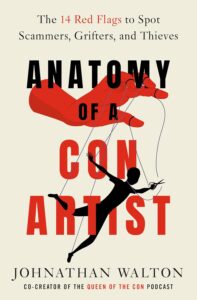 Most people picture a con artist as some shadowy stranger in a trench coat, sliding into your DMs with a dubious cryptocurrency opportunity. But the uncomfortable truth is far more sinister: The person most likely to scam you is someone who already knows your middle name, has sat at your Thanksgiving table, and knows exactly which emotional buttons to push because you showed them where every single one is located. Con artists don’t outthink their victims, they out-feel them, weaponizing love, sympathy, and trust with surgical precision. And the more convinced you are that you’d never fall for it, the wider open your door actually is.
Our guest for today, Anatomy of a Con Artist author Johnathan Walton, learned this the hardest way imaginable: scammed out of nearly $100,000 by a woman he considered a sister, over a four-year friendship built entirely on lies. But instead of retreating into shame (which is exactly how con artists keep their machinery running), Johnathan went nuclear, ultimately sending his scammer to prison twice and dedicating his life to cataloging the 14 red flags that show up in virtually every con. In this conversation, he walks us through all of them — from the “I’m here to help” entry point that hooked a brain-damaged retired NFL quarterback, to the cocktail parties where scammers mingle their victims together so everyone unknowingly vouches for the lie. He explains why con artists deliberately build complex, document-heavy schemes designed to make police shrug and call it a “civil matter,” and he lays out a step-by-step playbook for fighting back — including how to present your case to cops like a courtroom-ready pitch and why you should be calling the station every single day until they move your file just to get rid of you. Whether you’ve been burned before, suspect something’s off with someone in your life, or simply want to understand how the emotional wiring in all of us can be exploited, this one’s essential listening. Listen, learn, and enjoy!
Please Scroll Down for Featured Resources and Transcript!
Please note that some links on this page (books, movies, music, etc.) lead to affiliate programs for which The Jordan Harbinger Show receives compensation. It’s just one of the ways we keep the lights on around here. We appreciate your support!
- Sign up for Six-Minute Networking — our free networking and relationship development mini-course — at jordanharbinger.com/course!
- Subscribe to our once-a-week Wee Bit Wiser newsletter today and start filling your Wednesdays with wisdom!
- Do you even Reddit, bro? Join us at r/JordanHarbinger!
This Episode Is Sponsored By:
- Boll & Branch: 15% off first set of sheets: bollandbranch.com, code JORDAN
- SimpliSafe: 50% off + 1st month free: simplisafe.com/jordan
- DripDrop: 20% off: DripDrop.com, code JORDAN
- Gusto: Three months of free payroll: gusto.com/jordan
- The President’s Daily Brief: Listen here or wherever you find fine podcasts!
Thanks, Johnathan Walton!
Click here to let Jordan know about your number one takeaway from this episode!
And if you want us to answer your questions on one of our upcoming weekly Feedback Friday episodes, drop us a line at friday@jordanharbinger.com.
Resources from This Episode:
- Anatomy of a Con Artist: The 14 Red Flags to Spot Scammers, Grifters, and Thieves by Johnathan Walton | Amazon
- Queen of the Con Podcast with Johnathan Walton | Apple Podcasts
- Website | Johnathan Walton
- Dunning-Kruger Effect | The Decision Lab
- Producer Turned Podcaster Johnathan Walton Pens ‘Anatomy of a Con Artist’ Guide to Spotting Scams | Variety
- Depression Almost Ended the Life of Ex-NFL QB Erik Kramer. A Sham Marriage and Alleged Theft Threatened to Break Him Again. | Yahoo Sports
- The Quarterback and the Con Artist Podcast | Apple Podcasts
- Marianne Smyth: Con Artist Guilty of Fraud in Northern Ireland | IrishCentral
- The Intrigue of Revenge Fantasies | Psychology Today
- Revenge Fantasies after Experiencing Traumatic Events: Sex Differences | Frontiers in Psychology
- Jamaican Citizen Pleads Guilty to $220 Million International Ponzi Fraud and Money Laundering Scheme (David Smith/Olint Corp.) | U.S. Immigration and Customs Enforcement
- Confronting the Shame, Success, and Stigma of Scams | NPR
- How Psychopathy, Narcissism, and Machiavellianism Influence Con Artists | Slate
- Avoiding and Reporting Gift Card Scams | Federal Trade Commission
- BeenVerified Background Check Service | BeenVerified
- Intelius People Search and Background Check Service | Intelius
- Credit Freezes and Fraud Alerts | Federal Trade Commission
- How to Place or Lift a Security Freeze on Your Credit Report | USAGov
- Security Freeze | Equifax
- Freeze or Unfreeze Your Credit File for Free | Experian
- Credit Freeze | TransUnion
- Javier Leiva | Modern Romance Scam Tactics and Ways to Fight Back | The Jordan Harbinger Show
- Maria Konnikova | The Confidence Game | The Jordan Harbinger Show
- Frank Abagnale | Scam Me If You Can | The Jordan Harbinger Show
- How to Avoid Scams | Deep Dive | The Jordan Harbinger Show
- Coffeezilla | How to Expose Fake Guru Scams | The Jordan Harbinger Show
1305: Johnathan Walton | How to Spot Scammers, Grifters, and Thieves
This transcript is yet untouched by human hands. Please proceed with caution as we sort through what the robots have given us. We appreciate your patience!
Jordan Harbinger: [00:00:00] Coming up next on The Jordan Harbinger Show.
Johnathan Walton: A professional con artist is a psychopath, and they're not like you and me. We get a, a thrill from riding a rollercoaster and we like, that's fun. But for them, the fun is creating these worlds that do not exist. Watching with a God-like sense of glee as we say, what they want us to say, we do what they want us to do.
It's like they're directing a movie. We're all their actors, but we don't know it. But they do, and that's what they get off on. That's what brings them joy. They're not regular people. They are psychopaths.
Jordan Harbinger: Welcome to the show. I'm Jordan Harbinger. On The Jordan Harbinger Show, we decode the stories, secrets, and skills of the world's most fascinating people and turn their wisdom into practical advice that you can use to impact your own life and those around you. Our mission is to help you become a better informed, more critical thinker through long form conversations with a variety of amazing folks, from spies to CEOs, athletes, authors, [00:01:00] thinkers and performers, even the occasional neuroscientist, Russian chess Grandmaster, Emmy, nominated comedian or extreme athlete.
And if you're new to the show or you wanna tell your friends about the show, I suggest our episode starter packs. These are collections of our favorite episodes on topics like persuasion and negotiation, psychology and geopolitics, disinformation, social engineering, China, North Korea, crime, and cults and more.
That'll help new listeners get a taste of everything we do here on the show. Just visit Jordan harbinger.com/start or search for us in your Spotify app to get started. Today on the show, we're talking scams, real scams. Not the Nigerian prince wants your bank account kind of thing. But the kind that comes wrapped in a hug, sits at your dinner table and calls your mom auntie.
Our guest today was scammed by somebody. He considered family and instead of crawling away ashamed, like most victims, which by the way is exactly how scammers keep operating, he went nuclear. He sent his scammer to jail. Then he made it his mission to warn the rest of us. Because con artists don't outsmart you.
The good ones out feel you. They don't beat your logic, they beat your [00:02:00] emotions. And once his story went public, thousands of people came to him with their own con artist horror stories, and he started noticing patterns, red flags that show up in just about every scam. That's what we're gonna go over here today on the show, and we'll walk through every single one of those red flags.
Talk about con artists who move constantly, who build complex scams on purpose, who use technology to fake phone calls and text messages who manipulate trauma, and who mingle their victims together like a deranged matchmaker and who treat you like the art in their own twisted gallery. We'll also get into why reporting to police is basically like pitching a TV show, why contracts are a con artist's best friend.
Why police often say there's no crime here, when there absolutely is. And how to actually get law enforcement to take action. Of course, we'll show you what to do if you've been scammed already and how to keep it from happening again. All this and more today here on the show with Johnathan Walton. Here we go, man, you got scammed by somebody you considered family and then made it your mission to not only get revenge, but to warn others.
I love it already.
Johnathan Walton: Yeah, and what's funny is [00:03:00] everyone's celebrating me now. You know, my husband, my friends, my family, what a great job I did, getting her arrested and convicted twice and writing a book and everything, but I gotta remind them. Early on months into it when no one was doing anything, when police weren't doing anything.
When the con woman who scammed me managed to convince dozens of people that I'm the crazy one and she's the victim, everyone thought I was crazy and unhinged and obsessed. And at one point my husband, you know, told me, you gotta let this go. We have to move on. Let this go. So for a while I pretended to let it go.
I did all this in secret, you know, I was like crouched in the corner, going to the, the Starbucks down the street to research and investigate because everyone thought I was obsessed and I was obsessed. And you have to be obsessed to catch a con artist. That's just the plain truth. It has to be an obsession or, or they'll win.
Jordan Harbinger: Yeah. You know, it's interesting that you say people thought you were unhinged and nuts and you had to do everything in secret because. There's probably a very fine line between, okay, you need to go to a therapist and get like [00:04:00] mental help for this like, uh, victim complex that you have and you gotta put this woman in jail and somebody should be supporting you.
But since no one is, you just got a vendetta and you, you're just doing it.
Johnathan Walton: Yeah. And it got even crazier than that. Shortly after realizing she conned me outta close to a hundred thousand dollars and I was devastated and cried and I got so angry and I'm a live and let live kind of guy. I'm a vegetarian.
I catch the spider inside and take it outside and release it.
Jordan Harbinger: Yes,
Johnathan Walton: I don't hurt or harm anything. But for three or four months after the fact, I started having these daydreams, these murder fantasies. One, I was throwing her off the top of my building and watching her body splat at the floor. Another, I was throwing her down 20 flights of stairs and watching her tumble to her death.
And my favorite one, the one I relive the most. Was strangling her and watching the life drift out of her horizon. These things made me happy. These things brought me joy and relief at a, at a dark time and right. I remember telling [00:05:00] my, my best friend about it at the time, Evan, the look of horror and shock on his face.
And he's like, starts backing up and he is like, man, you need to see a shrink. Like this is not okay. So I looked into therapy, I looked into seeing a shrink and while I was looking to find the right therapist, 'cause I, this is not me, I'm not a murderer, I don't have fantasies of hurting anything, but I found out it's totally normal for victims to fantasize about harming their perpetrators.
It's totally normal and it usually subsides on its own. And it did. After three or four months for me, it went away. And I'm back to releasing spiders that I catch inside my house, let 'em outside. But for a while there, yeah, it was dark. I had no recourse other than fantasizing about killing her.
Jordan Harbinger: Yeah. It's funny 'cause I was gonna ask you what your favorite was, but you already said,
Johnathan Walton: I look back at that man.
I was and I don't recognize that. Yeah. I'm not a killer. But listen, until you've been effed over by someone you swore loved you, and then you find out it was all a scam for years. It was a four year long [00:06:00] con. The rage you feel is just, you know, ineffable.
Jordan Harbinger: What I liked about the book that I read was most books on scams, they don't have real life experience.
It's like a guy, well, there's Frank w Abna, who's just a conman and you know, lied about everything. But then there's other scam books that are like, don't do this, don't do that, don't do this. And the perspective is kind of usually, I'm so smart, I would never get scammed. And I'm telling you the things that I do that keep me from getting scammed.
And whenever I read something like that, I kind of put the book down after the first chapter because I know some con men, and I know some anticon men who are like magicians that expose con men. And one of the things that they always say is some variation of, if you are the type of person that thinks they would never get scammed.
You're exactly the kind of person that I wanna meet because I'm going to scam the shit outta you. And so anybody who writes a book that's like, I'm scam proof and you can be too. It's kind of like, uh, okay. So you just don't understand that you're vulnerable to this because you think you're too smart.
And so your advice has an aste. Every [00:07:00] single thing in that book that that person writes, has an asterisk connects to it, which is, Hey, this is kind of untested and may not work.
Johnathan Walton: Yeah. And it's also a level of victim shaming, right? Yes, I agree. I'm too smart for that. And I say that in chapter one in my book, con Artists, they don't outsmart you.
They're not smarter than you. They out feel you.
Jordan Harbinger: Yes.
Johnathan Walton: They create this emotional bond. They get a hook into your emotions and into your heart, and they trick you into falling in love with them or falling in love and caring about something. They created a cause or something. Once you're making decisions with your heart and not your head, you're gonna get scammed then.
Yeah. I double down on what you just said. If you think I could never get scammed Yeah. You are exactly who they're looking for.
Jordan Harbinger: Yes.
Johnathan Walton: Because you don't think it can happen to you and that's when it happens to you.
Jordan Harbinger: Exactly. And the whole emotions versus logic thing. A lot of people who are smart, they're just like, no, I'm really smart.
I look into things and I'll hear this from other people who, they'll go, oh, how did you get screwed over on such and such business deal? Didn't you have an agreement? And I'm like. I'm a lawyer, of course, I had an agreement. [00:08:00] What you're not understanding, it's like this Dunning Kruger thing. Like what you don't understand is, oh, like someone will go, well, that'll teach you a lesson about not having a contract in place.
And I'm like, dude, do you think we didn't have a contract in place? How do you sue a Dubai company with a Russian guy running it who you thought you trusted, who sent you a fake bill of goods? It's fraud. It's a crime. It would trick anybody who does business, as a matter of course, because it's fraud.
You're not smarter than me from having not had this opportunity to get scammed. You just don't run in circles where you would've even had this. It's like infuriating, right? Because it's like, I wouldn't have gotten scammed. Dude, no one's calling you for this because you're literally too small of a fry.
Okay? I wouldn't, don't count your winning chips just yet, pal. Um, but it's the emotions that get involved too. Like, oh, I would never get scammed. I would always check on a deal. Would you if you did it with your cousin? Well, my cousin wouldn't scam me. Are you sure about that? Because that's who scams you.
Family members, people you're friends with. These people just they, when they write stuff like this, they just don't get it. You know what [00:09:00] I mean?
Johnathan Walton: I agree a thousand percent. And that's exactly what I lay out, is the fact that most people are operating under this false belief, this assumption that a con artist is somewhere out there, someone you don't know.
But that's not true. Everyone listening and watching this right now, I guaran fing to you. You know a con artist,
Jordan Harbinger: right?
Johnathan Walton: There is a con artist in your life right now. They just haven't scammed you yet. And the people, they are scamming, your friends, your family, your acquaintances, they're not talking about it.
The vast majority of victims who get conned don't tell anyone. And that lets the con artists scam again and again and again. No one's talking about it. I see this all the time. And the other thing, the emotional hook is not to be underplayed. It's a powerful thing. We're human beings, we're creatures of emotion.
My con artist told me her family had disowned her after I confessed that I'd come out as gay and my family disowned me. I hadn't been home for Christmas in almost eight years, so I was in a raw place from that. [00:10:00] So she pounced and well, my family disowned me. That bonded us. You know, we weren't just two new friends in Los Angeles.
We were like these two discarded souls making each other family when our own families didn't want us. So it's a powerful hook, the emotional bond and the fact that you probably already know a scammer just like that. Sounds like you got scammed by someone you knew.
Jordan Harbinger: So I haven't been scam scammed, but I've been screwed over on a business deal.
And it's the same thing. Yeah. Because the only difference is the intent from the jump with the other party was not to screw me over. Whereas in a scam, it's the intent from the jump. But really I was thinking about this. Towards the end, like when you're in litigation with somebody who's really vindictive and has like all their ego wrapped into something, it's kind of the same thing.
They're gonna screw you. They want to torture you, they wanna needle you. They get a thrill out of it. They wanna keep your money because they can't afford to give you what's rightfully yours. It doesn't, the sort of end result is the same. Even if the function was not originally to screw you over, it became so [00:11:00] later on.
So a lot of the feelings I think, are probably quite similar. I think it hurts less to get screwed over in a business deal because everything goes awry and you realize the other person is crap and everything falls apart from there. Whereas with a scam, that person is smiling to your face the whole time.
Like in a business deal, they go, alright, we're lawyering up. Screw you. I'm not paying you this. And you're like, yeah, you are. And then it's like da da, da. Back and forth, back and forth. Whereas with the scam, they're like, oh my God, I'm so sorry you didn't get the wire. I, this is ridiculous. Okay, I'm going to Indonesia and when I come back, blah, blah, blah, blah, blah.
And you're like, they're so nice. And then meanwhile they're like, what an idiot. You know, that's worse. So getting scammed. Is worse because it, they take it's advantage of you and it's the plan from the jump and you just think what kind of sociopath? Whereas it a business deal that disintegrates what an asshole.
Yes. What a crazy psychopath that planned this from the very beginning. Mm. Not really, you know, it's different.
Johnathan Walton: Yeah. And when I look back, you know, she was my best friend. She was like a sister to me for four long years. The moments where she would cry, [00:12:00] I'd be consoling her, hugging her and her tears are wetting my shirt collar
Jordan Harbinger: right.
Johnathan Walton: All over her family that's trying to destroy her. And like, none of that was real, but she's crying. Like it's a hard for me and my brain to connect the two things. It's all fake. But I felt emotion from no, that wasn't real. She's an actress, right? Like she's so good at crying at the drop of a hat and, and even though I'm a gay guy.
A crying woman has a power over me. I was raised by a single mother who cried a lot, I guess, I don't know. But a crying woman, a damsel in distress is a powerful lure that I fall for and I fell for. And it just reinforced what she was saying. This was a, a woman being attacked and disowned by her family.
'cause they're trying to get her disinherited and, and the tears really sold it. My god.
Jordan Harbinger: That's another level of sort of psychopathy, right? Is like they, these people, I, I look at the amount of work that these scammers in your book put into scamming other people. And it's like. Get a job, you'd be great at it.
You'd [00:13:00] be so good at sales, you know, where you could make millions of dollars selling something and it wouldn't put you in federal prison, but they don't wanna do that. Right. The the whole thing is, I got one over on these people and I'm better than them. That's what's crazy.
Johnathan Walton: Yeah. You nailed it. I mean, they are psychopaths.
You know, a professional con artist is a psychopath, and they're not like, you and me, we get a, a thrill from riding a rollercoaster and we Right. Like, that's fun. But for them, the fun is creating these worlds that do not exist. And watching with a God-like sense of glee, as we say, what they want us to say, we do what they want us to do.
It's like they're directing a movie. We're all their actors, but we don't know it. But they do, and that's what they get off on. That's what brings them joy. They're not regular people, a regular person. Would lose sleep.
Jordan Harbinger: Yeah.
Johnathan Walton: Wondering, how am I gonna keep all these stories straight? I told this guy this, I got this woman doing this.
No, I'm a psychic. I'm a psychologist. No, no, no. I'm a witch. No, no, no. I'm a Satan worshiper. Lucia [00:14:00] Blay. I started my own Satanic church. Like she had all these characters going, how do you keep 'em straight? It would drive a regular person mad. It
Jordan Harbinger: really
Johnathan Walton: would. But it makes a con artist happy and fulfilled.
Jordan Harbinger: They create all this chaos that they're just controlling around them. It's really actually insane. You mentioned before shame. Most people who get scammed are ashamed. So this helps the con artist continue to con others because someone gives him 30 grand and doesn't wanna say anything, and they do their best to cover it up, which is a dream for the con artist, right?
Like, oh, you're never gonna tell your husband you're gonna continue to stress out about this until basically he does a financial audit in 10 years and wonders where the savings from the last three years. What I mean, y you know, it's crazy. And you had to sort of get around that to send her to jail, uh, because otherwise the shame allows them to cover and, and keep going.
Johnathan Walton: Absolutely. And two important points I wanna make here is number one, it's actually one of the red flags. It's red flag number 13 TMI. They use this TMI technique. Too much information where you meet a con artist for the first time. New [00:15:00] girlfriend, new boyfriend, new friend, new neighbor. In my case. And all of a sudden they start opening up to you and revealing all these personal details and these dark secrets of their lives.
And that's powerful. It does two things. It, number one, it makes you think, oh wow, this person must really trust me to tell me their deep, dark secrets. And number two, it makes you start revealing your deep, dark secrets to them. So by the time the money changes, hands could be weeks, could be months, could be years.
In my case, you don't wanna go to police because the con artist knows all your stories. Knows all your secrets. And the last thing you want to happen is to have to recite that to a police officer. Or God forbid you're sitting on the stand and their cross-examining the con artist. And is that true? Did you do that?
You know, and sudden you are on trial for your stuff. So that's what keeps victims quiet. But I look back at my own life and I wonder what made me so different? How am I the one to write this book about these 14 red flags? Nobody came up with this before me. Okay? It had to be me. But another reason, I'm the perfect [00:16:00] vessel for this.
Early on, I was a TV news reporter. My first on Air job, I was 24, 25 years old, KBB TV in San Antonio. I'd never been on the air before. And I got hired as a feature reporter, right, to do like fun stories. So I spent all day writing and shooting my story and getting it edited and I fronted it. First night on the air, never been on the air.
I'm a kid and I was a hit, the anchors applauding and laughing. At the end of my story, I walked back into the newsroom standing ovation from producers and reporters and photographers, and the guy who hired me, Alan, little god rest his soul. And Greg kin, my God, I felt like a king of the effing world. And then 60 seconds later, I go to my desk and I get my first viewer voicemail and it's this angry Texas woman and she's like, you Baldheaded m Fing faggot You so effing ugly.
You ball like she tore into me. And I laughed it off while people were watching 'cause it was [00:17:00] on speaker and everyone heard it. And I thought, oh this is funny. But inside I was dying. I went home that night, I fell asleep, coiled in the fetal position, crying. 'cause I'm like, I can't do this job. Like what am I, am I this brilliant, funny reporter that would go on to win Emmys and get applause?
Or am I too ugly to be on TV like this angry woman who hate like what am I? What am I? And I'm 24, 25 years old. And over the ensuing weeks I learned out of sheer necessity. 'cause I couldn't do a job like that without knowing. I can't care what anyone thinks. I can't solicit anyone's opinion about what I'm doing because if you ask 10 people, what do you think of this?
What do you think of this? What do you think of this? You're gonna get 10 different opinions and I'll never get any work done. I got, I'm gonna schedule, you know, turning a package a day, we call it in the news business. It's a herculean task. It's hard. You gotta shoot, write, come with an idea, go shoot it, interview people, track it, write it, edit it together.
Like I'm gonna run to get it on the news just in time, every freaking day. So I learned early [00:18:00] on not to care what people think, not knowing what a blessing that experience would become. Because when I got conned and I went to police, and people asked me, weren't you scared to go to police? Weren't you ashamed?
Weren't you worried what they would think? No, it never occurred to me because at that point I'd had two decades of practice, not caring. It literally never occurred to me and it surprised me. In all these cases I investigate. It is the chief concern of every victim. Like, what are people gonna think? Like, I really didn't care.
Jordan Harbinger: Yeah. This is interesting you, you also mentioned that reporting to the police is essentially an art. How is reporting a scam to the police? Well, maybe it's like a TV show pitch given your industry.
Johnathan Walton: Yeah. Pitching a criminal case to police is like pitching a television show to a network executive. You gotta make it sexy, you gotta make it interesting.
You gotta do the work and tell the story for them. Most victims think you can go to police and you say you were scammed and the emotion and you're crying. They don't care. They'll turn you away. And they turn a lot of victims away. They turn the majority of victims of scams [00:19:00] away. They tell them, quote, it's not a crime.
Go hire a lawyer and sue this person. It's not a crime. Especially if there's any kind of forged paperwork involved that turns cops off right away. Because that tells them civil, not criminal,
Jordan Harbinger: which is not correct because forgery is a crime. And fraud is a crime.
Johnathan Walton: Exactly. But the way the hierarchy is, you're pitching this cop on the front lines, right.
And it's, he's the judge and executioner, he's gonna decide if a crime happened, and if he doesn't think a crime happened, he's not gonna take a report. Simple as that. And you think a guy in a badge. I remember when the cop turned me away, he's like, it's not a crime. I'm like, okay, he must know what he's talking about.
He's got a badge. But he was wrong. And I pushed back and I found dozens of other victims and I built a strong criminal case on my own that they could not ignore. And I presented to them on a silver platter. I made it sexy and exciting.
Jordan Harbinger: Yeah,
Johnathan Walton: and that's what you have to do. You can't just go to police willy-nilly.
You gotta pick a time. I recommend Sunday and a 5:00 AM when no one's there. You have an audience with a cop and you gotta Vanna White present your evidence and you gotta write up an [00:20:00] affidavit. You gotta get witness statements. And I show people how to do this in the last chapter of my book because I realize and so many victims who call me for help, and I end up investigating their cases.
Most of them, the cops already turned them away and I send them back armed.
Jordan Harbinger: I don't want to disparage cops, but I will say that everybody looks for ways to make their job easier. Jour, like for journalists, if you basically write the whole article for them, they'll sort of rewrite the thing and go, yeah, all right, I'll cover you.
I mean, I've had cops tell me that package theft off my porch wasn't really a crime. And I'm like, I gotta draw the line here, pal. How long have you been doing this job? Just write the report. And he was like, you can file one online, but I'm not gonna take one. And I was like, you sir, are useless. But I also kind of get it like it's the eighth thousandth package theft of the week in San Jose, California.
You don't wanna fill it out, you're not gonna go after them. I have nothing to give you other than, gee, someone took something off my porch, maybe. I think kind of so who cares? And the answer is, my insurance company and [00:21:00] Amazon at that time cared 'cause it was an expensive item. And so I need this report 'cause I'm not paying for this and Amazon needs this for their insurance.
So you are going to sign this effing report, or I am not letting you outta my house. You know, it was that kind of thing. But it was, that's how ridiculous it is, right? They'll say, well this isn't really a crime. And it's like, this is the definition of theft. Okay, this is the easiest crime. But when something gets complex, a lot of times cops are either too new and not trained at this, or they go, man, it's early.
My coffee hasn't kicked in yet. I can't really wrap my head around why this is a crime. So it's civil. I mean, say this is a real, another real example, a friend of mine had a bunch of cryptocurrencies stolen from him and they were like, well, it's out of our jurisdiction. And I was like, no, dude. The cryptocurrency, yes, it's on the blockchain, which exists sort of wherever, but it's in every jurisdiction because it's on the freaking blockchain.
And it was your cryptocurrency that you have technically custody of in your home. And the cop was just like, but it's on the internet. And I was like, just get out your little pad and [00:22:00] let somebody, let somebody with more than three brain cells decide if this is a crime. How's that? Because they just couldn't wrap their mind around it.
'cause look and cops defense, he, he's probably never heard of Bitcoin at the time. So he thought it was data theft, which also they said was not a crime, which is also wrong. It's just they don't get this stuff. They get someone smash windows. Someone came in, grabbed TV and leave. That's what they understand.
I kind of get it. I understand why that's the limit. The FBI usually handles the other stuff. They're marginally better and understanding when a crime has occurred. But again, I'm not trying to crap on these guys. They're, it's kinda the backbone of safety in our society in many ways, but. Everybody wants their job to be as easy as possible.
And sometimes this is just not the way to do it. Right. Reporting something
Johnathan Walton: complex. Right. And, and that's definitely a factor. But the other factor that I think is more the majority of cases that people don't consider, you know, when you're the victim, you kind of have tunnel vision and you think everyone's against you.
But, you know, I've since made friends with a lot of detectives and [00:23:00] investigators and FBI agents and prosecutors. I've been fortunate. I've done six seasons of that podcast. Queen of the Con I, I've interviewed a bunch of 'em, so I kind of know how the system works now. And it's not that they don't wanna do the work, it's that, especially in major metropolitan areas like Los Angeles or New York or even San Jose or you know, big cities, there is so much bloodshed.
There are people who got beat up and raped and, and shot. Those take precedence, those get everyone's attention and they're overwhelmed.
Jordan Harbinger: Yeah.
Johnathan Walton: These cops are overwhelmed. So it's almost like being in a triage unit on the front lines of World War ii. It's like you got a guy coming with a little sore and a cut, and you got a guy missing an arm and his eyes blown out.
You know? Yeah. Send the cut away. Let's deal with a, the, the missing arm guy. So it's like that, like, you know, your scam pales in comparison to what they're dealing with. So, and nobody tells victims this, but I Say it again and again in the book, the onus is on you, the victim, to make your case.
Jordan Harbinger: What really opened things up for me, aside from just being a lawyer and seeing some of the inside of this, was [00:24:00] I just couldn't help but notice that when I was in New York City, if a crime occurred and I reported it or somebody else reported it, it was always, always, always quote unquote a civil matter or not a big enough deal for the cops.
If the cop was related to the victim, they had an a PB out on the person that took the cell phone from the taxi cab in lower Manhattan on a Friday night, and I was like, aha. They can do things if the incentives are there, if Aunt Mabel's gonna find out that her, you know, nephew cop didn't do shit when her, you know, sons phone was stolen, that's gonna be annoying for him and he's gonna figure out how to remedy that situation.
If there's no co consequence other than ano yet another citizen is sort of mildly disgruntled with the police, they're not gonna give a shit. That's just the fact of the matter. And you're right, there's somebody else who's got a sexual assault sitting there trying to file a report was shaking, and they're obviously going to be more important in that moment than the fact that you left your Bitcoin to some dude in Pakistan.
Now, here's something that won't [00:25:00] ruin your life. We'll be right back.
This episode is sponsored in part by Boll and Branch. People spend about a third of their lives in bed over the course of just 10 years. That's like 30,000 hours with your sheets. So when you look at it that way, investing in good bedding, it's not indulgent. It's just a smart upgrade. And that's why we're so into Boll and Branch.
Their signature sheets are made from a hundred percent organic cotton. They feel incredible, buttery, soft, 'cause you wanna sleep in some butter, breathable, instantly more comfortable the moment you climb into bed. They somehow make your whole bed feel cooler, cleaner, and more put together. And you won't have to laugh at your own jokes if you buy these.
And the thing about bad sheets is they don't usually fall apart all at once. First, they start slipping off the corners, then they feel a little scratchy, a little thinner, a little warmer than they should. You get used to it. And then finally you replace them with Boll and branch, and you'll realize just how much better sleep can feel because again, you're sleeping in some juicy soft butter.
It's one of those upgrades that pays off every single night. And I can personally say they really do get softer with every wash. We wash ours every week and they just keep getting better. And butterier.
Jen Harbinger: Upgrade your [00:26:00] sleep during Boll and Branch's annual spring event. Take 20% off SITEWIDE plus free shipping at bollandbranch.com/jordan with code Jordan.
That's Boll and Branch, bollandbranch.com/jordan. Code Jordan to unlock 20% off. Exclusions apply. See site for details.
Jordan Harbinger: This episode is also sponsored by SimpliSafe. Traditional home security always seemed designed to make things harder than they needed to be. The kind my parents got stuck with came with expensive monthly fees, long contracts, installation.
That meant waiting around forever. For a technician, it turns something that should have felt reassuring into a hassle for regular people. That's one of the reasons I like SimpliSafe. It strips all that friction outta the process. You can go online, build a system that actually makes sense for your home, have it shipped straight to your door, and you set it up yourself.
No drilling, no complicated install, no need to be particularly handy. The app walks you through the whole thing and you can have your system up and running and under an hour. Also, SimpliSafe is a full home security system. Sensors for doors and windows, cameras for inside and outside 24 7. Professional monitoring behind all of it.
So whether it's a break in a fire or even a flood, [00:27:00] there are people ready to act and it's all actually affordable.
Jen Harbinger: We want you to experience the same peace of mind we do, which is why we've partnered with SimpliSafe to offer an exclusive discount to our listeners. Right now, you can get 50% off your new system by visiting simplisafe.com/jordan.
That's half off at simplisafe.com/jordan. There's no safe like SimpliSafe.
Jordan Harbinger: If you're wondering how I manage to book all these great authors, thinkers, creators every week, it is because of my network and I'm teaching you how to build your network for free over at sixminutenetworking.com. Now, I teach this stuff to three letter agencies in law enforcement, and it has been brought to my attention that con artists are almost certainly also using these techniques.
So what better reason do you need than to learn them for yourself so you can see if they're being applied to you in a way that's white hat or black hat. The best way to avoid being manipulated is to know how these things work. This course is designed for you to be able to apply this in a non-manipulative white hat way.
Six minutes a day is all it takes, and many of the guests on our show subscribe and contribute to the course. Come on and join us. [00:28:00] You'll be in smart, honest company where you belong. You can find the course again, all free and free of shenanigans at sixminutenetworking.com. Now back to Johnathan Walton.
Your book is helpful. It goes through all these red flags. Red flag number one. I'm here to help. Essentially somebody who is. Overly helpful. Is that fair? I would love to go through what the red flag is and then maybe like a brief story of this inaction so that people can really internalize the concept.
Johnathan Walton: Absolutely. And the case I write about in the book is the Eric Kramer case for this red flag. Most con artists, 90% of the time in the cases I've investigated and we're talking hundreds of cases over the past eight years, the con artist enters the victim's life offering to help because who doesn't love a helper?
My con artist offered to help me and retired NFL quarterback Eric Kramer, his con artist offered to help him. He had battled depression on an offer 20 years, probably CTE, but we won't know for sure until, you know, he's, that there's an autopsy after he dies. So his [00:29:00] son died of a drug overdose and his mother died and his father was diagnosed with cancer and he was in a really dark place.
So he checks himself into a motel room, puts a gun to his head, pulls the trigger, but he lives. But he's got the brain capacity of a six-year-old for a couple years. And during his recovery. A con artist swoops in an ex-girlfriend who immediately sensed upon checking on him that he doesn't remember what happened in their relationship and she wants back in.
So she gets in his life, convinces his friends and family that she just wants to help. She wants to help him recover. Before Elong, she moves into his house, they start to get suspicious. They notice Amazon packages piling up on the doorstep. They're from her. She quits her job. She starts. Taking hundreds of dollars a day off of his credit card and cash advances and buying Visa gift cards at Walgreens.
Like that is the currency of scammers, right? Gift cards. So
Jordan Harbinger: it really is like the fact that those exist. I would love to see from these companies, what percentage of these are legit business. Like, oh, we sold $10 million in iTunes [00:30:00] gift cards. Okay, but what percentage of that was redeemed for songs in Apple Music?
And the answer is gonna be like 0.1%. The rest of it's gonna be scammers abroad.
Johnathan Walton: Scammers, yeah. Be suspicious of gift cards. Yeah. So once she figures out they're onto her and they've gone to the sheriff's department and there's a criminal investigation, what does she do? She marries him. Now he's got the brain capacity of a child.
So he just says yes to whatever. So secret ceremony, no friends and family, she marries him and continues scamming him. By the time he comes to he, he regains his mental capacity, you know, all of a sudden three years into it, three years into his healing. And he realizes she's scamming him and he tells her to get out of his house.
She calls the cops and runs another scam that he beat her. So the cops show up and because of OJ Simpson, they arrest Eric Kramer immediately. Right. Headlines across the country. Retired NFL quarterback Eric Kramer, you know, in jail for battery. And, and I fear for my life. They're quoting her court records that she fears for her life.
It was all another scam. So,
JHS Trailer: right.
Johnathan Walton: Long story short, that woman eventually pled [00:31:00] guilty. She was charged, arrested, pled guilty, but she cost Eric more than $700,000.
Jordan Harbinger: Oh wow.
Johnathan Walton: She would've gotten more, if not for the people in Eric's life who stepped up and stepped in and helped him. But it all started, she offered to help.
And who doesn't love a helper? So that is red flag number one. Con artists aren't like regular people. When there's a disaster going down, that's when they come out. When everyone's running away from something, a professional con artist is heading towards it. 'cause they know there is money to be made in offering to help.
You don't actually have to help. People are just blinded and distracted by the shine of the offer.
Jordan Harbinger: It reminds me of whenever there's a, a hurricane in Haiti and, and stuff like that, you get those texts that are like, donate to the Red Cross. We urgently need blood, but we're, you know, your $20 will do also.
And then you are like, why is the URL for the donation to the red cross ZYX ABC w.xyz/donate that is not an official Red Cross url. And then you, you're like, oh my god, millions of people got this text. This text [00:32:00] is preying on millions of people who saw a news report about a tsunami and these people are just stealing this money.
Like, I'm always so curious. I'm like, I wanna be a fly on the wall in this guy's house and just be like, what is your life like where you are this shitty of a human being?
Johnathan Walton: I don't think it's that. I don't think it's that they think they're shitty or something bad happened. I think con artists psychopaths are different people.
They enjoy the scam. They don't think of it as evil at all. They get a sense of a thrill, a God-like sense of I created this from nothing and look, I'm getting money now. Ha ha ha. Yeah, I'm the shit. You and I keep ascribing regular morals and values and feelings to these people, but I don't even think they're people.
Jordan Harbinger: Yeah, I agree with
Johnathan Walton: you. You know, I think they're caricatures of human beings.
Jordan Harbinger: This is one reason why I am, like, I have like a, I, I guess you'd call it a strong sense of justice. When I find somebody who is a scammer or something like that, I will dox them. You know what that is?
Johnathan Walton: Yeah.
Jordan Harbinger: I will go the extra mile.
And I've had FBI [00:33:00] agents in my house that are like, why do you want to take this person down so bad? And I'm, I'm like, they're like, do you know them? Do they scam someone? You know? And I'm like, no. And they're like, but why? And I'm like, you guys can relate to this. Your FBI agents. I wanna see them. Just crying behind bars and being like, why me?
And being like, because you're a piece of shit. Have fun. You're here for 10 years. Saddle up. Yeah, buck up buttercup. Same. You're gonna be here for a minute. I just, I that feeling I will float out of that prison just on a cloud of air.
Johnathan Walton: I mean, it's a public service.
Jordan Harbinger: Yeah.
Johnathan Walton: Because you're putting them outta commission and you're saving untold numbers of people from getting scammed.
So you're, if you're doing God's work, God knows. Absolutely.
Jordan Harbinger: Yeah. It's thrilling. Plus also when you can commit a borderline criminal hacker type act against a scam center in Dubai. I'm kind of like, this is a victimless crime. Yes. I'm stealing all of your records. This is a hypothetical people. Yes, I'm stealing all of your personnel records and handing them over to the FBI.
But you know what? Screw you. You're a scam center. [00:34:00] I don't really care if it results in a bunch of you getting beaten to death by your Chinese triad bosses, your scammers, who cares? It's your problem. You signed up for this. I don't give a crap. You're gonna end up at a Dubai prison getting tortured by the guards.
Oh, well guess you drew a bad hand this time. Should have thought of that. I don't really care.
Johnathan Walton: I love it. That's great.
Jordan Harbinger: Red flag number two, kind too quick. Tell me about Ma, 'cause this was kind of her initial entree into your life, was it not?
Johnathan Walton: Absolutely. Yes. She was a new neighbor. My con artist was a new neighbor.
Someone I, I knew and met and liked immediately because she stepped out of the fray and offered to help our building, lost our pool. We had this gigantic tropical paradise kind of pool in the middle of downtown la shared by three different buildings. Our building didn't wanna pay for repair, so they took it to court and they blocked us out and we were mad.
And I put up flyers everywhere. Let's get the pool back. I galvanized our building and got hundreds of people on board in this effort to get the pool back. And as I say that to you now, I realize me [00:35:00] putting up that flyer all over and me stuffing that flyer under everyone's door in our building, including the woman who would go on to scam me, I was inadvertently revealing all I needed to about myself to give her the idea of the perfect con just for me.
She must have been salivating licking her lips, reading that flyer and thinking to herself, wow, this guy's a do-gooder. I'm gonna make him do good for me. Because that's exactly what she went on to do. So she took over the meeting, she offered to help. She said her boyfriend is this married politician who sued our building and can get the pool back and blah, blah, blah.
And we all believed it. She was dating a married politician, but he had no idea about the pool situation, nor was he helping. But again, the help doesn't have to be real to get in. 'cause by then she was in, we loved her. And then Red Flag number two came out too, kind too quick. She took my husband and me for dinner, paid the $700 bill.
Oof. She was whining and dining as frequently. She bought us gifts. She got my sister, these 20 designer dresses that she said her client was a [00:36:00] costume designer in Hollywood is gonna throw them away. They're brand new, like Christian Dior, like big time designers. And my sister trying them on crying. She's crying.
She's so happy. Con artists are too kind, too quick. They're gonna buy you dinner, they're gonna walk your dog, they're gonna watch your kids. Mayor took us on vacations to Palm Springs and paid for everything. Like it was an investment for her though. She was investing and it worked like. Someone takes you on a vacation, how do you not love them?
Jordan Harbinger: Two gay guys from LA going to Palm Springs, that name of more iconic trio, I guess. Yeah, that's She got your no Propel. Yeah.
Johnathan Walton: Oh yeah. Oh, for sure. Yeah. No, we wa listen, looking back, she was just laying out the breadcrumbs and I was just eating 'em up. Unknowing.
Jordan Harbinger: But I hope your sister kept the dresses after all this.
Johnathan Walton: Oh yeah, she did. Yeah. Good.
Jordan Harbinger: At least she got something outta the deal. Um, so I just, I find some of the details about this person, this mare are comical, right? I mean, they're at your expense, so I'm sorry to say that, but some of them are. No, it's
Johnathan Walton: okay. They are absolutely
Jordan Harbinger: like, she comes back and she's got all these bandages on her legs and you're like, oh my God, what happened?
Well, I [00:37:00] have lupus, and you find out you just had liposuction and it's like, oh, for God's sake.
Johnathan Walton: Like, but listen, lupus, someone tells you they have lupus number one. Do you question them?
Jordan Harbinger: Of course not.
Johnathan Walton: No. And then the other, the she, a lot of these medical scams she was great at. I come to find out, she convinced our landlord that she had cancer.
And was getting chemo and, and our landlord let her skate rent free for six months.
Jordan Harbinger: Whoa.
Johnathan Walton: Like when someone tells you they have cancer, you just believe them.
Jordan Harbinger: Yeah.
Johnathan Walton: The reason the landlord believed her, she had evidence. Right. So come to find out, my con artist mare was 300 pounds years ago, and she got gastric bypass surgery and got thin.
And part of getting gastric bypass surgery is malnutrition. Right. So she would frequently get low blood iron. She would intentionally let her iron get so low that she'd have to be admitted into a hospital for an iron transfusion, which is not a major thing. They put you in a hospital bed, they hook you up to an iv, you get the transfusion, you go home.
But it was when she was getting these [00:38:00] transfusions that she would create because she could keep her iron up if she wanted to, but she wanted that hospital because mm-hmm. She would have the nurse take a picture of her in a hospital bed, hooked up to tubes and wires, and then she'd text that picture.
Tell the landlord, I'm sorry, I can't pay rent. I'm in the hospital getting chemo. It's so evil, but so geniusly effective.
Jordan Harbinger: It's nuts. And when people think I would never get scammed, it's like, okay, think about situations like this. I just did a show the other day that was about cybersecurity. And this is very apt because he, the guy said, whenever I consult for companies or government agencies, they always say, we want a hundred percent security.
And the problem with having a hundred percent security, you then have 0% functionality. Basically. Like you wanna secure phone, smash it, and burn the pieces. This actually makes sense here. 'cause people go, I would never get scammed. Okay then just don't have any relationships. Don't have any friends, never do any business and don't communicate with anyone.
Okay. You're scam proof kind of, I suppose. Now, how's your quality of life? Do you have good relationship? Oh wait, no. You don't have any friends. You don't have any [00:39:00] family that you talk to. You don't have any, uh, business relationships. Okay, so your scam proof kind of maybe. This is another, I think I'd asked this years ago on this very show, why are psychopaths still in society?
Why haven't they sort of been bred out over the past, you know, hundreds of thousands of years? The answer is because some psychopaths are a function, right? They're surgeons, they're CEOs, they're leaders. Whatever it is, we need them. The other thing is though society doesn't adapt to them because they're one, a small portion of society.
But two, in order to adapt, to defend everyone against psychopathic behavior, we would've to shut down the level of trust in society that allows things to function. When I go to a restaurant, they don't go, well, you better pay first in cash pal, because we don't know if you're good for it. And you're like, okay, so you're carrying around a wad of cash to have your dinner and da da.
No. You order the food, they bring you everything. You lay the card in there and they just assume that you're not going to call the bank and say it was fraud and yada yada. And that works. 99.99% of the time
Johnathan Walton: society would grind to a halt without trust.
Jordan Harbinger: Right.
Johnathan Walton: But nothing would get done. Yes. You wouldn't answer your [00:40:00] door or your phone, right.
Or anything. Yeah.
Jordan Harbinger: So like we have to go. Oh, she's in the hospital getting chemo. That's probably true because who in their right mind would lie about this? That is a normal human reaction. I know there's people going, I would never let her do this, and yada, yes, you would, or you're kind of an asshole and that's probably you bring, have other problems if you don't believe somebody who tells you they have lupus and then shows you a photo of them in the hospital getting a blood transfusion, right?
Like it's just, it would be very weird to not believe that story.
Johnathan Walton: Agreed. And con artists know this better than most, and that's why they engineer these situations and these photographs and these lies to text and email you and convince you of anything
Jordan Harbinger: because the idea that it's all chess moves to gain trust and later abuse it.
That's crazy work to even think like that. And in very, very, very, very rare cases, that is what's happening. So you've gotta look out for a, I assume, a combination of these red flags. So red flag number one, I'm
Johnathan Walton: absolutely,
Jordan Harbinger: I'm here to
Johnathan Walton: help, and I say this in the book, you know, on their own, each of the red flags is not a warning that [00:41:00] they're, you're being conned or you're in the presence of a professional scammer.
But as they start to compound, if you see three or four or more. You are being scammed, right? If someone's waving four of these 14 red flags, guaranteed they're gonna be waving some others really soon. And this is a game I play with myself all the time now because I say, if I met my con artist, mayor Smith today, knowing what I know now about how con artists operate, having written this book, anatomy of a Con Artist, the 14 Red Flags to Spot Scammers, Grifters and Thieves, would I know she's a con artist?
And the answer is absolutely. Mm. Looking back, she was waving all the flags almost immediately outta the gate. She was waving all of them very quickly. So it's obvious now, but until somebody catalogs and makes notes and points them out, what they are, you don't know. You just think, oh, what a kind sweet person with a lot of drama who has this great job.
And she's always showing me her phone and you know, there's this element of scarcity and beak wedding, and she's got a great day job and she needs a wire. And she, she's had [00:42:00] 46 different addresses until someone connects the dots for you, you, it's like I liken it to this. Times Square, New York City, right?
Thousands of people are just rushing by you. You don't notice anyone. But if I say, look for the guy with the brown bowler hat, all of a sudden you can spot that guy hundreds of feet away coming at you, right? Like if I point out what to look for, it's not just a sea of humanity flowing over you. You see that effing bowler hat and you know to be on the lookout for it.
So these red flags are similar. I point them out. This is what it looks like. How did she come into my life? Oh, that's right. She wanted to help me. That's how they all get in. They want to help you. Now. That's too kind to you. Quick and red flag number three. Drama. Drama. Drama.
Jordan Harbinger: Yeah.
Johnathan Walton: Once you love a con artist, God forbid, once you like or love a con artist, once they're in your life.
The drama starts, they create drama, they create emergency situations to throw you off. And then whatever thing you've told 'em about your life, they will invent stories around that to freak you out. You'll say, [00:43:00] my boyfriend's stalking me, I'm worried, blah, blah. They'll say, well, I saw him at your house last night, so now you're freaking out.
You're being stalked. But none of that's true.
Jordan Harbinger: This reminds me of when I lived in Ukraine. This is like 25 years ago. There were cyber cafes then, so you could see what other people were doing on the internet. And I spent a lot of time in there 'cause I was like, you know, bored and homesick. And I remember there was a guy sitting with like three or four, just very bored women, very bored.
They would chain smoke and yarn about whatever. And I finally was like, I'm gonna look at what this guy's doing. 'cause what is this guy doing with these women who are bored being here? He's not playing a game who, he's emailing people and he's talking in Russian. And I would look at the screen and I'd see like a British guy who's like.
Hello love. I'm just looking for my soulmate and your pictures were amazing. And he's reading the email to her and translating into Russians so she can like remember the details of the storyline with each of the guys because she might eventually have to do a call with him or something and recount some of this.
And then he would reply like, [00:44:00] oh, what's really sad lately is that my mother is very sick and she needs medicine. And it like the dumbest but the drama, right? Yeah. And then I was like, I bet the next email was this guy offering to send her 300 bucks for the medicine that her, her grandma needs or her mom needs or whatever it is.
And it was always that because I remember, so one time I followed them, which is totally not a thing you should do to scammers, but I did because I was 20 and I didn't give a shit and I followed them and they went to a, essentially a Western Union office and I was like, aha. They're getting money wired to them from the people that they're emailing.
When I came home from Ukraine, my friends were at the airport and I thought, oh, they're here for me. And I said, what are you guys doing here? And they said, my uncle is meeting a woman that he's been dating from Ukraine. And I said, I'm the last person off the plane because I got detained by customs and I had to fill out a police report 'cause I got robbed by customs in Ukraine.
Typical at that time.
Johnathan Walton: Wow.
Jordan Harbinger: There's no one else. And they're like, yeah, so are you sure she didn't get detained? And I was like, I mean, I can't be sure she didn't get detained. But I am definitely the last one [00:45:00] off this flight. Like I am the last one. Last one, last one. Who came outta that immigration office in customs?
Because I was there for an extra 45 minutes or an hour, whatever it was. And they were like, oh. And they stayed there for a while and I called the next, the next day and I was like, what happened? Did she ever show up? No. And then weeks later, yeah, she said she got robbed on the way to the airport and her ticket got stolen and she got beat up and she needs money for the hospital and then money for another flight ticket.
And I was like, this is a scam. I told them the story I just told you about the guys at the cyber cafe. Yeah. And basically he said, I can't afford to send you any more money. And she dropped him like a hot stone. Right. Because he was, he was juiced out. I said, test this woman. If he says, I can't help you with any money right away, watch her evaporate.
And that's exactly what happened. He was heartbroken, obviously, but
Johnathan Walton: yeah. 'cause up until that point, he loved her.
Jordan Harbinger: Yeah.
Johnathan Walton: And this is what I say again and again. Love is the most powerful force there is in the universe. You know, people will kill for love. People will die for love. And if a con artist can get you to love them, that's what they're trying to do.
You're sunk, you'll do anything 'cause you love them. Yeah. You know the [00:46:00] love blinds you,
Jordan Harbinger: it was sad, is looking at a, a guy holding a sign that says, welcome to America. And you know, and she's just like a bullshitter who lives in Odessa, Ukraine. It was just really sad.
Johnathan Walton: Yeah. And again, con artists don't, they don't outsmart you.
They out feel you. Right. Love is a feeling.
Jordan Harbinger: Yeah.
Johnathan Walton: Fear is a feeling. Sympathy is a feeling. Mm-hmm. They use your feelings, they get in there and play you like a harp. They play your feelings. So sympathy. She said her mother was sick and needed, you know, like how could you not believe someone with this story of woe and how could any anyone not want to help?
Of course you wanna help. This is someone you care about.
Jordan Harbinger: And Ma was doing this to you too, right? Oh, my family tried to, they told me that. What was the story? They told her Tylenol was candy when she was little and she ate the whole bottle or something.
Johnathan Walton: Oh yeah. So she almost died. She said when she was a little girl in Irish estate and her cousins would mess with her.
These same cousins who had disowned her now over this inheritance money back when they were kids. They terrorized her and they tricked her into believing a bottle of Tylenol was candy. And she ate the whole bottle. And she said she died for [00:47:00] minutes and they brought her back to life. And she said she remembers talking to an angel and saying that her father's praying really hard for her.
Really? They snow you with details, right? And this is a red flag further down in the list. But equally as important, a professional con artist will snow you with stories from faraway places. Why faraway places? Why Ireland? Why Australia? Why 20 years ago in Paris? Because stories from faraway places, they're hard to confirm.
And human nature being what it is, and these people being experts at engineering, human nature, if we can't prove something's false, we just accept that it's true.
Jordan Harbinger: Help keep me off the streets and outta your bank accounts by supporting the amazing sponsors who support this show. We'll be right back. This episode is sponsored in part by DripDrop.
Staying hydrated is one of those things that sounds basic, but it really does affect everything. Your energy, your focus, how you feel during the day, all of it. My wife, Jen jokes that I've got a walnut sized bladder, which. Fair enough. I'm constantly getting up to pee, but staying hydrated matters. The problem is I can't just [00:48:00] pound plain old water all day long.
That's why I like DripDrop. A doctor developed proven fast hydration that uses science-based formulas for rapid hydration so you feel results fast while getting three times the electrolytes of leading sports drinks. There are 16 original flavors and eight zero sugar plus options, and my current favorite is the zero sugar lemon lime.
It makes staying hydrated a whole lot easier, whether I'm traveling, working out, grinding through a long day, or just drinking like a maniac. No, I'm kidding, or just feeling a little depleted. It's one of those simple things I keep around because I genuinely notice the difference when I use it. And look, DripDrop is trusted by firefighters, medical professionals, and over 90% of top college and pro sports teams.
So I guess I'm in pretty good company.
Jen Harbinger: Right now, DripDrop is offering podcast listeners 20% off their first order. Go to DripDrop.com and use promo code Jordan. That's DripDrop.com promo code Jordan for 20% off. Dot up now at dripdrop.com and use promo code Jordan.
Jordan Harbinger: This episode is also sponsored by Gusto.
Running a business means there's work you actually wanna do, and then there's all the admin stuff that somehow [00:49:00] takes over your day. Payroll, onboarding, benefits, tax, paperwork, but it still has to get done. And if you're doing it manually or juggling a bunch of different systems, it can become a real headache real fast.
That's one of the reasons I recommend Gusto. Gusto is an online payroll and benefits software built for small businesses. It's all in one remote friendly, incredibly easy to use. You can pay, hire onboard, and support your team from anywhere. Gusto simplifies everything. Payroll runs are easy. Payroll tax filing is automatic.
Things like direct deposit, onboarding documents, health benefits, workers comp, even 401k options are all built in. It saves time, cuts down in mistakes, and makes the whole business feel more organized. I also appreciate that it's built for small businesses, not giant corporations with giant budgets. It's flexible, straightforward.
You don't pay a cent until you run your first payroll.
Jen Harbinger: Try Gusto today at gusto.com/jordan and get three months free when you run your first payroll. That's three months of free payroll at gusto.com/jordan. One more time. Gusto.com/jordan.
Jordan Harbinger: If you like this episode of the show, I invite you to do what other smart and considerate listeners do, [00:50:00] which is take a moment, support our amazing sponsors.
They really do make this show possible. All of the deals, discount codes, and ways to support the podcast are searchable and clickable over on the website at Jordan harbinger.com/deals. Got a little search thing going there. Featured sponsors, we try to make it easy as possible, but hey, if you can't find a code, email us: Jordan@jordanharbinger.com.
We are happy to surface codes for you. It really is that important that you support those who support the show. Now, back to Johnathan Walton. What I noticed con artists are really good at doing and I would love if you could come up with an example of this 'cause I don't think I can. They're really good.
Telling you something where you know the basic facts of that premise, whatever are true, and then your mind kind of fills in the blanks in a way the con artist wants you to fill in those blanks. And you think that part is true too?
Johnathan Walton: Oh, I have, I have examples. Absolutely. So, and this is a very common, powerful tool con artists use, right?
Every con has a kernel of truth to it. My [00:51:00] con artist said she was from Ireland. That was a lie. But she did live in Northern Ireland for nine years. You know, she had moved there as a ear in her early twenties for nine years, married a local and scammed up a storm and disappeared under, under the cover of night.
So the kernel of truth was she'd lived there. So she knew the culture, she knew the word, she knew how to build a fake story on that tiny kernel of truth. And in my experience, investigating all these other victims, she, my con artist, scammed, she did stuff like that again and again where there's a little crossover.
When she met me. I must have confessed early on that I didn't know much about Ireland. And she lit up, ah, I got a live one. He knows Ireland's a country and that's it. Yeah. So she could use my familiarity or my vague familiarity of Ireland and start piling on all these other details that I just accepted as anyone would.
She had, uh, she had a framed Irish constitution hanging on her wall, big parchment [00:52:00] paper. It looked legit like in a museum. And she point to the bottom and say, that's my great great grandfather, the signatory, the founder of Ireland, right? And I'm like, oh my God, you're like the founder of Ireland. The lineage is right here standing in front of me in Los Angeles.
How crazy. And she told that story with variations to a lot of other people. Sometimes. It was her great-great uncle to other, but based on my limited knowledge of Ireland, I just accepted all this other crazy shit she would tell me like when she was a little girl. Her gran. My gran. She'd say in a weird lilt, Gran would take her to the top of bridges and teach her how to hurl Molotov cocktails down on British soldiers.
Jordan Harbinger: Yeah, right.
Johnathan Walton: Very dramatic, very detailed stories from far away places, but they all rang true to me. Mm-hmm. Because I knew the ground floor fact. She was from Ireland. Okay. So then I just accepted and believed everything else she said with an Irish base, but none of it was real. The only real thing about her whole Irish story was she [00:53:00] married an Irish guy and lived there for nine years and scammed a bunch of people.
Jordan Harbinger: Another thing they do that I think is interesting is that it's almost counterintuitive they mingle the victims. Like you would think that a con artist wants to keep victims separate from one another, not the other way around, but they introduce people to one another and I think one, they probably get a thrill out of that.
Like, oh, all these people are just one second away from being able to compare notes, but they're not gonna do it because I'm controlling the whole play. It works in their favor because then you're like, oh, we met the lawyer that's helping us with the pool thing. And he's like, oh, I met the TV producer who's helping her with her TV show.
But it's like, you're not doing that and he's not doing that. But you never say that because why would you do that in front of her? Like it's just a whole thing. It's a whole very odd thing. I think they, again, I, I'm curious what you think about that, why they do that.
Johnathan Walton: I got chills hearing you talk. I gotta say, man, I've done hundreds of interviews plugging the hell outta this book.
But you are hands down the only one who truly understands what I'm [00:54:00] talking about.
Jordan Harbinger: Really?
Johnathan Walton: Yes. Yes. You're absolutely right. Mine did that. They all do that because for the two reasons you mentioned, my con artist would have these cocktail parties and invite multiple victims. She's scamming with different stories.
Jordan Harbinger: Yeah.
Johnathan Walton: Looking back, I realize at any moment, one of us could have said, Hey, right. Did she tell you about this 25 million inheritance with the Irish family? And hey, did she tell. But we never did because Right. We only ever made polite conversation. We just met and we're mingling and we're drinking. We're not gonna like compare notes.
But she was at the ready, this is what thrills them. They're not regular people. Could she diffuse the situation quick enough? If someone said something, how would she misdirect or redirect or cover that story to explain it? So it's twofold. They do it to, oh, and I didn't know she was doing this. So at the time I met her, I was producing season four of the hit show Shark Tank for a B, C.
I was a producer on that show. That's true. So when she would [00:55:00] introduce me and bring up Shark Tank, I just thought, oh, I'm just talking about what I do. People find it interesting. Yeah, it is interesting. It's a great show. I loved working on, it was a blast, but really she was trying to scam people. By telling them she can get them on Shark Tank.
And now she's introducing them to Johnathan Walton, one of the producers. So I was confirming her con, right. You know, I was giving her con evidence that it wasn't a con, but it was a con.
Jordan Harbinger: Right. And no one's gonna go, oh good. Can you get me on Shark Tank? 'cause it's like, oh, you're blowing it too early. You gotta play it Cool.
It's so they're now gonna say anything. Yeah.
Johnathan Walton: Yeah.
Jordan Harbinger: Then you're gonna be on. Right. So it's just a little bit of a, all right. They're gonna say that. They would never say that. And if the person said, okay, oh, you're gonna get me on Shark Tank, ma said that she's gonna go, I did not. And also, Ugh, you're blowing it.
And they're gonna be like, oh, sorry. Yeah. And you're just gonna laugh it off because
Johnathan Walton: Yeah, I would, I would laugh it off. 'cause yeah, everyone in their mother wants to be on Shark Tank. And it's funny, shark Tank was crucial in my life in getting that cop to take the police report.
Jordan Harbinger: Mm-hmm.
Johnathan Walton: Because when I went to him, he turned me away.
He said, it's not a crime. I start walking outta the [00:56:00] door. I put my hands on the glass door to leave and something screams in my head. No. This cannot be right. I turn back around, I have a satchel with all my evidence that I printed out. I got emails and phone records and text messages and bank records and credit card statements.
And I start telling him, how is this not a crime? You say, I gave her the money. So it's a crime. It's not a crime, but every victim gives the perp the money. Like even a stickup at a seven 11 with a gun, you give the money. How's, this is a crime. And, and all of a sudden this cop was impressed by my, my force and my organization and all the evidence I, I piled in front of him and he said, what do you do for a living?
And I said, I'm a TV producer. And he's like, are there any shows that you worked on that I would've heard of? And I'm like, shark Tank. And his eyes light up, right? Mm-hmm. He's like, I've been trying to pitch something to the Sharks for years. And I'm like, listen, I'll help you if you help me. And um, he agreed.
Yeah. You know, but Shark Tank to my defense multiple times. But yeah, it was a thing she was using. I found this out years la literally years [00:57:00] later, she was using to try to scam people by claiming she could get them a Shark Tank and then introducing me as Shark Tank producer to people.
Jordan Harbinger: It sounds like the antidote to this, if there is one, is check everything, even if you think it'll make you look rude or paranoid.
And you mentioned this in the book, you say it's especially important to call people they tell you to stay away from,
Johnathan Walton: and this is the red flag of isolation and it's the biggest red flag there is. Right. If someone tells you, don't talk to so-and-so, be suspicious. And if someone starts turning you against so and so, be suspicious.
It is so remarkably easy to do, to turn people against each other, and this makes con artists happy and it's just tragic and sad. One of the cases I've investigated for a couple years is the case of Carol Porter and the con artist. Her name is Bina F in South Florida. Carol's husband died. She was a widow, kind of a kept woman her whole life.
Her husband did everything for her. And Bina classic con artist style enters her life offering to help becomes her best [00:58:00] friend. Her husband left her a million dollars, right? And she starts whispering in Carol's ear, listen, this guy, this family member, this sister, this brother, these people who've loved you your whole life, they're trying to take your money.
So Carol cut off communication with everyone because she thought everyone was coming out to get her money. When really that was the con artist isolating Carol from everyone who would've talked her out of going along with a con. My con artist did that to me. I had a neighbor in my building who also got scammed, and early on my con artist told me, and I foolishly believed, but how?
I didn't know any better. No one knows any better until you do. She told me this neighbor was on the run from authorities in Canada, wanted for murder. Very specific. These lies that con artists tell are very detailed and very specific. The neighbor's name was Sherry. I started avoiding Sherry like the plague.
I would see Sherry in the parking garage. I'd run the other way. I'd dodge, and I don't wanna have any interaction with her. Come to find out. She was scamming Sherry too, and she told Sherry fake stories [00:59:00] about me that I was mentally deranged and violent and I beat people up and I've destroyed her apartment mayor's apartment.
I broke things. And so Sherry, unbeknownst to me, she sees me in the parking lot and she's running the other way, and then we're never talking. So ma is scamming both of us with different stories. And we were none the wiser. And even after God, it took so long for me to convince Sherri that I'm the good guy.
She blocked me on social media. She blocked my number. I had to create a Google account and email her and call her. I had to have other victims sent her court records and criminal records of mayor. Finally, she came around. But it took a while. That's how powerful this isolation technique is. It's easy to get people not to talk to each other.
Jordan Harbinger: Yeah. That's crazy. Um, mayor has some pretty impressive whoppers that she's told and got away with. What, so she embezzled money from somebody. She ended up going to jail. And what did she say? Like, oh, I'm, I'm gonna go through a period. Deep morning and my phone's gonna be off and I'll be in Ireland for the month.
Or like a monastery. I mean it was so ridiculous, but it's like, [01:00:00] okay. Sure.
Johnathan Walton: Yeah. It was the guy, she was scamming Bob. He was an engineer in Newport Beach. He was gonna add her name to the titles of his two homes, 'cause she was gonna buy him this $13 million mansion with her 25 million inheritance. And he had got a realtor, she got a home inspection, she put an offer in on the home, that's how far she got.
And she disappears for 30 days. She tells Bob that, yeah, her uncle who's a a a in the Catholic church in, in Rome died and the pope's gonna do a funeral and she's gonna take a vow of silence. So she's turning her phone off. She's not reachable by phone or email. She's just silent in the Vatican in Rome.
And I mean he bought it.
Jordan Harbinger: Yeah.
Johnathan Walton: Because by then he thought, she's Irish royalty, right? She's, she's got billions in in Ireland and now her uncle is high placed in the Vatican and the details are stunning. They really are. But it was all, it was all bs.
Jordan Harbinger: Some of this is just extra levels of gymnastics though.
She uses voice changers. There's fake emails and fake texts that she'll show people. It's just a ton of work, man. It is. [01:01:00] Like, imagine you're like, oh, I'm getting a call from somebody and then on the other end is like a recording of you with voice changer. I mean, it's just, I just can't, it's exhausting even thinking about lying this much.
You just can't. I can't relate.
Johnathan Walton: I know, but they get off on it. And that's a major red flag. We all need to be suspicious. And on the lookout for red flag number six, technology con artists use digital screens to sell you their story. So Ma was always showing me, Hey, look what my barristers, I didn't even know what a barrister was.
I had to Google it. It's a, it's what they call lawyers over there.
Jordan Harbinger: It's like a, a lawyer that goes to court instead of just doing transactional work. Yeah,
Johnathan Walton: right. Look what my barrister texted me. Look what my barrister emailed me. Look what my cousin Fenton and Tristan and Dermot. Look what they text. Look what their email.
So she's building up these characters and I believe they are real, but they're not. She creates Google accounts in their names, text herself as these people and shows people. Look, look, look. One of the cases that broke my heart that I investigated and write about in the book dealing with technology.
Listen to this [01:02:00] shiat. So this woman. An airline executive, super smart, wealthy woman, meets this guy on Bumble. He's an oil and gas man, and he's always on the go building an oil rig here. Rip repairing an oil thing here in Russia in the Indian Ocean. He's like an international man and she's video chatting with him a few times and she's fallen in love with him.
It's been four months, they're gonna meet every time, but then he has an emergency. He meets with Obama, you know, he sends pictures of him and Obama, come to find out, the con man found a guy who looked a little like him and stole pictures and used those pictures, and it was a guy who met Obama, but, well, now you can do it with ai.
But this was like 10 years ago. So finally he calls her talk about technology. He says, listen, I am on an oil rig in the Indian Ocean. I need to log into my bank to pay this thing. It's like a $5 million drill bit I need, but the internet is so bad here. Can you log into my bank account and make this payment for me?[01:03:00]
She's like, of course, but look, what is that? Have you ever given anyone your bank login credentials? Right?
Jordan Harbinger: Like,
Johnathan Walton: oh, oh,
Jordan Harbinger: I really trust you. I'm giving you this.
Johnathan Walton: Yeah, exactly. So unbeknownst to this victim, and this is how sophisticated the con can be, he had created a fake bank website that she logged into and she saw he had like a hundred million dollars in the bank, and she made the payment of 5 million, whatever, and she did it.
So that did two things for the con. Number one, it made her think, wow, this man loves me, who's giving me their bank login details. This man must really trust me. And number two, he's loaded. I saw you at a hundred, but all that was fake. Technology is easy to fake. You can create a fake bank account. You can create a fake bank statement in a Photoshop or whatever.
So if someone's always using a digital screen to sell you their story, be suspicious.
Jordan Harbinger: This reminds me of I have a friend of a friend of a friend that's as close as I'm gonna say, and he, he's single. He is kind of a, a player. I [01:04:00] don't always approve of his methods. This is one of those methods. It's just, but it is kind of comical.
So I'll have someone over. And he'll say, oh, I didn't think you were coming over until eight. And she's like, oh, you said seven 30. And he is like, my bad, uh, let me just finish this and I'll go take a shower. And he'll leave his like, laptop open on the kitchen island and he's got like a fake crypto account that has like $480 million in Bitcoin in it.
And he's like, I'm just gonna jump at the shower. I'm so sorry. And he'll jump in the shower and he knows like eventually she's gonna walk by the thing while she's getting a drink, even if she's not snooping. And she's gonna be like, holy shit. Right? And then he'll just close it casually when he gets back out and just like, and he'll go.
You know what? You can tell who's seen it because the ones who haven't seen it, their attitude doesn't change at all. Everything's fine. 'cause he's picking up girls in like clubs in LA or something, right? So these are, you know, it's casual and then he's like, the ones that have, they're just so nice after that.
And like, you, you guys deserve each other. But it was just kind of a funny method, right? It's, it, it makes sense. Oh, [01:05:00] look how much I trust you. I'm gonna give you this bank login. And then when he asks her to do something with her own money, it's like, well look, this must be legit. He'd let me log into his bank and wire $5 million.
Why would he then, you know, not use his own money? Oh, the bank is down, or this. Then, you know, this, that and the other thing now. Drama, drama, drama, drama, drama, drama. Yeah, it's cra This is just crazy. Con artists put a lot of time into wanting to seem better than you. You note this in the book. So they are either involved in philanthropy, they're filthy, stinking rich, they're religious and pious like ma was with her whole Vatican Vow of silence thing.
Um, they are involved in all kinds of weird charity stuff that's obviously not real. Later on, probably it's so calculated that it makes you think, holy crap. How can anybody really be scam proof? It's very difficult.
Johnathan Walton: I would agree. And you know, as much as I know about scams and the red flags, I still, I lose sleep at night worrying.
When will the next con artist emerge in my life? And how soon can I spot them? Because I don't [01:06:00] think I'm immune. They're everywhere. If they find a good lure, something I want, the minute anyone makes me an offer or an opportunity, I'm suspicious and I can't not be. But yeah, the I'm better than you Red flag.
Your listeners probably already know, but in case some of them don't. Con artists are short for confidence artists because they're brilliant at engineering your confidence. They need your confidence, they need you to think highly of them, and they go about that in two ways. They'll brag about themselves and it's so obvious now, but at the time you don't know I'm the best at this.
I'm the best at that. I got voted the best at this. My con artist told me that she works for this luxury travel agency. She sells the most Pacific Islands vacations in the world, and the Prime Minister of French Polynesia flies her out first class every month to inspect all the hotels. And it made me think, wow, like I'm lucky to know her.
They want you to feel privileged to know them, so they'll be the best at this. The best at that. They'll paint a picture. They donate to charity. They do. They're such great [01:07:00] people. How fortunate you are to have them in your life,
Jordan Harbinger: right?
Johnathan Walton: Yeah. That's the feeling they will weaponize later, but that's the feeling they need to implant to incept into your brain.
They want you to think highly of them.
Jordan Harbinger: That makes sense. Crypto scams do this. A lot of crypto scams do this, right? They'll ask you for an investment. You'll sort of hesitantly put in a couple hundred bucks. They'll show you, look, your investment tripled overnight. Isn't that crazy? And you're like, shoot, I should have put in more money.
And then if you try and withdraw, then they will often let you do it. You can take your 200 bucks out now, but you should put it back in and let it roll. And you're like, you know what? I'll put a couple grand in there and see what happens. And then it rolls over and it triples and it quadruples, and blah, blah, blah, blah, blah.
And then when you're like, I wanna take out my $300,000, then suddenly the system's down. Or you need to pay a transaction fee using a different currency and yada, yada, yada. And but you're like, but wait, I got my money out before, so this part is not a scam. And then it's like, well wait a minute, actually it is.
Johnathan Walton: Yeah. Listen, beak wedding, they let you wet your peak. It's very [01:08:00] powerful. And my entire family who did not want me writing about them, and I don't name anyone specifically, but in the book I write about this crazy case, my entire family, cousins, uncles, et cetera, lost millions of dollars in this Ponzi k.
This guy had created a banking investment type website for his con, he was a, a foreign exchange trader by the name of David Smith. And he did it off the island of Jamaica and Florida and other Caribbean islands too. He got hundreds and hundreds of millions of dollars.
Jordan Harbinger: Wow.
Johnathan Walton: And his trick, he was waving so many flags technology by creating this fake site.
Right. So people could log in and look at their investment growing. His return on investment was 120% a year.
Jordan Harbinger: First big red flag.
Johnathan Walton: Yeah. But the greed, right? Right. Greed is a powerful feeling. And con artists don't outsmart you. They out feel you. Yeah. So the greed took over. So my family got swept up in it, probably 11 members of my family and all.
And they would withdraw money and he would let them take [01:09:00] out money. Every month they're making 10% a month. They would take out money, but a lot of them would double down. Alright, put it back in, let it, let it roll, let it roll, put it back in. And then another classic technique he used, red flag number seven, scarcity.
If you think something's going away, you're gonna want it more than ever. So all of a sudden he shuts down. He says, no more new members. It's an investment club. I'm not letting any new members in. So what happened? His investments went up because suddenly the friend of a friend, Hey, you're in. Can you invest this million dollars for me?
Ah, hey, can you, aunts, uncles, cousins, Hey, you're in, can you? So suddenly he doubles and triples the money coming in by telling people no more. When you tell someone no, they want it, right? More. So he ended up scamming hundreds of millions of dollars from a couple thousand people, and 11 of those people were my family members.
And if you could see some of your money, it's real. This is legit, but it's not. It's a trick.
Jordan Harbinger: I know. Now you run a criminal background check on [01:10:00] anyone that comes into your life in a significant way,
Johnathan Walton: even insignificant. Really? I'm a freak man. I'm a, but here's the thing, it's like Reagan said, trust but verify.
You know, I'm friendly. I'm not rude. I'm pretending to trust everyone, but I don't trust anyone. I verify I look for not just criminal records, but has this person been sued. I look at all the addresses they've lived at and that's another red flag. Most people will live a total of 11 places in our lives.
Right. That's a regular person.
Jordan Harbinger: Sure.
Johnathan Walton: By the time I met my con artist, she had 46 different actresses.
Jordan Harbinger: I was gonna say, oh, I might have like 15. 'cause when I was younger I traveled a lot and I worked abroad. Right.
Johnathan Walton: But not 46.
Jordan Harbinger: No, no sir.
Johnathan Walton: And, and that is obvious because when the gig's up, they gotta move on and scam some other people who don't know them, so they, they're constantly moving around.
But yeah, when you meet a con artist for the first time, if you don't know what the flags are, the beak wedding, the scarcity and technology that I'm better than you. The good day job. And it's not a red flag on its own because obviously we all work. But [01:11:00] professional con artists, even though their main occupation is conning, that's not what it appears.
Right? They have jobs, they worked for at and t Mine worked for a Pacific Islands travel agency, a luxury travel agency in Los Angeles. The case I write about, uh, the con artist worked at the mayor's office.
Jordan Harbinger: Geez.
Johnathan Walton: So you would never suspect she's a con artist 'cause she's got a, a good job. And that's the thing, the job is just a cover.
They're just doing the job for the cover. The real occupation is scamming everyone and no one knows.
Jordan Harbinger: That's interesting that the real money maker is the scam.
Johnathan Walton: Yes.
Jordan Harbinger: So they can afford to be like overly generous that they'll pay, they get from work and they can sort of spend extra time because it's like whatever.
They're, they're compensated elsewhere. How do you run the background? What services are you using to run background checks on people? And also, I'm curious what the level of involvement in your life has to be that triggers this, right? Like you go to the gym with someone, you're not running a background check on 'em.
You have, you have coffee. Oh, I
Johnathan Walton: am.
Jordan Harbinger: You are. Wow.
Johnathan Walton: I am, yeah. Everyone I meet. And I meet a lot of people. I'm friendly, but I [01:12:00] check 'em out. Where have they lived? Where are they coming from? Because I'm looking for two things. Obviously a criminal record, if that exists, or I'm looking for inconsistencies. Well, they told me they're from Kentucky, but I don't see any Kentucky addresses coming up, so that's weird.
I look back at my con artist. She introduced herself as Mayor Smith, not her real name. So the me now would've immediately run Mayor Smith and come up with nothing and thought, huh, that's a fake name. Why is she using a fake name? I would've snapped a picture of her license plate. I would've run her plate and got her legal name, Marianne Elizabeth Smith.
I would've run that name, and I would've seen charges for felony, for fraud, for grant theft, for passing bad checks in multiple states, and I would've never talked to her again. I use a couple different sites. One's been verified, one's intelius. They're also great at bringing up an address, history. A lot of courts you can search for civil records for free or for a dollar or two a search.
Just go to the counties they lived in and see if they've ever been sued. Because if you're meeting a con artist as an adult, [01:13:00] chances are they've been busted a few times already and they just get better, but they leave a trail. Mm-hmm. If you know their real name and where they lived, you can find that trail.
And I do.
Jordan Harbinger: And just like that trust issues installed, updated, and running in the background forever. You're welcome. We'll be right back.
And now for the rest of my
JHS Trailer: conversation with Johnathan Walton,
Jordan Harbinger: if it's a good con artist, I was just thinking this, passing bad checks. What an amateur bullshit thing to do. Write a bad check. Oh, this is when she was sort of cutting her teeth on exactly how to do something that makes real money. Like get people to literally just give you a hundred thousand dollars over a period of time and not question it.
Versus like passing a $300 check for some crap and getting arrested for like That's amateur hour. That's white belt shit.
Johnathan Walton: It is. But yeah, just like, dude, no one understands this better than you, man. You're exactly right. She was a teenager getting busted. Yeah. And each time she got busted, she got better.
The con she was running in high school, she would [01:14:00] date college guys. I heard this from a guy she dated. She would pretend to be pregnant and that she would shake them all down for abortion money and they would pay her quickly.
Jordan Harbinger: That makes perfect sense. I was actually thinking she was gonna say, Hey, I'm a minor and I'm gonna tell somebody we had slept together and you're gonna get charges unless you gimme a thousand dollars.
I'll go away.
Johnathan Walton: But that would be too evil, right? Yeah. That would just make her look like an evil bitch as opposed to Help me. I don't wanna have this baby. It's gonna ruin my life.
Jordan Harbinger: You're right. No, it's even better. One thing that you, you noted in the book that I thought was quite interesting is you said con artists are the easiest to fool because they're narcissists and they always think they're the smartest person in the room.
That was a little counterintuitive, right? Because these are people of this clever scam, they're manipulating everybody, and it's like, oh no, actually you are also a sucker. It's just that we're not jerks. That's kinda all it is.
Johnathan Walton: Yeah. And you know, the older I get, I'm 50 now, I realize again and again and again, and I keep, these moments keep happening where this is obvious to me, life is a series of paradoxes, right?
And this is a paradox. [01:15:00] How crazy that a woman conning all these people would be the same woman that is so trusting. She was so trusting. And they all are. And it has to do with the same reason. If you're a victim or you're someone who thinks, I can never get scammed, you will get scammed because your guards are down.
You think it can't happen. So you're not really worried about it. It's only if you're worried about it can you prevent it. So with con artists, they think they're the lions. We're all lambs, we're nothing. We would never dare to scam them, you know? We would never dare to double cross them. So they're trusting my con artist foolishly, and it led to her demise two years into our friendship.
You know, she's like, my sister, I love you. I love you on the phone when we hang up. Mm-hmm. You know, we loved each other. Well, I thought she loved me, but it was always a scam. She calls me frantically one day. I was producing 10 things you don't know for the History Channel with Henry Rollins. And I'm at my desk and I get a call.
She's like, uh, she's stuck in traffic on the 4 0 5 in la. She can't get into her email from her phone. [01:16:00] Uh, she thinks she was hacked. She asks me, can you log into my email account to see if I'm hacked? She gives me her password, she trusts me with her password. And she was right to, I'm not gonna do anything.
I logged in. She was fine. I said, just restart your phone. Yeah, that'll probably fix it. And it did. And I forgot that whole thing ever happened because it was in the middle of my workday. I'm busy. I forgot it. And then after two years later, I realized she scammed me and I still don't remember. And then one morning, a couple weeks after I went to police, I'm sitting watching CBS Sunday morning on my sofa sipping coffee.
I remember. I'm like, oh my God, she gave me her password. I know her password. I know her password. I run over, you know, mission Impossible Musics in my head, right? I run to my computer, I bring up her email. I'm like, is it the same password? My hands are shaking, right? I type it in. Yes.
Jordan Harbinger: Oh
Johnathan Walton: my gosh, gosh, it's, and I'm in there.
I'm in there, and immediately I change it.
Jordan Harbinger: Smart.
Johnathan Walton: I start snooping around. I find all these other emails, all these characters she created, they're all linked to that [01:17:00] account. And for all those fake accounts for her cousins, Tristan, then Dert and Patriot Clark and her barristers. It's the same password for all the accounts.
Jordan Harbinger: Oh yeah, of course.
Johnathan Walton: So I lock her out of all the accounts and I wasn't the only victim. She gave her password to another victim. She scammed, was helping her set up her fire stick on her TV and gave her a password for the fire stick. And I'm like, this is a thing con artists never suspect you'll use anything against them.
They're the scammers. You're the sheep.
Jordan Harbinger: Yeah.
Johnathan Walton: She was wrong in this case.
Jordan Harbinger: It must have felt so good to go in there. And you're like, you know, you can see like, Hey, you have three log failed login attempts, and you're like, I bet I do. Exporting all the email, having it, you know, copied to a Google drive for the police.
Did you go in and start emailing people that looked like victims and tell them that they were being scammed or send them court records or information or did you want to fly low a little bit when you got in there?
Johnathan Walton: I flew high, so I started cataloging everything, thinking police would care. Who [01:18:00] knew they wouldn't?
It was a game changer. I did find a lot of victims and tried to convince them to go to police and all of them refused. I found out she was a sugar baby. She had sugar daddies, so she belonged to the site, sugar daddy for me.com. Okay. She had a profile and she had a dozen married men paying her for sex.
Jordan Harbinger: Wow.
Johnathan Walton: For listeners who don't know how sugar babies, sugar daddies work, it's sex work, right? You, you meet a wealthy guy, they wanna buy you gifts and give you money with the understanding that you meet once a week or once a month and have sex, and that's the arrangement. So she had this arrangement. She only chose married guys because every time these guys would try to end the deal, she would threaten to go to their wives and they would pay her thousands of dollars to go away.
Like this was another revenue stream for her. She was a sugar baby.
Jordan Harbinger: Wow.
Johnathan Walton: So I contacted all of these guys and told them my predicament and said She scammed you too. You will. You go to police, I'll, I'll come with you. I'll help you file a report.
Jordan Harbinger: No,
Johnathan Walton: no. None of them. None of them went to police, but. The best email I found was from a friend of hers who was warning her.
So [01:19:00] this is how I found out she was on the run from police in Northern Ireland. A friend had tipped her off, Hey, your ex-husband in Ireland posted this on Facebook. Be careful. And it was a screen grab of the post. If you know the whereabouts of Marianne Smith, she's done horrible things. Call the police this number.
So I call that number and I left a message and I got a phone call from a detective in Northern Ireland who told me, we've been looking for her for 10 years. She scammed dozens of people at hundreds of thousands of pounds. And you know, now that we know where she is, thanks to you, she's in Los Angeles.
We're gonna start extradition proceedings. This,
Jordan Harbinger: oh my gosh.
Johnathan Walton: Wow. This is back in 2017, and I thought it was never gonna happen. And as the years go by and as I get her convicted in my case, and she goes to jail and gets out early 'cause of COVID, she disappears. I'm constantly hearing from other victims and I'm sending him the victims and sending him the, she's still up.
She's still scamming. She, when is this extradition gonna happen? And he kept telling me, I'm working on it. I'm working on it. I'm working on it. Finally, [01:20:00] she got extradited last year. She was just put on trial last month and I was there.
Jordan Harbinger: Wow.
Johnathan Walton: I was there. I flew to Northern Ireland 'cause I could not miss this with a world.
Jordan Harbinger: Of course,
Johnathan Walton: as soon as I entered that courtroom, one of the victims recognized me. 'cause you know, there's been a lot of press about me and this. And one of the victims is like, that's the man, that's the reason we're here. And they kind of surrounded me and thanked me and hugged me and cried. And I, I sat with them and watched the trial unfold.
And, um, a jury deliberated for 17 minutes. She was convicted on all counts, and she got sentenced to four years in a, in the Northern Ireland jail.
Jordan Harbinger: Maybe trials are different in the United States, but 17 minutes is kind of like, by the time you sit in the chair, stretch, crack your knuckles, and you go, so she's guilty as shit, right?
And everyone goes, yeah. And they're like, all right, let's sit in here for another 12 minutes. So it doesn't look like we had any, had nothing to say. Yeah. And then they're writing the verdict down in the sheet or whatever. It's like if you deliberate for 17 minutes, either it's so flimsy that you have to let them go and acquit or it's guilty [01:21:00] without any caveats whatsoever.
Johnathan Walton: I know. And, and in my trial, in the trial in la, um, they deliberated three hours and found her guilty.
Jordan Harbinger: Even that's not that long for a lot of this stuff.
Johnathan Walton: True. I mean, 'cause you know, here's the thing. Once you catch a con artist, it's over. No one in the trial in LA for me. And in the northern island trial last month, she couldn't find a single, solitary person to testify in her behalf.
Not a family member, not a coworker, not a friend. No one would sit on that stand and say good things about them. That omission is huge, and I think if you're a juror thinking so no one, not, not her daughter. No one would say good things about her. So she must be a POS? Yeah, she must be.
Jordan Harbinger: Did you not get her own daughter to testify against her as well?
Johnathan Walton: I did. I did. That was one of my reach outs. I convinced the daughter and the daughter was on the fence the whole time. But in the last minute, at the 11th hour, she agreed. She got on a plane, she flew to la. She testified, and you know this as a lawyer, what I hate about [01:22:00] the criminal justice system, no prior bad acts.
Right. So in my case that went to trial in Los Angeles, jurors were only allowed to hear evidence for what she did to me, not what she did to all these other people.
Jordan Harbinger: Right. The hundreds of other victims in her life. Yeah.
Johnathan Walton: The daughter was only brought in to testify to prove that she's not Irish. There is no inheritance.
That's it. The daughter was not allowed to testify what a POS her mother is, but she got in some jabs. And this is what, how I advise people to testify. 'cause this is what worked for me when I was on the stand as a testifying witness. You're only allowed to answer the questions that are asked, but I will just make my answers so long and weave in everything and I'll get an objection.
But by the time you get an objection by the defense and the judge sustains it. The jury heard it. Yeah. Cat's outta the
Jordan Harbinger: bag,
Johnathan Walton: right? Pretend you didn't hear that. Okay.
Jordan Harbinger: Yeah.
Johnathan Walton: And it's so funny. Full circle moment During the trial in LA I would work into my answers. And she's wanted, there's police want her in northern island for crimes over there.
Objection. All right. Stricken jury. You didn't hear that? But they did hear that. Yeah. [01:23:00] And her lawyer tried to make me look like I'm crazy, like I'm making up this whole Northern Ireland thing. Cut to, she was extradited last year and convicted last month, and she's got a four year sentence, so I didn't make anything up.
Jordan Harbinger: It's also a kind of a dangerous road. 'cause if he says you're lying about that, it's like, well now I get to prove that I'm not. So you might wanna tone it down a little bit and just have your little bitty objection, which is too late. Anyway, pal. Sorry.
Johnathan Walton: Exactly.
Jordan Harbinger: I've only been on the stand a couple times, but I, I love doing that.
It's like you say, well, I met, how did you meet this person? Well, I actually met him 'cause he had sc she had scammed this other, oh, sorry. Allegedly, uh, uh, done something with that other person. I don't know how to handle this, your Honor. Just keep talking and then the, the council's like objection. And you're like, I didn't actually say the thing, but everybody knows I'm dancing around it 'cause I'm not allowed to.
And so it's like. This person is screwed up so much that it's like, why are there so many holes? Well, we're not allowed to talk about prior bad acts, so I kind of had to strike nine outta the 10 pages of things I was gonna say and they're like, uh, okay, that's not [01:24:00] good. Right? Like they're, the jury's mind is now filling in the blanks of like, what are they leaving out?
'cause it's obviously a lot and it's probably all really bad 'cause this person already seems like a piece of shit. You know? It's tough. I would love to, in the little bit of time that we have left just con artists, they try to make the scams as complex as possible. It's harder to explain to the police, it's harder to explain to a jury.
It's easier to frame things as some kind of weird mistake or something like that. They try and get written contracts because then they could say it's a civil matter. I had a contract to steal all his money through deception. How do we follow up with the police? Right? If they, if we're not a Shark Tank producer and they kind of don't really give a crap about our case, what do we do?
Johnathan Walton: So before you even go to police, you need to write a detailed timeline up. Use a Word document on a computer. When did you meet this person? What did they tell you? When did the money change? Hands? Write up the story and make it make sense, and make it compelling. Share it with your friends and family and neighbors.
Get input. Does this make sense? Read this over for me. Do you understand? When you know, and they'll give you input. [01:25:00] Get it to a one page narrative of on this day this happened and this and this, and she stole this money. Then you need to zero in on the crime. Taking money based on a lie is a crime. If it's over 900 or a thousand dollars, depending on the state, it's grand theft or grand larceny punishable by years in prison.
Regardless of what a cop will say, it's not a crime. It is a crime. So focus in on the lie that was told and the money that was given based on believing that lie. That's the crime. And then get witness statements. Did anyone witness this? Have them write a statement, get it notarized, get everything notarized.
That's impressive. Have notary seals right? And then have your evidence. Have bank records, phone records, texts, print everything out, put it in files, organize and then rehearse. It's gonna be a 10 or 15 minute presentation. Pretend you're doing a college speech class, you're presenting. Present it to your family, your father, your brother.
Make sure everyone can see you perform this. And then when you're ready, go to the police station. 5:00 AM on a Sunday. And present it to the cop. I guarantee you, they will be impressed. You're not just going, I got [01:26:00] scam and you're crying. They don't want tears. They want facts. They want an easy case. Give them an easy case.
Do the work for them. That's the trick. And then the other thing most people don't understand, if there are documents involved, save them. If they made you sign a contract that they showed you, save that until it gets assigned to an investigator. Because documents turn police off. They may immediately, they think business deal gone wrong.
And they say it's a civil matter. It's not a crime. So hold those back. Don't share everything. Only show the compelling things and the obvious evidence that a crime has happened. They took money based on a lie. Oh, and then even after you get the police report, call them every day. Call them at 6:00 AM Call them at 7:00 PM Call them at noon.
Call them every day at a different time. 'cause every time you call about your case, it gets taken from the bottom of the pile and put at the top of the pile. There is some discussion. Hey Johnathan Walton's calling again. Where are we on this? Uh, Maryanne Smith came, you know, and they talk about it, call every day.
And I did and I got my [01:27:00] case assigned in three weeks. 'cause I called every day. I became such a pain in their ass. They wanted to get rid of me And the only way to do that would be to just move it on to the next level. Give it to an investigator. I don't wanna hear from Johnathan Walton ever again.
Jordan Harbinger: Right?
Yeah. Now it's an investigator's problem getting called every day and I feel bad. We're sorry cops. We're creating annoyance for you. But you know, if that's what it takes to get you to handle this problem, then here we are. Man. I think it's just fascinating you, did you mention doing a background check on the con artist when you report to the police as well?
Do we hand them the, hey she has 46 addresses. Is that normal to you officer?
Johnathan Walton: Absolutely. Do a background check. Um, find out locations they've lived at and do a civil record check to see if they've been sued. Because a lot of times those civil suits point to crimes and a lot of times those victims who are suing are only too happy to help you with your case.
'cause they want that person going down. You can say, Hey, can you write a statement for the police to testify? Or even just show the cop, I found this, she did this to this person, this to this person, this to this person. Show a pattern.
Jordan Harbinger: I like this. And everybody should freeze their credit.
Johnathan Walton: Oh yeah.
Jordan Harbinger: Because [01:28:00] you don't want people opening accounts in your name.
That's just a miscellaneous tip. But I feel like everybody should do that. And it's free to do that. You don't have to pay anybody for that.
Johnathan Walton: And it works great. I was leasing a, a car the other day and I forgot to unfree, so I froze my credit with the three bureaus. I forgot to unfreeze it and I couldn't get the car.
It came up as they said, you, you're not, we're, you don't have any credit. We're not sharing a credit history. I'm like, oh crap. Wait. Hang on. And I took my phone and I logged into the three bureaus. Yeah, unfreeze, unfreeze, unfreeze. Got the car, freeze, freeze, freeze. So yeah, everyone listening. It's only a matter of time before someone takes out a loan or a credit card in your name because our information's already out there.
Yeah. Those data breaches from Bank of America or the Social Security Administration or you know, uh, at t your name, your social, it's already out there and scammers are buying and selling it in groups and it's only a matter of time. The reason it hasn't happened yet is because there are like close to 400 million people in America.
Thank God they're not 400 million scammers. So there are a few thousand scammers working feverishly to get credit in your name, so freeze your [01:29:00] credit.
Jordan Harbinger: Johnathan Walton, thank you so much. Hell of a story. It's so satisfying that she got extradited and is now sitting in a northern Irish prison. That's great.
Love it.
Johnathan Walton: And she's scamming over there, I heard from the mother of an inmate. She's telling people her name is Maxine and she's in jail because she wronged the IRA or something. So she's still scamming,
Jordan Harbinger: what is it? Uh, tigers can't change their stripes or leopards won't change their spots. One of those things.
Johnathan Walton: Exactly, exactly. Thank you so much for having me on.
Jordan Harbinger: Yeah, this is a lot of fun. What if the person charming your lonely aunt isn't after love, but her home, her will, and her life savings? In this preview, Javier Leiva reveals how modern romance scams have evolved into full-blown identity takeovers, hiding in plain sight.
JHS Trailer: A lot of con artists, they are very generous at first. They're the types of people that are gonna pick up the tab. When you go to dinner, they're buying you stuff. They're very generous and they're doing that. It's almost like they're fattening you up for when they need that favor. When they need that favor, when they need that loan, you wouldn't question it [01:30:00] because this guy is so generous.
Why wouldn't I trust him with money from a distance? We're thinking about these romance scams, like how could anybody fall for these things? Right? But the closer you look into it and put yourself in the shoes of the victim, you realize that when you're in the center of the cyclone, it all makes a lot more sense.
Another thing is when somebody smothers you and just consumes all. Of your time. That's a warning sign too, because what they're doing is that they're cutting you off from your surroundings. They create the urgency so that you could make stupid decisions and you kind of bypass your reasoning. Don't forget your friends and don't forget your family.
Their opinion counts, and you should take it honestly. When you start seeing all these signs, you recognize that maybe this is a situation where you gotta create personal space. You have to create boundaries. Most victims of any con artists, they feel so ashamed that they don't want to tell their story because [01:31:00] they've been violated, they're trust, and they're no longer trusting people.
Jordan Harbinger: To hear how predators turn affection into control, listen to episode 1195 of The Jordan Harbinger Show. Thanks so much to Johnathan for joining us today and walking us through the wild twisted, borderline cinematic world of real con artistry. Not over the top movie stuff, but the everyday manipulation.
The I just wanna help the two kind, two, fast charm, offensive, the fake texts, the isolation, the pity stories, the urgency, the oversharing, all of it designed to hijack emotions. Before logic has ever had a chance to show up to the table, we covered how con artists build elaborate narratives, how they recruit victims to vouch for each other, how police departments often don't have the bandwidth to help unless you force the issue and why You should always, always check everything, even if it makes you look a little bit paranoid.
Remember, don't be ashamed. Shame is the con artist's greatest weapon. Sunlight is your revenge. All things Johnathan Walton will be on the website in the show notes, advertisers deals, [01:32:00] discount codes, ways to support the show, all at Jordan harbinger.com/deals. Please consider supporting those who support the show.
Also, our newsletter is a lot of fun. I really love writing this. I love seeing your responses to it. It's something practical, something that'll have an immediate impact on your decisions, your psychology, your relationships in under two minutes every Wednesday. If you haven't signed up yet, I invite you to come check it out.
I'd love to hear what you think. It's a great companion to the show. Jordan harbinger.com/news is where you can find it. And don't forget about Six Minute Networking over at sixminutenetworking.com. You can use it for networking, or at the very least, know what's in there so that you can spot some of the social engineering stuff for yourself if it's being used against you in a way that is unfair or unethical.
Again, sixminutenetworking.com. I'm at Jordan Harbinger on Twitter and Instagram. You can also connect with me on LinkedIn and this show. It's created an association with PodcastOne. My team is Jen Harbinger, Jase Sanderson, Robert Fogarty, Tadas Sidlauskas, Ian Baird, and Gabriel Mizrahi. Remember, we rise by lifting others.
The fee for the show is you share it with friends when you find something [01:33:00] useful or interesting. In fact, the greatest compliment you can give us is to share the show with those you care about. If you know somebody who's been scammed might be getting scammed or is definitely getting scammed, share this episode with 'em.
In the meantime, I hope you apply what you hear on the show so you can live what you learn, and we'll see you next time. If you like this show, there's another podcast you should check out. If you wanna stay informed about what's happening around the world without drowning in noise, check out The President's Daily Brief.
It's built for people who want the big stories fast and clear. Think 20 minutes in the morning, then a quick 10 minute update in the afternoon. Just focused coverage of the developments shaping the world right now from the Middle East and Venezuela to China, Russia, and beyond, with an emphasis on what actually has real world consequences for the United States.
The show's hosted by Mike Baker, a veteran of the CIA with decades of firsthand experience. So you're getting smart analysis from somebody who's been inside the system. You get straightforward context to help you understand what's happening and why it matters. Follow The President's Daily Brief wherever you get your podcasts and stay ahead of the [01:34:00] curve.
Sign up to receive email updates
Enter your name and email address below and I'll send you periodic updates about the podcast.


 Tiktok
 Spotify
 Apple Podcasts
 Overcast
 Podurama