




90% of Americans privately agree on most issues, yet publicly act like enemies. Author Todd Rose unmasks the collective illusions fueling our division.
What We Discuss with Todd Rose:
- Collective illusions are social lies we all participate in because we mistakenly believe everyone else believes them. On most controversial U.S. issues, around 90% of people privately agree, yet publicly act like they’re at war — we’re not divided, we’re confused and copying each other.
- Our brains use a flimsy shortcut to gauge group beliefs: the loudest voices repeated the most are assumed to be the majority. On X, 80% of content comes from just 10% of users — fringe extremists who are not remotely representative — yet their volume warps our sense of what “everyone” thinks.
- Foreign adversaries (China, Iran, Russia) have weaponized this vulnerability with AI-enabled bot armies. Roughly a quarter of social media interactions are with bots, and just 5% well-designed bot presence can dictate group consensus — manufacturing illusions to destroy social trust cheaply and effectively.
- Conformity is biologically hardwired: agreeing with your group triggers a dopamine reward like hard drugs, while disagreeing fires an error signal that disrupts memory and attention. In one study, people unconsciously shifted their ratings of attractiveness to match a fake group — some literally seeing differently.
- The good news: these illusions are fragile because they’re lies, and shattering them happens at the speed of trust. Have one honest conversation with someone who matters to you, or simply inject uncertainty (“I’m not sure yet”) into group conversations. That small act of moral courage cascades faster than you’d ever believe.
- And much more…
Like this show? Please leave us a review here — even one sentence helps! Consider including your Twitter handle so we can thank you personally!
You’re scrolling through social media, and it feels like the country is one bad headline away from a full-blown civil war. Everyone’s screaming, everyone’s furious, and everyone seems convinced their neighbor is secretly plotting something nefarious. But what if the whole thing is a magic trick? What if we’re not actually as divided as we think we are, we’re just trapped in a hall of mirrors, each of us performing beliefs we don’t really hold because we’re convinced everyone else holds them? It turns out that on most controversial issues in America, roughly 90 percent of people privately agree, but publicly, we act like we’re at war. We’re not really fighting each other. We’re fighting ghosts. And those ghosts have a name: collective illusions.
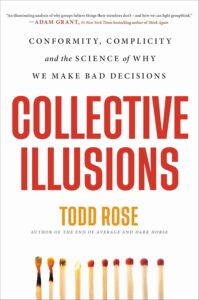
Our guest today is Todd Rose, Harvard-trained social scientist, co-founder of Populace, and author of Collective Illusions and The End of Average, who has spent years gathering private opinion data on what Americans actually believe versus what we pretend to believe. In this conversation, Todd walks us through the wild story of Elm Hollow (the first public opinion study ever done, where everyone secretly drank and played cards while pretending to be scandalized), the neuroscience that makes conformity literally feel like a hard-drug high, and the unsettling reality that foreign actors, particularly China, Iran, and Russia, have weaponized AI bot armies to manufacture fake majorities and quietly shred American social trust. You’ll hear how “defund the police” had only nine percent private support among Democrats despite 60 percent public endorsement, why the marriage equality movement cracked open one of the fastest opinion shifts in history, and how the Velvet Revolution toppled an authoritarian regime without a single death, all because one playwright realized the whole system was running on a lie. Whether you’re exhausted by political tribalism, fascinated by the psychology of conformity, worried about disinformation warfare, or just looking for a reason to feel hopeful about your fellow citizens again, this one’s worth your time. The fix, it turns out, might be embarrassingly simple: have one honest conversation with someone who matters to you. Listen, learn, and enjoy!
Please Scroll Down for Featured Resources and Transcript!
Please note that some links on this page (books, movies, music, etc.) lead to affiliate programs for which The Jordan Harbinger Show receives compensation. It’s just one of the ways we keep the lights on around here. We appreciate your support!
- Sign up for Six-Minute Networking — our free networking and relationship development mini-course — at jordanharbinger.com/course!
- Subscribe to our once-a-week Wee Bit Wiser newsletter today and start filling your Wednesdays with wisdom!
- Do you even Reddit, bro? Join us at r/JordanHarbinger!
This Episode Is Sponsored By:
- SimpliSafe: 50% off + 1st month free: simplisafe.com/jordan
- Progressive Insurance: Free online quote: progressive.com
- Quince: Free shipping & 365-day returns: quince.com/jordan
- AT&T: Get an iPhone 17 Pro for $0: att.com/iphone or visit an AT&T store for details
Thanks, Todd Rose!
Click here to let Jordan know about your number one takeaway from this episode!
And if you want us to answer your questions on one of our upcoming weekly Feedback Friday episodes, drop us a line at friday@jordanharbinger.com.
Resources from This Episode:
- Collective Illusions: Conformity, Complicity, and the Science of Why We Make Bad Decisions by Todd Rose | Amazon
- The End of Average: Unlocking Our Potential by Embracing What Makes Us Different by Todd Rose | Amazon
- Private Opinion in America: Research Reports | Populace
- Website | Todd Rose
- A Century of Pluralistic Ignorance: What We Have Learned about Its Origins, Forms, and Consequences | Frontiers in Social Psychology
- Sizing Up Twitter Users: How U.S. Twitter Users Compare to the General Public | Pew Research Center
- Forget Law School, These Kids Want to Be a YouTube Star | CNBC
- Americans’ Perceptions of Success in the U.S. | Gallup & Populace Success Index
- Poll Finds Only 18 Percent Support ‘Defund the Police’ | The Hill
- ‘Fund the Police,’ Biden Says at State of the Union | PBS NewsHour
- Collective Illusions: A Series with Todd Rose | Big Think
- Online Antisemitism: How Tech Platforms Handle User Reporting Post 10/7 | Anti-Defamation League
- The October 7 Attacks | Wikipedia
- TikTok Faces Calls for Ban amid Claims of Anti-Israel ‘Indoctrination’ | Al Jazeera
- Laowhy86 | Decoding the Secret Slang of China’s Censored Internet | The Jordan Harbinger Show #1299
- Laowhy86 | How the Chinese Social Credit Score System Works Part One | The Jordan Harbinger Show #643
- The Guns of August: The Pulitzer Prize-Winning Classic about the Outbreak of World War I by Barbara W. Tuchman | Amazon
- Twitter (X) Use Predicts Substantial Changes in Well-Being, Polarization, Sense of Belonging, and Outrage | Scientific Reports
- Delta’s AI-Based Price-Gouging: Running an Airline Like a Hedge Fund | Pluralistic
- Cory Doctorow | Why Everything Got Worse and What to Do About It | The Jordan Harbinger Show
- Todd Rose Knows Your Private Opinions | Semafor
- America’s Secret Opinions: The Populace Social Pressure Index | Axios
- The Dissident | Prime Video
- The Bees Army: Khashoggi, Saudi Troll Farms, and Online Resistance | Wikipedia
- Mike Milken | Milken Institute
- X’s New Location Transparency Feature Unleashes Questions about Origins of MAGA Accounts | NBC News
- René Girard: Mimetic Desire and the Scapegoat Mechanism | Wikipedia
- October 2023 Harvard CAPS / Harris Poll: Key Results on Israel and Hamas | Harvard-Harris Poll
- The American Aspirations Index | Populace
- Project D.A.R.E. Outcome Effectiveness Revisited | American Journal of Public Health
- Modern Family Season 10, Episode 13: “Whanex?” | Modern Family Wiki
- Pop Culture Helps Change Minds on Gay Rights | The Seattle Times
- The Power of the Powerless by Václav Havel | Amazon
- The Garden Party and Other Plays by Václav Havel | Amazon
- Czechoslovakia’s Velvet Revolution (1989) | International Center on Nonviolent Conflict
- The Stasi Records Archive | Bundesarchiv (German Federal Archives)
- The 2026 Internet Blackout in Iran | Wikipedia
- Reinforcement Learning Signal Predicts Social Conformity | Neuron (Klucharev et al., 2009)
- The Asch Conformity Experiments | Wikipedia
- Pluralistic Ignorance and White Estimates of White Support for Racial Segregation | Public Opinion Quarterly (O’Gorman, 1975)
- The Decline of FGM in Egypt since 1987: A Cohort Analysis of the Egypt Demographic and Health Surveys | BMC Public Health
- Window to the West: Memories of Watching Finnish Television in Estonia during the Soviet Period | VIEW Journal of European Television History and Culture
- Americans’ Declining Trust in Each Other and Reasons Behind It | Pew Research Center
- ‘Maybe We Cried Too Much’ over Shoplifting, Walgreens Executive Says | CNN Business
- Harvey Milk’s Gay Freedom Day Speech: Annotated | JSTOR Daily
- Author Talks: Todd Rose on Why We Shouldn’t All Just Get Along or Conform | McKinsey
1323: Todd Rose | The Collective Illusions Tearing America Apart
This transcript is yet untouched by human hands. Please proceed with caution as we sort through what the robots have given us. We appreciate your patience!
Jordan Harbinger: [00:00:00] Coming up next on The Jordan Harbinger Show.
Todd Rose: Close to almost half of Americans think other Americans are the greatest threat. Once you realize that this is a war that we're losing, we didn't even know we were fighting. You can't beat us militarily or even economically if we're really got our act together.
So what would you do? What you do is you actually destroy the social trust, the very fabric, right? Like you actually start to get us to see each other as enemies. This is really effective. If we really were that divided, if we really did have these wacky beliefs that we were consolidated around, we should say it.
It's just not true.
Jordan Harbinger: Welcome to the show. I'm Jordan Harbinger. On The Jordan Harbinger Show, we decode the stories, secrets, and skills of the world's most fascinating people and turn their wisdom into practical advice that you can use to impact your own life and those around you. Our mission is to help you become a better informed, more critical thinker through long form conversations with a variety of amazing folks, spies, CEOs, athletes, authors, thinkers, performers, [00:01:00] even the occasional former cult member, Fortune 500 CEO, or Russian Chess Grandmaster.
If you're new to the show or you want to tell your friends about the show, I suggest our episode starter packs. These are collections of some of our favorite episodes on topics like persuasion and negotiation, psychology and geopolitics, disinformation, China, North Korea, crime and cults and more. They'll help new listeners get a taste of everything we do here on the show.
Just visit jordanharbinger.com/start or search for us in your Spotify app to get started. Today on the show, apparently, we're all lying, not in the fun, "Yeah, I read the article" kind of way, but more like we are collectively pretending to believe things that almost nobody actually believes, which sounds insane until you realize it explains basically everything.
Why people panic, buy toilet paper like it's currency, why politicians chase opinions that don't even really exist, why everyone online sounds like a radical, and everybody in real life doesn't. Today's guest, Todd Rose, calls this collective illusions, basically social lies that we all participate in because we think everyone [00:02:00] else believes them.
On most controversial issues in the United States, something like 90% of people privately agree, but publicly, they act like they're at war. So yeah, it turns out we're actually not that divided. We're just confused, insecure, and copying each other like middle schoolers trying to fit in. And the internet makes the whole thing a million times worse.
Today we'll break down why you might be agreeing with things you don't actually believe, how social media manufactures fake majorities, why your brain literally rewards you for conforming like a lab rat, and how this whole thing quietly wrecks trust, politics, and your sanity. All this and more today here on the show with Todd Rose.
Here we go. I really got into this book. It might actually sound kind of weird, but I found it quite a relief that basically everyone is a hypocrite of some kind and lying to each other. And I know that sounds odd. People are listening and they're like, "What are you talking about? I'm not a hypocrite." But hear me out.
The idea that we don't tell the truth about what we believe is actually kind of a good thing. And maybe we [00:03:00] begin with the story of Elm Hollow where the moral is, everyone's a hypocrite, basically.
Todd Rose: That's right. When I was writing the book, I found this story was really the first major collective illusion, but it was actually happened to be the very first public opinion study ever done.
This guy, Richard Shank, this was right before Gallup was formed and everything. And he said, "I want to know how people form their opinions." So he did his dissertation, he went and lived in this small community. Um, he called it Elm Hall, it was in upstate New York. And it was a kind of religious community a little bit, tightly knit.
At first he gave everyone this survey just to kind of get their opinions. And he asked a lot about church stuff. You weren't supposed to play face cards, you didn't drink alcohol, whatever.
Jordan Harbinger: Oh, it was like super conservative.
Todd Rose: Yeah. Like-
Jordan Harbinger: you can't play cards, holy smokes.
Todd Rose: Yeah. Face cards, apparently. And so they're asking a bunch of other attitudes and he said, "Okay, I got the baseline."
And he goes, "But after six months, I actually drank alcohol and played cards with [00:04:00] everybody in this community in the privacy of their own home." And he's like, "Everybody's lying." And he was like, "What would lead them to lie like that? " He did something really clever, which then we just have copied like crazy in our research.
He decided to give him another survey, but instead of asking him their own opinions, he said, "What do you think most people in the community believe on these issues?" And that's what he found out. He said, "Oh, they all think everybody else believes this stuff. They don't personally, but they don't want to get kicked out of the group, so they're going along."
Now, here's what's wild. He figures out, like, wait a minute, how could they be so wrong about their group? I mean, just talk to each other. It turns out that there was this one old woman, and he called her Mrs. Salt, and she was one of those, like, true believers, like fire and brimstone, religious thing.
Her dad was a preacher back in the day. She also happened to be the biggest donor to the church in the town, so, like, everybody was afraid of her. The pastor wouldn't really push back [00:05:00] because he wanted to get a paycheck. And so she would just tell people how it is, she'd shut them down, she'd cancel them.
So everybody sort of just assumed she was speaking for the group, and she dies, and it doesn't take very long, but everyone's like, "Wait, hold on. "
Jordan Harbinger: They're playing cards at the funeral. Yeah.
Todd Rose: Yeah, but seriously though. Richard Shank goes to the pastor, he goes, "You gotta do something. People all believe this.
And so he had the pastor show up at a church event and play cards. And then the gossip started, "The pastor's playing," and they're like, "Yeah, you can play cards. That was never a rule. You just believed it. "
Jordan Harbinger: That was a Mrs. Salt thing, and she's gone now. We don't have to w- worry about her. In that case, let me go get the whiskey I've been holding in my cabinet for-
Todd Rose: Yes.
Jordan Harbinger: three years as far as it's not a new bottle from Costco. Yeah.
Todd Rose: It's so funny. So that was the very first, like, time that ever tried to look at public opinion. And the first thing they find is people don't tell the truth because they want to be part of their group, but it turns out we're really, really bad at reading what our groups believe [00:06:00] because our brains have this really flimsy shortcut.
Your brain assumes the loudest voices repeated the most are the majority. So that's why Mrs. Salt being the only one speaking ... Look, she speaks for everyone. So no big deal. You can happen in these small communities. It wasn't until social media-
Jordan Harbinger: Yeah. ...
Todd Rose: that this became a runaway train. In fact, it's funny, in the '70s and '80s, psychologists were like, "This happens when you're wrong about your group," because that's all collectives are.
They're group think, but you're wrong about the group.
Jordan Harbinger: So it's a collective illusion is like a social live, so it's just not true. We can form because we're doing what we think others want, but then we're just doing what nobody wants.
Todd Rose: But nobody wants. And so we all have a conformity bias. Our brains are wired to be with groups.
It's survival. But then, again, how do you know what your group believes? And so the shortcut of loudest voice repeated the most, it's quite, like, efficient, and it [00:07:00] must have worked to evolve, right? That you were accurate enough. And in most communities, at some point, you could just pull your neighbor aside and go, hold on, do you really believe this?
But you go into social media without any distorting effects, but we'll talk about that too, because countries are weaponizing this. And if you look at, like, X right now on the platform, 80% of all content on X is generated by only 10% of the users.
Jordan Harbinger: That totally makes sense. Whenever I see a crazy tweet or somebody shares something with me, I always go like, "Oh, I wonder who this person is."
And you can see that they've tweeted 48 times that day, and I'm like, "That's more than I've tweeted in the last decade."
Todd Rose: It's all they do. And then Pew Research actually studied this 10%, and they found, like, they are not remotely representative of the public. They're extreme on everything.
Jordan Harbinger: No, they're fringe kooks.
Yeah.
Todd Rose: Yeah, they are. And so they're really loud, but here's the problem now. If 10% of the country holds a view, you think it's 80%. Unless you're willing [00:08:00] to go against your group, you're just going to say nothing, or you'll start saying what you think you're supposed to say, and suddenly, the result's a collective illusion.
Jordan Harbinger: That makes sense. My friend is a teacher, and I was like, "Hey, I heard that every kid wants to be a famous YouTuber." And she's like, "Yeah, they all want to be famous YouTubers." And then she came back a couple of weeks or months later, and she's like, "You know, actually, remember when you asked me that? " It turns out that they think some of these YouTube people are cool, but when we actually talked about what we really wanted to do, not, "I'm going to be a rockstar astronaut."
When you actually talked about what sort of path are you thinking of taking, it was the same as it's always been. Like, mom, my dad's a lawyer, and that seems kind of interesting, or, like, I really like watching true crime, so I thought maybe I'd be an, an investigator. One kid wanted to be a YouTuber, of course, or two, but it wasn't like the whole class.
But if you ask the class and everyone has to raise their hand, it's like, "I want to be a YouTuber," and everyone's like, "Oh, that sounds cool." Because it's kind of a LARP, their plan, and it's in front of everyone else, but it's like when you really sit down, it's like, "No, no, no. I want to go to dental school."
Todd Rose: What's funny about that [00:09:00] is-
Jordan Harbinger: That's where I'm
Todd Rose: at. You just nailed exactly like ... So at my think, we do this private opinion research. It's not just what you'll say out loud, but what do you really believe? And we can get around that sort of social pressure. And we did a massive study on what you mean by a successful life.
The illusion is we think everybody wants to be famous, like the number one trail priority.
Jordan Harbinger: And rich, right, as well?
Todd Rose: And rich.
Jordan Harbinger: Is that the second one?
Todd Rose: They're all status related, is what we think everyone wants. In reality, those are, like, bottom quartile. You want to have enough money to live your life, but, like, the tops are all, like, what you'd actually be happy with.
People want to contribute, they want to be in their community, they want to have good relationships. The problem is that if I think everybody wants to be famous, and I'm sitting in a group and, like, these kids, and we see this with younger people, they're like, "Yeah, I want to be an influencer." I'm like, "Do you? " And I was like, "Not really, but if you say it, it's, like, performative."
I know that I think this is what everyone thinks is really cool and successful, so I'm going to say that. Well, of course, you saying it is more evidence to everybody else that we all want to be that.
Jordan Harbinger: When somebody says that, the other kids are going, [00:10:00] "Yeah, not really, but I don't want to be the guys, like, I want to be a dentist.
Everybody will make fun of me. So I'll just, fine. I'll say I want to be a fitness influencer too." I think also there's an element, especially among kids, but probably among everybody where it's like, in this particular moment, that sounds like something that would be fun for a day. As a job though, I don't know.
And so you see these people who, like, even, like, more extreme takes. I've got a friend who was like, "We should stop all immigration." I was like, "Do you really think we should stop all immigration?" And they're like, "Not like doctors from other countries." And they're like, "What about software engineers?" They're like, "I don't know.
I mean, we probably need some of them." And it's like, so basically you don't want to stop most of the immigration that's actually happening. You just don't want people to jump over the wall thousands per day unmitigated in the southern border, like you're watching on whatever news channel you watch, but you don't actually want to stop all of the immigration.
You're just agreeing with, like, a literal Nazi on X because they said this thing that sort of in the moment got you charged up in emotional, but your parents are from China, dude. What are you talking about?
Todd Rose: Exactly. We see this all the [00:11:00] time. So, like, there'll be this fringe. We have, uh, in our data on immigration.
Like, actually, super majority of Americans across all stripes are like, "I don't want to close the border entirely. It's why would we do that? " They really like legal immigration. They do worry about not knowing who's coming in, that's fine. But then the problem is, is the fringes are really good at coming up with slogans that actually reflect their crazy views.
And people go, remember, like, abolish ICE, and we're like, a lot of my sort of normie friends were like, "No, I don't like what they're doing." I'm like, "You're saying abolish it. " And they're like, "Well, they don't mean abolish." No, they actually do. You're just repeating this. We saw that the best example in our data is remember the defund the police movement.
Jordan Harbinger: Yeah, I was going to say, defund the police. So get rid of the police. No, not really. It just make them stop shooting people for no reason. Okay, but that's not as catchy.
Todd Rose: That's very different. And so we actually got pulled in with the Biden administration because they had read the book and they were like, "So wonder if we're dealing with any illusions here?"
And I'm like, "Sure are. " Like, at the [00:12:00] peak, 60% of Democrats publicly said they supported defunding the police. It was 9% in private, 9% in private. You can get 9% of people to agree to anything. Like, so the administration was like, "Oh no, that one's real. We get a lot of calls." From 10 people over and over again, so we got one line in the State of the Union address.
It was that, it was the State Union where the Ukraine crisis had blown up too. And he said, "It's not defund the police, it's fund the police." 'Cause we're like, "Your constituents don't believe this. And if you go out in public and endorse this, it's going to be on you. " What's so funny is, is we're all susceptible to it, but what we find in our research, there's like three groups of people who are the most susceptible, young people, which makes sense.
They really want to fit in. CEOs, because you're like, "What do my customers think? What do my employees think? " And politicians who are like, "Which way is the wind blowing?" Y-
Jordan Harbinger: you know what it reminds me of? I don't do politics that much on the show, but I feel like this is relevant. Somehow, certain Democratic politicians got it [00:13:00] in their head that the most concerning thing in the entire country was like whether trans people could be in sports or something like that.
And then the Republican side was like, "Oh, we have to talk about this thing that they're talking about. " And also it's a great opportunity to show how crazy out of touch these people are. And so everyone's talking about that. And I remember talking to some of my super conservative friends and some of my super almost comic liberal, you know, friends.
And they were like, "Do you care about this? 'Cause we don't care about this. " And I was like, I don't think most people actually care that much about this. I think everybody's, why is this the thing that's taking up all the airtime? And it was weird to see, like, my almost fascist level right-wing friends and my, like, almost kooky, comedy-level friends and everyone in between be like, "I'm pretty sure we agree that this is not the most important issue going on in the country riht now.
Like, what the hell?"
Todd Rose: You're getting at something really important is, like, because of our social media saturated worlds out that it's so easy for these vocal fringes to end up [00:14:00] masquerading as majorities, which it has two effects, right? Like, one, it's, wait, so if, let's say I'm a Republican and I'm like, "These people believe this?
So first of all, in my group, if I'm Democrat, I'm like, "Oh, I guess we're supposed to be over here." So we start repeating the, "Yeah, we should defund the police." I'm like, "You don't believe that. Nobody believes this. " But then if I'm Republic, I'm like, "What the hell is going on with these people? " So it's sort of like pulls everybody to the extremes in a way that is just nuts.
And I feel bad. I think that the whole trans thing is a perfect example because it's the first real hyper online movement, so it's made it deeply susceptible to collective illusions. The thing that makes me sad is there is a, a small alternative people who really do struggle with this who need help and just want to live their lives.
They don't care about college sports. They're not coming after kids. They're like, "I need hormones to live, and they're the ones that end up getting screwed out of this. "
Jordan Harbinger: For sure. Yeah, no, I've got a friend who's, she's an older lady now. She's the first trans person I ever met, because I didn't even [00:15:00] know that existed when I met her 25 years ago, and she'd already, like, lived her life and had kids and was married and everything.
And I was like, "Hey, friend to friend, how much do you care about this? " And she's like, "Jordan, I can't even explain to you, even if we only focus on the trans thing, the sports thing is, like, not even making the top 10." She's like, "We need to have people stop killing us for no reason. That's kind of up there.
Maybe the right to just go to the dang restroom without having somebody chase me in there," stuff like that. And so it was just, like you said, an illusion where everyone's, oh my God, everyone's so concerned about whether this person can join the Olympics. And it's, no, this is a weird click bait headline that just got way too much airtime and runaway energy and fringe people who wanted to make a name for themselves as, like, pro or against this.
You'd think, "Oh, this guy has millions of followers." And then you look at their actual, whatever platform where they make money and you're like, "This guy has 3,000 actual people supporting him."
Todd Rose: So this is such a good example because we've found this exact phenomenon in over 100 issues in the country right now, [00:16:00] but what we just walked through, this is the consequence.
You took something that was tricky and we're trying to learn how to deal with it and societies are progressing by expanding who we include and it's hard and these people just want to live their life. And then some fringe is able to manufacture the illusion that a subset, this is what this party believes and everyone's like tribal and they go to their little group because they want to belong and they're wrong, but now they've pushed it and the other side's like, "Hey, that's crazy.
Let's go to the further extreme." And now all of a sudden it dominates the discourse. It shoves out the space of like things we actually care about. It makes solving this problem almost impossible. And the end result is it harms the actual people who just need hormones and the destruction of social trust and the sense of false polarization that I'm sitting here going, "You cannot believe this crazy thing."
When someone says they actually want to defund the police, I'm like, "I will be the first to tell you the [00:17:00] police should abide by the laws and should not viol- light your rights. And we should have gotten rid of qualified immunity. There's lots of stuff we could do. " I do not want to defund the police. And anyone that tells me that's a good idea, I'm like, "You're crazy."
Jordan Harbinger: I said, "Dude, have you seen the purge? That's not going to work."
Todd Rose: It's not how it works. And so then I'm like, now imagine across 100 issues, those are the most fundamental values we have as a society if I'm wrong about what most people believe. And I'm like, hold on, you don't believe in dignity, you don't believe in this, you don't believe in daddy, you don't believe in free speech.
I don't think I have anything in common. With my fellow Americans now, I lose trust in each other and now it just, it's a downward spiral. And so this is the thing is like, even though illusions are social lies, they're self-fulfilling if you don't do something about them and they can destroy entire countries.
Jordan Harbinger: Yeah. I think right now, and I wonder if this is a collective illusion, it seems like if you go online right now and you look at anything having to do with Israel or something, there'll be a guy who posts some sort of Nazi thing. "I get this all the time. I get, " Well, I'm going to throw you in the oven, like your [00:18:00] grandpa or whatever.
"And I'm like, " Okay, if you look at who's saying that online, it's, oh my God, 80% of people online hate Jews and want to kill me for no reason. "And then you look at other folks and you're like, " This is like a lot of bot activity. These Nazis are terminally online. Even Nazi influencers, I'm like, this guy would've been a crypto influencer five years ago.
He just happens to pick up on the Nazi thing now and he's wearing a Nazi shirt and he's got his Nazi tats. And I'm like, "This is just a grifter who found a niche. This guy would've picked something else if this wasn't trending on social media." And people are like, "100,000 people follow him." And I'm like, "Yeah, 50,000 are bots, 20,000 are like journalists who are like, Holy shit, a Nazi on social media?
And the other 30 are like maybe on the fence and teenagers. So it's bad, but it's not like this Nazi has an army behind him. He's a tool, he's an influencer. He might as well be selling protein shakes.
Todd Rose: Yes, exactly right. It's crazy. There's always going to be a tiny fringe of people that hold batshit crazy ideas.
That's always been true. It'll always be true. And then what we've been part of a coalition that's been studying not [00:19:00] just collective illusions that we uncover, but the fact that foreign entities have figured this out and weaponized it, whatever people think is going on, it is so much worse. So here's the thing.
Like I will tell you just full disclosure, a lot of this started for me after October 7th. So I was actually on vacation and I got a call and they said, "You need to come to Tel Aviv." And I'm like, "In a war, we think we've uncovered something that relates to collective illusions, but we need to show you.
And it turns out that there was really solid proof that foreign entities, China, Iran was particularly at play and Russia, in this case, China was manipulating the algorithm of the TikTok to drive anti-Semitic sentiment. China didn't care. They weren't like, "Hey, we hate Jews." It was actually more, this was a psychological weapon that you can refine this way so that when they tried to take Taiwan, they can get our young people streaming out into the streets and protest.
Very, very effective. But what we found, and I say we broadly, there's a lot of people in this now, is [00:20:00] I would put it this way, we were losing a war that we didn't even know we were fighting in the space of propaganda and manipulation, not to be too wonky, but there's a book about World War I called Guns of August.
Jordan Harbinger: Oh, I've heard of this. Yeah, yeah.
Todd Rose: So good. So Barbara Trookman, an historian, her thesis was basically that the reason that war was so bloody and awful was that the technology for war had changed exponentially, but the mindset about war hadn't. And so they built strategies like, "We're going to fight over small amounts of land.
We're going to dig trenches." Yeah, but now you have machine guns and chemical weapons. You're not just firing muskets at each other. And I think we have a guns of August moment here in the form of propaganda where we've been taught to think that these state sponsored actors, so disinformation, it's actually not really true.
That's not terribly effective. What they do is they can manufacture collective illusions very easily with bots and now with AI enabled bots that we've been tracking, [00:21:00] very easy to get you to believe that your community believes something they do not. And then your conformity bias kicks in, you start acting.
And it's like, to me, like the way drones have changed war with the Shahid drone or whatever, here's my $50,000 drone against your $5 million interceptor, building a bot army and sowing discontent and distrust and manufacturing illusions in another country is so cheap.
Jordan Harbinger: It is, yeah.
Todd Rose: And so effective. And right now, for example, conservative estimates.
So we know from the research that if your interactions online are about 5% with bots, if the bots are well designed, they can guarantee what consensus in that group will be. They can drive it. Conservative estimates on social media is a quarter of all your interactions are with bots.
Jordan Harbinger: I totally believe that.
I mean, the people who say, "I'm going to turn your family into a bar of soap." Like I got that comment the other day. I always look at it and it's like a picture of a totally normal looking person that's probably AI. They have [00:22:00] two followers, they have four posts and they're all like weird photos that look AI.
It's like a picture of a book or something or like a meme of a Jewish person and then it's like following 3,000 people. And I'm like, "I bet you that if I worked for Instagram or Meta, I could look and see account created three days ago, immediately followed 3,000 totally random people and then follows everyone who interacts with it online."
I mean, it's just obviously fake nonsense.
Todd Rose: And the thing is, is what they've gotten really good at too is the bot armies. Now with AI though, if I want to shape your view and get you to be like someone who will start to speak up for things you didn't even believe in to begin with, so it's the bots that amplify and then there's entire bots that are dedicated to comment threads.
So the first three comments in the thread basically dictate the tone of the thread. And so I get you to post about something because you think it's the right thing to say, and then the bots will also go in, in addition to retweeting you, will actually go in and basically [00:23:00] verbally confirm that you're so smart, or if you say the wrong thing, they attack you and they condition you into a certain behavior like, "Oh, this is what my group believes."
Jordan Harbinger: Exactly.
Todd Rose: So effective.
Jordan Harbinger: I had a post like this, it was from Corey Doctoro, and he writes about technology and stuff. And he said, "Yeah, there's an Israeli tech company that is actually working with Delta Airlines right now where they do ... " It's like algorithmic pricing. It's like they find out who you are based on your IP and they might charge you more if you're in Silicon Valley or more or less.
And not everyone knew about that. And I was like, "Oh man, people are going to be so pissed at Delta Airlines when they find out that they're doing this. " No, the top comment was, "Of course, the Jews are doing this to us." And I was like, "Delta airlines are Jews?" And they're like, "No, dummy. The first thing he said was Israel's doing this to us."
And I was like, "No, a company based in Israel is hired by an American airline and all of the American airlines to do this to you. It's not the Jews you absolute n income poop." And it was just like, didn't matter. And people were like, "Oh, Jordan's getting ratioed here. Ha, we're onto you. " And I'm like, "To me, what do I have to do with the
It's [00:24:00] my post. I'm the one that put this out there. What are you talking about? " And it was just these comments had hundreds of upvotes. And I was like, "This just does not seem like normal people activity."
Todd Rose: It is so manufactured. China's been really great at it. Russia's been doing it for a while, but Iran mastered it and it's so clever.
So if we take away the, like, awfulness of it, that's really smart. You can't beat us militarily. I'll tell you, so we have more private opinion data on the American public than anybody. We predicted Trump's final vote percentage in the last election within a half a percentage point, six months in advance, because Gen Z was not telling the truth.
Black and brown men were not telling the truth about their willing to vote for them. So I'm just say that because when you look at the private views, it's a completely different country. We are so similar in our views, it's hilarious. And then you look at the public opinion and we look like we're this close to Civil War.
Jordan Harbinger: Yes, it, that's what people are saying. We're so close to a Civil War and it's interesting because, man, I'm in such a bubble because I know [00:25:00] Jewish people here, obviously, and they're like, "I carry a gun now because I have so many threats against me, but I, it's not, I don't really trust my neighbors less.
They're fine. Nobody's done anything to me yet." And it's like, yeah, because you're online and you're seeing all this, but guess what? That's an army of bots, yeah, in Iran or China. In fact, I watched this documentary recently about Jamal Kashogi, the journalist that got murdered in the Turkish embassy by Saudi Arabia, for those who don't know, and they were talking about how he got, his profile initially got big, and it was on Twitter, and they exposed the bot farm in Saudi Arabia, and there were something like 10,000 people there in this building, and each one of them had maybe a few dozen or a hundred accounts or something, and they were using these decks to tweet and manufacture this.
And now you can do most of that probably with AI.
Todd Rose: AI.
Jordan Harbinger: And Jamal Khashoggi would be like, "Hey, I kind of disagree with this, uh, thing that Muhammad bin Salman did." And it would be like thousands of people would be like, "You're a trader. We're going to kill you. " And it just turned out to mostly be bot activity, and then of course they murdered him in the embassy, but that was the government [00:26:00] doing that.
It wasn't like he couldn't walk down the street because civilians were all angry at him. "Oh, there's that journalist. No one wanted to kill him other than the government, and they made it sound like, Oh, he had so many enemies. Look at that guy. "
Todd Rose: And if you think about it, what it does is it creates a cover for behaviors like that was unacceptable.
Well, it's kind of like he had a come and lots of people felt, but it's so easy to do. Once you realize that this is a war that we're losing, we didn't even know we were fighting. If you think about, my friend Mike Milken gave me this, so I want to credit him. When we started uncovering these things and we found like this AI enabled bot farm that China was running through Pakistan and they were going after the American dream.
And I was like, " That's weird. Why waste your time? "And he's like, " Look, Mike's like, you can't beat us militarily or even economically if we're really got our act together, so what would you do? What you do is you actually destroy the social trust, the very fabric, right? You actually start to get us to see each other as enemies.
And you think about right now, was it close to almost half of Americans think other [00:27:00] Americans are the greatest threat? This is really effective. If it were true, then we should call a spade a spade. If we really were that divided, if, if we really did have these wacky beliefs that we were consolidated around, we should say it.
It's just not true. And the reason I bring this up is that the distinction between private truths and public lies is important because the way you solve it is very different.
Jordan Harbinger: Now, I invite you to blindly and uncritically follow us into this ad break. We'll be right back.
This episode is sponsored in part by SimpliSafe. Have you ever looked into home security system and then you just backed out once you saw the contract? These traditional systems, they want you locked into multi-year deals, huge cancellation fees. It feels like something you just can't escape. That's what I love about SimpliSafe.
They flip the whole model. You get really solid twenty four seven professional monitoring, but without being locked into some long-term contract. As the person responsible for protecting this house, what I've appreciated most about SimpliSafe is how easy it is to live with. Set up way easier than I expected, especially when Jen did it all.[00:28:00]
If she could do it, so can you. Armit ... Uh, she's going to kill me. Arm it when you leave, disarm it when you get back, it's simple. The peace of mind is huge, especially in the evenings and when we're traveling. Customize it with sensors, cameras, all of it. It's not just break-ins, it's fires, floods the whole picture, and if something actually happens, there are real people monitoring twenty four seven who can dispatch help right away.
Jen Harbinger: We don't put our name behind many brands, but we trust SimpliSafe. Our listeners will get 50% off a new system when you sign up for professional monitoring and your first month is free by visiting simplisafe.com/jordan. That's half off at simplisafe.com/jordan. There's no safe like SimpliSafe.
Jordan Harbinger: This episode is also sponsored by Progressive.
Insurance isn't one size fits all, and shopping for it shouldn't feel like squeezing into something that doesn't fit. That's why drivers have enjoyed Progressive's name your price tool for years. With the name your price tool, you tell them what you want to pay, and they'll show you options that fit your budget.
Enough hunting for discounts, trying to calculate rates, tinkering with coverages. Maybe you're picking out your very first policy. Maybe you're looking for something that just works better for you and your family. [00:29:00] Either way, they make it simple to see your options, no guesswork, no surprises. Ready to see how easy and fun shopping for car insurance can be?
Visit progressive.com and give the name your price tool a try. Take the stress out of shopping and find coverage that fits your life on your terms. Progressive Casualty Insurance Company and Affiliates, price and coverage match limited by state law. If you want to create real connections with other people in real life as well as online, I highly recommend our course, six-minute networking.
It's totally free. There's no shenanigans. It's not cringey. It's not, not going to make you look bad or weird. It'll just make you a better connector, a better colleague, and a better friend. In about six minutes a day as all these steps taken, hey, many of the guests on our show subscribe and contribute to the course.
So come on and join us. You'll be in smart company where you belong. The course, again, all free, sixminuteworking.com. Now, back to Todd Rose. We can't just say, "Hey, new legislation, you have to tell the truth about the things you believe on the internet." You can't do that.
Todd Rose: From my mind, it's not really a legislative salt, right?
There's [00:30:00] something they're going on. Remember one thing that has helped a little bit as we start to teach people, maybe the people you listen to are just bots and they're not like actually representative of anything. When X did the sudden reveal of the location of all the accounts, have you remember this?
Jordan Harbinger: I was going to bring this up, yes, where ... So for those who don't know, it was like American Patriot 1234. She's been tweeting hardcore about the influx of immigrants and how they're taking all the jobs. And then X, yeah, Elon at X, love him or hate him. He was kind of like, "I'm going to make it possible for everyone to see where these accounts were created."
And it was all like Nigeria, Bangladesh, Pakistan. And it's like, these accounts are created and being used. This person's not American. This is not the white blongeck of the profile photo. No, it's a bot in Bangladesh. That's all it is.
Todd Rose: My colleagues were the ones that worked with him on it around this. You can't give people a heads up that this is going to happen because they'll do it.
So you just all of a sudden sprung it on people. It became this, this game of like, "Oh, really? You say you're a MAGA supporter, you're literally in Bangladesh." Or, and you realize like how much of it was just [00:31:00] bullshit.
Jordan Harbinger: I saw somebody tracking these and it was like this influencer who had 300,000 subscribers and tweeted almost exclusively about immigration, as soon as they got exposed that they were in Nigeria, they shut their account down three days later because they were like, "Well, the jig is up.
No one believes that I'm Pam from Nebraska anymore, so I'm done. This is over."
Todd Rose: So we're doing some things like it'll help, but ultimately I do think one thing is we have to get to the place individually where we realize you cannot trust your brain to tell you what your group thinks anymore. You can't. It is just impossible.
I'm pretty sure, like the number of my super liberal friends who were like, "Yeah, I'll defund the police. I put that up there." I'm like, "You don't believe it, " but they're like so convinced. And then they tell themselves, "Well, they don't really mean defunded, but that's just a way to be like, I don't want to go against my group."
They're like, "No, I'm sure that this is what they believe." So it feels like you're just wrong. You have to stop by saying like, "Whatever you think your group believes, you just take with a grain of salt," which is not a bad thing in the sense that we should get back to trying [00:32:00] to think for yourself just a little bit, not the worst thing in the world.
Jordan Harbinger: Yeah, not the worst thing in the world. It does surprise me that part of it is just, it makes you shake your head because you look at somebody like, I don't know, Dan Bill's area, right? And he's like, "I'm going to run for Congress and the Jews are doing this. " And it's like, how dumb do you have to be to follow somebody like this?
How dumb do you have to be to look up to somebody like this? What is going wrong in your life where this person is a, an influence on you that you don't think is negative? Nothing about this person stands out.
Todd Rose: What's interesting to me in this space is one of the most frightening private opinion pieces of data we have is the amount of resentment in America right now.
It is significantly higher during the Great Depression. The number of people who think society is just unfair and are resentful about it. The problem is at a neuroscience level, when you become resentful, it's a signal like, stop cooperating, you're getting screwed, it's time to compete. So you become zero sum in your thinking and sort of burn it down.
The behavioral economics research on this is so funny, but where it's if we're playing a trust game and you [00:33:00] start to screw me, I will zero you out even if I get nothing. I still have $5, but you get 10. Screw you. We're both getting zero. It kind of explains the behavior in society right now where we're just like
And now, under resentment, I don't know how much you've read like Rene Girard, which on mimetic desire- Mm. ... worth reading. It is so good. So he basically showed that as humans, we copy, right? We imitate, including what other people desire. But one of the things that he was really good at was showing that once we get into this rivalry where we're all resentful and competing, ultimately it leads to you need a scapegoat, right?
Why am I getting screwed? And Jews have historically always been a great scapegoat because they punch above their weight. They're small enough to not be able to do anything about it and successful enough to like, "It's plausible. They might control everything." And so then it's like, my life sucks, I'm resentful, I don't feel like I have any power.
They're telling me this group that I probably don't even know very many people is the cause of all my problems, get them.
Jordan Harbinger: I [00:34:00] follow these people, some on social media, and what they do is that they'll go on, I think it's Omegle, one of these chat things where you can just chat with a random person and it, it matches you and they'll go on there and they're talking to people who hate Jews and they post it and there's one guy who pretends to also not like Jews, but he's Jewish and he's a comedian.
He asked people like, "How many Jews do you think there are? " And the guys are like, "Dude, there's at least one billion." And he's like, "What if I told you there were only 15 million?" And they're like, "That's ridiculous, man. You gotta Google that. " And he's, "I did. Google it yourself." 15 million. Well, wait, the Jews control Google.
And it's, no, think about it. You're telling me that half the world's population is Jewish and that's why you're oppressed. It's a smaller number and it's, wow, how can they do all this when there are only that many people? And the guys, it's almost like they're not doing all this. And then it's like this chat ends because the guy's out way.
Right. It can't be that.
Todd Rose: It's exactly right. And it's, what's sad about this particular one is we found right after October 7th, the thing that had gotten everybody nervous was Harvard Harris had released a poll that said 61%, I think [00:35:00] it was right, of Gen Z said Hamas was justified. So not that like care about innocent kids, like the rape and murder of 1200 innocent people was justified.
It was like, if that's even close to true, that is terrifying. Yeah,
we're
Jordan Harbinger: cooked as that generation likes to say.
Todd Rose: Yeah. No, it never was higher than 7%. And because of the ability to manufacture these illusions, they were targeted directly at Gen Z, and then you get them streaming out and you remember the, I remember one video of the young woman, at least she was honest about it.
They were protesting and someone, they interviewed her and she asked friends, "What are we mad at again? What are we here for? " So it's so effective to get that. So then what we found was once we realized that this was intentional and we started helping with a bunch of other agencies to start throttling down some of this fake content, you watched even their public belief in it just collapsed as the content disappeared.
So it's like, and again, look, reasonable people can have different views of what's going on in the Middle East right now. [00:36:00] And anyone that doesn't care about innocent women and children is a monster, but when these illusions take hold and the fringes start to dominate our discourse there, it now becomes almost impossible to solve it at all.
And we're left with the thing that's scary about the scapegoating is historically, it usually just ends in violence, right? You, it ends in violence toward the scapegoat and then the, the thing resets.
Jordan Harbinger: It does. It's a complicated situation because a lot of these Gulf countries, for example, manufacturing a lot of animosity towards Israel, but if what is that metaphor, it's the dog chasing the car.
I guarantee you that if Saudi Arabia and all these other Gulf countries, let's say they weren't going to work with Israel like they are and create peace now, those leaders would be in deep trouble if they couldn't say, "Oh, it's Israeli's fault. We can't do this. Hey, this is what-
Todd Rose: The enemy of my enemy keeps me from having to get dethrone."
Jordan Harbinger: Exactly. In this country, there's a joke where it's like, "Oh, Cuba's about to find out why we don't have free healthcare. They're going to get some freedom. Yemen's going to find out we don't have free healthcare. They're going to get bombed." And it's crazy, but this is what a lot of [00:37:00] leaders in other parts of the world are doing.
They're like, "Okay, we really need to lean on, hey, it's the Jews" or, "Hey, it's Israel." Or people do it with Iran too, like, "Oh, we can't do this. We gotta have boll work against Iran." And it's all there because in many ways, if we don't do this, it's, "Wait, how come you're a trillionaire and I'm a subsistence farmer?"
Like people are going to start asking very uncomfortable questions about why this dude has two yachts, one for his mistresses from Russia and the other one's for his wife.
Todd Rose: It's 100%. And it's so easy to activate that every time. I'm like allergic to politics. I'm like registered independent. I, like, I think they're all just terrible.
But my favorite is when my otherwise reasonable progressive friends have a view of Trump, which may or may not be right as this narcissistic sociopath, and they're like, and he's completely controlled by the Jews. And I'm like, okay, so on the one hand, here's a guy that doesn't care about anybody else and just wants his ego, and yet doesn't make any sense.
Jordan Harbinger: Jeffrey Epstein, something, something blackmail tape, something, something Netanyahu. I mean, you really have to go down this weird web rabbit hole of everybody's in the Mizad and everybody has Pi tapes with [00:38:00] Donald Trump and dot, dot, dot, the Jews. That's why people get more ridiculous with it because you have to make more and more crazy leaps in order to make it make sense because otherwise it doesn't make sense.
And the other explanation is, "Hey, this doesn't really add up." And it's, no, what if we add in this other crazy conspiracy theory? Now it all adds up. It's
Todd Rose: just layers and layers of
Jordan Harbinger: it. Yeah. Conspiracy theorists, what they do is they connect dots that are not there. That's what a conspiracy is.
Todd Rose: What's funny is, is all the people that do this and then they're like, "You know those dumb QAnon people?
I'm like, "You sound very similar. I hate to tell you. "
Jordan Harbinger: Yeah, it's crazy to me. But it does seem like it's, again, the majority of people believe this, but it's good to know it's not the case because that would be terrifying.
Todd Rose: Honestly, like, if I didn't do the research, if I didn't have the data ... It still feels to me.
Jordan Harbinger: It does feel that way. People are going to go, "I feel like Todd is wrong," because when I read the book, I was like, "I feel like you're wrong, but there's data that says that it's not wrong. So why do I still feel like you are because of what I'm looking at
Todd Rose: online?" Yep, it's exactly right. And the easiest [00:39:00] way out of this is touch grasp for just a minute and go have one conversation with your neighbor.
Like, it's comical how fast you're like, "Oh." And then it'll be like, "Okay, so maybe not my neighbor." But we're like, "Okay, talk to one other person." It's crazy how fast you're like, oh, I'll give you an example I thought was funny is, so we look at the research on highly polarized issues, so abortion, for example, it splits in the abstract at identity level as pro- life pro- choice, and those people are like die hard in those camps, and they think the other side isn't just wrong, they think the other side's evil, right?
You either hate women or you want to kill babies, and there's just real, no greater-
Jordan Harbinger: No nuance. Yeah.
Todd Rose: But then we have these methods that will take that and break it down into its concrete, like, okay, what does that mean from a policy standpoint? It's 70% of Americans are literally identical, identical in their views.
Yeah, we should probably not make it that easy in the third trimester, you know, life of the mother, rape, incest, otherwise someone's gotta make this choice, or it's like a very nuance that you have, like, uber [00:40:00] consensus on, and yet the people that have the identical profiles split almost evenly as pro- life pro- choice, and they're like, those people, I'm like, they're you.
They literally believe the same thing you do, and we've gotten to this point of false polarization where we just see each other as bad, and so we don't even engage anymore.
Jordan Harbinger: It's crazy that it's the virtue signaling that's polarized and different, but the actual beliefs are very similar, if not the same.
That's what's crazy to me.
Todd Rose: It is wild. Right now, you'll have, for example, you take any issue. When it comes to, say, the DEI stuff versus, like, turns out overwhelming majority of Americans across every demographic are like, yeah, there is some discrimination, that's not okay, but also we believe in meritocracy, and there are ways to solve this that don't require discriminating against other people in return.
And you're like, "Yeah, that's a very sound position. It's just not what the fringes on either side, believe." But they're so convinced everybody has these extreme views and that they have to essentially pick a side. And so if you're a Democrat, you're like, [00:41:00] "I don't hate minorities, so I guess I gotta go over here, and I'm anti-racist now."
Or if you're Republican, you're like, "I do think we should acknowledge that racism's real and sexism is real." And it's like, "Oh, are you that progressive?" So now you're like, "Ah, but no." So you go over here and you're like, "It's not a problem."
Jordan Harbinger: And lose my seat if I mention this in public. Yeah, of course.
Exactly. Wow. It's a little bit scary that we're so beholden to these collective illusions and, like, the cognitive dissonance probably that we would have to endure to break out of that is also going to be highly uncomfortable.
Todd Rose: It's going to be uncomfortable, but this is why there's a couple of ways out of it, right?
One is individuals that deal with the dissonance, right, which trust me, your life is way better. If you want to conform and go with group think, go for it. That's up to you. I think there's downsides to that. The only truly, really bad decision is when you conform to something that the group didn't even want, because now you're destroying the very group that you're trying to belong to.
It doesn't benefit anybody but fringes that try to manipulate through manufactured consent. So there's a handful of things, right? Some of it's [00:42:00] so stupidly obvious, but in liberal societies, we developed over a long time the norm of tolerance. Not because you endorse that, but because you know it's way worse.
The concept of tolerance came out of the religious wars in Europe where it was like, "Dude, I think you're evil. I'm going to try to kill you. Well, I can't quite get up the upper hand. Now you're killing me. My kids are going to kill your kids." And we're like, "Hold on. No one's winning. What if we just said live and let live?"
It's okay. We don't have to all agree, but we can mind our own business. We cannot have to feel like we have to control everyone. So those norms that we're shredding right now are quite important. But the other thing is, I said this earlier, but I think it's worth hitting on. So when they're collective illusions, historically, the bad news is, is they become self-fulfilling.
The good news is they're pretty fragile because they're lies. And if you pursue the right strategy, you can actually unlock change in a hurry, but it's not persuasion. So often ... So like right now, I'll give example, like, um, under free speech, people are fully convinced. Democrats are fully convinced that other [00:43:00] Democrats don't care about it anymore.
There's other issues are more important. So even like the ACLU now is one thing that we do. And you're like, "It was the thing that you do. " Like, it was a really important thing. They're convinced, but in private, it's just not true. In fact, Democrats have slightly higher commitment in private than Republicans, but everybody basically still wants that.
So say, okay, there's a problem. So I go tell my more influential center left people, "Okay, we gotta do something." And then they go out and be like, "Guys, free speech is under attack. It's really important. We gotta solve this. " That doesn't actually shatter the illusion, it reinforces it. And let me give you an example, how not to ever solve this problem.
Remember that Say No to Drugs campaign?
Jordan Harbinger: Yeah, of course. Like the Derr program and just say
Todd Rose: no. This is your brain on drugs. Yes. Okay. So this comes about in the '90s and 2000s because the government had a slight uptick in first time drug use amongst teens, mini pot. Very small bump. They freak out and they're like, "We gotta solve this.
Jordan Harbinger: Nancy [00:44:00] Riggin's like, "I'm on it. Just say no. Mic drop."
Todd Rose: My spiritual advisor told me.
Jordan Harbinger: That's right. My astrologist told me to tell you- Michael. "Just say no. We're done here, folks. You're welcome."
Todd Rose: So you get the best ad agencies in the country. They spent a billion dollars trying to get kids to just scare them straight.
From a marketing standpoint, it was amazing. The typical American teen saw three ads a day for six years. The problem was, the whole premise for this was that the reason kids were trying drugs is they were curious about drugs, but even back then, private opinion data existed that showed that wasn't true.
Kids were kind of skeptical, but they were under this massive illusion. They thought that most American kids did drugs.
Jordan Harbinger: Yeah, I can believe that. Dude, the irrelevant old white guy frying eggs, this is your brain on drugs. Any question? And then you're like, you talk to your doctor and you go, "So is my brain frying?"
And he's like, "No, that's actually complete bullshit." And you're like, "Well, wait a minute." Right. This is a dumb movie called Walk Hard where this guy, comedian, he walks in and there's two people smoking pot and he's like, "Oh my gosh, [00:45:00] should I try that? " And they're like, "No." And he's like, "I wouldn't want to get addicted to it.
And they're like, "It's not addictive." And then, uh, I, I don't know, man. I wouldn't want to go crazy and hurt someone. And they're like, "No, no, it doesn't really do that. It's not that kind of drug." I don't know. It seems like it's got to be really expensive. It's cheapest drug there is. And the guy's like, "What the hell is, what's the problem here?"
Yeah, it's just so ridiculous.
Todd Rose: Well, this is, this campaign, right? So into the illusion, you blitz him with a billion dollars of ads trying to scare him straight. What the kids took from the ads was, "This must be what we're doing. Why would adults try to already get us to stop?" No kidding, that campaign caused an increase in drug use.
So you don't do that, but what's nice is under illusions, the way you deal with it is just social proof. And so it's basically, I gotta hear it from people like me, so talk to your neighbor, hear it from people I admire or cultural artifacts. So I'll give you an example. We've done some work on this with Hollywood, showrunners and stuff where I'm like, I'll give you the private truth about what people believe where there's illusions and if you want to tell a better [00:46:00] story.
So in the success research, for example, oh, everybody wants to be famous and rich. So do you remember Modern Family?
Jordan Harbinger: Yeah.
Todd Rose: So season 10, episode 13, they wrote a whole episode. Cam is a acting vice principal, has to put on a play. The idea is show the illusion, reveal the truth, and because if I like modern family, which I did, you have this parasocial relationship with it, and your brain treats members of the characters as part of your in group.
So if I hear it said in these shows or movies, it has an outsized effect on what I believe that we believe. So there's ways to deal with this, but ultimately, it's a whack-a-mole game unless people start to internalize the, you're being manipulated and here's the things that you need to do, right, to be able to not let that affect your life.
Jordan Harbinger: You should support our sponsors. Everybody's doing it, well, except for those people and we don't want to be like them now, do we? We'll be right back. This episode is [00:47:00] sponsored in part by Quince. I simplify what I wear did today because figuring out an outfit is one more piece of mental load that I don't need.
There's a reason Steve Jobs had a uniform. Fewer decisions, more brainpower for things that actually matter. That's why Quince has been my go- to. I just want quality, comfortable pieces that look good, fit well, don't cost a fortune. I also like stuff that looks clean and timeless. Quince really nails that.
Their fabrics feel elevated. The fits are easy. Everything just works without needing to overthink it. They've got great spring staples, like 100% European linen shirts, shorts from $34, soft Pima cotton teas, pants that are relaxed and comfortable, but still polished enough to wear almost anywhere. Jen's a huge fan as well.
She gets everything from jewelry to luggage from Quince because it has that same clean quality feel without the crazy markup. And because Quince works directly with ethical factories and cuts out the middlemen, everything is priced 50 to 80% less than what you find at similar brands. So you're getting premium materials without the ridiculous markup.
Jen Harbinger: Refresher every day with luxury you'll actually use. Head to quince.com/jordan for a free shipping on your order and 365 day returns. Now available in Canada too. That's [00:48:00] quince.com/jordan for free shipping and 365 day returns. quince.com/jordan.
Jordan Harbinger: This episode is sponsored in part by AT&T. You know why I love summer?
All those plans we made, they finally make it out of the group chat. Seems like there's more time to fit everybody in. Whatever you've got in store this summer, capturing those memories is a must. That's why I love the iPhone 17 Pro I picked up from AT&T. Its center stage front camera auto adjusts the frame to fit everyone into group selfies.
You don't even have to turn your phone. No awkward cropping or asking strangers to take it, just the perfect group selfie every time. And AT&T makes sharing those moments with everybody easy because you gotta share the pic or it didn't happen, right? Right now at AT&T, ask how you can get iPhone 17 Pro on them with eligible iPhone trade-in, any condition requires trade-in of iPhone 15 plus or higher, excluding iPhone 16e and 17e. Requires eligible plan.
Terms and restrictions apply, subject to change, visit attor.com/iphone or visit an AT&T store for details. If you [00:49:00] like this episode of the show, I invite you to do what other smart and considerate listeners do, which is take a moment and support our amazing sponsors. They make the show possible. All of the deals, discount codes, and ways to support the podcast are searchable and clickable on the website at Jordanharbinger.com/deals.
If you can't remember the name of a sponsor, you can't find the code, email us, somebody here will get you Jordan@jordanharbinger.com. We're happy to dig up codes for you. It is that important that you support those who
support the show. Now, back to Todd Rose.
Keeping Kids Off Drugs campaign thing, now that you say it caused an uptick in drugs, it makes perfect sense and it's almost funny except for the results were disaster.
There was one where this guy's like, he finds his kids weed in a cigar box or something and he goes, "Where did you learn how to do this? " And the kid goes, "You all right?" And I remember thinking, "Dude, people's parents are doing this too? Am I the only kid who doesn't smoke pot?"
Todd Rose: I had that exact experience. I learned it by watching you.
I'm like, "Oh, I didn't realize reasonable adults smoked pot."
Jordan Harbinger: This guy looks functional. He came home from work.
Todd Rose: He's got a job. Yeah. He's got pants on. Yeah. Yeah. [00:50:00] It's like the exact opposite of whatever they thought they were doing. But history is littered with counter examples where under illusions, if you use social proof, including, again, we all get to be part of that.
A little more authenticity without putting your whole job at risk goes a long way and shattering illusions in your groups, but marriage equality is a phenomenal example. 2003, 30% approval for gay marriage, activists and academics met in, I think it was Chicago. It was like, "Listen, do not try for marriage.
The public's not ready for it. It'll backfire." Private opinion actually had a slim majority. It was the love is love crowd and libertarians who were like, "I don't care." But they all thought that people in their churches, people at their work, oh, they care. So there's an illusion. They were smart enough to realize this persuasion, this trying to convince people to change their minds doesn't work because it reminds them, "Oh, everybody else must not really agree with this because you're knocking on my door trying to convince me to change my mind.
I kind of already agree with you. " So a bunch of them peeled off and went to Hollywood [00:51:00] and started just telling stories. Will and Grace is like a famous one, but even modern family, right? And it's not just put it in the background. And it's the fastest change in public opinion ever recorded. It went to 70% approval in the span of like 14 years.
And that sort of exponential change in public opinion doesn't happen if people privately don't agree with it.
Jordan Harbinger: It's a floodgate opening of people going, "Oh, I can express that this is the least important thing in my life now or that I'm totally fine with it. " And yeah, that's really interesting.
Todd Rose: Right. You can do that these other places where it's like countries have been transformed.
I mean, I know my book I wrote about the Velvet Revolution in Czechoslovakia was anchored in this. Just real quick on that, because I still think it's like something more people should know. It's the only time where an authoritarian communist government was overthrown without anybody dying. And it was like, what was amazing is the guy that did it was Vaseli Havel.
Wasn't a politician at the time, wasn't a military guy. He was a poet and a playwright. And [00:52:00] like he had written this satire of communism called The Garden Party. And it was so subtle, like even the censors didn't know they were being made fun of.
Jordan Harbinger: I see. Wow.
Todd Rose: But he sat and watched it and it became like literally the Hamilton of its time, runaway, sold out every night.
And he said, "I watched the audience every night, not the play." And he said, "They laughed at all the right parts." They laughed at things you wouldn't find funny if you really believed in communism. And so he realizes that the problem wasn't that everyone believed, it's that they all thought they believed.
And he wrote this phenomenal manifesto called the Power of the Powerless, which you can get for free and download. It's like worth reading where he realizes the problem's an illusion. And he's like, "Well, if that's the case, then there's only one way out of this, right, is that people have to find that responsibility to live in truth again, because we're so used to living in the lie."
And they went about these called them small works. They were non-political. They literally like, would have like a literary club so people could start to write poetry a little bit more authentically. And people made fun of him. Like they [00:53:00] were like, "You're so naive. Like they have all the guns. You're going to overcome this with authenticity and personal responsibility."
But it happened so fast that like literally no one saw it coming. The KGB missed the Velvet Revolution, the CIA missed it. Even Havel, just before the revolution, the 12 days that overthrew the government, he was on an international radio doing an interview and he said, he was trying to rally the troops and he was like, "Look, revolutions take a long time, stick with it.
I probably won't be alive to see the end of it, but I'm committed to it. " Three months later, he was the first Democratically elected president of a free Czechoslovakia.
Jordan Harbinger: So crazy. That's wild. That's incredible. I did not know that story. I wasn't exchanged in the former East Germany. And I remember asking, how many people were like really communist?
And my host father was like, "I don't know. We didn't exactly have data on who totally didn't believe in the system, but there are a lot of people died driving into the other country or going over a minefield or trying to get over the Berlin Wall or trying to sneak out on a train." [00:54:00] And they dedicated a lot of resources to not letting us do that, you know, a lot.
Landmines, machine gun nests, there's a listener to the show, she'll write me after this. She told me that she was a kid and she had family in East Germany and every time they would go to East Germany on the train and come back, the border police would pull her aside because she was a kid and go, "Where are you really from?"
And they would ask her to say things and try and see if her dialect would slip into an East German dialect because it's slightly different. And she wasn't East German, so they always let her out, but she's like, "I remember every time they would pull me aside away from my parents and ask me different questions.
Where are you really from? How do you say this word? Read this sentence for me to see if she would slip into an East German dialect." You don't dedicate that kind of resources when you have a bunch of true believers and it, it doesn't matter. It's not a thing. You wouldn't have to worry about this.
Todd Rose: Are the guns trying to keep you in or like it's a dead giveaway, right?
Jordan Harbinger: Exactly. And then when the wall fell, my host father told me, he's like, "Pretty much everyone who could went there." I mean, you had people riding on the top of cars, because most people didn't have a car, and then you'd fill the car [00:55:00] with your neighbors, and then somebody would get in the trunk, and another person's like, "Drive slowly and I'll hold onto the top of the car, because I want to go.
And there's this old documentary footage where border guards are like, "I'm not going. There's nothing for me over there." As people are just streaming past them, and there's a German joke that says the old president at the time, his name was Eric Honicker, he was like the president or whatever you'd call it of East Germany.
And the joke is, "Hey, man, don't forget to turn out the light," because the last person in a room turns out the light in Germany. So they're like, "Hey, Eric, don't forget to turn out the light." "If you want to go there, you can. " And they're like, "All right, don't forget to turn out the lights, buddy. Everybody's out of here. Everyone."
Todd Rose: I love it. And again, this is that scale where, like, repressive regimes have understood the need to control that narrative and manufacture the illusion because that's the best way to keep people in check. There's not for nothing, regardless of what you think about the war, there's a reason Iran turned off the internet for the last 45 days.
The last thing that they want is for everyday people to be able to say anything about, because it would be the end for them. We look at that, we tend to think, "Oh, wow, these governments doing this. " Okay, but now come back into our lives [00:56:00] and realize that the same kind of manipulation is being directed towards us in more small ways around our identity groups and around
And it's all happening online. And part of it is just realizing we're not special. It's happening to me too. I wrote the book on it and I guarantee you I fall for the same stuff. It's everywhere right now.
Jordan Harbinger: It seems ... You mentioned earlier we're wired for this. So why are we wired for this? Obviously it has something to do with social cohesion and things like that.
I wonder, is there any sort of FMRI experiment that shows like, "Hey, when I conform to the group, I get a dopamine hit," or, I don't know, something along those lines.
Todd Rose: Some of my favorite studies on this, yeah. So we've been wired to be with groups, not against them. We just, we're not a lone wolf species. And that makes tons of sense from a survival standpoint that you would just be like, there's an old saying better wrong together than right alone.
Just like, you're going to survive. Being the dude that's like, "You guys are all wrong." I'm like, "Well, good luck to you. "
Jordan Harbinger: Yes, have fun out there.
Todd Rose: One of my favorite studies that a colleague of mine did [00:57:00] in the Netherlands, he was like, "Yeah, conformity, like a lot of the conformity studies we do are so artificial that you're like, yeah, does anybody really have that experience?"
It's like the classic like ash line experiment where we put you in this room and judge lengths of lines, you're like, "No one's doing that though." So he was like, "Let me pick the most subjective thing I could imagine." And it was like, it's who you think is good looking. That is such a personal thing, okay?
He's like, "I wonder if conformity goes that far." So he did this super clever FMRI study. So he brings people in and he's like, "We're just doing this study, rating faces. It's just like hot or not. " Like, and he's going to give you like a couple hundred faces and you ran on a scale of one to five how attractive they are with five being the hottest.
So you're doing this in the scanner and then ... So a picture comes up, I'm like, "Oh, five." As soon as I give it a score instantly above my score, it shows you what the average was for everyone who's done the study before you. So this is a group [00:58:00] you don't know, it's not even that important of a group, but what was super clever is they have you do all that and at the very end they're like, "Oh, shoot, it didn't record your scores.
I'm really sorry. If we pay you a little more, would you just quickly do the ... " And they don't show the group scores anymore and just quickly have you rerate them. So when you're in your brain, when you are told that your five ... Oh, it's a five, too. And by the way, the group data was all bullshit, completely made up.
There was no other group. Half the time, the group agrees with you, the other half, it doesn't in a far away, and then kind of a little bit in between. When the group confirms ... Oh, you said five? The group says five. It triggers a dopamine reward response. The same brain areas that hard drugs activate. Just saying like, "Do more of this.
This is awesome." When you are told you're against your group, it triggers what's called an error signal. There's these very special neurons called spindle neurons that cascade electrical signal all across your brain. They disrupt everything else, memory, attention, [00:59:00] saying, "Something's wrong, start paying attention."
It's that hardwired, right? Not surprisingly, when we gave them the test again, almost everyone moved their scores on attractiveness to be close to the group and they had no idea they did it. They swore they hadn't changed anything and they randomized them, they didn't even really know. You saw a couple hundred of them, but it's just, "Oh shit, I'm way far away from my group," on who you think is attractive.
Jordan Harbinger: Such a personal choice, but how did they know who to shift their rating on if they didn't have the ratings from the group in front of them?
Todd Rose: Their brain remembered. So it's that instant where I rate this face, I'm like five and the group says one, that error signal instantly. And so what happens is you get this instant almost like flashbulb kind of memories like, "What is going on in my environment right now?
Something is off." It's not even like conscious, you're not even aware of it. It's just, it's evolved for survival, but then you pair that with, "So how do you judge what your group thinks?" And you're like, "The loudest voices repeated the most?"
Jordan Harbinger: Right. The most extreme loudest person [01:00:00] He's willing to constantly berate everyone.
It reminds me of those experiments. They have a bunch of Confederates and then there's one person who's the test subject and it's like, okay, which circle is bigger? And everyone's like pointing to the small one. If you think it's a small, raise your hand. Then the person who's, wait a minute, that's clearly the smallest, not the biggest.
They're looking around and their hands like slowly goes like, "Oh, I guess I am wrong." And it's like they're just, they won't even believe their own eyes at that point.
Todd Rose: It was wild about those studies. Solomon Ash was the first guy to do them in like the 50s and they were obsessed about what happened in World War II.
Like how could so many people commit atrocities? Like they're not all evil of people. So what led them that? So he showed that, the exact studies where it's like, they'll literally just lie. The objective truth, the different circle sizes, it wasn't hard. There's an obviously a right answer, right? They're all saying the wrong answer and you go with it.
What was wild though is afterwards in those studies, Ash would interview them and be like, "Okay, all right, all right. You could fess up now. That wasn't true." And like about [01:01:00] half of them would be like, "Yeah, but I didn't want to ... What was the point? Why am I going to stand out? " A subset of them swore up and down that they actually saw what the group told them to see.
Jordan Harbinger: Really? So their brain just changed the visual.
Todd Rose: So he was like, Ash, like, "That's not true. They're lying." A colleague of mine in Georgia actually said, "Wait, we have FMRI now." So he redid the entire study and found that for a subset of people who conformed, it changed in their visual areas of their brain, what it was they were seeing.
We are so wired for this. And again, if that were really true, that's what your group wants out of you. There may be some trade off where you're like, "Am I really going to stand on my own, like, I like X, but your whole group likes Y's? Does it matter? Maybe I want to be with the group." But collective illusions are, it's a lie.
The group doesn't even believe this. So your conforming to it is actually literally changing the group, [01:02:00] right? And you destroy the group that you actually want to be part of.
Jordan Harbinger: Is this how bad social norms or corrupted social norms develop and coming to p- because people think because a social norm exists that everybody agrees with that.
I'm thinking primarily, I guess, of racism, for example. So there's so many people that grow up in a racist environment, and this is an embarrassing example, I think I might get in trouble for this, but my dad's family, half the family, kind of racist. Michigan in the 50s and 60s and 70s, it was just like a little bit racist.
And it's weird, right, because they're like teachers in Detroit public schools, but they say racist stuff all the time. But my dad is not at all. And he was very much, "Hey, we don't talk like that at all. " And I'm like, "But Uncle Bobby and Uncle Steve..." And he's like, my mom was like, "Don't listen to anything these people say because they are racist."
And it's bizarre because they had the same upbringing. They grew up in the same house. They went to the same schools, everything. I am almost convinced that they don't really necessarily believe this. Like, how are you a teacher in a Detroit public school where [01:03:00] almost all the students are Black and then you make all these really inappropriate, horrifying jokes and family parties?
What is true? You care about your students, so what are you dedicated your life to these people? What the hell?
Todd Rose: Is exactly right. So first of all, you did a good job. You won't get in trouble with your family because you said half. So everybody in there can be like, "Why I was not the racist half?"
Jordan Harbinger: Everybody goes, "Well, it's not me.
It's-
Todd Rose: Yeah, it's not me. Yeah,
Jordan Harbinger: it's Uncle Steve."
Todd Rose: Well done. So you're exactly right. So there's actually some really good private opinion research on this during integration in the South. So a guy named Ogorman did this research where he found that white southerners privately were done with like segregation.
They were like, "This doesn't make any sense. I don't really want this. " But they were so convinced because of the norms that this is definitely what everybody else believes and they're faced with, do I stand on principle but lose my group, like my actual community? And so most of them literally upheld and fought against desegregation even though they were privately for it.
And people go, "That can't be true." No, [01:04:00] listen, again, people want to belong. That's such a powerful force, right? So at risk of losing your community, others go along with this, those norms, they just stick around. They're so hard to get rid of. I'll tell you, another one that we know for sure right now is female genital mutilation in Egypt.
Jordan Harbinger: Yeah.
Todd Rose: What a horrific norm. We know as a matter of fact, over 90% of adults in Egypt do not want that. Parents don't want to hurt their little girl.
Jordan Harbinger: That's interesting. I'm doing a show about this right now, actually. It's funny, good timing.
Todd Rose: But you think about how that works, right? They're still convinced that most other people are okay with it.
In that culture, that norm has consequences. If you don't do this, she is unmarriable, like, what, 10 years later. And if that's your retirement, basically, you're playing a dangerous game, you're like, "I'm pretty sure everyone believes this. I don't want to do this, but if I don't do it, they're stuck."
Jordan Harbinger: They're stuck.
The whole FGM, female, genital mutilation thing is quite interesting because if you go into [01:05:00] this, like my researcher did, she was like, "Clearly men want to do this because they want to control women." And it turns out in her research, she's like, "Jordan, you're not going to believe this. " It turns out the people who are tricking young girls into a basement with a chocolate bar are aunties and grandmas.
The men, when we surveyed them, where she read research, when they're surveyed, the men are like, "I don't care. I think it's kinda gross they're doing that and they're mutilating her and uncut versus cut." I don't care. I don't even believe any of these wives' tales. She's going to cheat on me if she has a clears.
None of that makes any sense to me. But grandma really wants to do it and we're just all going to turn a blind eye while she commits this atrocity in a basement somewhere and it's crazy because it's the opposite of what you think. You think it's like, "Oh, these old men are so gross. They're just doing this with a patriarchy.
The guys don't care."
Todd Rose: Yeah, there's like a small subset of religious zealots, but you're right. So we see this in our data too. And some of the explanations for it are like a little bit of misery loves company or like, "I had this happen to me, so therefore to suddenly say like, this isn't okay or this isn't [01:06:00] good."
It's kind of tough to do that. But it's funny how many of the guys are like, "I don't care." We're like, "Oh, the men are doing it. " And you're like, "Okay, if we can't accurately understand what's driving this problem, you have no chance of solving it. "
Jordan Harbinger: There's a story, you probably know this. There was a community, I think, in somewhere in Sub-Saharan Africa where this was commonplace and the pastor who was a man suddenly decided, "This is really gross and not hygienic and there's no reason for us to be doing this.
And so he went up in church where everybody goes to church is one of those kind of ... And he goes, "This is not something that God actually wants us to do. " And everyone was like, "What?" And so every sermon, every Sunday, he was like, "By the way, there's nothing in the Bible about this. God does not care if we do this.
This is something you are doing. If you're doing this, you're doing this. God's not telling you to do this. This is on you. " And the village was like, "Oh, okay. I guess we just won't do that anymore." And it's basically like they just stopped.
Todd Rose: So this is what's important is these collective illusions, the most powerful things are like, okay, the people I admire, he's a social meaning maker.
For him to say it is like, okay, well, [01:07:00] obviously like that. So-
Jordan Harbinger: This is the pastor playing cards and Mrs. Saltz, whatever village is the same thing. He just shattered the reality, uh, the collective illusion. We don't need to do this. And everyone was like, "Oh God, thank God."
Todd Rose: Thank God. And what's nice is then one person just needed the pastor to say it and they're like, "We're done."
And then the other person's like, "Oh, and my neighbor's not doing it. " You know what I mean? And it sort of snowballs. Like we all have different thresholds.
Jordan Harbinger: Like, "Oh, we have a choice. We have a choice. We don't have to do this to our kid now."
Todd Rose: Yeah. And what you see in a lot of the research is fun is like, it often just takes one person.
So when you do those same, which circle is bigger, if you have one other person, it doesn't matter how many other people are lying, one other person telling the truth is enough to get the other person. It's like, I'm not alone. So it's like that initial willingness to be honest about your views, I think people underestimate like how profoundly powerful that is to enabling other people to start being honest too.
Jordan Harbinger: Nothing like realizing your beliefs and your behavior don't match to give you that low grade existential dread. Good news, you can also distract yourself with the fine products and [01:08:00] services that support this show. We'll be right back.
Don't forget our newsletter, We Bit Wiser. The idea is something specific and practical that'll have an immediate impact on your decisions, your psychology, your relationships in under two minutes just about every Wednesday. If you haven't signed up yet, I invite you to come check it out. It really is a great companion to the show.
Jordanharbinger.com/news is where you can find it. Now for the rest of my conversation with Todd Rose. I'm not trying to pat podcasting on the back, but it does do this for certain people. Like, look, if you're listening to this and you live in New York City or Chicago, most of what I say here is on this show with a guest is, is interesting enough.
You listen to it, obviously, but it's not world changing. The emails I get from people that live in countries where they don't necessarily have free media and they don't have a lot of sources because you would need a satellite dish to get anything that's not state run, for example. We have a lot of listeners in Iran, we have a lot of listeners in random African countries and stuff where they speak English, and me and the guests speak clearly enough that they understand what we're saying a lot of the [01:09:00] time, even if it's their second language.
I get emails from these people that are like, "I had no idea you didn't have to do what your parents wanted you to do. " That was news to me when I started listening to your podcast, you don't have to have the same religion or you can marry somebody who's not from your area or the same belief system as you.
This show is like the first time that idea had ever been communicated to them and that to me is crazy. Ideas like this, shows like this and any other podcast for that matter, any other internet media can shatter these collective illusions because you're the only voice that they have in their head that is not echoing the exact same things as their neighbors in some of these small communities.
Todd Rose: And what's interesting is these illusions shatter at the speed of trust, right? So what's interesting with the podcast space is you've built a very dedicated following, right? So sometimes think of these fragmented media ecosystems like, yeah, there's no more Oprah anymore. Yeah, that's true. There's not like a person that now, that's fine, but the people that listen to you trust you, you know what I mean?
And you have a re- relationship. So when you [01:10:00] say something, it actually matters in a way that it doesn't at scale with, we just get a famous celebrity to say it's ... No, we're choosing in to listen to you. To your point too, is I found it wild. The amount of emails that I get from Iran, like I literally just got one last week from a graduate student in Iran who's doing her dissertation on collective illusions and she's, "Huh, I think that maybe I'm like-
Jordan Harbinger: Yeah.
Todd Rose: maybe don't be too loud right now. Like give it another month."
Jordan Harbinger: Yeah. Oh man.You may
be
Todd Rose: okay.
Jordan Harbinger: Finish your dissertation in London. How's that sound? Yeah, let's get you visa to get out of there. You reminded me of something when you mentioned trust. I find it so ironic that China, Iran, Russia, and other low trust societies are the ones that are like, "We need to make sure people in America don't trust each other, and we need to chip away at that trust."
'Cause when I think of low trust society, I think of post-Soviet countries, because when I lived in former Yugoslavia, I remember talking to people there and they were like, "It's not that I don't [01:11:00] trust my neighbor. I don't trust anyone." And I was like, "Really? What's it like growing up and you don't trust anyone?"
It's, "Oh yeah, my dad's best friend murdered him with an ax." And it's like, why? They were both in this, uh, intelligence services and like they got drunk and like, I don't know, something happened and he murdered my dad with an ax. And I'm like, "That doesn't sound like a random argument like this. " And it's like, no, in, in East Germany, you would go and look at your Stasi file, which is the state police, like the secret police for people who don't know.
And they had counseling on the second floor because you'd go and you'd look at your Stasi file to find out which one of your like student friends was spying on you and you find out it's like your wife and your brother and your dad and they're all reporting on you. And so your faith in all of your closest relationships is immediately destroyed because you've read this file and it's like there's no trust.
Todd Rose: For the most part then you look at like why post Soviet satellite states have had such a hard time rebuilding because social trust is like a threshold variable where free societies just don't function below a [01:12:00] certain level. The counter example there, and I've spent some time there is Estonia, which has done a phenomenal job.
They have some of the highest levels of social justice, but it was intentionally cultivated. They were lucky enough that when that Iron Curtain fell or went up, they had access to the radio through Finland and so they didn't lose complete and they kept traditions alive, subtle ways to signal to each other that they hadn't bought into this stuff.
So they've recovered a lot faster, but it worries me here in the US. So we now have the lowest levels of social trust ever recorded in the United States.
Jordan Harbinger: That does not surprise me at all.
Todd Rose: And this is where collective illusion is both a problem and part of the solution, which is the single best predictor of social trust is perceived shared values.
If I think you share some of my basic values, I'm inclined just to trust you till you prove me otherwise, right? So what if we share a lot of fundamental values, but the illusions have led us to believe that we don't? So then we end up losing trust. It like the result's the exact same. So destroy the trust that we [01:13:00] have each other by formatting false polarization and driving a resentment to sky high levels, you can do a lot of damage to a country that you would never have been able to do with guns.
Jordan Harbinger: Yeah. So it's not just distrust in institutions, it's distrust in other people.
Todd Rose: And I would argue that's the trust that matters the most. So when I think of trust institutions, maybe this is just like semantics, but I think about it as confidence. Through transparency and accountability, I have confidence that this institution will do what it says and isn't going to have too much grift and say this.
Trust requires vulnerability, right? Trust requires that I can't actually know. And that's the kind of stuff you have to have with your fellow citizens that on the whole, I think most people can be trusted. That small thing, think about it, like even in the free market, like if I'm a mom and pop shop and I sell stuff to Walmart, in theory, if they don't pay their bills, I could sue them, but not really.
Jordan Harbinger: Not really. They're going to bury you in paperwork
Todd Rose: for two decades. Oh, of course. Yeah. You have no recourse. None. So there's like even this trust that they will pay their [01:14:00] bills, right? That trust erodes, like basic free markets don't even work.
Jordan Harbinger: Yeah.
Todd Rose: And so it's like a very clever.
Jordan Harbinger: Imagine going to a restaurant you have to pay upfront even though you're not sure what you're going to get during the meal.
That's annoying and it's like, okay, well, I'm going to go out less and maybe I go to the places that still allow me to do this. We don't let just anyone in because we get stiffed on the bill all the time, you know, and I gotta do a credit check before you go out to dinner.
Todd Rose: And look at the spiral where rather than treat crime seriously, look, we can get at the underlying causes of it or whatever, but the idea that you're going to excuse crime in some of these cities, and now all of a sudden plays are like, "I guess we lock up our deodorant now."
Jordan Harbinger: Yes. You lock up the deodorant.
Todd Rose: And then I go in and go, it's like ridiculous. You go into like a CVS and you're like, "I just want a deodorant, but now I gotta find someone to open it like-
Jordan Harbinger: You ring the bell, no one shows up and I'm like, geez, I'm about to steal this just so I can get out of here and go on with my life."
Todd Rose: But they're doing it in response to stupid policies that basically decriminalize theft. And then the signal that sends to everyone in the community is, "There are, must be a lot of [01:15:00] criminals here because these guys are having to lock up everything. It's certainly not convenient." And so then I'm, it changes my view of my neighbors.
It's like this spiral and you're like-
Jordan Harbinger: This is San Francisco, man. They had all the shoplifting, you couldn't do anything about it, so the store would lock everything up. I stopped shopping there because I don't want to spend an hour at CVS getting razor blades, waiting for an employee to come unlock it, walk it up to the front.
I'm like, "For God's sake, this is taking way too long. It's easier for me to just order it on Amazon with everything else." Then Walgreens closes and then everyone goes, "Oh, they're closing the drug stores in this area. It's because they hate poor people or whatever." And it's, no, it's because of these dumb ass policies and all of the theft that was done by 0.1% of the people that walk in here.
Todd Rose: All you had to do was take care of that. And, you know, it's funny, the defund the police one is such a good example too because I spend so much time trying to teach senators and Congress people about this just to help them understand, like, if you want to do right by your constituents, you can't just assume the 10 people calling you all the time, but the defund the police is like, [01:16:00] in Seattle, San Francisco, a few other places, policies were implemented, and let's just give them the benefit of the doubt.
They thought that's what people wanted. They thought that was obviously, policies just want to get, uh, reelected. So, like, the last thing I'm going to do is do a bunch of stuff that everyone hates. I think people want this, so I get ahead of it, I inlet policies, they were disastrous, not my opinion, they've rolled back all those policies because they were terrible.
It'd be one thing if the people of Seattle were like, "No, we kinda want this. " Then you get to live with, like, your choices.
Jordan Harbinger: Yeah.
Todd Rose: It's tragic when it was, like, no one really wanted it, but we all thought that's what we wanted.
Jordan Harbinger: This is what happened in my neighborhood in San Francisco. I, I went there, I visited a friend.
I was like, "Oh, I'll walk you back to the train station." And then I did a loop and I walked back to my place and I see this dude who broke into a bike garage, which is like a freestanding thing with, like, a building with a roll down metal grate. And I saw him slide under there and I was like, "Holy crap, he doesn't see me.
So I called 911. They're like, "The police are busy right now. Can you wait?" And I'm like, "Sure, I'm just going to stay out of sight." 41 minutes later, they show up with their [01:17:00] guns drawn and they're like, "Is he still there?" I'm like, "Yeah, he's stolen, like, 10 bikes already. He just keeps going back. He knows no one's coming.
He's piling these things up and he's going to ride them all back. He's just taking them out one by one." So they get him out of there. They're like, "Are you sure it's him?" I'm like, "There's one guy in there with burglary tools. You're going to find him. It's a tiny one room thing." And then they go like, "Oh, there he is.
He's right here." So they drag him out from under the thing and they're like, "Drop your weapon and your tools." They drag him out. I have to go testify, right, because I'm the witness. I don't even think he had bail. He just basically, they let him out and then he, like, never showed up to court, surprise. They catch this dumb ass jaywalking because he's a brilliant individual who can't even follow the most basic of laws when you have a warrant out for your arrest.
They finally get him in there and the jury lets him go basically because they're just like, "Oh, we think maybe that this was motivated by racism on part of one of the witnesses and stuff like that. " And I was like, "You think that I watched this man who is also ambiguously white, I can't even tell, break into a building."
And I stood there for 41 minutes because I wanted to [01:18:00] frame him for stealing bikes even though they caught him with burglary tools and stolen bikes and there's video footage of the whole thing. And then they were like, "Time served." And I was like, "You know what, Jury? You deserve the neighborhood that you live in.
When this is your bike and your car's getting broken into, don't shed a tear because this is what you are doing to yourself." And I thought to myself, how many people in that jury room were like, "Let's show the book at this guy." But then one person was like, "This is all systemic racism against this dude."
And it's like, "All right, let me just get out of here."
Todd Rose: And everybody else is like, "Yeah, I want to get out of here."
Jordan Harbinger: Yes.
Todd Rose: Or, "I don't want to be called a racist."
Jordan Harbinger: Yes.
Todd Rose: That's the irony of all that is the use of those kind of tools to silence people only works. When we could call everything racism, it only works because people aren't racist.
No one in the KKK is like, "Please don't call me racist."
Jordan Harbinger: That's a good point. I had not thought about that. You're right. 'Cause if you get that cranky old 1960s guy in there and they're like, "That's racist." And he's, "Yeah, I don't like people who are brown." It's like, "Oh, well, that weapon didn't work. Yeah.
Melvin's not going to vote not guilty. Melvin wants to go home too, but he doesn't care. He wants to put him away."
Todd Rose: But yeah, so it's so [01:19:00] clever. It's, "Oh, I actually don't like racism. So you threatening to label me as that is really quick to silence you. "
Jordan Harbinger: Powerful. Exactly. Yeah. I'm not a fascist, but I found one of the quickest ways to shut people down who are like, "You're basically a Nazi."
I'm like, "Yeah, and. " And they're like, "Oh, crap, that was my car." It just
Todd Rose: kind of ended. That was all
Jordan Harbinger: I had. Yeah, that was all I had. I thought you were going to defend yourself. It's ... No, you want to call me a Nazi for something? That's fine. I'm literally Jewish, but you go off. And they're like, "Well, crap."
Todd Rose: That's like the mental equivalent of closing the straight hormous.
Jordan Harbinger: Yep.
Todd Rose: You played your one card. Now it doesn't work anymore.
Jordan Harbinger: That was all you had. That's all you had. Here we are. I'm just shrugging it off. What are you going to do now? I wonder if this whole trust thing, does this feel populism or is that kind of like-
Todd Rose: It does. When trust gets below a threshold, we're looking at in the rear view mirror right now, and especially when there's a lot of uncertainty in the world, instead of think as we the people, right?
Part of being a democracy with hundreds of millions of people is it's an imagined community, right? I'm not going to meet most everybody, but feel like we're part of a community. When that breaks [01:20:00] down, it's resorting to tribes as fast as possible. And so you'll see it, in this case, it's political a lot, but they'll just keep going smaller and smaller to the group that I feel like I can trust.
And then I'm going to cling to that like a life preserver. And that's why you see like right now, it just doesn't matter. If I'm a Republican, it's like, what do we believe? Just tell me what we believe. And you're like, "Weren't you guys the ones that were about free trade and you're like, now you're like tariffs."
And you're like, wait, or wasn't the left like counterculture, free speech, this and like, what?
Jordan Harbinger: It just turned out they just wanted people who agreed with them. Oops, I saw this funny joke the other day where somebody was like railing against Palantir, right? This company that kind of like spies on everybody and is like working with all these three letter agencies and is owned in part by Peter Teal who is gay and this person was like railing against them and their bio had all of this like sort of progressive stuff and it, and this very clever sort of right wing troll replied, "I support queer owned businesses."
And it was like, "Oh, what are you going to do to the way [01:21:00] you so good? How are you going to fight against that? "
Todd Rose: That's
Jordan Harbinger: so good. "What are you going to say?" And it was like, "Yeah, but not like that. No, not Peter Diehl, not like that. " It was the other gay owned businesses, the ones I like.
Todd Rose: That's amazing though. Yeah, that's the way out of this when people are trying to play this is you just take it to the absurd, you escalate it up, "Oh, like, I support gay own businesses.
Let's just double down on this or to your point if you say," Yeah, okay, so ... "
Jordan Harbinger: Exactly. Yeah, the virtue signaling things. I am wondering how we push back on this lack of trust. Can this even be rebuilt? Leave us with something optimistic here because, uh, I'd love that.
Todd Rose: This is what's really important. Social trust has been in free fall, but most people that study it think it as sociological.
So they're like, " Countries with high trust have good welfare systems. "Yeah, yeah, yeah. That's a little carp for the horse. Again, the single best predictor of social trust is perceived shared values. This is a huge opportunity that we all have a role to play here. We, I promise you, Americans have unbelievable common ground in the values that matter most.
You can [01:22:00] get all the data from our website. It's like shocking. They're buried under these public lies. If you shatter those illusions, the first thing that changes is trust because it's," Oh, wait, okay, no, you're on my, so you're one of me. "And we all have a role to play. So we'll do our part institutionally.
We've got lots of stuff in culture with music and television to try to shatter them. We can do stuff. We have these conversations on your podcast with your reach, but everyday people are by far the most powerful. So we've go back to marriage equality. Yes, it was the television and stuff, but the real thing that changed it was the come out of the closet campaign where everyday people found the courage to tell the people that mattered most to them that they were gay.
And when you look at the curve for approval of gay marriage, it looks the exact same just lagging behind like of the curve of do you know someone who's gay? It happened in my family where it was one thing when it was an abstract question, it's another thing when it's my brother, right? And everyone's like, " Well, it's our brother.
We just wanted to be happy. "So [01:23:00] when you're sitting there right now listening or watching this and you're like, " I don't know. I wish this were true, but I don't ... First of all, go read the research and look at how many of our predictions have come true. Like this is not rocket science. We're just not telling the truth.
"And then realize that you are part of the social proof. You don't need to go light your job on fire, right? You don't need to take risks like crazy, but have an honest conversation with respect, with at least one person that matters to you. And again, we wanted to be like, " Hey, asshole, I'm a big Trump supporter.
"You can be like, " Hey, how about that? "Or," Listen, I care so much about you. I want you to know how I feel on this. "If you don't feel like you can be honest, there's a close second, which is just inject uncertainty. So people are like, " We're all for Camela. "You're like, " Yeah, I haven't met up my mind yet. Tell me about that.
"And it's like, just introducing the idea that maybe, or I'm not so sure yet, it's amazing how many people will grab onto that. "Oh, you don't have me either. I'm not sure yet either." But I promise you, if you could find that courage, [01:24:00] we get out of this, it seems simple. Find the moral courage to be honest with the people that matter to you.
Don't be an asshole about it. There's a way to be respectful and let people have their opinions too. The second piece is have the civic courage to make it safe for other people. In some ways, that's easier. If I'm sitting here and we're all hanging out and some super MAGA person's tell- saying something, I'm just trying to shut them down and I can be like, "Look, I don't agree with her, but let's hear her out.
She has a right to speak." That's pretty safe thing to do, just to create the space for people. Doing stuff like that, you can make a difference in a hurry. Just like that as one person starts being like, story you told, right? Oh, wait. So the pastor is so, we don't need to mutilate genitals. This is okay, right?
It will cascade and you will be shocked. And I promise you, again, underneath these public lies are private truths that are pretty heartwarming. I think we'll be okay as a country if we can recognize the real nature of the problem and realize that we have a role to play in solving it.
Jordan Harbinger: Todd Rose, [01:25:00] thank you very much.
Let's not wait two and a half years to do the next one.
Todd Rose: Next time in person.
Jordan Harbinger: That's right. Thank you so much.
We're more connected than ever and somehow more vulnerable than we've ever been. Cyber crisis author, Eric Cole explains how AI-driven attackers, corporate scale, scam operations, and aging systems have turned everyday tech into an open door.
JHS Trailer: Do you want to be 100% secure? You want your family to be 100% secure? It's easy. Pack up your bags, sell everything, move to Pennsylvania and become Amish. Because I'll tell you, I hacked a lot of things in my life. I have not been able to hack a candle and a horse and buggy. If you have no functionality or no benefit, you can be 100% secure.
And to give you a more realist example, my smartphone. As soon as you add any functionality, you're decreasing security. Security and functionality or inverse 100% security is zero functionality. What is the value and benefit? What is the risk and exposure? Is the value worth the risk? If the value or [01:26:00] benefit is worth the risk, do it.
If the value and benefit is not worth, the risk, don't do it. And the reality is, and I always tell people, the most dangerous word on the internet is the F word. And it's not what you're thinking, the F word is free. Free is not free because all the times when you have a free app, you're basically allowing them to access your microphone or your camera or your pictures.
If they ask you and you say yes and you give them permission, that's actually an authorized app and it's allowed. And the reality is most people don't even realize when they install these apps, they're hitting yes, yes, yes, yes, yes, and allowing access. If I want to make my smartphone 100% secure, smash it, burn it, throw it in a ditch, turn it off, and it'll be 100% secure.
It's actually freaking scary of how much you're being monitored and tracked with your phones that you don't even realize it.
Jordan Harbinger: Check out episode 1247 of The Jordan Harbinger Show with Eric Cole, and you'll start looking at your phone, your home, and even the power grid very differently. So yeah, [01:27:00] turns out the biggest thing dividing us might not actually be division.
It's the fact that we think we're divided. We're guessing what everybody else believes. They're guessing what we believe, and somehow we all end up stuck in this weird social game where nobody says what they actually think. And the cost of that, bad policies, broken trust, a whole lot of unnecessary conflict and bad blood as well as vitriol online, but the upside, and, and this is the hopeful part, these illusions are very fragile.
They only exist because we keep reinforcing them. So the moment you question the norm, you say what you actually think, or you just ask, "Wait, why is that? " You start to break the spell, which is a rare case where just being a little more honest and a little less performative actually makes the world a better place.
So maybe we don't fix the entire country today, but maybe we just stop pretending. That's a decent start anyway. All things Todd Rose will be on the website, advertisers, deals, discount codes, ways to support the show, also on the website at Jordanharbinger.com/deals. Please consider supporting those who support the show.
Don't forget about Six Minute Networking [01:28:00] as well over at 6minutenetworking.com. I'm @Jordanharbinger on Twitter and Instagram. You can also connect with me on LinkedIn. There's not a whole lot of bots there, not yet anyway. This show is created in association with PodcastOne. My team is Jen Harbinger, Jase Sanderson, Robert Fogarty, Tadas Sidlauskas, Ian Baird, Gabriel Mizrahi.
Remember, we rise by lifting others. The fee for the show is you share it with friends when you find something useful or interesting. In fact, the greatest compliment you can give us is to share the show with those you care about. If you know somebody who's interested in social science, extremism, or is just wondering why the discourse in this country has actually gone completely to heck in a hand basket, share this episode with them.
In the meantime, I hope you apply what you hear on the show so you can live what you learn and we'll see you next time.
Sign up to receive email updates
Enter your name and email address below and I'll send you periodic updates about the podcast.


 Tiktok
 Spotify
 Apple Podcasts
 Overcast