




Think “like” and “um” make you sound dumb? Linguist Valerie Fridland reveals why so-called bad English is older — and smarter — than you think.
What We Discuss with Valerie Fridland:
- Why many speech habits we call lazy or uneducated — like saying “ax” for “ask” or “walkin’” for “walking” — actually have centuries of history behind them, from Beowulf and Chaucer to the Salem witch trial transcripts.
- How language innovation tends to come from people with the least social power — the young, the working class, and women — and how words like “dude,” “y’all,” and even “you” were shaped by speakers outside polite society.
- What the “never end a sentence with a preposition” rule reveals about the elitist roots of English grammar, and why our irritation with accents or a figurative “literally” says more about how we view the speakers than the speech.
- Why lower-pitched voices are heard as more authoritative and competent, how that puts professional women in a double bind, and what vocal fry — long linked to upper-class British men — is (and isn’t doing to your vocal folds).
- How to use filler words to your advantage — a well-placed “uh” before a complex term helps listeners remember it — and why, before correcting someone, it’s worth asking if you truly misunderstood them or they just didn’t sound like someone you respect.
- And much more…
Like this show? Please leave us a review here — even one sentence helps! Consider including your Twitter handle so we can thank you personally!
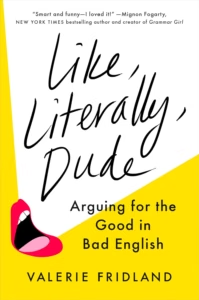 Somebody says “like” three times in one sentence, and suddenly we’re administering an IQ test. Somebody drops a G, says “ax” instead of “ask,” or lets their voice crackle into vocal fry at the end of a thought, and we’ve already filed them under lazy, uneducated, or unprofessional. We’re all amateur linguists, it turns out — no training required, just very strong opinions. But what if the English we love to correct is older, more systematic, and more useful than the “proper” version we were taught to defend?
On this episode, we’re rejoined by linguistics professor Valerie Fridland (hear her first appearance here), author of Like, Literally, Dude: Arguing for the Good in Bad English. Here, Valerie explains why “ax” turns up in Beowulf, Chaucer, and the Salem witch trial transcripts; how the young, the working class, and women have always been the engine of linguistic change; why the rule against ending a sentence with a preposition owes more to snobbery than syntax; how a well-placed “uh” can actually help listeners remember what you say; and why we hear authority in low-pitched voices, a bias that leaves professional women in a double bind. Whether you’re a grammar stickler, a public speaker, a parent wincing at your kid’s slang, or someone who’s ever been judged by the way you talk, this conversation will change how you hear everyone else, and maybe yourself. Listen, learn, and enjoy!
Please Scroll Down for Featured Resources and Transcript!
Please note that some links on this page (books, movies, music, etc.) lead to affiliate programs for which The Jordan Harbinger Show receives compensation. It’s just one of the ways we keep the lights on around here. We appreciate your support!
- Sign up for Six-Minute Networking — our free networking and relationship development mini-course — at jordanharbinger.com/course!
- Do you even Reddit, bro? Join us at r/JordanHarbinger!
This Episode Is Sponsored By:
- Hostinger: 10% off: hostinger.com/jordan, code JORDAN
- SimpliSafe Home Security: 60% off: simplisafe.com/jordan
- Whatnot: Start selling today: whatnot.com/sell
- AT&T: Get an iPhone 17 Pro for $0: att.com/iphone or visit an AT&T store for details
Thanks, Valerie Fridland!
Click here to let Jordan know about your number one takeaway from this episode!
And if you want us to answer your questions on one of our upcoming weekly Feedback Friday episodes, drop us a line at friday@jordanharbinger.com.
Resources from This Episode:
- Like, Literally, Dude: Arguing for the Good in Bad English by Valerie Fridland | Amazon
- Valerie Fridland, PhD | Official Website
- Why We Talk Funny: The Real Story Behind Our Accents by Valerie Fridland | Amazon
- Valerie Fridland | Why We Talk Funny and What Our Voices Reveal | The Jordan Harbinger Show
- Dude: A Long History of a Short Word | OUPblog
- Dictionary.com’s 2025 Word of the Year Is Viral (and Baffling) Gen Alpha Slang 6-7 | Euronews
- What Were the Zoot Suit Riots? | History
- Teenage Girls Have Led Language Innovation for Centuries | Smithsonian Magazine
- Thee, Thou, You, and Ye | A Way with Words
- Y’all, You’uns, Yinz, Youse: How Regional Dialects Are Fixing Standard English | Atlas Obscura
- Despite All the Likes, Literallys and Dropped G’s, English Isn’t Decaying Before Our Eyes | The Conversation
- Linguistic Society of America Resolution on the Oakland Ebonics Issue | Stanford University
- Salem Witch Trials: Documentary Archive and Transcription Project | University of Virginia
- Why Chaucer Said Ax Instead of Ask, and Why Some Still Do | NPR
- The Words That Shift in the Wind | The New World
- There’s No Such Thing as G-Droppin’ | The Dead Language Society
- Better Living through Spelling | National Endowment for the Humanities
- Grumpy Grammarian: The Dangling Preposition Myth | The New Republic
- Danny Bate | Why English Spelling Is a Beautiful Mess | The Jordan Harbinger Show
- What’s with the New Yawk Accent? | Mental Floss
- Interviewees’ Overuse of the Word Like and Hesitations: Effects in Simulated Hiring Decisions | Penn State
- Sound–Meaning Association Biases Evidenced across Thousands of Languages | Proceedings of the National Academy of Sciences
- G-Dropping as Non-G-Adding | Language Log
- Invented Spelling Leads to Better Reading, Study Says | Education Week
- How the Letter E Almost Ruined English | The Dead Language Society
- Um . . . Who Like Says You Know: Filler Word Use as a Function of Age, Gender, and Personality | Journal of Language and Social Psychology
- It’s, Like, You Know, Science: Why We Use Fillers When We Speak | Babbel Magazine
- Why Everyone Is Saying ‘I Mean’ More Than Ever | Psychology Today
- Using Uh and Um in Spontaneous Speaking | Cognition
- Variation and Change in the Use of Hesitation Markers in Germanic Languages | Language Dynamics and Change
- The Disfluent Discourse: Effects of Filled Pauses on Recall | Journal of Memory and Language
- Like, What? The Power and History of a Popular Phrase | Psychology Today
- Did We Change the Definition of Literally? | Merriam-Webster
- Linguistic Phoenix: The Recycling of Very in Ontario English | Language Variation and Change
- It Seems Very Extreme: Did Elizabeth Holmes Change Her Voice? Experts Weigh in on the Way Women Speak | Northeastern Global News
- Voice Pitch and the Labor Market Success of Male Chief Executive Officers | Evolution and Human Behavior
- Voters Favor Deep-Voiced Politicians | Duke Today
- What’s Vocal Fry Really All About? | Dictionary.com
- Using Crowd-Sourced Speech Data to Study Socially Constrained Variation in Nonmodal Phonation | Frontiers in Artificial Intelligence
- Die Hard | Prime Video
- John Ohala: Vocal Fry and the Frequency Code | Social Science Matrix, UC Berkeley
- Sociocultural Aspects of Pitch Differences between Japanese and Dutch Women | Language and Speech
- Chinese Slang: Temper Tantrum 101 | The World of Chinese
- Faith Salie: On a First-Name Basis | CBS News
- The Matter of Me-Avoidance | The New World
- American Glottalization: Why Younger Folks Say Words Like “Kitten” and “Mitten” as “KIH-un” and “MIH-un” | A Way with Words
- Sean Hemeon | The Good Little Drug Lord | The Jordan Harbinger Show
1416: Valerie Fridland | Arguing for the Good in Bad English
This transcript is yet untouched by human hands. Please proceed with caution as we sort through what the robots have given us. We appreciate your patience!
Jordan Harbinger: Welcome to the show. I'm Jordan Harbinger. On The Jordan Harbinger Show, we decode the stories, secrets, and skills of the world's most fascinating people.
Our mission is to help you become a better informed, more critical thinker through long-form conversations with a variety of amazing folks, from spies to CEOs, athletes, authors, thinkers, performers, even the occasional gold smuggler, international con artist, or AI safety researcher. And if you're new to the show or you're looking for a handy way to tell your friends about it, I suggest our episode starter packs. These are collections of some of our favorite episodes on topics like persuasion and negotiation, psychology and geopolitics, disinformation, China, North Korea, crime and cults, and more.
It'll help new listeners get a taste of everything we do here on the show. Just visit jordanharbinger.com/start or search for us in your Spotify app to get started. Today on the show, somebody says like three times and suddenly we're administering an IQ test.
Somebody talks with vocal fry and we've decided they're unprofessional. Apparently we're all linguists now, with no training but very strong opinions. Today, actual linguistics professor Valerie Fridland returns.
Her book is called Like, Literally, Dude: Arguing for the Good in Bad English. We'll explore why some of the English that we call lazy or incorrect has centuries of history behind it, how ums and uhs can actually help listeners remember what we say, and why we hear intelligence and authority in certain voices before we've evaluated a single idea. If you enjoy correcting other people's grammar, this episode may explain why everybody has a separate group chat without you.
Here we go with Valerie Fridland. Alright, you begin the book with your teenage son dismissing your advice. I can't remember what you were correcting him on, it was will or going to or something, and he says, oh okay boomer.
So set that scene for us because he basically told a professional linguist to mind your own business. He is not interested.
Valerie Fridland: Well, he told his mom to mind her own business, which is something that happens frequently and he could care less what I do for a living.
Jordan Harbinger: That's a good point, yeah.
Valerie Fridland: Yes, my kids both roll their eyes whenever I would try to have any kind of conversation with them. In fact, I can't even remember what that specific word was that we were talking about, but one of the things that he really used to get irritated on is the origin of dude, so he used dude all the time when he was a kid. And so I'd like, did you know what dude actually really means?
Do you know what historically dude actually means, which was you're a fop or a dandy with ostentatious regard for dress? It was really about men involved with the aesthetics movement and that were sort of effeminate and acting outside the norms for masculinity, which is so ironic considering what dude means today. And it certainly wasn't what my son meant, but I would get the eye roll on the okay boomer.
My son was in the okay boomer phase for a long time where I was dismissed out of term for anything I said with okay boomer. But you know what, I think one of the things we don't recognize is really the language of our future is written on the mouths of the language of the young.
Jordan Harbinger: Of course. Yeah. You have to adapt to what they say.
I won't say six seven because it doesn't mean anything and it's a stupid joke, but there's other stuff that even kids now are starting to go, I'm like, oh, I have to say that looks sick now, doesn't it? I can't say, oh, that looks nifty.
Valerie Fridland: No.
Jordan Harbinger: Right.
Valerie Fridland: You have to move with the times. Certainly six seven is going to die out, I think, because it was so specific and its meaning is that it's meaningless, right? It has a meaning in the sense that it's drawing attention to this shared experience.
This is like silly and meaningless.
Jordan Harbinger: People were saying it in China.
Valerie Fridland: Oh, anywhere. You could, once it gets that far, young people don't want to say it anymore because it loses the specialness that it had. But a lot of the words we say once started in the mouths of the young that then became things that everybody said.
Dude is a great example. Its original meaning was actually an insult.
Jordan Harbinger: This guy's wearing an ascot.
Valerie Fridland: It was actually a certain mode of dress. Usually it was a tight vest, tight slacks, big hats with feathers. And really, these people, I think there was a quote that they live without recompense for their living because they are considered these people that were just so concerned with themselves and how they look.
And they would have let a woman get run over by a horse carriage before they would offer help if they were worried about how they're...
Jordan Harbinger: Going to get dirty.
Valerie Fridland: Yeah. Oh, my goodness. I can't get some dirt on myself.
Also in New York at the time, in the late 1880s, they were written up in the New York Times, a lot of people that were just out drinking and gambling, but very concerned with how they appeared to the sacrifice of all others.
Jordan Harbinger: And those are the dudes.
Valerie Fridland: Those were the dudes. And Oscar Wilde was pointed to as sort of the ultimate dude. He was actually written in a poem called Ode to a Dude, which was written in 1884.
And it refers to him and how he brought his dudeness over. Meanwhile, now it's the Marlboro Man. Absolutely.
It's shifted. And that actually happened with Mexican-American and African-American zoot suiters in the 1930s and 1940s.
Jordan Harbinger: Is that jazz stuff?
Valerie Fridland: That was, yeah. The zoot suit was kind of a rebellious way of dressing because it was considered ostentatious in some ways because it used a lot of fabric at a time when that was something that during the war era, not something you were supposed to be using a lot of, but it was also a very showy, flashy kind of dressing, but particularly associated with marginalized groups that were considered edgy and dangerous.
So a lot of the riots that occurred because of the zoot suit wearing was really not about the suits at all. It was about this clash between African-American communities and what they represented to white society that looked at them as subversive and dangerous. So the idea is they started calling each other dude, and that's when dude had moved from being about the way people dressed in an inappropriately effeminate and self-absorbed fashion in the 1880s, and it was a complete insult.
In fact, duels happened over being called a dude to the early 1920s, 30s, and 40s, where it started to be more about someone that had a specific style of dressing. So dude ranch is actually about non-Westerners that would come out West overly dressed to these ranches, and they were called dudes because they were dressed inappropriately. They had this city slicker outfits on.
And so that was the sense that they used it with each other. We're dudes. We are representing a certain culture and sort of belief system and subversive.
Jordan Harbinger: It's like gangster. Like that used to be an insult if you called somebody a gangster. Now it's like, oh, look, oh, he's a gangster.
Valerie Fridland: He's a geek. He's reclaimed. Right.
And they were often thought of as gangsters only because they were members of marginalized groups. So it was like taking that and using it against mainstream culture. So they called each other dudes, and that's when dude became cool because it became non-conformist and edgy.
Then, of course, surfer culture picked it up, druggie subculture picked it up, and that's how it flipped from being about really fashionable clothes in Mark Twain's time to being about a slacker but really masculine sense in modern times. So that was something I used to always try to tell my son about, and it was just like, I don't want to hear it, mom, dude's dude. So he would roll his eyes.
But the reality is it's through these young people. So whether you're a young African-American man in the 1930s or my son in the 2000s, it's through the creative use of language in those subcultures that we see this kind of edging of meaning that brings full circle to the meanings where it's opposite what it used to mean.
Jordan Harbinger: This is interesting because it seems like the people who have the least institutional authority, if you can call it that.
Valerie Fridland: The least social power.
Jordan Harbinger: Yeah. But they have the most linguistic influence.
Valerie Fridland: A hundred percent. That's the way that language work gets done. If you look back in the history of many things that we say today, a lot of them actually started in the mouths of the lower classes.
The young, the lower classes, and women, interestingly enough, because who are those people? They're all people that are often looked upon with disdain, whose words are often discounted, whose ways of speaking are often discounted. And in many ways, that is bad for your ability to fit into the sort of organized power of a government or a state, but it gives you a lot of freedom in terms of being able to be innovative with your language.
And for young people, it's that they don't want to sound like their parents and they're not yet in that social structure, so they have that freedom more. But for people that are in lower classes, it's that they don't get the same gains from using it. It's not the model to which they aspire because it won't help them, even if they start sounding that way.
But what we tend to forget is many people don't need to be in the white middle class. That's not everybody's goal, and it's actually since World War II, the rise of the middle class has been extreme. Prior to that, I think 80% of the population was lower or working classes.
When you're living in that group and you're working in that group and you're meeting the people you're going to hang out with and marry in that group, or you're looking at each other's back in that group, speaking like a middle-class white person is not going to help you.
Jordan Harbinger: Yeah, probably not.
Valerie Fridland: And that's where innovation gets born because you're not working under the sort of institutional pressure on language that colleges exert, that institutions exert, that legal institutions exert, right? All of those are very norm-enforcing so that if you want to speak and interact in those groups, you're going to have to talk a certain way. But when you're hanging out with your friends, you let low-level linguistic pressures that always operate on us, that are repressed by people in higher classes, operate, and that brings changes.
So a great example is something like when we now say you for everybody, whether it's singular or plural or subject or object, if you look back at the old system, where did ye go? Right? Ye.
Like, here ye, here ye.
Jordan Harbinger: That's plural, right?
Valerie Fridland: Well, it's plural. So is you. You was a plural pronoun.
Historically, thou was the singular pronoun.
Jordan Harbinger: Oh, I did not know that. I think most people probably don't know that.
Valerie Fridland: Yeah. Thou and thee were the singular pronouns in the Old English, Middle English paradigm. Thou was subject case, single pronoun.
Ye was the subject case plural pronoun.
Jordan Harbinger: Is that where y'all comes from?
Valerie Fridland: Ye all? Y'all comes from ye all, which is Scots-Irish. Yeah.
Yeah, you did get it.
With some West African influence. That's a whole other interesting thing. But ye all was you all from Scots-English, and that became y'all because there's a lot of Scots-Irish influence in the South, and that's where y'all probably came from.
Jordan Harbinger: I find y'all totally useful.
I'm Michigan.
People don't say it, but I'm like, I'm using that.
Valerie Fridland: It's such a useful- We need it. Y'all has expanded because the whole problem is when we got rid of thou, which was singular, and we started using you for everybody, we lost the ability to tell someone whether we're referring to one person or many, which is why we have yuns, yins, yous, which you is actually, yous is great because it's Irish. It's from the Irish, and it's you plus a plural s, which I think is brilliant, right?
Jordan Harbinger: Yous, yeah.
Valerie Fridland: Yous. But the whole idea with you is even if you just start using ye and you for both, what happened to ye? Well, ye was nominative, and you was for accusative or object case, so you'd use ye at the beginning.
Jordan Harbinger: Almost no one knows what that means.
Valerie Fridland: No one knows. Like, if you use ye as a subject, that's where you'd use it. You would have been in the object place.
But gradually over time, people just started saying, what you doing, or what you doing, and where you sounded- So it should be what you doing. Doing what, right?
Jordan Harbinger: Oh, good.
Valerie Fridland: But then we started just abbreviating you to ye, right, because you'd be like, hear you, hear you over there, or something, or however you'd use it as an object, and you'd just say, yeah, and then yeah and yes sounded the same, so it all became you. And that happened with women in working class. Like, we see it more in letters in the early modern period from people that are less dominant in society because they spoke like they wrote, and they weren't policed as much at that era in terms of having to enforce these norms because they were not educated.
They were not doing the writing for the society. They were not in the professional context. Men actually tended to adhere to more norms that were going to be standard in that way because those were the people that were doing a lot of that at that time.
Jordan Harbinger: I see.
And the women or the marginalized people were at home, and nobody was like, I better make sure that she says this the right way. It's like, who cares how they talk with each other when they're, I don't know, at home?
Valerie Fridland: Right.
And there were probably women that were in an upper class at that time. They certainly were probably more educated than women that were in the lower classes at the time, but they weren't formally educated, and the pressure on them to have those speech forms was less. And the other thing is they spent a lot more time with people in the lower classes because those were the people that took care of them, that were the maids, the servants, the people that they went and bought things from would have been from those classes that were not the polite society classes.
So they had more interaction and interaction is really the bread and butter of the way we sound.
Jordan Harbinger: So language goes from minorities, minority women to minority men to white women to everyone.
Valerie Fridland: If we're talking about in the British pre-American, right, evolution, wouldn't have been sort of minority influence in 1600 on women's speech. Most likely it would have been probably servants from other more rural, less...
Jordan Harbinger: The Irish servant that you had, the men's servant that you had.
Valerie Fridland: Yes, exactly, or Scots, Scots, which was a despised language at the time. So it would have been that kind of influence. People would have been like rural or from the north of England when there was mass migration to London in this sort of pre-industrial revolution.
People don't realize the Hiberno English or Irish English, a lot of times when you go to Barbados, people, there's a lot of Irish influence there. A lot of the West Indies, there were a lot of people, a lot of slaves brought from the West Indies, and they were brought as well to Britain as well as the colonies. In fact, a lot of Northern British influence came into London and stuck around.
So, for example, that third person on verb forms, like he goes, he does, that actually replaced doth.
Jordan Harbinger: I couldn't use that if you paid me. I don't know if you want to use that meaning again.
Valerie Fridland: Or maketh instead of makes. But that was actually a Northern British form that got brought into the London area and then started to replace that th around Shakespeare's time. Shakespeare still had the th he used a lot.
But it was around that time. Yeah, maketh.
Jordan Harbinger: What does he maketh?
Valerie Fridland: That was really just that kind of influence.
Jordan Harbinger: Yeah. Gosh, it's funny to think all these things that sound so fancy to us are actually from just uneducated poor people from parts of England. It's crazy, right?
Valerie Fridland: That was one of the reasons I wrote this book, because all these features have such a really fascinating history. And people come into their knowledge of them from only this one moment, cultural moment. But the reality is they have a long cultural and social history that people don't know about.
Jordan Harbinger: When I think doth, I think, oh, the queen used that word. Shakespeare used it. It's like no toothless servants who are digging in manure all day used it.
Valerie Fridland: That would have been the sort of form that most people in London used. But it was actually the S form that we use was the low class form that came in from the north. And now that's what everybody uses.
And the way that you know how in African-American English you might hear he go. Sometimes it drops off. But you also say you also can sometimes I goes.
Where you hear it on other forms that S usually is a third person marker. So it'd be he goes. But you might hear I goes there where one of the complaints sometimes you hear about African-American English is that they stick an extra S.
Well, actually, around 1600, 1700, that S was not just a third person marker. It could be used on other verb forms with different subjects. So it could be I goes, he goes as well.
And it slowly went away where it only appears on third person subjects. But that's actually a relic of an older form, just like ax acts as a relic of an older...
Jordan Harbinger: Is it really? Because people think like, oh, modern African-Americans just made this stuff up because they're uneducated and it's not true at all. And I thought that was one of the most interesting takeaways from the book, because I think the majority of people think that African-American vernacular is just some stuff that's made up and by rappers that just gets disseminated among the community.
They don't realize. No, this is centuries old. It's as old as any other dialect of American as valid as any other dialect of American, which is absolutely another thing that I think people don't really believe.
Valerie Fridland: That's again that example of when we have feelings about certain speakers, we put those feelings about speakers or their stereotypes we have on the speech features they use. And African-American English is absolutely that. Because if you look at, for example, the New England area in the early colonial days.
So like 1690 or so, we get the Salem Witch Trials going on. That actually is a goldmine for linguists because they actually transcribed those trials.
Jordan Harbinger: So they had records like court records.
Valerie Fridland: It was written in 1690, so it didn't use standard English because standard English, as we know, it didn't exist yet. Yeah. So they wrote more like they spoke.
And so we can tell from spellings what people said. And we actually see ax everywhere in those Salem Witch Trials.
Jordan Harbinger: Why is there ask and ax then? What's going on?
Valerie Fridland: That's a really fascinating. So it has to do with the process called metathesis, which I'm going to put it out there. I think it's a great heavy metal band name.
Jordan Harbinger: Oh, yeah.
Valerie Fridland: Saying if you have a new band, you're opening for Metallica next week. Exactly. But there's a process called metathesis, which is where sounds switch the order in which they're said.
So if you have children, you can hear this sometimes at work.
Jordan Harbinger: Pasghetti.
Valerie Fridland: Pasghetti is a perfect example. That's actually a metathesis process that's happening. But it's actually something that operated a lot in Old English.
The word like a bird was actually brid in Old English. Third was thrid in Old English. Thrid.
And wasp was waps in Old English. Horse was hross in Old English. These are all examples where the sounds just switch the order they received.
And then interestingly, in Old English, there were two forms of the verb to ask. Askion and a metathesized version axion.
Jordan Harbinger: I've heard that word before, but I couldn't tell you what it means.
Valerie Fridland: It means to ask in Old English. And axion.
Jordan Harbinger: Oh, it's a name of a company that's around here.
Valerie Fridland: It might be a modern company, but in Old English, there were just two versions. And if you look at, for example, Beowulf used axion. Chaucer used it.
You see old Bible translations using ax. So it's a historically old feature. It was often like Chaucer spells it A-X-E.
In the biblical translations, they spelled it A-X-E at that time. Was basically it's an A-K-S. And that's where we get it from.
So it was two competing versions. Now, here's another example of where London migration from the North happened. The form in the South was actually more often ax or axion or ax at that time in the 1500s.
The form for the North was ask. And so when we had a lot of Northern migrations in Britain from the North to the South during the pre-industrial revolution era, that brought the ask form and made it more popular and it tended to replace ax.
Jordan Harbinger: So we could actually have the same thing happen. We could just all start saying ax eventually over the next hundred years. We could just decide to do it.
Oh, I was listening to this old podcast with this boring dude named Jordan Harbinger, and he says ask a question. Isn't that funny?
Valerie Fridland: And he can't say it right ever, right?
Jordan Harbinger: He never says it right. Yeah. So my great grandkids will be like, didn't great grandpa Jordan talk like a weirdo?
He says ask.
Valerie Fridland: He doesn't know how to pronounce ax, right?
Jordan Harbinger: What an idiot.
Valerie Fridland: What a dum-dum.
Jordan Harbinger: He must have grown up in the hood.
Valerie Fridland: Exactly. So what happened is it was actually a colonial era feature that gradually disappeared from the colonies outside of the South. And it was a lower class Southern white and African-American feature because those were the people that sort of kept it as a relic.
And then it gradually solely became black and lower class and just disappeared from other varieties. So really what happened is that it didn't get invented in African-American English, that it's just a relic feature of a much older form. Okay.
Fun fact though, another two words that had metathesis that still exist in English are the word task and tax. They're from the same root, which was taxa in Latin, and it meant basically to make a payment and one is to make a payment with labor, the other is to make a payment with money, but so they originally meant the same thing, like to make a payment to make some exchange of money, but there became a metathesis version, so tax was the original form, it metathesized to task, and instead of getting rid of one and keeping the other one, like one means a task is something you're doing with labor and tax is something you're doing with money. Isn't that cool?
Jordan Harbinger: That is cool.
Valerie Fridland: I know.
How could you not love these facts?
Jordan Harbinger: It is cool.
Valerie Fridland: But all metathesis, man. So get that heavy metal band going.
Jordan Harbinger: That's right. All your lyrics have to have that.
Valerie Fridland: All metathesized words in them.
Jordan Harbinger: Man, this is fascinating. That's like an AI rock band, right? Because it can write all the lyrics like that.
Valerie Fridland: Exactly.
Jordan Harbinger: I would love to hear the strongest example in the book where the version people call bad English, it just communicates something the supposedly correct version of English cannot communicate.
Valerie Fridland: I think that in-ing alternation, which is something we don't think a lot about, so when you say like I'm walking, I'm talking, I'm doing, people first of all don't realize that the in version is historically the accurate one, so it really wasn't until the 19th century where we started to shift towards ing as the correct version and had that idea that it was, it was kind of a spelling pronunciation because people were more literate than they had been.
But it actually, there's a long history to it, but it dates back to Old English.
Jordan Harbinger: Were more literate or more illiterate?
Valerie Fridland: They were more literate in the 19th century than they had previously been. So people would see it written and then think, oh my gosh, there should be a G, which is also a fantasy, there's no G on there, so you don't say sin-g when you say S-I-N-G, you say sing because it's actually what we call a velar nasal, which is fancy linguist talk for a nasal sound where your tongue is up there.
Jordan Harbinger: But the G on sing is different, right? Because the gerund, is that what it's called, of that is singing, so there's another ing at the end of it.
Valerie Fridland: And that is the gerund, we tend to delete the G off, if you want to say, use that term, of gerunds less frequently than we do when they're verbal participles, which would be like a progressive, which is I'm walking, I'm talking.
Jordan Harbinger: Yeah.
Valerie Fridland: That's a great example because it does so much for us and it does it for all of us, so unlike some of the features that maybe people don't use, so maybe if you're 80, you're not saying like a lot, and that's a feature that young people use a lot and it has purpose, but...
Jordan Harbinger: The comments we get about this...
Valerie Fridland: Oh my gosh, we are going to have a whole field day with it.
Jordan Harbinger: Jordan said like too many times, I used to think you were smart and now I don't, and it's like, that one might be on you.
Valerie Fridland: Yeah, exactly. And well, and who has the time to be counting your likes? I mean, get something else to do, people.
Jordan Harbinger: Yes, somebody who's gardening. And look, no shade on gardening, but focus on the flowers, granny.
Valerie Fridland: Exactly. Get those weeds out. But anyway, the thing about the G is it's a universal habit that we all have.
So everybody who's an English speaker, particularly native English speakers, and it doesn't matter whether you're Australian English or British English or American English, you have that alternation in your speech where you sometimes say walkin' and you sometimes say walking, and a lot of people do think that walking is the correct form, but if you hang out at a bar and you want to actually have friends and you walk around saying, I'm walking, I'm talking.
Where's that guy from?
Jordan Harbinger: See, from Russia or something? He talks funny.
Valerie Fridland: They talk funny and they're not going to want to hang out with you because it really communicates solidarity, friendship, casualness. It has that whole ethos that goes with it. So while we think of it of having a good version and a bad version, even though that's actually incorrect historically, because the bad version was the good version, it really does a lot for us.
And if you talked to someone with all your G's in everyday conversation, they would get a different sense about you. They wouldn't think you were as friendly. You would be communicating something really stiff and formal.
It does a lot of work for us and we don't tend to think of the work it does as important.
Jordan Harbinger: Apparently removing every filler word makes you sound less like a real person. Anyway, purchase goods and services, fellow humans. We'll be right back.
This episode is sponsored in part by Hostinger. Building this show also meant building a place online where people could find our work. And as the show grows, that website needs to keep up.
We recently tried Hostinger's AI website builder to improve our site. In fact, check out jordanharbinger.com/deals. I'm not technical really when it comes to this stuff.
And I don't know anything about how websites should be, but I was able to improve on our website's design and usability using Hostinger's tools. So if you're starting a business, you know that moment when somebody says, Oh yeah, send me your website. And you're like, Oh yeah, right.
I need to make one of those. You want it to look legit, but finding a web team, comparing notes, spending an arm and a leg before you've landed your first customer, that's a lot. Hostinger makes that barrier much lower and help doesn't stop at launch.
It's AI tools can help with website copy, SEO, email marketing. You can spend more time building your business instead of figuring out your website.
Snag Hostinger services at their lowest prices before the sale ends. Create your website today for just $1.99. Go to hostinger.com/jordan10 and use code jordan10 for an additional 10% off Black Friday and Cyber Monday pricing.
This episode is also sponsored by SimpliSafe. You know that home security upgrade you keep meaning to get around to? This is a good time to move it up the list.
SimpliSafe has their biggest savings of the year, 70% off a new system with professional monitoring. Usually it's only 50% off. So now really is a good time to pull the trigger on the deal.
It's a security system that I use and trust. And for me, it comes down to my family. When we're away, I want to enjoy being with them instead of wondering whether everything's okay at home.
And when we're home, I want potential threats dealt with outside before somebody gets anywhere near us. That's what stands out about SimpliSafe. It's designed to help stop a break-in before it starts.
AI-powered cameras watch for potential threats and alert a live US-based agent. The agent intervenes in under 30 seconds, speaking through the camera to deter the intruder and calling for urgent 911 dispatch when needed. Somebody can actually step in.
We've partnered with SimpliSafe to offer our listeners their biggest savings of the year. 70% off your new system with professional monitoring. When you visit simplisafe.com/jordan, that's simplisafe.com/jordan. And when you order, write in The Jordan Harbinger Show at checkout. It tells them we sent you and it really helps support the show. SimpliSafe.
Ahead of crime in real time.
When you use our codes, you don't just get a discount. You also help out the show. Companies see that you're using the codes, that you're hearing the ads.
It's a double win because you get a great deal and you help keep the show going strong. Thank you for your support. Now back to Valerie Fridland.
Years ago, when I first started this podcast, somebody would listen to it. He loved the show and I appreciated that. But what he would do is send me all of the grammar mistakes I'd made in my speech on every episode.
And it would be like a three page long email. And I thought to myself, if you do this in real life, you must have absolutely no friends at all. Because imagine saying, who are you talking with?
And someone goes, uh, with whom are you talking? And you go, okay, who invited this guy?
Valerie Fridland: I'm not talking to you anymore would be what you'd say. You know, I called them the grammar police.
Jordan Harbinger: Yeah, the grammar police.
Valerie Fridland: I get the same emails. And the funny thing for me is I actually spend my career talking about how we get things wrong with language, that being prescriptivist in our approach to language is not always the fair or right way to look at it if you think about it historically and scientifically. So pretty much everything I'm talking about is how the grammar police are sort of overreacting to things that have a historically different take and a scientifically different take.
And yet people still write to say, oh, did you know you deleted the T when you said sentence?
Jordan Harbinger: Oh, gosh. Yeah.
Valerie Fridland: People just can't help themselves. And I think that's something that has to do with a lot of America's founding because of the way that America came to have its own language and the way that Noah Webster and the founding fathers actually believed that good language, this sense of language that was an upper-class kind of educated form was accessible to all and should be something that everybody had access to, which was really not historically what had been thought of in Britain. There was a certain speech of the upper class and the educated class, and they were felt to have been born into that, and they deserved it, but the commoners didn't. But America was founded with a different ethos.
And part of Noah Webster's goals in writing his spelling reform and some of his spelling books and some of the educational materials was to share that ability to have better language with everybody. And I feel like that has really imbued us with this idea of sort of prescriptivist correctness in a way that sometimes makes us less friendly.
Jordan Harbinger: Yeah. So Jen, my wife, she books all the shows and she used to write, what's a good number to reach you at? And I would go, oh, it's at which to reach you.
And I corrected that so many times over and over and over. She finally made it a shortcut that she just pastes into the email. Now she probably knows it.
And then one day she's like, I still think it's dumb. I want to look it up. Turns out you can say either one and it's fine.
And I just realized like, oh, why do I care about this at all? I'm just Mr. To whom are you speaking?
Valerie Fridland: And would you ever say that in person? If you had a conversation with someone and you said it the way that you wanted her, at which to reach you, that person would run. There'll be no number at which you'll be reaching me.
But so here's a perfect example of a historical inaccuracy and something that we believe because we have these prescriptive ideas and you're, you probably had an English teacher in sixth grade that said, don't end your sentence with a preposition.
Jordan Harbinger: You can't end a sentence with a preposition. Of course. Yeah.
And you get marked down by Mrs. Lanzetta or whatever.
Valerie Fridland: Mine was named Mrs. Warfield. That was her name. And I felt like it was a perfect sixth grade English teacher's name.
And it's called preposition stranding. That's the official word for it. But if you look back at the history of why we have that role in English, there's nothing about prepositions that makes it incorrect to do that.
But at the time when English was having its grammar codified in the 18th century, there really were no models because English was a bastard language. So English was not considered a language of learning, a language of religion, a language of politics. It was this common, grotesque form that had been cobbled together by all these different languages coming together.
Jordan Harbinger: Every guest on this show who tries to explain the alphabet. We did a show about the alphabet.
Valerie Fridland: Oh yeah, yeah. Probably with Danny Bae.
Jordan Harbinger: Yeah. It's like Q is a monkey glyph and it's like, why is that useful?
Valerie Fridland: Spelling is a perfect example where you've had all these different forms and influences, English as well. I mean, it started Germanic and it is still a Germanic language, but most of our word stock is not even Germanic anymore and we have all these weird rules. But when they started writing the grammar of English, it was based on the grammar of Latin, which makes no sense because English is Germanic and Latin is romance, right, is Italic, but yet because Latin was such a classic language and was thought to be the learned language and the sort of language of antiquity, they wrote the rules to match that, figuring that a good language had to have the same rules and in Latin, you can't have a preposition at the end of a sentence because that's just not how Latin works.
So that was actually written by Bishop Robert Lowth, wrote that to be more beautiful, English should follow Latin's example. He didn't actually prohibit it. He didn't say it was wrong.
And in fact, analysis of his own correspondence showed that he stranded prepositions as well.
Jordan Harbinger: He yelled at all of his kids to not do that.
Valerie Fridland: Yeah, exactly. He just said it's less polite to do it, it's less learned, so don't do it. And that's the history of that rule.
So it has nothing to do with language and everything to do with elitism.
Jordan Harbinger: Yeah, that's what it sounds like, right? It's like, oh, if you talk this way, people will see, oh, he's been educated well. Oh, that's important to me because I'm a douchebag, you know, kind of guy.
It's like, oh, listen to the way they talk. It's posh or, oh, this person had expensive schooling and therefore isn't what, entitled to more respect? I mean, that's the subtext, right?
Which is nonsense, actually. When we hear somebody say literally or whatever, are we judging the language or are we judging the kind of person that we associate with the language?
Valerie Fridland: It's the latter. When we put on speech features ideas about the type of person that says it, that's all about the way we feel about those people. And it has nothing to do with intrinsic value of any kind of word or form.
And the same thing with accents. When we hear an accent, I mean, R dropping is a perfect example. If you say, pock the car, in British English, it sounds very effete and refined and sophisticated.
If you say, pack the car, in New York, it's a totally different vibe we get. So it can't be the feature itself because in both cases, it's dropping an R. It's got to be what we think about the speakers who use it frequently.
And whatever we associate with those groups often become stereotypes we associate with their language. And that's really where we get these feelings about things like who uses, who's saying literally, non-literally, and the idea about singular they.
Jordan Harbinger: I think you said literally in a figurative way on the last episode we did. And I had to say something, right? And I could basically see your middle finger through the airwaves.
We weren't even on video and I was like, I know I'm getting the eye roll right now for sure, because it is unfair. It's funny to think that as a deep Southern drawl or a New Jersey or Staten Island accent is actually closer to this posh British English that we think is hoity-toity versus somebody who talks like me, which is really kind of further away. Before we get too comfortable, can something be linguistically systematic and still be strategically unwise to use?
Let's say you're in a courtroom, you're in a meeting with your boss and his boss and that guy's boss for a job interview, because it seems like in a job interview, I should probably be as hoity-toity as possible. What's the best number at which to reach you before I come in on Monday? That kind of thing.
Even though the second I get to that office and sign my paperwork, I'm never saying that phrase again.
Valerie Fridland: Never again.
Jordan Harbinger: Yeah.
Valerie Fridland: Well, I think there are two things, right? It depends on the type of job. So we talk as if the same type of language will get us every kind of job.
And when we're talking about professional contexts and white-collar jobs, absolutely there is definitely a pressure for standard language norms. But there are a lot of jobs where your interaction is with people or in communities, and that kind of speech won't actually get you very far. I don't think if you're interviewing for a mechanic job, the same kind of language is going to get you that job or matter as much.
Right. So I think it varies. So I don't want to give the impression that standard speech is always the right form.
You're absolutely right. Linguistically appropriate use of forms, often in conflict with socially appropriate use of forms. And that's really where we have most of our issues.
So when you take a form like like or um, or something like that, that's generally dispreferred socially, you use it in a context where you want to make a good impression, especially in a context where standard language norms are what's appropriate, then it can hurt you in that context. Now, that doesn't mean it's always ineffectual. So what we find is actually when we look at studies of job interview speech, we do see that when people use a lot of like in job interviews, you know, and these are usually mock interviews situations, but it does tend to get them rated lower in terms of should they get that job.
But when we actually look at strategic use of like, so that when it's not in the actual interview portion, but in some of the sort of social greasing portions where you have to chat about your children or the weather or whatever, we find that actually people come across as more sociable when they use like in those contexts. So it's again, there's nothing that's ever black and white. It's all nuanced when our use is appropriate.
Jordan Harbinger: I didn't realize that walk in was the is so it does that because it comes from German and they use the E N. I don't understand why there's no G.
Valerie Fridland: Well, OK, so there are a couple of different things here. When we talk about the sounds of English, there's a world sounds a nasal sound. So N and M and N are nasal sounds.
And that just means the air flows going through your nose and it comes across in that sort of way, which is interesting side, totally adjacent fact. One of the interesting things when we look at sound symbolism are the ways that language patterns in non-arbitrary ways. We see that in languages around the world that are completely unrelated.
Words for nose tend to have a nasal sound in them, which is because, right, you use your nose to make them. So just cool, fun fact there that just statistically, it seems like that has influenced how we call our noses because we refer to actually making noise through the nose. So you have like in French, which has an N, nose in English, Hana in Japanese, which has an N, all because they're made through the nose.
Jordan Harbinger: But in Chinese, it's bízi.
Valerie Fridland: It's not statistically every language, right? So if you, yeah, so you hear it when you have enough people that speak those languages. But so if you could say, I want you to say N and then M.
OK, so that's an N and an M. And now let's think about the sound at the end of a word like thing or sing. Ng.
Jordan Harbinger: Ng. Right.
Valerie Fridland: So there's actually no N. What it is actually, if you take your tongue and make an N sound and then move your tongue a little back so that the sort of flat part of the tongue is up against that soft palate, Ng, that's the actual sound you make that we spell NG, but it's a single sound. But we don't have a symbol for it in English.
We have a symbol for it in the international phonetic alphabet, like an N with a little doohickey off the end.
Jordan Harbinger: Oh, OK.
Valerie Fridland: But it's represented by it's one sound.
Jordan Harbinger: Is that the N with the tail?
Valerie Fridland: It's a tail that goes in. Yeah, there's different kinds of that's a palatal N.
Jordan Harbinger: Kind of like a scary looking H.
Valerie Fridland: Yeah, it's a little bit of a scary looking H. That's right. So if you notice in English, we never have that sound word initially.
So you don't have that Ng sound starting words in any English. Sometimes we have it in other languages, but not English. So it's a weird sound as it is.
But we've had that sound since Old English time, but it was allophonic, which meant that it was patterned by the sound that came after it. So let's go back to Old English. And the ending that became the participle I-N-G was actually spelled I-N-D-E, if you spelled back then, which not many people did, but it was Inde, Inde.
And so you'd be Spikende.
Jordan Harbinger: Wakinde.
Valerie Fridland: Or Wakinde, yeah. Really? Which would not have been the exact form, but yes, or Spikende or Spikende, depending on whether you had the R in there, would have been speaking.
Now there was a different slightly form of it because we had grammatical gender in Old English. So it could be U-N-D-E or I-N-D-E, depending on whether it was masculine or feminine in that form. But what happened is there was also a competing form that was Inge that made some verbal roots into nouns, like herg meant to pillage in Old English, which I think there was a lot of...
Jordan Harbinger: There's probably a lot of herging going on back then.
Valerie Fridland: Hergiong, which was with the I-N-G-E ending attached to it, meant a raid. So the act of pillaging was what we would say they had a raid. That was hergiong.
And so the word evening actually is that I-N-G from Old English that was making the breaking of the dawn or the breaking of the sun or whatever into a noun. So that was what that I-N-G did. It wasn't a progressive form, but to make a verb participle, it would be I-N-D-E.
But between Old English and Middle English, a lot of sound changes happened. So we basically dropped all endings. So we don't have a lot of case endings in English anymore because they just kind of dropped off around the 11th century.
Jordan Harbinger: Good, because those are a huge pain.
Valerie Fridland: Exactly. They were big. Who wants those endings?
Like German is a pain, right? A lot of languages have some endings that we, but English decided let's make it simple around the 11th, 12th century. So what happens when you have a form like Inge and a form like Inde and you don't say endings anymore, it becomes Inge and Inde.
Jordan Harbinger: I see.
Valerie Fridland: And then we also had other things that, you know, when you say like what, I don't say what, you say what. So we tend to drop sounds off the ends of words. So then you get Inge and Inde and then you drop the G and the D and then you get In and In and they merge together.
But the trick was when you had a G following the N versus a D, you started to say the N a little bit like the G. So you slightly pronounced it In versus N. That was the only slight difference left in those two endings.
So they convalesced and that's how we ended up with Inge for everything. But that's why we have that N sound is because at one time, historically, there was a G back in Old English that we got rid of, but a trace of that G stays on the N and now it's a N.
Jordan Harbinger: My son's class, the teachers, they don't make them spell things correctly except for the words they're actually supposed to know. So they call them heart words because you know them by heart. So it's like run, walk, in, out, whatever.
There's a bunch of them and they know them, but anything else, they just let them spell it however they want because otherwise they won't write. They'll get too confused, right? They get too confused and they get too in their head and they're like, oh, I can't write what I want to say because I don't know how to spell all of it.
So I just won't write. So my son will write all this really funny stuff that walk in. There's a lot of dropped G's.
Valerie Fridland: Wait, they spell it like they say it, right?
Jordan Harbinger: It's all phonetic.
Valerie Fridland: How it sounds to them.
Jordan Harbinger: And then my son will be like, why is there an E on the end of home or whatever? I'm like, ah, French. That's my go-to answer is because it's French.
Valerie Fridland: That's a great answer. Not always correct, but great. I use that one a lot in my house too is, oh, those French.
Spelling, right? A lot of times spelling problems you can blame on the French.
Jordan Harbinger: He likes that better than I don't know and there's no way for me to find out.
Valerie Fridland: So, okay. Some of them are from the French where French scribes were writing English for several centuries when French was the language, like Anglo-French was the language after the Norman invasion. They spoke French in Britain for a couple hundred years and those E's sometimes were scribal E's.
So they just got stuck there because they look prettier. But actually a lot of those silent E's on the ends of words like stone or tail are sort of remnants of Old English endings where we used to have them. So a lot of them were the sort of nominative case ending.
So it would be tala and stone in Old English. And then we just stopped saying the endings, but we kept them in the spelling.
Jordan Harbinger: Oh, I didn't, so interesting. You'd think a scribe would go, I want to do less work. No silent letters.
Valerie Fridland: That was all they did, right? That was their whole life. So whether they were writing an extra E.
Jordan Harbinger: They're getting paid by the letter.
Valerie Fridland: Yeah, exactly.
Jordan Harbinger: They're like, look, I could chip three letters into the stone, but you know what, I can chip seven in here and make twice as much money.
Valerie Fridland: Well, most of them were monks, so I think it was all spiritual payment.
Jordan Harbinger: Oh, I see. Geez, they're getting paid by the letter with good vibes. Yikes.
Valerie Fridland: Their pathway to heaven was paid with those E's.
Jordan Harbinger: I hope you're happy up there guys, because it's a pain in the ass for everybody else. I want to talk about, um, or, uh, because if I say, um, or, uh, which I deliberately got rid of that habit, and then I had to re add it into my speech because of the podcast, right? So over years, I edited my show initially until I hired producer Jase a few years in. Call out to Jase.
Valerie Fridland: Yes.
Jordan Harbinger: Who's he's the one who fixes all my F-bombs or when I have to start over, just deletes the first one. So I sound always like I know what I'm going to say all the time. You will too.
I used to edit out all my ums and uhs because it was driving me crazy. It's subconscious now. I don't think it happens where it happens, but I don't do it all the time when I'm trying to buy time when I'm talking.
Valerie Fridland: Um and uh are filled pauses, but they're often thrown together with a larger group called filler words, and they're slightly different in terms of how they operate and actually universally how they operate, which is cool. But filler words are things like, I mean, so well, all those words that people often don't like. What you're talking about, the things we edit out or we think make us sound less certain about what we're saying or just not as articulate, but when we look at how people that don't use those are rated, they tend to be almost robotic and not as sociable.
So it really does affect how you're perceived from a social attractiveness scale when you don't have them. But the trick is sometimes people overuse them and that's when we get into trouble. But if you don't have them at all, it feels weird.
And in fact, people that are more socially conscientious on personality scales tend to use them more often because they really attend to other people. Right? That's what you're doing.
You're appealing to those listeners. And when you don't have them, that suggests you're not really paying attention to people listening to you.
Jordan Harbinger: It's funny because when I learn languages, one of my favorite parts is when you get to learn filler words, you learn Serbian and they say pa, which means like. And then in, I think Russian has nu, Chinese, there's some like shu and stuff like that, or there's little smaller ones that don't come to mind right away. And then they're cute. They're funny in other languages because they sound cute, I think is the best way to phrase it because it's usually one sound.
Valerie Fridland: There are almost always just one syllable, not necessarily one sound, but one syllable. So it's interesting because I had a friend that was learning Japanese and she was in class with her Japanese instructor and he kept saying ano and eto.
Jordan Harbinger: Oh yeah.
Valerie Fridland: And she was like, what does that mean? She raised her hand and completely embarrassed him. He was mortified because it was a filler word.
But she didn't know that because she didn't speak the language, but they're really part of what it means to become a competent speaker in another language. Because if you are a true fluent speaker in a new language, that part of that fluency is learning those little conversational mechanisms that help conversations flow and cohere. And that's what those do.
Jordan Harbinger: In German, it's also is a common one. There's also so just like we have, but also means like, well, or so therefore, but if you don't use it, you could still speak correctly, but it's a little weird. So when I hear somebody who doesn't use that, I'm like, is this person foreign?
And like, oh, you can hear the accent. I'm like, actually I can't. I just noticed they're not using these filler words.
Valerie Fridland: You're not using those little filler words because they tend to, they don't contribute to the semantic meaning. So if you say a statement without them, the statement means the same thing, whether you include them or not. So that's semantic meaning, but they add pragmatic meaning, which means they give cues about other aspects of the situation or our relationship or importantly, how that sentence relates to a previous one.
So when, you know, I say something like, I'm not going to do that, usually that well is signaling. I'm going to say something that conflicts a little bit with what came before.
Or if you say, let me tell you about what happened to me yesterday. That's like, story alert, here's a backstory you're going to need to know before we go on to that other thing. They say something that's over and above the meaning of the specific words you're saying.
So they're super useful.
Jordan Harbinger: It is useful. It's funny because you're right. You can say, this sounds ridiculous.
And then you can say, this sounds, well, ridiculous. It's like, I'm reluctantly telling you bad news or giving you some feedback that you might not love. But the other statement is completely fine.
If someone's not using that, say in German, you might say like, oh, it sounds a little, a little bit ridiculous in German. That's a little softer than saying, that sounds ridiculous. Where you might go like, I'm getting fired.
My boss just told me this sounds ridiculous. But if they say, oh, it sounds a little ridiculous. You're like, he didn't like that.
I'm not going to do that next time. But you're not thinking I better start looking for jobs.
Valerie Fridland: Exactly. It's softening kind of, it's interpersonally softening. And a lot of what that work that those filler words do is interpersonal relational work.
Yes.
Jordan Harbinger: Yeah.
Valerie Fridland: And so that's why you're kind of a jerk if you're not using them, right? That's what you sound like. I mean, there are people that just have different norms for how often they use them, and that is actually a really interesting thing we see with this idea of when you're more conscientious from a personality scale, that it's just, you're more attuned to making sure you're giving those cues.
But what we also find is that women tend to be more greater users of filler words. And part of that is not because they're women, but because women are often socialized to be more conscientious of others in their conversations and in their activities, and that encourages the use of sort of other oriented features of their speech.
Jordan Harbinger: When I think about that, probably I know it subconsciously, but I couldn't tell you.
Valerie Fridland: Well, it would be really interesting to analyze some recordings and see which one do you lean on, because a lot of times we have a preference, but there actually is a really interesting difference. When you study the time, the length of the pause that follows them, what we find is uh signals a short pause and um signals a longer pause.
Jordan Harbinger: So I think I'm an uh guy.
Valerie Fridland: You might be, because a lot of times when you use them, especially like just for flow and for kind of being more approachable, you're not going to pause for a long time, but it does seem to signal a knowledge of the speaker's pause length. So when you think you're going to need a long pause, like you have to search for a word or something mentally, you use um, and when you are just needing a second, you use uh. So we do find a statistical probability of pause length following them.
Jordan Harbinger: Want to remember these sponsors? Uh, here they are. Look at that evidence-based pandering.
We'll be right back. This episode is sponsored in part by Whatnot. We're super into Pokemon in our house.
And by we, I mean, my son Jaden obviously has been wanting more shiny cards. So we took a shopping trip on Whatnot to find some and for Jaden, they're not for me, let's keep that clear. Whatnot is a live shopping platform where millions of customers buy directly from sellers, you can find deals on everything from Pokemon cards to clothing, electronics, beauty, houseplants.
And the business side is what interests me. If you know your products, live selling gives you a way to put that knowledge to work, show people what makes something special, answer their questions, build relationships with customers who share your interests. Think about the small businesses behind those shows.
Someone's taking a subject they care about and building a business around it. One customer conversation at a time. You can start selling for free with products in a phone.
Whatnot handles the transaction. You print a label and ship the order. Take a shopping trip.
Look for great products without paying full price and see what's possible for your own business.
Search Whatnot, W-H-A-T-N-O-T in the app store, download and start selling right away.
This episode is sponsored in part by AT&T. If you've done my free Six-Minute Networking course, you know, I'm big on keeping in touch. It doesn't have to be a whole production.
Send somebody a quick text, share a photo that reminds you of them. That's part of digging the well before you're thirsty, building relationships through little everyday conversations so you're not only reaching out when you need a favor. And AT&T has a deal to keep those connections going.
Right now at AT&T, you can get the new iPhone 18 Pro for $0 with eligible trade-in. It has the ultimate pro camera system and a big leap in battery life. So you can turn this deal into a long lasting connection.
Share a photo, check in on an old friend, follow up on something they told you last time you talked. You don't need a big reason to reach out. Just remembering what's going on in someone's life is a pretty good one.
Learn how you can trade in your phone for the new iPhone 18 Pro at AT&T. Connecting changes everything. Required trade-in of $230 or more in an eligible plan.
Terms and restrictions apply. Subject to change, visit an AT&T store for details. If you liked this episode of the show, I invite you to do what other smart and considerate listeners do.
Take a moment, support the sponsors. They make the show possible. All of the deals and discount codes are searchable and clickable over at jordanharbinger.com/deals. Thank you for supporting those who support the show. Now back to Valerie Fridland. Um, seems less sure to me.
So I might say, is this, uh, what you're going to wear to the restaurant tonight? I know what I'm going to say. I'm just adding, uh, for some kind of emphasis.
Valerie Fridland: So that's interesting because you're talking about it more as a discourse marker. So we're actually using, uh, or, um, to communicate something more figurative about what we're thinking. So I would say that's, um, an interesting choice of outfit.
I would tend to use, um, more. I think that's actually due to our gender. So if you look at who uses, um, versus, uh, we find that men tend to be much higher, uh, users and women tend to be more, um, users.
And part of that is that, um, has become more of a discourse marker. So you can find it. If you look at written, like Google Ngram searches, when, um, really takes off, we start to see it in written literature and so you wouldn't just find it where it's actually just a hesitation in prose in speech or something where it's actually written into the text to do some function.
It really takes off a few decades ago. And that's when we start to see, um, extending into this territory where it actually is a metaphorical pause marker. So it's highlight something maybe a little indiscreet or a little indelicate coming.
Like he was, um, indisposed where it's highlighting, like, okay, I need to take a pause because it's indelicate. It's actually giving additional meaning, not just speech planning, but, uh, and, um, are actually speech planning markers. So that's not their original use.
So taking out those uses, like the one you just gave and the one I just gave where they're doing something more metaphorically extending of their original speech planning meaning, if we look at them as simply filled pauses. So where they're actually just an articulation during a pause, they actually have some really interesting traits. And one of those is that they're universal.
Every language we've studied has them. Not necessarily in that exact form, but there often are two. There seem to be two in all languages or more, and that they all seem to correlate with this idea that one gets used for shorter pauses and one for longer, but the other thing they do is they have both speaker purposes and listener purposes.
So if I say, uh, or um, as a speaker, if we look at where that patterns, and it'd be interesting to look at your patterns, for example, because you've added them back in for radio purposes, right?
Jordan Harbinger: Because if I'm thinking about an answer, people are like, why is there dead air and no sound coming out of my headphones right now, literally, I don't want someone to look at their phone and make sure they didn't hit the button by accident, and when I was on the radio, radio on satellite, dead air is the enemy. If you're thinking about something, somebody else is supposed to be talking. So you have a producer, I might say, hold on, I've got to figure this out.
And then my producer goes, Hey, Jordan, I'll look it up for you right now. And then I go, okay, anyway, moving right along. And then I don't sit there and go, hold on, I'm typing this into Google and then just sit there.
And I noticed that bad interviewers and bad presenters, which there are a million, because there's so many podcasts now, they'll do this thing where they're like, I'm thinking, and they'll just be thinking, and it's 30 seconds goes by while they try to think of the most pretentious thing they could possibly say, using fancy vocabulary, and there's this dead air and it's on YouTube, he's sitting there with his hand on his chin, trying to look smart.
But in the audio, it's like, is this idiot going to waste more of my time? He's not even doing anything.
Valerie Fridland: So you're using it to signal I'm still talking, which is really interesting because actually that's one of the purposes of using an uh, an um. So there are speaker purposes, so where they come and why they, we use them. But from a audience perspective, one of the reasons that speakers use them is to audibly signal to the listener that they're not done talking.
Jordan Harbinger: If I say something, I don't want them to go, oh crap, am I supposed to talk right now, like his intonation was not such that he was done, I'm on the spot. I'll go, hold on, so I don't want you to start talking in the middle of that.
Valerie Fridland: It's totally useful. And it also just from a perspective of everyday conversation, a lot of times when we're talking and we're trying to think about something, we don't want that other person to take our turn. So we want to let them know, hey, I'm not done yet.
Back off, buddy, right? And uh and um are very useful in that regard because they signal, okay, I'm doing exactly that work, I'm still thinking, saying uh or um is useful. So if you think about, okay, if I use uh for shorter pauses and um for longer pauses, that also invites a different inference in your listener.
So if I am just doing uh, you're probably not going to jump in and try to help me, right? You're just going to give me a second. But if I'm like, what we find is it's more often someone else will try to fill it in for me.
Jordan Harbinger: Oh, I totally would do that. I would try to finish your sentence or guess what you're going to say, like the word that you're not quite getting.
Valerie Fridland: And I've given you a clue as you're like, oh, this is something I'm really working hard to come up with. So then I might need your help. But if I, and you do that, I might be like, back off, buddy.
I don't need help. I'm coming up with it. But from a speaker's perspective, if we actually study how they pattern before more complex words, more unfamiliar words, less common words, and more complex syntactic structures, which is a fancy way to say longer sentences with more embedded sentences, which tells me as a listener, I do, I'm Southern.
It's my Southern, it's my Southernness that comes out sometimes.
Jordan Harbinger: I say it's important that you support those who support the show. It's important. And I always go, I know someone's cringing out there because I don't want to say it's important.
Valerie Fridland: Well, and no one does in casual. I, if you're having a casual conversation, you probably wouldn't say that. And it sounds overly hyper articulate, but sentence is something that I happen to say a lot in the kind of work I do.
And people do remark on it, but that is a very Southern pronunciation of that word.
Jordan Harbinger: You have to have an excuse.
Valerie Fridland: I have an excuse. So it's, it's where my Southernness comes out. So I do have a few things that will tell you I'm Southern.
Some people might say, oh, you don't have an accent. I do. It just comes out in more subtle ways.
But so anyway, if I'm using a very complex sentence, now I'll say sentence for the rest of the show.
Jordan Harbinger: Now you've screwed me up.
Valerie Fridland: No, I'm kidding. Then I will use uh more often when I start that sentence, because it's like my brain is mapping out the complex structure. So what that says to me as a listener is when someone's using uh and um, they're doing a lot of cognitive work because they're doing a lot of cognitive planning and they're doing things that are not that easy for them, meaning they're using more complex, more difficult, more abstract or less frequent words or more complex sentence structures.
So when is that a bad thing, right? It's not a bad thing that people are doing a lot of complex work for you. When it becomes a bad thing is when you do it so often, or you lean on it too much, some people are heavy ummers and then it becomes destructive in terms of letting other people get your meaning.
Jordan Harbinger: I just noticed one place that I deliberately put it in is if I'm about to say something that's either important for them to understand or complicated, if I say this is uh, and then that's like vocabulary that's not everyday, like I'm talking about nuclear power, I would say this is uh, the reticular activating system of the prefrontal cortex. That probably isn't a real thing.
Valerie Fridland: And it's, but it's exactly what I'm talking about. You're doing it because it's a less familiar, less common word. So it's taking you a little more speech processing time, but you're doing it also to signal to a listener, oh, you pay attention to this is something different.
And here's something really fascinating about that. When we do studies about how people either do word recognition or retain knowledge of the words we've said, guess where an um come in handy.
Jordan Harbinger: Is it right around those things?
Valerie Fridland: When you do it right before a new word, people are going to remember it better.
Jordan Harbinger: So my subconscious placement of um is actually scientifically validating.
Valerie Fridland: And if you use something else, say I cough in front of a word, or I use a silent pause in front of the word. If it's just that you gave someone more time to get their brain ready, that should work as well, but it doesn't. So if you are in front of a word versus just take a pause in front of a word or don't do anything in front of that word, and then we test people an hour later, the people that heard the uh before the word are more likely to remember that word.
Jordan Harbinger: That's amazing. So if I say this is the reticular, that's more powerful.
Valerie Fridland: That's more powerful. In terms of getting people to either recognize a word more quickly, word recognition happens more fast that way, or remember it later. Yes.
There was another study where someone was saying the plot points of Alice in Wonderland, they were talking about the story Alice in Wonderland, and they had them insert an uh before certain plot points. And then they asked people to talk about those plot points later that had heard the stories and they heard them, some people without the uh and other people with the uh, they found that people who had heard the story with the uh were containing those plot points better.
Jordan Harbinger: That is crazy. So if you're writing a talk that's verbatim or you're giving a lecture that you've given a hundred times, maybe add ums or uhs into the thing right before you say complex terms you want your students to remember.
Valerie Fridland: Strategically, but there's a number of caveats. One is it has to be uh, not um, possibly because um signals more problems, right? Um seems to signal that you're having a little more cognitive problems.
So that kind of throws people off. Also, if you're not a native speaker, we find that work doesn't happen. So if someone assumes you may be uh-ing and um-ing because you're unfamiliar with the language rather than that you are working harder for coming up with a word, a vocabulary word or a thought, a complex sentence, then they suspend the expectation of what it signals.
So if you're a non-native speaker, it may not work for you. The third thing is it also depends on what your goal is, because I think part of the reason we hate uh-ing um-ing in presentations and you'll never find a speech coach that says leave them in is because we have an expectation for fluency with people that are practiced in what they say. And if you find someone telling a story and then they tell that story again, and then they tell it again, what we find is a reduction in the numbers of um and uhs they'll have because our expectation is practice makes you know stuff better.
It makes it more familiar. So our assumption is someone giving a presentation should have worked on what they're saying. And so signaling uncertainty about a word or extra cognitive processing probably signals less familiarity with subject matter.
So you have to be very strategic in what you would use those uhs for.
Jordan Harbinger: What about the word like? Is that the modern um? Because it sort of seems like it, but then it also has totally different characteristics or usage.
Valerie Fridland: If you look at their patterning, they don't coalesce. So if you look at where like occurs versus where uh and um occur, I mean, you could possibly find some overlap just because they sometimes occur in the — before a sentence or something like that. But generally speaking, they function differently.
And so they're not the same thing. That's where uh and um are what we called filled pauses where they signal sort of speech planning. Like is different.
It signals a variety of things. And that's where people get annoyed, I think, because like has so many functions that people that use it for all its functions, namely, you know, anybody under the age of 40 or so now, for sure it's gotten older, the number of functions people use it for.
Jordan Harbinger: Yeah, I'm 46 and I still say like, but I think I usually use it to signal that I'm talking approximate.
Valerie Fridland: It's right, an approximator.
Jordan Harbinger: So if I say I moved out when I was like 17, I'm thinking, I think it was 17, but maybe I was 18, but also it doesn't really matter.
Valerie Fridland: You don't want to commit yourself to that age. Well, so you're using it instead of about where it's actually a one-to-one substitution for about. There's also the discourse marker like, which is where it's a extra piece that's put on a sentence that doesn't have to be there for pure semantic purposes, but adds that kind of pragmatic meaning we were talking about earlier.
And that's where I'd say, like, I think he's going to go to the party, but I'm not sure where what it does is signal what I'm about to say is just my own thought, I don't really know this for sure. It's subjective, right? Sort of the subjective sensibility it's communicating, or you might have it where it's more emphatic.
Jordan Harbinger: He was like, so mad.
Valerie Fridland: Yes, exactly. And that's also a discourse. And then you probably, so when you, if you were going to report what someone said in a conversation, but not necessarily verbatim, what would you say?
So you would say, you know, John said, how would you say that?
Jordan Harbinger: She said, like, literally wasn't always a literal thing. Sometimes it's been figurative. And she said, it's been that way for like a hundred years.
Valerie Fridland: But you've had different kinds of likes. So if I say, if I said she was like, I don't think so. And I was like, I do think so.
That's called quotative like, and that's actually a substitution for the verb to say, or a different form of goes, like he goes versus I go. Sometimes we use that as a quotative verb as well.
Jordan Harbinger: My dad says, and then she says, and then I says, not I said.
Valerie Fridland: Right. I says, yeah. So those are all quotative verbs where they're basically saying what someone says.
But the problem with says is when you say someone said something, it kind of hints that they actually said it verbatim. When you say he was like, the subjective sensibility. So the thing that all of those likes communicate is some sort of subjective sense that's being added, but they're different in purpose, different in function, and if you use all three, it can make people feel like use like all the time, especially if you start sentences with it, like, when are we leaving?
Jordan Harbinger: That's what I think people start to get really annoyed.
Valerie Fridland: Because that's just a well or a so, it's a discourse marker and it's providing cohesion.
It's often saying this is related to something or giving you a signal, but here's what's fascinating about that form of like, it feels that's very Valley Girl.
Jordan Harbinger: It does. That's the one that annoys people the most, I bet.
Valerie Fridland: But guess what?
It's a couple hundred years old.
Jordan Harbinger: Oh, it's not Southern California circa 1992 or something.
Valerie Fridland: It's been repurposed, baby. If you look at elderly speakers recorded in the early 1900s in New Zealand, because they had this project called the ONZE project, which was older speakers of New Zealand English that were trying to get at the first generation of New Zealand English speakers, because both New Zealand English and Australian English are much younger than American English. So you can record some of the people that were that first generation of speakers or they did in the early 1900s.
They use like all the time in that context. And you can go to these little British villages and record 90-year-old octogenarians in the middle of the 19th century, we also find they use like often at the beginning of sentences.
And if you go to Ireland in some villages, you hear like all the time at the beginning and ends of sentences. It's actually a British feature. And the oldest known written version of it is from the Old Bailey trial transcripts in the 1700s.
Jordan Harbinger: This is where they wear the wigs. They still wear that.
Valerie Fridland: Yes. Yeah. So some witness testimony had like used in exactly that place.
Jordan Harbinger: That's really weird to think about.
Valerie Fridland: So not the Valley Girls.
Jordan Harbinger: A bunch of, to judge with a wig and a serious frown and barristers with wigs. And all sweating and their faces off in tweed or whatever they were wearing. And a guy in the box going like, I saw him robbing the bank.
That in a transcript, I would say this has to be a mistake.
Valerie Fridland: No. Yeah. 1700.
So yeah, the Valley Girls were not the start, but what they did is propel it into sort of the American ideology of like use.
Jordan Harbinger: Okay. Now then you'll have to break this one for us too. Literally.
Now people say he was literally like a hundred years old. No, he was just 75 and had gray hair. He wasn't literally a hundred.
So now literally has a figurative meaning. People think that's new somehow. And then they added it, I think, to the dictionary and everyone's like, no, we're just dumbing our speech down.
So is that a hundred years old too? And it's always been like that?
Valerie Fridland: Well, it hasn't always been like that, but people get so upset about the meaning of literally is already a figurative extension of its original meaning. So the word literal is from Latin. Litera, which meant pertaining to the letter or of the letter.
And it was usually used in old French and previously in Latin to refer to copying a letter hand by hand, like writing letters, hand by hand scribble. Right. So even just using literal in the way that we use it, like a literal reading versus a metaphorical reading, which is how it was first used in English to talk about sort of spiritual readings versus the literal meaning of scripture.
The word for word meaning of scripture. That's where we first find it used in English. That's already a metaphorical extension of copying a letter hand by hand.
So everything we do in language is always moving us more metaphorical. And so literally it's just one of a long line of words that have gone under a process called semantic bleaching, which is where the meaning of that word moves away from its original meaning and focuses on one sort of side effect of that meaning and escalates that meaning. Very is another good example that we use in similar way to be emphatic.
Well, the original meaning of very is true. So when I say something like on this very spot, that means on this actual or true spot, that is actually a relic form of its original meaning. And so in the Tyndale Bible, which was written in the Middle English period, you find sort of reference to Jesus as the very prophet, as the very prophet.
It would have been said, if you know French, vrai, French, vrai, c'est vrai, c'est vrai, it's real, it's true. If I say c'est vrai, it's true. That is actually the same root word that English very comes from.
So what you see is around by the 1700s, what the meaning of true where it's like, if something's true, it's a hundred percent, it's a high degree of something. If it's a true representation, it's the exact representation. It has a high degree of that thing, or the extremeness of that.
This high degree-ness has a lot of this thing that makes it seem real. That was all the meaning of very that got left. And we started to say, instead of he was a very prophet, meaning he was a true prophet, we'd say like, he was a very proper fool, which actually you see Chaucer using, which means he was a true proper fool in the sense of true being extreme.
And that element of its meaning got related. So when we start saying literally happened that same way. So it first was met literal meaning versus a metaphorical spiritual meaning of scripture.
That's where we first find it used. And then people would say something. He was literally dying of thirst to emphasize the fact that he was truly dying of thirst.
So it became emphatic.
Jordan Harbinger: Like hella.
Valerie Fridland: Like hella.
Jordan Harbinger: Is hella dying of thirst?
Valerie Fridland: It was still used truthfully. So we see Jane Austen use it in that way a lot, actually, where it was this emphatic use of literally. And then what gets separated is it just becomes emphatic and not tied to this actuality, it has to be a literal meaning.
It's becomes completely figurative just to mean extremely. And so I could be literally starving without actually being literally starving.
Jordan Harbinger: We have other words like this, though. He's awfully good at math. Wait, does that mean he's terrible or good at math?
Valerie Fridland: It's been semantically bleached. Awfully is another of this class. They're called intensifiers.
Adverbial intensifiers. Hella is another one, right?
Jordan Harbinger: By the way, where does hella come from? Because my kid said he's not allowed to say it in school. And I was like, I think that might be because they think it has to do with hell.
Valerie Fridland: I think originally it was like hell of a or something. Hella.
Jordan Harbinger: That's why.
Valerie Fridland: But it's sort of like saying darn. Right. It's still a bad word because it reminds us of damn.
Jordan Harbinger: I think it's a dumb rule that he can't say hella because their parents were all saying that and we don't mean that's a hell of a good time.
Valerie Fridland: You can just tell your son to tell the teacher it's been semantically bleached so she shouldn't complain.
Jordan Harbinger: I want to hear her reaction when my son says it's been semantically bleached. Calm down.
Valerie Fridland: Exactly. Then she really can't have anything to say. What do you say after that?
When a seven-year-old comes in, yeah, exactly, exactly. How brilliant your son is.
Jordan Harbinger: He's using such a good word. You're a little brat, told me, yeah, yeah.
Valerie Fridland: So literally, yeah. So literally you should not get upset about literally. That's what I'm saying.
People still will. I've written a bunch of articles about literally. You can look in literature and find how it over time starts to be used more and more metaphorically.
The problem is people are still going to irritate about it because it means the opposite of what it once meant. But if you're one of those people, all I'm going to say is if you say it was hardly a bother, you should look back at the history of what hardly means because what's hard, it means difficult. So when you say something is hardly, it actually used to mean with great difficulty or violently.
Jordan Harbinger: It was difficultly, not difficult, is what you just said.
Valerie Fridland: So we're saying the opposite of what it meant.
Jordan Harbinger: Awfully good.
Valerie Fridland: Yes.
Jordan Harbinger: Awfully good explanation. So does an intensifier inevitably weaken once people start using it? Are we going to end up with linguistic inflation?
Valerie Fridland: We already have. So intensifiers are actually the things in language that are most replaced. They cycle through because the whole reason you use an intensifier is to be emphatic and hyperbolic.
Like to draw people's attention to what you're saying. But if everybody's using that intensifier, it becomes less intense. And that's why very, it doesn't get used that often anymore.
Certain people do use it a lot and you might have that.
Jordan Harbinger: It just sounds unimaginative. It's unimaginative. Really?
You don't have any better kind of more colorful vocabulary? Amateur hour.
Valerie Fridland: But if you look at older speakers, they tend to use more very because they haven't replaced that intensifier because it was still a little bit shiny and new when they were using it. But if you look at a 20 or a 30 year old, they're using hella or so, or really, right, those are the newer ones. And so that's why you have this replacement, but they'll all be replaced in another 50 years because the whole point is to be emphatic and hyperbolic.
And if you're using the same old, it's no longer hyperbolic.
Jordan Harbinger: I like to bring back stuff that's old, but not super old. Like I'll say, wow, that's really neat. And people are like, whoa, I haven't heard that in 20 years or more.
My grandma used to say that. Somebody's like, my grandma used to say that all the time. Or how nifty.
I say nifty also.
Valerie Fridland: Yeah, I think you actually used nifty earlier.
Jordan Harbinger: I might've.
Valerie Fridland: It sort of gets back to that emphatic or hyperbolic, something that draws notice to what you say. So either when you use something completely new or you use something so old, it feels completely new. It has that same effect.
And so that's why I said recycling. What we find is a lot of times intensifiers recycle. So well was in older forms of English, a very common intensifier.
So he was well old means very old. If you look back, you know, people say that. Yes.
Yeah. Well, it's come back. Oh, it's a recycled form where it was like no longer used for a while.
And now it comes back as an old form recycled. That's now new.
Jordan Harbinger: It's funny listening to my kids learn how to speak. So my daughter's four. I think I might've even told you this in the last episode.
And she said, I'm ready for bed. And I said, oh, are you going to sleep well? She goes the wellest in the world.
Oh, I love it. It was so cute. Because oh, I wish I had that on video moments.
Right.
Valerie Fridland: Because it was so many things. Write it down. Because one of the things my kids used to say things like that.
And you're like, oh my God, I'll remember that forever. And then you realize, no, I don't remember it at all.
Jordan Harbinger: Wellest in the world.
Valerie Fridland: I love it. I love it.
Jordan Harbinger: So vocal fry is unbearable until Bruce Willis does it in an air duct. We'll be right back. By the way, y'all, if you can't remember the name of the sponsor, you can't find the code.
Email me jordan@jordanharbinger.com. We're happy to dig up codes for you. It is that important that you support those who support the show.
Now for the rest of my conversation with Valerie Fridland. I want to talk about vocal fry, but first I want to start with the, what was going on with, what was her name? The Theranos, Elizabeth Holmes.
Oh, she was talking like this, but she was a girl and a woman. And her voice totally wasn't fake, but then suddenly she gets convicted and she's like, actually, I'm going to talk in a normal voice. So we're just not supposed to mention your voice has changed three octaves.
Valerie Fridland: Oh, a lot of people did mention that.
Jordan Harbinger: Journalists do, but like her friends. There was an article, I think probably by one of the many journalists who covered it.
And it was, so I met with her before she was sentenced and she was at some bar. And her voice was just back to how it was when she was a student at Stanford. She's got to be some kind of psychopath, right?
How do you just go, I'm going to change my voice and we're just supposed to accept that this is your normal voice now?
Valerie Fridland: Well, a brilliant psychopath because she made a lot of money and almost got away with it, but she's a really interesting case because there's a lot going on with that. She's definitely not someone I would hold up as a model of a professional woman that we all want to be, but she is responding to this long-term prejudice we have against women's voices and high-pitched voices. And what we find, especially when women were getting into broadcasting in the 1950s and 60s, a lot of the comments were about that they didn't have the voice for broadcasting because they were shrill.
Jordan Harbinger: Shrill, that's a word everyone has.
Valerie Fridland: And when do you use it? Only towards women, really. Or if you call a man shrill, it's sort of talking about his effeminate sounding...
Jordan Harbinger: I was going to say, maybe you would say that about a gay guy if you're being a jerk.
Valerie Fridland: It's not a nice word and it's absolutely targeted towards women and their voices. And if you look at literature on dominance, on social dominance and how voices are rated, it is an incredibly consistent finding of voice research that lower-pitched voices for both men and women are associated with social and physical dominance, as well as competence, intelligence, and dynamism for male voices particularly, but also for women's voices. So if you're a man and you have a low-pitched voice, you tend to have a greater chance of being a world leader, an elected leader, or a CEO.
And in fact, when they did a study on CEOs with low voices, they found that the CEOs with the lower-pitched voices made hundreds of thousands of dollars more a year than ones with higher-pitched voices.
Jordan Harbinger: Men or women?
Valerie Fridland: These were men that they studied, and they also tended to stay longer at those companies. And then they also have studied how we elect leaders and that vocal pitch plays a role, that all things being equal, there are certainly things that can sway you, but people will vote for the lower-pitched voice. And this is also for women.
So in that case, it's also for women. So there's a lot of literature that supports the fact that we hear low-pitched voices as more authoritative, as more dominant, as more capable, as more competent, and that translates to what we think in the professional workplace. And so I think with Elizabeth Holmes, she was responding to that idea about shrill women's voices in workplace environments not being taken seriously and lowered her voice pitch, although it was so weird the way she did it.
Jordan Harbinger: It was so weird. Yeah.
Valerie Fridland: It was off-putting. But she seemed to be a person that was also really interested in building a persona of sorts that stood out. Yeah.
The same way she wore all the same clothes, like the...
Jordan Harbinger: Just copied Mark Zuckerberg in one outfit.
Valerie Fridland: One outfit, I think, was like a black turtleneck every single day. She wanted a style and a persona, and I think that low-pitched voice also was part of that. But when you look at how women's voices were received in journalism, you find that shrill voices were always considered negative.
So you find this really interesting tendency of women to lower their voices when they're on the radio. And in fact, if you compare women's voices, like there was a study in the 1990s that compared women's voices in broadcasting and men's voices in broadcasting and found a higher rate of vocal fry in women's voices.
Jordan Harbinger: OK, we have to talk about what that is because everybody brings this up.
Valerie Fridland: OK, so vocal fry is the NPR voice of women's voices. So people at NPR are often criticized for it. It's when you get that low, creaky, crackly sounding, particularly.
OK, tell me how you really feel, Jordan.
Jordan Harbinger: Yeah, no, it's very irritating and there's a lot of people that do it. And I just think you don't really talk like that. This is affected bullshit.
Valerie Fridland: Not necessarily. That's not necessarily true. I'm going to be the real devil's advocate on this.
But let's talk about what it is because people might know it. You'll know it if you hear it, but you may not know what the word vocal fry. It's also referred to by something called creaky voice, the same thing.
And that kind of gets more at the description. It's a little creaky. And a lot of times you'll hear it when someone gets to the end of an intonation phrase.
So they're slowing down their speech and dropping in pitch. And especially with women, it kind of gives us crackly sound. So I'd say something.
Yeah, I'm going to do it. So I don't know about that. I don't know.
I really I kind of I kind of feel like.
Jordan Harbinger: OK, so that doesn't actually bother me. I'm thinking of something else that bothers me.
Valerie Fridland: OK, what are you thinking of then?
Jordan Harbinger: So there's a deliberate lowering of the voices that some women do on NPR. There's also a I'm going to really lean into my regional accent to a point where nobody in that region actually talks like that. You're just cosplaying Philadelphia or whatever, to the point of absurdity.
I don't want to name anybody because they're journalists, broadcasting and whatever. It's not nice.
Valerie Fridland: Where they're playing up the sort of commonality, the authenticity associated with local voices.
Jordan Harbinger: Elizabeth Holmes also did this. She would go, actually, it's more of a it's like you don't really talk like that. You're just over articulating sounds.
You don't need to do that to be understood as a broadcaster. I don't need to talk like this. But people will do that on NPR.
And I'm like, what are you doing? Just talk like a normal person. You're trying to talk to a bunch of normal people.
Why aren't you talking like a normal person?
Valerie Fridland: I find I found that to be true of radio broadcasters. A lot of times when I'm on the air with radio stations, I find they have all been trained at the same broadcasting school of hyper articulate. And I think that historically, that is the broadcast form that was taught to be hyper articulate in that way.
Jordan Harbinger: First thing they told me at SiriusXM was don't do that shit. It sounds annoying and everyone hates it.
Valerie Fridland: It's become less common. If you listen to broadcasting years ago, it was very traditional and typical. I think now we want more of authenticity, a relatability when we hear people on the radio.
And that's what you're responding to. It doesn't feel authentic and relatable. But I do think that there is a certain school of broadcast journalism that yes, that actually teaches that.
OK, so vocal fry is also very associated with NPR. They have received a lot of letters. Every NPR show I've been on, the women tell me they get letters about their vocal fry.
Jordan Harbinger: I feel bad about that.
Valerie Fridland: And that's the thing at the end of their voices. And that's not something they're putting on. It's probably an accommodation towards needing a slightly lower pitch to be taken seriously on the radio.
And especially when you're stopping your breath unit at the end of a sentence. It's basically when you get vocal fry that I just did right there, that little crackiness, it's because your vocal folds are bunched up and heavier. And so they vibrate in a more erratic way when the air is being pushed through them.
So as your airflow is lessening at the end of a sentence, it's going to cause your vocal folds to be heavier, which will then sort of more erratic in their pulsing.
Jordan Harbinger: Floppy is the technical term.
Valerie Fridland: Yes, lax. We sometimes call them lax vocal folds, and that will make a more irregular popping noise. And that's where it comes from.
But it's stylistic. It's become stylistic for women in the United States because it has this kind of relaxed, chill, urban, sophisticated feel.
Jordan Harbinger: It sounds a little bit like, OK, California, lay off the weed before you go on air.
Valerie Fridland: It definitely has a California vibe, which is where we often hear it. That's right. L.A. urban, but very urban, young, professional, female kind of sense. The interesting thing is when you look at people talking about it, they refer to it as an epidemic, as a disease state. People talk about it negatively.
Jordan Harbinger: It does not make the top 10 list of annoying things.
Valerie Fridland: No, but some people really hate it. But if you look at it historically, where it was first studied, it was actually studied in Britain. And in Britain, it's more typical of men's speech.
And it was actually associated with upper class aristocratic speech in the 1970s. And still today, they did a study with smartphones where they basically got people to send smartphone recordings of their speech in. And so they had hundreds and hundreds of samples.
And they also found it more associated with young men's speech in Britain. But you don't hear that sort of disease state vilification of it in Britain because you'll see things written about how it will ruin their professional job prospects.
Jordan Harbinger: When women do it.
Valerie Fridland: Yes. When women do it, how it hurts your vocal folds. It does not.
Jordan Harbinger: Oh, it doesn't. People. Yeah, it's unhealthy for you.
Valerie Fridland: What happens is sometimes when you have diseased vocal folds, they also have vocal fry because they're heavier because of the disease state of the vocal folds. But when you're doing it stylistically, it has no bad influence on your vocal folds.
Jordan Harbinger: That's good news for a lot of people who talk on the front. Exactly. That so that doesn't actually bother me.
That's funny. I was thinking of something totally different. I in the book, you mentioned that men fry too.
And you mentioned Bruce Willis, which is funny because I was thinking like, when have I heard that? And it come out to the coast. We'll get together, have a few laughs.
Remember from Die Hard?
Valerie Fridland: Yeah.
Jordan Harbinger: Where he's crawling through a duct.
Valerie Fridland: Yes, he has a good fry in his voice.
Jordan Harbinger: Come out to the coast. We'll get together, have a few laughs. It's so funny when he does it.
That line is funny and the whole movie is great. But yeah, I never thought about that being vocal fry.
Valerie Fridland: Because it's a men's voice. And when we hear deep voices go into fry, it's not as salient because they're not dropping in pitch as far to get to it. Versus women, it's coupled with a lower pitch.
So it's more noticeable.
Jordan Harbinger: I also have to give female journalists a little bit of a break or broadcasters a little bit of a break. Breath management's not that easy. I can do whatever I want when I breathe because I can stop in the middle of this sentence, take a breath.
And producer Jase, who had his finger on the button, is going to leave that one in, but he's going to cut out all my other breaths because they're unnecessary. And that's why it takes eight hours to edit this two-hour conversation, not even two-hour conversation.
Valerie Fridland: Sorry, sorry.
Jordan Harbinger: Yeah. It's going to be a long night. It's going to be a long night.
He's got coffee over there, but he'll cut my breath out. But if you're on live radio and you just go, oh crap, I'm running out of air. You, that sounds bad.
So you just keep talking and then you eventually end up doing a little bit of this and then you can, somebody picks up for you.
Valerie Fridland: Right, you can't sustain the breath as well.
Jordan Harbinger: It's really tough. Yes, and you don't want to stop in the middle of a sentence and take a breath because that's like amateur hours. So you just let it fry.
Valerie Fridland: Live radio sucks. It's hard.
Jordan Harbinger: It's tough.
Valerie Fridland: It's hard. Yeah, absolutely. More power to all those doing it.
Jordan Harbinger: I started off on live radio too, and it was like, oh, I'm running out of air. And then I would look at my producer and then he would go like, when I go, he would go, I don't, I was wondering about that. And then I'm like, right?
Right. And you don't want it to be so audible either, right? So I have to lean away from the mic and take a giant breath.
Valerie Fridland: Like you're, you're toking back there.
Jordan Harbinger: Yeah, like I'm smoking a blunt in the studio, which actually happened a lot at SiriusXM now that I think about it. Okay. See, I can breathe right there and Jase will remove it.
Maybe he'll leave that one in too. But there's a lot of those because I don't want to go, oh no, I'm out of air.
Valerie Fridland: And just more noticeable when you're dropping in pitch for a woman because their pitch tends to start on average higher, but it is true that women have a double bind because lower voices are perceived as more professional and competent and more educated, sort of intelligent for radio, but for attractiveness, now, if you're an attractive male, we find that it's also a low pitch that helps you with that.
But if you're an attractive female, it's a higher pitch. So men can get both with a low pitch. They can both get professional competence and sort of social dominance read from their low pitch and they can get attractiveness read from their low pitch.
But for a woman, there's actually some really interesting studies about how voices were used as sort of markers in early human periods, perhaps as communication of health, right? What sort of a good sounding voice for a fertile younger woman would have been a higher pitched voice. So this translates into higher pitch voices being attractive in women, but lower pitch voices being more authoritative and competent in women.
So you're in a double bind as a person who wants to be both a woman and a professional, and so vocal fry helps get you there because you can use a higher pitch at the beginning and a lower pitch at the end and put on a little vocal fry and helps you achieve both.
Jordan Harbinger: There is an epidemic of this in Asia, China, and Taiwan. So there's something trending among 20 and 30 something and possibly 40 some, 40 something women, probably I'll say 20s and 30s. It's this baby voice that is from basically cartoons.
Valerie Fridland: Yes, I have heard of this.
Jordan Harbinger: It's completely asinine and annoying as hell. So this grinds my gears and again, no really good reason. So there was a flight attendant and she was talking to me in this ridiculous cartoonish baby voice asking me what I wanted in like medium broken English.
And I started talking to her back in Chinese and she would answer in English and I was like, I wish you could hear what I'm hearing because you sound so effing incompetent and dumb talking like that. It's cartoonishly idiotic. It probably sounds fine in Chinese.
Valerie Fridland: Well, and it's really about these cultural norms of voice. And we see this going way back. If you look at what was idealized as the woman's voice for this idea of sexual availability and also politeness and kindness, all of that is often conveyed with a higher pitch voice in sort of literature, literary renditions of what the ideal woman is.
Jordan Harbinger: So in English, fine. Oh, it's a little bit of, it's a bubbly female. This goes all the way into why are you talking like an eight year old girl?
It's weird.
Valerie Fridland: These notions of femininity that are tied up in voice and certainly in Japanese culture, for example, cultural norms on femininity are much stronger than they are in many Western cultures and American culture. And if you look at voice pitch differences, it's actually quite interesting because males and females in Japan, and this was a study done in the 1900s, so later 1900s, so maybe it's less so today, 20, 30 years later, but they found that the distance between male and female voices was further in Japan than it was in cultures, and I think it was maybe Danish culture that they studied it comparatively to where the more equality-based roles for men and women were really foundational to that culture. And so they had less distance between male, female voice pitch.
It was really culturally driven because if you look at body size and the correlation of body size to pitch, Japanese men and women are much smaller in body size, but their voice pitch suggests they would have bigger body differences.
Jordan Harbinger: It's fascinating. And again, I think it's probably fine in Chinese, although I've asked Chinese friends, because I was like, this is driving me nuts. Is this as dumb in Chinese as it is in English?
And they were like, well, it's so common. My Chinese teacher, who has a real normal voice, I said, do your friends do this? And she goes, some, but it's a choice.
That's how I know it's fake, which is another reason why it bothers me even more because it's an affect you put on. It's not your normal voice. When you're at home, you don't talk to your parents like that.
You don't need to. You do it when you're in a social setting. And I think in a professional setting, it just sounds so dumb and unprofessional.
Valerie Fridland: Who are they doing it for? I mean, it must be read in some environment or context positively.
Jordan Harbinger: It's supposed to be cute because, oh, I'm just this little girl who's just out in the world and I'm like, no, you're a flight attendant in a first class or business class or whatever cabin. Can you act like somebody who's not a child? I don't want a literal child getting my food.
I sound like a boomer, but it just sounds so dumb to me. And I'm like, you're acting dumber than you are. Why?
Valerie Fridland: Unfortunate that we have a pressure on women to speak that way in general.
Jordan Harbinger: There's actually a word for it in Chinese. I can't remember the Chinese word, but it translates essentially to coy. And so it's like, oh, I'm deliberately being just this innocent little girl.
I think what creeps me out is it's supposed to be sexually attractive in some way, but it's not just a bubbly female who's got a voice like a 18, 25 year old girl, and she's 35.
Valerie Fridland: Yeah. It's sexualizing young children, which is disgusting.
Jordan Harbinger: And this is a 28 year old or a 35 year old talking like a single digit year old girl. That's the part that makes me go like, ugh.
Valerie Fridland: Yeah. Oh, that is gross. Because I do remember my children, you know, when they were little, I just loved the child voice as children because they're so sweet and adorable.
And it made me sad when my son became older and stopped having that little kid voice. I still have recordings from that time. And it's just, oh my God, my little guy.
But it's because it represented his young self. It would feel weird if he used that voice today, but yes. So voice pitch, I think what all this gets us to is this idea that voice pitch is incredibly meaningful to us.
That we use it to judge characteristics socially of people, whether that's their sort of availability, attractiveness, sexual desirability, fertility on that scale, or it's their ability to move mountains and make things happen, which is the authoritative dominant scale. And if you look at how we came to those associations, there's been a lot of work on this idea that it had to do with originally physical dominance, not in the human species so much as when you look in animal species, it was called the frequency code, this idea that larger animals with larger larynxes or larger voice box, or it wouldn't be a voice box in a lion, but their physical structure created deeper resonance, which would create a lower pitch. And so what you're kind of using as a proxy for physical dominance is this voice deepness because it's projecting this idea of a large bodied creature that might attack you.
Jordan Harbinger: Now I feel like I have to do the rest of the show in this voice. I don't want to talk like this. Oh, there you go.
That's not, see, that's, it's creepy.
Valerie Fridland: I can try to be crazy the whole time.
Jordan Harbinger: Oh, yeah.
Valerie Fridland: Oh, that feels weird to say. Okay. I'm going back.
I'm going back. I'll vocal fry instead, annoy a whole other set of listeners.
Jordan Harbinger: Which speech habit right now is being mocked? What's your best candidate for that to be totally unremarkable English by the time, let's say your son is a grandfather. What's something that we mock now that's just going to be a thing and no one's going to think twice about it?
Valerie Fridland: Well, I think vocal fry is for sure. It's one of those that has a trajectory that I don't think will be stopped. It's very prominent, especially with young women.
And if we look at who are the harbingers of change, it's often young women.
Jordan Harbinger: Whenever I read that in a book, I'm like, I like this author.
Valerie Fridland: You're a harbinger of change. Yeah. So if you're not Jordan, but you're a different kind of harbinger, it's almost always young women.
So we really need to look to what young women are doing now. Probably not that high-pitched squeaky voice that you're talking about, but things that can be commented on, but so widespread in terms of having an attractive meaning to the group that's using them, that they will probably go on and become new norms. I would say vocal fry is one of them.
The other thing I think this move towards more casual speech that is often upsetting older generations. I know a lot of people don't like this fact that we don't use titles anymore and Mr. and Mrs. and things like that. That's really, I think, a reflection of our move that has been happening for a century towards this more egalitarian, more democratic social structure.
And certainly it's not something that just happened with Gen Z, but they're pushing it further. And I think we are definitely embracing a more casual ethos and that affects our speech as well. And so these more casual forms where people use first names instead of honorific titles is probably something that's going to stick around too, that I know a lot of people get annoyed by.
Jordan Harbinger: I think you might be right. When little kids are here for Jane's birthday or something like that. I really don't care if they call me by my name, but if my friends had called, I remember my friend said, what's your name?
And she said, I'm Mrs. so-and-so. But then I think he heard my mom say, Arlene, do you want some tea? And he goes, Arlene, here's your tea.
And she goes, excuse me, no, my name. And I was like, geez, but I would never do that to a kid. If some kid calls me Jordan, I'm not going to correct them and say, it's Mr. Harbinger. That's ridiculous.
Valerie Fridland: My dad is Mr. You wouldn't have been corrected. I grew up in the South and I think it's still a little more typical in the South to use those forms. But even there, I think in young urban children, it's not so much.
But if I had called anybody by their first name, I couldn't even do it. When I was in graduate school, because of this sort of perceived social distance between me and my professors. I had several that would ask me to use their first name.
Jordan Harbinger: Call me Bill. No, actually, I will not.
Valerie Fridland: It hurt me to do it. I couldn't. And I had one professor, Barbara Abbott was her name.
She was a wonderful woman. And she instantly was like, no, call me Barbara. You're a grad student.
And I'm like, I won't. And I will never call you. And I saw her years later when I was a professor at a conference and I still called her Dr. Abbott. I just, I can't do it because that's how I was raised. But it's not typical now to call people like that.
Jordan Harbinger: What way of speaking did you once judge harshly that you now hear differently?
Valerie Fridland: Boy, you know, it's so funny because I've been a linguist for a long time and part of our whole mantra is that we are descriptive rather than prescriptive. But I will say that one thing that really irritates me, and I'm still not going to love it, even though I know it's the evolution of the future, is saying things like him and me are going to the store instead of he and I are going to the store. My kids do that.
And if you were going to talk about another feature that I think is on its way in, this loss of a subjective objective case distinction and pronouns is going the way of the dodo. And for me growing up, when someone used that, it was considered uneducated speech and I still hear it that way, even though I know that it's actually just this next step on the evolution of us losing case that has, we've been on that road for a thousand years, but it still makes me cringe.
Jordan Harbinger: What word pronunciation or vocal habit right now is spreading underneath our noses that most of us haven't learned to complain about yet?
Valerie Fridland: Oh my goodness. Okay. So what we're doing with our T's is very interesting.
In a word like mountain, how do you say, you'd say mountain?
Jordan Harbinger: Yeah, I would not say mountain.
Valerie Fridland: But some, right now people are saying mountain, but not only that mountain.
Jordan Harbinger: That's kind of a New York thing, right? Manhattan?
Valerie Fridland: Well, no, actually you might notice it in Manhattan, but it's something that's becoming really widespread that you're finding in young speakers all over the place where they're changing the quality of the vowel. So it's like the T is changing from either being a glottal T or a deleted T or being a flap, so mountain or kitten, kitten. So think about, I think kitten's a better word.
So kitten.
Jordan Harbinger: Oh, I thought you said kidding.
Valerie Fridland: Some people say kitten, kitten, kitten, or kitten.
Jordan Harbinger: Oh shoot. I don't say the T.
Valerie Fridland: So that's an alternation. Yeah. How do you say it?
You probably say kitten, where you, it's actually, you do say the T, but you say it as a glottal. So it's your glottis, which is sort of where your vocal folds come together, are just slapping together and they're making a sound, kitten. You can hear it.
It's like a catch in the throat. So you actually are articulating something there. It's just not a T sound in your mouth, but some people use a flap, which is more like a D sound, kitten, kitten.
And then some people are saying kitten, where the vowel is becoming more heightened. And that's actually, it feels strange, but it's very common among young speakers. And you don't see a lot of conversation yet about this widespreadness of it, but it's really a new change coming in.
And it's this really interesting relationship between what happens with the T and what is possible with a vowel. So when you have a flap like kitten, you can't really change the character of that vowel because of some attributes phonetically of the flap. But when you get rid of it and just say kitten, you actually can raise that vowel.
And so you and I say kitten, but if you're young, you say kitten, where you actually are raising that vowel. Listen to a 15-year-old saying that word and you'd hear kitten, man, man.
Jordan Harbinger: So I will be complaining about that.
Valerie Fridland: Yeah. So this is where you see that once I mentioned something, you will not be able to unhear it.
Jordan Harbinger: And as soon as I say something, okay, boomer.
Valerie Fridland: I know we need to come up with something new though. Okay, millennial. What's, what would be that one?
Jordan Harbinger: They're just going to keep saying, okay, boomer.
Valerie Fridland: All right, Milli Vanilli.
Jordan Harbinger: Yeah. All right, Milli Vanilli. Yeah.
Oh gosh, that's even worse. Valerie Fridland, thank you so much.
Valerie Fridland: It's been a blast. Thanks for having me.
Jordan Harbinger: Sean Hemeon went from devout Mormon kid to meth dealer to federal informant, but even getting caught couldn't stop his downward spiral.
Sean Hemeon: I robbed this woman of grief, of closure of her son, and I can still feel it. 22 years later, I can still feel that. A year later, after I got sober, I tried to find her.
I tried to look at my phone bill. I've tried to look up the hospital. I've tried to look up obituaries.
I tried to find this woman to make amends and to say, this is what happened to your son. I could never find her. I tried a year later after that happened.
I tried 10 years later. I tried recently when I wrote this book. I wrote a book in response, telling her, this is what happened to your son.
I'm not making light of my awful choices. People have died and it's haunted me. So I signed the agreement.
I had the blessing of the federal government. As far as I was concerned, I felt invincible to go deal drugs. The profound sense of loneliness that I felt was lower than I thought any human could go.
So I started smoking the meth because I needed to eclipse any feelings I had in order to continue finding out information and what ended up happening, it was so good that I got in this time warp of just using drugs and not selling. The mother's voice was haunting me. I can't rat people out.
Okay. Maybe I should run out the Russian mafia guy. Right?
That seems like the right get. Like, oh, wait, are they going to go after my family now? So I got nothing.
And at this point, it's really obvious that I can't stop using, like really obvious. So I'm going to prison. I'm going to prison.
The premise of my story is gay Mormon, drug dealing narc for the federal government.
Jordan Harbinger: Pretty dramatic. To hear how he got pulled into dealing, working for the feds and what it took to finally get sober, check out episode 1376 of The Jordan Harbinger Show with Sean Hemeon. First, what stuck with me is how easily we confuse our reaction to somebody's speech with evidence about their intelligence.
A voice reminds us of a teenager, a social class or somebody we dislike. And suddenly we think we've accurately evaluated that person. You can still adapt how you speak to the situation, but before correcting somebody else ask, did I actually have trouble understanding them or did they just fail to sound like somebody that I already respect?
That second question tells us quite a bit about ourselves. All things Valerie Fridland will be in the show notes on the website. Advertisers, deals, discount codes, and ways to support the show, all at jordanharbinger.com/deals. Please consider supporting those who support the show. Don't forget about Six-Minute Networking as well over at sixminutenetworking.com. I'm at Jordan Harbinger on Twitter and Instagram.
You can also connect with me on LinkedIn and this show is created in association with PodcastOne. My team is Jen Harbinger, Jase Sanderson, Robert Fogarty, Tadas Sidlauskas, Ian Baird, and Gabriel Mizrahi. Remember we rise by lifting others.
The fee for the show is you share it with friends when you find something useful or interesting. In fact, the greatest compliment you can give us is to share the show with those you care about. If you know somebody who's interested in speech, social class, sociology, definitely share this episode with them.
In the meantime, I hope you apply what you hear on the show so you can live what you learn and we'll see you next time.
Sign up to receive email updates
Enter your name and email address below and I'll send you periodic updates about the podcast.


 Tiktok
 Spotify
 Apple Podcasts
 Overcast