




Maximizers are miserable, satisficers are happy. Inside the Box author David Epstein explains why limits beat limitless options for creativity and sanity.
What We Discuss with David Epstein:
- The periodic table wasn’t a dream — it was a deadline. Mendeleev cramming elements into a textbook beats the genius-wakes-up-inspired myth. Hand your brain total freedom and it bolts for the familiar; the right constraints are what actually force original thinking.
- Why infinite options quietly make us miserable. Endless scroll breeds boredom, and the “maximizers” hunting the perfect pick end up less happy than the “satisficers” who grab something good enough and move on. The dizziness of freedom is real, and your brain isn’t built for it.
- What Pixar’s “beautifully shaded penny” reveals about wasted effort. Teams polish details nobody notices while real priorities stall. The fix: make every commitment visible, run a subtraction audit, and live by the rule “stop starting, start finishing.”
- Why writing down your prediction first feels so uncomfortable. It quietly removes your license to fool yourself later. When the NIH forced scientists to pre-register their hypotheses, a parade of “miracle” supplement results suddenly went negative.
- How to build your own “bad piano.” Keith Jarrett turned a broken instrument into the best-selling solo jazz album ever by dodging its dead keys. Block your default move, force a fresh one, and set a decision rule so good-enough finally beats endless agonizing.
- And much more…
Like this show? Please leave us a review here — even one sentence helps! Consider including your Twitter handle so we can thank you personally!
Everybody loves the story of the lone genius who wakes from a dream with the answer fully formed. Dmitri Mendeleev supposedly dreamt the periodic table into existence, and chemistry got its seating chart overnight. Great story. Also mostly nonsense. The real version is less magical and a lot more useful: he was boxed in by a textbook deadline, cramming elements into too little space under pressure, and that limitation is exactly what made him see the pattern everyone else had missed. We’ve been sold a comforting lie that creativity flows from total freedom, that if we could just escape every rule, our best ideas would come pouring out. The brain doesn’t actually work that way. Handed an open field, it sprints straight for the familiar. So the interesting question isn’t how to think outside the box. It’s how to find the right box — and when to willingly climb inside it.
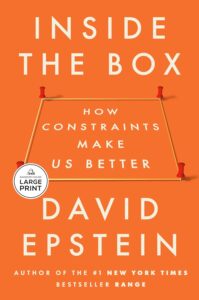
This week, Range and The Sports Gene author David Epstein returns to discuss his new book, Inside the Box: How Constraints Make Us Better. David explains why too much freedom quietly makes us miserable: how infinite options breed boredom and anxiety, and why the “maximizers” chasing the perfect choice end up less happy than the “satisficers” who pick something good enough and move on. He walks us through how the right limits sharpen our best thinking, from Pixar’s “beautifully shaded penny” problem to Tony Fadell making his team design the packaging before the product, and why constraints don’t just make us more creative, they make us more honest. Write your prediction down before the results roll in, and you lose the ability to fool yourself later. There’s the broken piano that forced Keith Jarrett into the best-selling solo piano album of all time, the 50-word bet that produced Green Eggs and Ham, and Monet banning the color black on his way to inventing Impressionism. Whether you’re a writer staring down a blank page, a founder drowning in options, a manager trying to focus a scattered team, or just someone with 47 open browser tabs and three half-started side projects, this conversation will change how you think about the limits you’ve spent your whole life trying to escape. Listen, learn, and enjoy!
Please Scroll Down for Featured Resources and Transcript!
Please note that some links on this page (books, movies, music, etc.) lead to affiliate programs for which The Jordan Harbinger Show receives compensation. It’s just one of the ways we keep the lights on around here. We appreciate your support!
- Sign up for Six-Minute Networking — our free networking and relationship development mini-course — at jordanharbinger.com/course!
- Subscribe to our once-a-week Wee Bit Wiser newsletter today and start filling your Wednesdays with wisdom!
- Do you even Reddit, bro? Join us at r/JordanHarbinger!
This Episode Is Sponsored By:
- BetterHelp: 10% off first month: betterhelp.com/jordan
- Boll & Branch: 15% off first set of sheets: bollandbranch.com, code JORDAN
- Marathon Rewards: Sign up today: marathonrewards.com
- AT&T: Get an iPhone 17 Pro for $0: att.com/iphone or visit an AT&T store for details
Thanks, David Epstein!
Click here to let Jordan know about your number one takeaway from this episode!
And if you want us to answer your questions on one of our upcoming weekly Feedback Friday episodes, drop us a line at friday@jordanharbinger.com.
Resources from This Episode:
- Inside the Box: How Constraints Make Us Better by David Epstein | Amazon
- David Epstein | Why Generalists Triumph in a Specialized World | The Jordan Harbinger Show
- David Epstein’s Range Wildly Newsletter | Substack
- David Epstein | Website
- Mendeleev’s Periodic Table: The Deadline Behind the Discovery | Origins (Ohio State University)
- Your Brain on ChatGPT: Accumulation of Cognitive Debt When Using an AI Assistant | MIT Media Lab
- Jacob Ward | How AI Turns Convenience into Control | The Jordan Harbinger Show
- Toil and Technology: Why Automating Bank Tellers Did Not Eliminate Their Jobs | IMF Finance & Development
- How Fallingwater Became Frank Lloyd Wright’s Architectural Comeback | History
- 15 Myths About Creativity | Psychology Today
- How Steve Jobs Built “Insanely Great” Products with a Two-by-Two Grid | Bootcamp (Medium)
- Kierkegaard: Young, Free, and Anxious (The Dizziness of Freedom) | Philosophy Now
- Swiping Through Online Videos Increases Boredom, Study Finds | American Psychological Association
- Maximizers vs. Satisficers: Who Makes Better Decisions? | Psychologist World
- Scott Stanley on Sliding vs. Deciding: Cohabitation, Commitment, and the Future of Marriage | BYU College of Family, Home, and Social Sciences
- People Systematically Overlook Subtractive Changes | Nature
- Creativity, Inc.: Overcoming the Unseen Forces That Stand in the Way of True Inspiration by Ed Catmull | Amazon
- Build: An Unorthodox Guide to Making Things Worth Making by Tony Fadell | Amazon
- General Magic: The Legendary Apple Offshoot That Foresaw the Mobile Revolution | Fast Company
- A Dozen Things Learned from Bill Gurley (“More Startups Die of Indigestion Than Starvation”) | GeekWire
- The Homer: The Car Built for Homer | Simpsons Wiki
- A Scientific Approach to Entrepreneurial Decision-Making (and the Tattoo-Artist Search Engine Pivot) | CEPR / VoxEU
- The PalmPilot: How Jeff Hawkins Won by Doing Less | Computer History Museum
- When Thinking “Inside the Box” Is Better (David Epstein on Fundamentals Over Polish) | On Point (WBUR)
- Likelihood of Null Effects of Large NHLBI Clinical Trials Has Increased over Time | PLOS ONE
- Is Everything We Eat Associated with Cancer? A Systematic Cookbook Review | American Journal of Clinical Nutrition
- Is There a Good Side to Drug Side Effects? (Viagra and Rogaine) | Harvard Health Publishing
- Range: Why Generalists Triumph in a Specialized World by David Epstein | Amazon
- “The Köln Concert”: How Keith Jarrett Made a Masterpiece on a Broken Piano | uDiscover Music
- The Creative Cliff Illusion | Proceedings of the National Academy of Sciences
- Did Dr. Seuss Write “Green Eggs and Ham” on a Bet? | Snopes
- Desirable Difficulty: Why Effortful Learning Outlasts Easy Learning | Davidson-Davie Community College
- Creativity from Constraints: The Psychology of Breakthrough by Patricia D. Stokes | Amazon
- Why (and How) I Wrote This Book: The 100,000-Word Note Sheet and One-Page Outline | David Epstein (Substack)
- The Anti-Social Century | The Atlantic
13475: David Epstein | How Constraints Make Us Better
This transcript is yet untouched by human hands. Please proceed with caution as we sort through what the robots have given us. We appreciate your patience!
Jordan Harbinger: [00:00:00] Welcome to the show. I'm Jordan Harbinger. On The Jordan Harbinger Show, we decode the stories, secrets, and skills of the world's most fascinating people, and turn their wisdom into practical advice that you can use to impact your own life and those around you. Our mission is to help you become a better informed, more critical thinker through long form conversations with a variety of amazing folks from spies to CEOs, athletes, authors, thinkers and performers, even the occasional rocket scientist, war correspondent, or arms dealer.
And hey, if you're new to the show or you want to tell your friends about the show, and I always appreciate it when you do that, I suggest our episode starter packs. These are collections of some of our favorite episodes on topics like persuasion and negotiation, psychology and geopolitics, disinformation, China, North Korea, crime and cults, and more, that'll help new listeners get a taste of everything we do here on the show.
Just visit jordanharbinger.com/start or search for us in your Spotify app to get started. Today on the show, everybody loves the story of the genius who wakes up from a dream and changes the world. Dmitri Mendeleev supposedly dreams the periodic [00:01:00] table into existence, bolts upright in bed, and suddenly chemistry has a seating chart.
Beautiful story, also apparently mostly bullshit. The real story is less magical and a lot more useful. Mendeleev was boxed in by a textbook deadline. He had to cram the known elements into a limited space under pressure with imperfect information, and that constraint helped him see the pattern everyone else had missed.
So today, we're asking a question that sounds like something your boss says right before ruining your weekend. What if constraints actually make us better? Not all constraints, obviously. Some constraints are just bureaucracy with a necktie. Some are budget cuts wearing a fake TED Talk mustache. But the right constraints, limits, deadlines, rules, friction, forced choices, those can sharpen thinking, expose nonsense, and turn chaos into creativity.
My guest today, David Epstein, author of Range and The Sports Gene, which many of you have probably read, and his new book is Inside the Box: How Constraints Make Us Better. We'll discuss why too much freedom can make us stupid, how a company full of Apple legends built the iPhone before the iPhone and still somehow [00:02:00] face-planted, what Pixar understands about creative discipline, why writing down your prediction before the results come in makes it harder to lie to yourself, and how a terrible piano helped create one of the most legendary jazz recordings of all time.
So forget think outside the box. That advice has been beaten to death by consultants wearing quarter zips. The real question is: how do you find the right box, and when should you willingly step inside it? Now, here we go with David Epstein. Weird time to be an Epstein, am I right? I don't know.
David Epstein: Yeah,
Jordan Harbinger: yeah, it is.
That's topical.
David Epstein: I honestly don't get as much crap about it as I would've expected. You know, there are always the same jokes online if I post something, like, "Don't you have an island or something like that?" And I'll respond, "You know, if you watch this video enough times, then I'll buy one." But yeah, it's a little weird.
Like, when I walk my son to school, since we're in DC, there's sometimes people holding signs that say Epstein, and he can read.
Jordan Harbinger: Yeah. "
David Epstein: What's that?" I'm like, "Well, they're not cheering for us, bud."
Jordan Harbinger: Yeah, it's not us. It's a different Epstein, and I'll tell you in 15 years.
David Epstein: [00:03:00] Then it's like, "Well, he abused some people.
What abu- how abuse, what is that?" You know, and you're like, "Oh, boy." Remember.
Jordan Harbinger: You're like, "He lied on his tax forms. Anyway, what do you want for lunch, bud? What's going on for lu-" Yeah, yeah. I do hope that you call your tax drawer The Epstein Files. I think that would be a funny household-
David Epstein: Just lean right into it.
Why not? You know, the saving grace is that it's like the Jewish Smith, so there's a lot of us.
Jordan Harbinger: That's true. I would love to hear about Inside the Box, the sort of constraints ideas, because I feel like I've spent my whole life with everyone telling me, you know, remove the constraints. You know, your book title, Inside the Box, the idea here I assume is everybody's telling you to think outside the box, and it's, I don't know, maybe there's a box for a reason.
That's kind of where you're going with this, right?
David Epstein: That's right. The cliche outside the box, telling people to free themselves from all of the bounds or restrictions that usually, you know, you're talking about creativity, that are restricting their creativity, and there's a mountain of psychological research that shows that actually giving people this [00:04:00] totally open space and saying, "Think differently," is the quickest way to get them to do something completely uncreative. Because the cognitive scientist Daniel Willingham says you may think your brain's made for thinking, but it's actually made for preventing you from having to think whenever possible because thinking is energetically costly. And so if you're just given an open field of possibility, you'll just do the convenient thing or the familiar thing, or what neuroscientists call the path of least resistance.
So actually, the best way to get someone to have outside-the-box ideas, like new, creative, original ideas, is to really narrowly confine them in a way that blocks the solutions that are most familiar to them.
Jordan Harbinger: I just did a show about this yesterday, about how AI is taking advantage of our brain's shortcuts, right?
So the whole we only construct reality in our brain, your eyes aren't really seeing what your brain thinks they're seeing. It's constructing this, and all the cognitive bias that goes along with it. It seems like in order to be as creative as possible, we have to put boundaries around those things so we don't just activate all of that and create the [00:05:00] same thing as everyone else.
David Epstein: No, that's exactly right. You put it exactly right. Again, the quickest way is to use what psychologists call a preclude constraint. You block those things that your brain would do for convenience. There are interesting ways that this interacts with AI, right? We're seeing now this first generation of research about how using AI impacts cognition.
It's early days, but it looks so far like GPS, where if you are always relying on it, you don't learn how to get around. And that's fine if you always have access to GPS. But when it comes to learning how to use your brain in everything that you do, because you're wired for convenience, if you're turning to that immediately, it's not really great.
My summary of the research so far is: brain first, tool second.
Jordan Harbinger: Yeah, that's smart. I failed to make this point yesterday, but I guess after I've slept on it, it's more clear. AI is doing to our brains what teachers always thought calculators were doing to us. Like, "You're not going to have a calculator in your pocket."
It's like, "Aha, Mrs. Career, I do have a calculator in my pocket," right? But now it's like, well, hey, you're not always [00:06:00] going to have an AI assistant brain here to draft your documents for you. And it's like, maybe, but I don't know. Drafting a document's pretty hard, and I don't really want to do it manually or outline it.
I'll just have ChatGPT do the whole thing. And then it's like, oh, I tell myself this with AI stuff all the time, right? "Oh, I'll put my spin on it." And then I get it and I go, "No, that looks pretty good. I'm just going to use it, like, just exactly as it is on the screen." And then months down the line, or possibly years, I don't even know how long I've been using AI, and I go, "Is this creating just like me in my voice in a really expert way?
Or has my voice just changed to be whatever ChatGPT spits out at me and puts on the screen?" I don't know the answer, dude. I don't know. Yeah.
David Epstein: And for some of those uses, maybe you will have access to it all the time, and like a GPS, and maybe you can just use it that way. But in terms of- developing your own thinking.
People use it a lot for writing, and that's fine, but certain types of writing, the point is not as much the writing as the you learning how to organize [00:07:00] ideas or how to think. So these are what psychologists call desirable difficulties, these things that are effortful and are frustrating oftentimes, but are exactly what make you learn.
And I think there's a danger of outsourcing all of those things, and then it might get to the point where you're not really adding anything, right? You're not actually, like, learning anything, and that's what's showing up in some of these studies. So I think we have to be structured in how we decide to use AI unless we want to outsource our entire brains to it, at which point, what is the purpose of you?
Jordan Harbinger: Yeah. Well, that's the uncomfortable truth. Somebody had pitched me something today. They were just on a bunch of shows, and this is, like, their media pitch. And it was essentially Will your job be around in two years? Which is the speed of adoption they're assuming. And, and the test was, can somebody who sits with a manual or three for two weeks with nothing else to do learn how to do your job at a sort of functional level?
They don't have to be great at it, but can they do it? Will it take a manual or two, and will it take a week or two? And if the [00:08:00] answer is yes, you're totally screwed, so you have to figure out something else to do.
David Epstein: That's right. And I do think, though, there's hope for some of this stuff. If you look at the history of technological innovation, an example I always like is when ATMs were introduced in the US in the early 1970s.
And I went back and read news coverage there, and it's apocalyptic.
Jordan Harbinger: There's going to be no more banks, right? Or something.
David Epstein: And the tellers, I think there were about 300,000 at the time, they're all going out of business. And instead, what happened over the next forty years at least, maybe they will eventually, but as there were more ATMs, there were more bank tellers because they made branches cheaper to operate, and so banks opened more branches, fewer tellers per branch.
But more interestingly is that it fundamentally changed the job from one of someone who's doing repetitive cash transactions to someone who's a marketing professional/customer service representative, financial advisor, like this much broader mix. What sometimes people call soft skills, what I like to call durable skills because they never go out of fashion.
And actually, the Financial Times just did this analysis showing that since the mid to late [00:09:00] 1980s, the returns to these social and collaborative skills have been outpacing the returns to technical skills at an accelerating rate, which I think is probably the opposite of a lot of people's intuition of what happens with technological disruption.
Jordan Harbinger: Yes. This jives with my experience, right? Because I go to a bank around here, and 50% of the time, I get a teller that English is their second language. They count the money, and that's it. And they're new. They've been there for a week. It's coin flip if they're there next month, right? Then there's another sort of middle-aged lady who's a bank teller.
And I go up, and when I get her, I can ask her all sorts of questions about how the accounts operate, and what's the cheapest way for me to wire money over h- And she'll be, "Actually, you should use this." And, "Well, in this case, I would give you a cashier's check, and I can waive the fee for that. It's usually four bucks.
But I would do that because otherwise it's going to delay the payment by this, and they're going to wait till it clears because it's over this amount, and then that's going to delay your transaction." I'm like, "Wow, you actually know a lot about these things. Try asking an ATM those questions and [00:10:00] see what happens."
David Epstein: Yeah. Of course, now, you know, say, asking a chatbot those questions, but they still go wrong in all kinds of ways. I was recently talking with ChatGPT, and it brought up some obscure stat about the number of pen pals that Charles Darwin had. And I happen to know that stat because it's something I've written about in the past, but I'm like, "There must be a handful of people in the world that know this."
And then it started saying how this was researched and attributing it to this one researcher. And I was looking, and I'm saying, "That's wrong." So I asked, "What's your source?" And it turns out it was me. Oh, wow. Somebody had taken some of my writing, put it on Goodreads, and The AI took nearby paragraphs and kind of mashed them into something new.
Jordan Harbinger: Yeah.
David Epstein: And so there are all these really convincing ways that they still go wrong. And so I think human judgment in connecting to strategy is still really important. And this I actually think does relate to some of the stuff in Inside the Box where Over the last year, I spent a bunch of time with a company that helps other companies implement AI.
And in most of [00:11:00] those cases, the implementation was sprawling. People rush and they-- how many different things can we do with it? And it leads to what researchers are now calling work slop, where you've taken away the hard work of deciding what not to do because it's almost frictionless to start stuff. And you start a million things, and it leads to this huge volume of work that nobody's sure how to connect to strategy.
Whereas the organizations that I think did better would-- One of them literally did a map of jobs to be done, or others would define a problem and then say, "How do we match the tool to this problem?" So instead of just rushing into this huge implementation, because I think it, it's never been easier to do too much than it is now.
That's a major theme, which is in that circumstance, how do we figure out what not to do? And that becomes this critical skill.
Jordan Harbinger: That's an interesting new problem to have. All right, so David, you open the book with one of the greatest science urban legends of all time. This guy Mendeleev, he dreams up the periodic table, and I remember [00:12:00] hearing this, "Oh, it came to me in a dream," you know.
It was probably in one of those YouTube cartoons where it's like, what's the story behind this? And I thought, wow, what a genius. His dreams came up with this really concise way that we still use to look at all the elements. It's incredible.
David Epstein: Yeah. Not just an important visualization poster in your high school classroom or whatever, but because we only knew about half the elements at that time, it actually led to us realizing where we could look for new materials and motivated the search for atoms, which is the underlying cause of this order.
And the idea was that Mendeleev, this Siberian genius, was trying to order all the elements, all the building blocks of the universe, stayed awake for three days and then finally fell asleep. And in his dream, they snap into place in this grid where if you move across the grid, the chemical and physical properties repeat periodically, which is why it's called the periodic table.
Jordan Harbinger: Oh, I always wondered about that. Okay. We don't have to explain that, but that does make sense. Yeah. And then they just added a random block underneath it of elements that you can make in a lab that don't [00:13:00] exist for more than a fraction of a second?
David Epstein: Pretty much. That's true. And so that-- I learned that story in college chemistry, that he dreamed this.
But it's celebrated by scientific societies. Casper used it hilariously in their mattress advertisements, but it's completely false. And so I was surprised to learn the true story was that Mendeleev had a publishing contract for a two-volume intro to chemistry textbook, and he'd only gotten eight of the then sixty-three known elements into volume one, so he had to get the other fifty-five into volume two.
He didn't have enough space to go one at a time, so he started looking for families that he could describe at once, and that's where he stumbled on this pattern. He wasn't looking for a law of nature. He was looking for an organizational scheme for a textbook. And I think the gap between the Mendeleev myth and reality is symbolic of something much more important, which is that we overvalue complete freedom, that outside-the-box blue sky thinking, and undervalue the power of useful constraints to drive our best thinking.
Jordan Harbinger: Why is it that we love the dream version so much? Is it [00:14:00] because it lets us believe breakthroughs are some kind of magic instead of a ton of work?
David Epstein: I think that's definitely part of it, and we associate freedom with creativity. A group of psychologists did an international survey of known creativity myths.
So these were things that we know from mountains of research are not true, and the two most popular were that people are most creative when they're most free, and that group brainstorming is a great way to come up with creative ideas. And so I think it's just intuitive. We feel, "Oh, if only I had more freedom, my imagination would fill the gaps."
It's not how our brains work, so our intuition is just wrong about how to get our best ideas.
Jordan Harbinger: What is the actual box that Mendeleev was trapped inside, was putting himself inside, perhaps, is a better word?
David Epstein: There are a number of layers of constraints that he had. So there was first the space constraints of the textbook, where he just did not have enough space to keep going in the... Because what he did was, again, he did the path of least resistance. "Oh, what's the best way for me to describe all the elements? I'll just go one at a time," basically. And so you do the thing that's convenient and easy. One of the really [00:15:00] important things that constraints can do is launch us into productive experimentation that we would not have taken on otherwise.
Necessity is the mother of invention. And so when he was forced away from that thing that came to him easily, I have to start experimenting with these other mechanisms. And he also had a customer problem, which was it had to be a logical organization for beginners. So he had to save the space. He needed a logical organization for beginners.
He had a deadline, right? We know deadlines can be either really bad or really good for creative problem-solving, and it depends if it leads you to start multitasking or to hyperfocus and monotask. And if it's the latter, which is what happened to him, then you really can have some of your best ideas if it forces you into this monotasking.
Like Duke Ellington said, "I don't need time. I need a deadline." So he had all these constraints that pushed him into this almost hyperfocused experimentation, where he was going through all these different possibilities very quickly that he had never explored before.
Jordan Harbinger: You know those people in college that it's the night before a giant [00:16:00] thing is due, and it's 8:00 PM, and you walk in, and you're like, "Man, I'm so jealous.
Are you done with your paper?" And they're like, "No, man, I haven't started yet." And they're rolling a joint and watching, I don't know, Super Troopers or something like that on the TV. I love Super Troopers. And you go, "What?" Around 10:30, when you're putting your mask on or whatever, you're going to bed, they're like, "All right," and you hear their knuckles crack, and the light turns on, and they stay up until 6 o'clock in the morning, and somehow they put this thing out.
And these aren't guys that, like, failed out of school, right? These are guys that went to law school with me afterwards. Is that what they're doing? Is their brain just going, "You know what? I need a crazy amount of pressure and constraints in order to do my work, so here we go"?
David Epstein: Yeah, I don't know that I'd advocate the Super Troopers roll a joint 3:00 AM method.
But yes, Super Troopers. But it is really hard. Focusing on ideas, abstraction, symbolic language is not something that was a part of most of human history in the way that we have to do it now. And so it's actually quite hard to force yourself to focus [00:17:00] on abstract stuff for hours on end. And a deadline can really help with that, where you have this sort of definite space that you're going to have to fill, and this shows up in eminent creators, not just in college students.
I mean, Frank Lloyd Wright famously had months to draw up the plans for Fallingwater, you know, the most famous piece of architecture in America, and didn't do anything. You know, he sort of thought about it. Things are gestating, right? You're using this network in your brain called the default mode network where it's sort of like marinating in there, but you're not exactly focused on the task.
The guy who commissioned it called him and said, "I'm a few hours away. I want to drop by and see the plans." So he marches across his office and starts working so fast that his assistant said they could barely keep the pencils sharpened fast enough, and does it in those few hours, and that's it. And so I think that mix of having some gestation with then this really now is go time.
You can't focus for that long at a really high intensity anyway. And so that deadline can often push us to [00:18:00] say, like, this is the time, this I can do, and so it can be helpful.
Jordan Harbinger: I'm not one of those people, to be clear. I get anxiety thinking about those, even other people starting a paper on the last night beforehand.
That's just not... I can't.
David Epstein: That's extreme, obviously, right?
Jordan Harbinger: Yes. But I knew so many people like that. There were people in law school that got almost straight As, as far as I know, that would be sober maybe a few moments before finals and would go to class sometimes or most of the time, but then there was a guy who didn't buy the books.
And then finals would roll around, this person would be in the library when I woke up and went to the gym, and they would be there when I went to bed at night, and they would crush it. Absolutely. Are they sociopaths and had other problems? Yes. But the way these guys could cram, I've never seen anything like it in my life.
David Epstein: That's interesting. And arguably, maybe they succeeded-
Jordan Harbinger: In spite of that ...
David Epstein: in spite of those, not because of it. But when I sign a book contract, it's like, deliver this thing at 5:00 PM two years [00:19:00] from today And I go, "Okay, what do I do tomorrow?" There's this huge list of tasks to be done. And so to even make it feasible, I think of it, I call it cutting stone.
It's like taking a hack at the stone just a little bit each day. But I need a what is the task that I'm going to make do for myself tomorrow to give myself some actionable thing. That goal in two years is not an actionable thing. It's a vision, basically. I think sometimes having that, this is the allotted time, and I know what I should be doing during this time, you're not having to make all these little decisions about competing priorities.
So I think having this system of smaller goals where it takes away that what is the priority. Because obviously, these people you're talking about would get to a point where, oh, the priority is now very clear. And for them, it was leaving it to the last minute, but I think everyone can use that in work.
They figure out a way of, how can I box myself in enough so that the priority for what I should be doing right now is very clear? I'd say the two pillars of what useful [00:20:00] constraints can do for you is forcing you to clarify priorities and launching you into productive exploration. It sounds to me that they were using this time pressure to clarify exactly what they should be doing.
Jordan Harbinger: Most people hear constraints and they think bureaucracy, lack of money or resources, lack of time, some idiot manager ruining everything. So what kind of constraints, you mentioned, you touched on this earlier, but what kind of constraints are we defending and what kinds of constraints are we not defending?
David Epstein: Yeah. The word constraints obviously is practically synonymous with something that's frustrating.
Jordan Harbinger: Restraint and constraint have the same root word, right?
David Epstein: That's right. And I think when it comes to, when you mentioned managers and bosses, in many cases, it's not only the constraint itself, whatever it is, but it's that the people upon whom it's being foisted don't feel like they have any agency in it.
And so that I think is a leadership issue. Actually, in the book, I ended up interviewing a lot of people who used to work with Steve Jobs. I wasn't writing about Steve Jobs, but because I wrote about some companies that had a lot of people who worked with him, [00:21:00] I ended up talking to dozens of people who'd worked with him.
And one of the things that they told me was the biggest difference between his first time at Apple, where he then got forced out, and when he came back in the late '90s. As he gets forced out of Apple, he goes to NeXT Computers, where he says, "We're going to have a... The hard drive casing's going to be a perfect magnesium cube."
He really was micromanaging and dictating everything. Then when he came back the second time, he was much more of a constraint setter, right? So he comes in and Apple's a mess. They're in danger of going out of business. They're making a ton of computer models. They were making printers and servers and this tablet thing called the Newton, and he comes in and draws a two-by-two grid on a whiteboard and puts desktop and portable on one axis and consumer and pro on the other.
That's it. Cancels everything else, and lays out some of the customer need, what problem do these things have to solve, and then lets people go within that. At first, of course, because so much stuff got canceled, people were upset. But then he really [00:22:00] defined the box for people and then let them go to town within that, and the people I talked to said they actually found that liberating.
It's like this saying the advertising industry has, "Give me the freedom of a tight brief." They're showing you the problem to be solved, but then giving you a lot of freedom within it. If a manager is putting constraints on someone and that person says, "Is there room for me to surprise myself?" And the answer is no, then it's way too constrained.
You're not using the good part of constraints to get people to experiment.
Jordan Harbinger: Constraints make us smarter. Ad breaks mostly make me employable. Back after this. This episode is also sponsored in part by BetterHelp. Summer's a funny time because it can make life feel really full in the best way, and also in the how the heck are we supposed to do all this kind of way.
Maybe your calendar's packed with travel, work deadlines, weddings, family visits, trying to see friends, trying to actually relax, and somehow feeling guilty that you're not making the most of the season. For us, it's been especially chaotic. There's school events, getting ready to be away for a month on a long family trip, packing, schedules, work, [00:23:00] logistics.
We're definitely losing our minds a little bit, and that's why summer can be a really good time to check in with somebody who is trained to help, not because anything has to be wrong, but because life moves fast. Therapy can help you zoom out, figure out what actually matters, and make choices that line up with the life that you want to be living. Because you only get one of these and the goal isn't to have a perfect summer, it's to build a life where you feel more present, more grounded, and more connected to what matters. BetterHelp has over 30,000 fully licensed therapists in the US, has served over six million people globally, and helps match you with a therapist through a short questionnaire.
If it's not the right fit, you can switch at any time. You don't have to say yes to everything this summer. Find support in therapy. Sign up and get 10% off at betterhelp.com/jordan. That's better H-E-L-P .com/jordan.
This episode is also sponsored by Boll & Branch. I've noticed something funny about getting older. When you're younger, you'll spend hours researching a new gadget, but the thing you spend a third of your life lying on every night, somehow that just gets ignored. At some point, you realize comfort isn't indulgent, it's practical. We upgraded to Boll & Branch and we haven't looked back. Their bedding is made from [00:24:00] 100% organic cotton, designed to be soft, breathable, comfortable right out of the box.
We started with the signature sheets, then added another set for the hot summer months. They're percale sheets which have that crisp, cool feel that we love. The quality is obvious the second you climb in. The sheets feel cool and breathable, and somehow they get even softer after washing. It's one of those rare upgrades where you feel the benefit every single day.
And right now, Boll & Branch has a special deal for our listeners. Sleep cooler this summer with Boll & Branch during their annual summer event. For a limited time, get 20% off sitewide at bollandbranch.com/jordan with code Jordan. That's Boll & Branch, B-O-L-L-A-N-D-B-R-A-N-C-H .com/jordan, code Jordan to take 20% off.
Bollandbranch.com/jordan, code Jordan. Exclusions apply. Here's a little scoop you might not be aware of. When you use our promo code, you're not just scoring a discount, you're also giving the show a pretty big boost. We don't earn commissions from sales, but when companies see that listeners are engaging with the ads and the sponsors on the show, it encourages them to keep sponsoring us.
So if you're planning to sign up for anything, please remember to use our codes. They're all on the deals page, [00:25:00] jordanharbinger.com/deals. It is a win-win. You get an awesome deal and you help keep the show going strong. I really appreciate your support. Now back to David Epstein. You write in the book about, you call it the dizziness of freedom that modern life gives us.
There's just, we just have so many more options than any humans before us. What does this do to our brains? Because it leads to confusion where we think, "I need more freedom," but we actually need more boundaries or better boundaries.
David Epstein: Yeah. That phrase, dizziness of freedom, comes from Søren Kierkegaard, the philosopher.
And that idea, to emphasize your point, that there could be too much freedom and choice would've been laughable for most of human history, and it's still laughable for a lot of people in various parts of the world. But increasingly, since about the 19th century, you started to see in a lot of eminent thinkers, and philosophers, and things like that, would start taking up this issue for the first time in history of we have too many options.
Less of our life is structured by rulers, and religions, and all those sorts of things. And [00:26:00] so people started having to face choices about everything. Who to love, what to do, what to be, et cetera. And that's when you started to see mass anxiety basically popping up in society, because there's the weight of all of these potential options.
And we see it now with social media, for example, where things like socially prescribed perfectionism, that behavior are on the rise because people have so many things to compare themselves to. So it's like this endless possibility of choices, of what you could be doing or what you should be doing, and it tracks with this steep rise in anxiety.
And so our brains are really not built for this kind of endless comparison and optionality. In the past, you'd compare yourself to the people you could physically see wherever you lived.
Jordan Harbinger: Yeah. That's right. Yeah, the whole, this is like Dunbar's number, right, and your tribe is 150 people, but even then, your whole village Saxony might have been, like, 75 people or somewhere [00:27:00] around there.
So you're, yeah, you're comparing yourself to the other four people in your generation that you grew up near.
David Epstein: That's right. You would think that having endless number of entertainment options can't be bad, right? You'll get to something better. And yet, since the introduction of infinite scrolling, people have been getting progressively more bored.
And in these studies to follow up on that, if you give people 20 videos they can watch, for example, they will be more bored than if you just give them one from that same set of 20 and say, "You just have to watch this one." And the theory is that it's this endless ability to think about what else you could be doing, your other possible choices, that undermines the experience of the moment itself.
Jordan Harbinger: I can't remember what this was related to, but somebody told me this week that some of the most popular stuff on streaming platforms is Friends and, I don't know, Seinfeld. It's stuff that's been gone off the air for 25 years. And the reason that this is bad is because streaming platforms, one, it illustrates your point really well, right?
It's just like, "Oh my God, there's so many new movies out. You know what? They have Friends, and I've already [00:28:00] seen this, and it feels comfortable. I'm going to go watch that again." It's like, you mean there's 7,000 movies on here that you haven't seen, and you're going to re-watch a series from the '90s? But also, it causes streaming platforms to go, "Why are we making all this new expensive stuff when we can license Friends, Seinfeld, and Curb Your Enthusiasm for a flat fee?
It's already done. We could upload this in a week when we sign the papers," or something like, if that. And it's actually limiting the amount of new stuff that's going to get made, at least that's the theory. I thought that was interesting. But to your point, we're so bored because there's infinite options.
That doesn't really make sense on its face, and yet, is it that we're bored, or is it we're just so overwhelmed by choice that we decide, "Okay, I'm going to constrain myself to something I already know well," and the answer is the thing you watched every day in college. I don't know. Is our brain sort of doing this automatically, you think?
David Epstein: Yeah, I think, I mean, I think these are sort of two sides of a coin where- these studies that show that people are getting more bored. So we know there's this increasing kind of boredom. And I [00:29:00] should distinguish when I say bored, sometimes it's good to be still, not have something that you're doing. That can actually be really good for all sorts of things, for wellbeing, creativity.
But this is bored where you're actually engaged with something and still feeling bored. So we know that's on the rise. And I think there is also this choice paralysis with overwhelming stuff that I think a lot of people smartly, but certainly not everybody, choose to limit by just picking something they know is good enough. Because there's probably something in those 7,000 movies that they would like better potentially. But it, it turns out to be actually a really healthy behavior called satisficing, which is a portmanteau that this Nobel laureate psychologist and economist coined that's a combination of satisfy and suffice.
And picking just good enough rules for something, being like, "This show that I know I like is good enough, and I'm not going to keep looking," turns out to be really important for a sense of wellbeing. Whereas on the opposite end of the spectrum from satisficing or satisficers are what's called [00:30:00] maximizers, or maybe we'd now call optimizers maybe, where you really do want to keep looking and see, like, is there something better?
And maximizing, it turns out in psychological research, is it's almost always bad to be a maximizer.
Jordan Harbinger: This sounds miserable already. "This girl I'm dating is really amazing, and she checks 25 out of 26 boxes. But there's a lot more women in this app. Maybe I should look for the one that checks all 26 boxes.
That way I have somebody who also loves pickleball or something." You know what I mean? It's just like you're never going to be happy.
David Epstein: Exactly. That's right. And so maximizers turn out less happy with their decisions. They're less happy with their lives. They're more prone to regret. They're more likely to prefer reversible decisions even though that prevents them from basically committing one way or the other.
So they'll act for the purpose of maintaining optionality, and that just becomes an end to itself. I've heard this in businesses, by the way, where they'll say, "Well, this decision is a two-way door." A- and then that just prevents you from committing one way or the other.
Jordan Harbinger: I think you've just described every bachelor on Earth.[00:31:00]
That's what I was doing in my 20s, right? Like, "Oh, man, she's so great, and she really likes me, and she wants to date me exclusively. Time to break up with her, I guess. It was fun while it lasted." What are you doing to yourself?
David Epstein: I don't want to date anybody who would date me. Somebody better. Yeah, exactly. There is this psychologist named Scott Stanley who studied this and came up with this phrase called sliding versus deciding.
You do want to take data and understand what you like and what your options are when you're young, but the sliding versus deciding documents this trend that he found in relationships where younger people will increasingly do what he calls sliding, which means they'll be in a relationship, but they want to keep their options open, so they won't decide, "You know, I'm really committed here."
But as time goes on, they end up sleepwalking into escalating commitment. And if they do that and get married, they're more likely to be unhappy, more likely to get divorced, versus those who decide and say, "Okay, now I'm committed, and we're doing this." And so how you get into it, whether you slide with the intention of keeping your options open, because they're closing anyway, it's really the [00:32:00] illusion of keeping your options open, you're less likely to end up happy with your decision.
Jordan Harbinger: Man, it's so interesting. There's so many roads we can go down here. But I want to make it practical. So for somebody listening who feels overwhelmed, which is a lot of folks, what is one of the first constraint audits they should run? Is it I have too many projects? How do we sort of do this? And I would like you to be specific, if possible.
Like, if somebody's got tabs open, three half-started side hustles in a book and a notes app full of ideas, what is the first box that you would want to see them put themselves in?
David Epstein: Two things to start with. The first one, make all your current commitments visible, and this can be Post-its on a wall.
Visualizing it is really better. And what people will typically see when they do this, or teams, that, I describe a lab that does this in the book with their innovation team. They will usually see, okay, first of all, there's a lot of medium priorities competing with high priorities, and there's more stuff here than I could get done even in a best-case scenario.
And so put those up and force yourself to say, "If I had to cut something out in the next [00:33:00] 90 days, what would it be?" And then make a funnel with the stuff that's high priority. Physical funnel. Put the Post-its in the physical funnel. Nothing else can go in the top until something else comes out the bottom.
It's a rule called stop starting, start finishing, and you will actually get more stuff done. This works really reliably. And once you've got that funnel, change your to-do list, right? People's to-do list, we have a hardwired bias always to add. It's called additive bias.
Jordan Harbinger: Tell me about it, yeah.
David Epstein: Our associated bias called subtraction neglect bias.
We overlook solutions that involve taking away, so we always add and end up with too much stuff to do. And so with your to-do list, put one thing that if you got this thing accomplished tomorrow, it would be a good productive day. You can have other bonus things that once you get that thing done, but usually what happens is people have a to-do list and they don't get to everything, called the planning fallacy.
We're really bad at estimating. We always think that things will take less time than they actually will. What happens is you [00:34:00] think you're going to get more done, you don't get it done, you carry stuff over to the next day's to-do list and that happens repeatedly until the list gets so long that you just rip it up and throw it out because you don't even want to look at it anymore.
Maybe I'm just describing me.
Jordan Harbinger: This is hitting home so hard. I've s- said this on the show before, but one of the things I learned how to do, I don't know, a decade ago or so was instead of... I have a to-do list, right? But it has certain things in it that live also in my calendar. And I know via experience in order to do 10 emails from show fans, it's going to take me this number of minutes.
And I guess other things. I guesstimate. I have review notes for David Epstein podcast and it's going to be 30 minutes long. Okay, and that's on the calendar. So if I have 15 things on my to-do list, I also have 15 calendar entries and then I go, huh, that has me working until 9:00 PM. I have to move a few of these things off and they have to go somewhere.
There's only so much physical space on this calendar. That way you start to quickly realize, oh, I've planned 27 hours of things to do in an eight hour, if I'm lucky, day. And [00:35:00] that is not a recipe for success. And so you start to eliminate things that don't need to get done and then they also vanish from my to-do list.
And I was at a seminar probably 15 years ago and the speaker made some joke like, "Half of the people in this room probably have 'write book' as a to-do list entry," and everyone laughed and I remember going into my to-do app and being like delete, because I definitely had that in there. And the joke is write book.
Yeah, as if that's one task. That's something that's going to take eight months, like eight hours a day or whatever of work, and you have it on there as a thing you're going to check off on Saturday morning after you get coffee. It's ridiculous.
David Epstein: What you're talking about is really smart, and not many people do that.
Pixar. Every project has its own idiosyncrasies, but there's a lot of similarities. And so they would time how much different processes took so they could go forward and make better predictions and not fall prey to the planning fallacy. So we see that in, there's this research on managers that shows that they always underestimate the time things will take [00:36:00] and they don't learn from it unless they're actually recording the time that things took.
So seeing that, making it visual. When I was spending time with Ed Catmull, the co-founder, and he described to me this problem Pixar had that they called the beautifully shaded penny problem, where the director might get obsessed with some little detail in the background of a shot, like the shading on a penny that the audience would never really notice.
And so they'd have animators working and working away on it. Meanwhile, there were higher priorities, things that needed to get done. And so they came up with this system where they figured out how much work one animator could do in a week, so they had their baseline understanding, and then they put Popsicle sticks Velcroed on a board, and each Popsicle stick represented the amount of work one animator could do in one week And if they wanted to keep animating that penny, they had to take sticks away from some other maybe major character and start putting it on the penny.
And once they saw that, like your calendar, once they saw that visualized, it became clear the real trade-offs that you have to make and what your priorities should be.
Jordan Harbinger: That is [00:37:00] fascinating. And yeah, the beautifully shaded penny You can probably apply that to building anything. I mean, I could see looking at something like the iPhone, for example, and going, "When you open an app, instead of just appearing, it should expand like the Genie effect on a Mac."
"Well, it's not quite smooth enough. The processor's only this." "Okay. Well, we have to design an animation that works within that processor." And it's like, "Sir, we don't have an email app for the phone, and we think that would be really useful." And it's like, "Ah, no, I need them to animate beautifully when they open."
And it's like, "Okay. You know the phone is 15% less useful than it could be because we don't have an email app on here." I can see getting really sucked in to things like that regularly.
David Epstein: Being able to do a lot is a gift, but it can also be a curse in some ways. I mean, someone who really influenced me when I was working on this book is a guy named Tony Fadell, who was the lead designer of the iPod, and then he was the co-founder of Nest.
He had worked at this company before that had, like, all the resources and talent in the [00:38:00] world, and they could do anything, so they did, and it became a disaster because everything just grew and grew until it completely was incoherent and collapsed. And so he became obsessed with putting constraints and bounds on design projects.
And so with Nest, for example, he forced the team to work inside a literal box where he had them prototype the box, the packaging before the product. Because he said, "This is what the customer is going to see, and if we can't fit it on this box, then clearly it's not a priority. That doesn't mean we can't have other ideas, but those are on the back burner," right?
So he was always using these kind of limits to try to get people to rein in that excessive design stuff and really focus on the priorities. He told me that the main advice, the best piece of advice he gives entrepreneurs now, because he mentors a lot of entrepreneurs, is to write the press release for whatever they're doing before they start the project because it forces you to address what problem am I really trying to solve here, right?
What is my value proposition? It gives you that bounding box of what is it I'm actually trying to do? And if it's [00:39:00] not on here, that doesn't mean it's a bad idea, but maybe it's for later.
Jordan Harbinger: So give listeners a test. How do you know if you're lovingly polishing some detail that nobody cares about but you while a big thing is still broken?
David Epstein: I mean, I think really, really narrowly defining the problem you're trying to solve and the person you're trying to solve it for. So that company, that disastrous company I mentioned that Fidel was at, they were basically trying to make the iPhone a generation early. And they defined their customer as Joe Sixpack, and nobody ever really defined who that was.
Jordan Harbinger: What does that even mean? Yeah. A guy with a six-pack or, like, he drinks a lot of beer? I'm confused.
David Epstein: You know, it's like average Joe. And after they missed a bunch of deadlines, they realized nobody knew the guy, right? Who is Joe Sixpack? They hadn't defined who is the person we're trying to solve a problem for and what is the problem.
There's this famous saying in design that people don't want a quarter-inch drill, they want a quarter-inch hole in the wall.
Jordan Harbinger: Yes, exactly. That's funny.
David Epstein: What is the problem that I'm actually trying... Not what are the thing that I think I'm [00:40:00] making or doing. What is the problem I'm trying to solve? And taking a lot of time to define that really narrowly.
Jordan Harbinger: I think it's somehow hilarious that they thought the first guy to buy a smartphone with a touchscreen was going to be a dude who drinks a six-pack of beer every night and is the average Joe. No, sir. Has that ever happened? Early adopters are always not the average person, by definition.
David Epstein: They just did not think about it.
They had so much money, right? It was this company called General Magic, and they were the first concept IPO in Silicon Valley history, where Goldman Sachs took them public with an idea, not a product, because their vision was correct. When you read their plans and documents starting in 1990, they saw the future.
They had the right vision of what was coming. The CEO in 1989 drew in his notebook a schematic of a thin glass rectangle with no protruding buttons and a touchscreen and rectangular apps and label it Remota Phoneputer. Wow. This was before the web existed. Wow. this was before the web existed. Oh, my God. So they had the vision, [00:41:00] but they didn't define who they were doing and what they were doing.
Let me actually give you what I think was the emblematic interview from what went wrong at General Magic. There was a guy named Steve Perlman there, whose job was to create a calendar function for this personal communicator, and he writes it to go from 1904 to 2096, and then he checks it in and thinks he's done.
Then one of the team leaders comes to him and says, "Steve, someone might write a historical app. You've got to make this thing go back farther." So he writes it to go from year one to the future, checks it in, thinks he's done. Then another team comes to him and says, "Steve, why are you tying this into this arbitrary religious context?
You should make it go back all the way to the beginning of astronomical time." He opens it up again and writes it to go from the Big Bang to the future, right? And if he had stuck with 1904 to 2096, it would've been four lines of code, and instead it drags on for months. And that's how everything there worked, because they had the talent to do it, they had the resources to do it.
So every interesting idea someone had, they did it. And when the thing came out, [00:42:00] nobody understood what they were supposed to do with it, because they were just building for each other, ultimately, because they hadn't defined the person they were actually building for.
Jordan Harbinger: This reminds me of... I don't suppose you're a Simpsons fan, but remember there was an episode where Homer Simpson meets his long lost brother, and his brother owns a car company, and he's like, "I need you to help me design a new car," and he designs the biggest crap.
JHS Trailer: I do remember this,
David Epstein: yeah.
Jordan Harbinger: And it's, like, this ugly green car that has terrible everything, because it's way overloaded with junk that no one cares about.
David Epstein: Yeah, Homer had the, the General Magic problem.
Jordan Harbinger: And he runs the company. That's what this sounds like, right? Because General Magic had Apple legends, money, partners, talent, this proto-smartphone vision years before everyone else, the pioneering concepts, the touchscreen, App Store.
I'm going off the book here, but I think they had emoji-like things or stickers, the cloud. The web doesn't exist, and they're thinking about the cloud. This is just the Avengers of Silicon Valley building the future and somehow still face-planting even though they had unlimited everything.
David Epstein: They had so many partners. Because it was such an [00:43:00] alluring vision that information technology companies from around the world, you know, poured in millions of dollars each, and there were so many of them. They covered so much of the IT world and the communications world that their meetings had to start with an antitrust lawyer listing all the things they weren't allowed to discuss.
They had everything, and they did do innovative thing- They made an early form of USB, precursors to emojis, like you said. They were doing interesting stuff. I interviewed a few dozen of the former employees, and I would say three-quarters of them said some version of, "I just couldn't figure out what not to do."
So they would just do stuff. They would just do any idea that they would have. But in a certain way, I think the company was a success in that it scarred these younger people so thoroughly that they came out of there, because it was such a collapse. The stock price doubled on the first day, and two years later it's basically worthless.
So some of the people that came out of there learned these lessons about the importance of putting boundaries around your projects, and they created Android and iPhone and iPod and, and LinkedIn and eBay and Nest and Safari, you know, things that all of us use [00:44:00] every day. But they came out really with these lessons about how you have to constrain a project and define the problem you're trying to solve, or else it will inevitably grow because of our additive bias.
Jordan Harbinger: I think it's interesting, you'd said something along the lines of more startups die of indigestion than starvation.
David Epstein: Yeah, that's something that Bill Gurley told me, the venture capitalist who, well-known for his investments in Uber and Zillow. Actually, more than one investor I spoke to claimed that they coined that one, but Bill is certainly the one that told me first.
Jordan Harbinger: What is the difference between a visionary founder and a founder who's just drunk on possibility? Because it seems like General Magic was not killed by incompetence by any stretch. It was basically brilliance with no adult supervision, kind of.
David Epstein: Mark Porat, the CEO, said years later his goal in raising all that money and bringing all that talent was to create heaven for engineers, where they were only limited by their imagination, as he said, "What more could anyone else want?"
And the answer is a little less freedom.
Jordan Harbinger: A working product? Yeah.
David Epstein: Give me the freedom of a [00:45:00] tight brief. People get liberated when you give them these boundaries, and there's some research I cite looking at founders that I think is relevant, where it actually randomized different founders who were very early stages, very early, like just starting out basically, to different types of training to get their product going.
And some of them got the typical, you know, do some market research training, and others got trained in basically the scientific method of market research, where it says, "What's your hypothesis for the problem you're trying to solve? What's your value proposition?" How are you going to test if that's correct?
And what's a decision rule for deciding? One of the companies I described that went through this training was making a search engine basically for tattoo artists specifically, and their theory that people would recognize the artist they wanted if they just found them. It just took too long to find them, and so they were going to collapse that time.
And they went out and started interviewing people and realized that actually the time was not the thing that they were concerned about. It was their own ability to [00:46:00] evaluate the artist's skill essentially. And so once they realized that their theory of the problem they were solving was wrong, they pivoted and created this sort of expert network to help people find what they were looking for instead.
And the companies that were trained in that process of articulate what your proposition is and go test it pivoted much more often. The other companies that didn't would just retrofit their story basically, and they would very rarely pivot away from their initial idea. And so I think in that research, again, where people were randomized into different types of training, those that got the scientific method training ended up doing a lot better and making more money.
It was the ability to take that vision and actually before you rush into big execution to test is this right? Does the problem that I think I'm solving even exist? "
Jordan Harbinger: Think outside the box" is what people say when they have no plan and a lanyard. We'll be right back. This episode is sponsored in part by Marathon.
At Marathon gas stations, every stop is the start of fun, [00:47:00] like the awesome fuel savings you can get with Marathon Rewards. Join Marathon Rewards today and start earning rewards on every gallon of gas. You can redeem rewards at any time, saving up to $1 per gallon. And don't forget, Marathon stations are packed with all the conveniences you need to stock up and live life on the go.
Marathon: where fun runs on full. Available at participating Marathon locations. Terms and conditions apply. See marathonrewards.com for details.
This episode is sponsored in part by AT&T. You know why I love summer? All those plans we made, they finally make it out of the group chat. Seems like there's more time to fit everyone in.
Whatever you've got in store this summer, capturing those moments is a must. That's why I love the iPhone 17 Pro I picked up from AT&T. Its center stage front camera auto-adjusts the frame to fit everyone in group selfies. You don't even have to turn your phone. No awkward cropping or asking strangers to take it, just the perfect group selfie every time.
And AT&T makes sharing those moments with everyone easy, because you've got to share the pic or it didn't happen, right? Right now at any AT&T, ask how you can get the iPhone 17 Pro on [00:48:00] them with eligible trade-in. Requires eligible plan. Terms and restrictions apply.
David Epstein: Subject to change. Visit att.com/iphone or visit an AT&T store for details.
Jordan Harbinger: If you liked this episode of the show, I invite you to do what other smart and considerate listeners do. Take a moment, support our sponsors. They're amazing. All of the deals and discount codes and ways to support the podcast are on the website, searchable and clickable, over at jordanharbinger.com/deals.
If you can't remember the name of a sponsor, you can't find a code, email us: Jordan@jordanharbinger.com. We're happy to dig up those codes for you. It really is that important that you support those who support the show. Now, back to David Epstein. You mentioned this in the book. You need some sort of kill list.
You're going to build this. Okay, who's it for? Let's get real clear on that. We can expand it later. What's it going to have? These three functions. We can always expand it later. I mean, the problem with General Magic sounds like the idea of an over-the-air OS update was not anything that existed, right? So they were like, "No, it has to be in the thing that ships because we can't [00:49:00] update it until we build a new one, so we have to make this one amazing."
Whereas iPhone could launch and go, "Yeah, this doesn't work. This isn't really there. There's no App Store," yada, yada, yada. But who cares? We're going to build that, and then everyone will just download it over AT&T or whatever overnight, and we can do it later.
David Epstein: Yeah, and, but even before that, there was one third-party app developer who was working with General Magic, making an app for their operating system called Graffiti, where you could use a stylus to make different strokes that would be turned into writing.
And when it was clear that General Magic was going to fail, he decided to make his own product. He identified a customer problem, busy professionals want to sync their contacts and calendar and take it on the go, period. He said, "I'm going to have three functions, memo pad to use the writing thing, contacts, calendar.
That's it."
Jordan Harbinger: Was this a PalmPilot or something?
David Epstein: PalmPilot. It was, like, three of the bajillion things that General Magic was already doing, but presented in a way that showed people the problem to be solved, so they understood what to do with this thing. And [00:50:00] at first, General Magic laughed at him. They're like, "You can't compete with us.
You know, we got all AT&T, Motorola, Sony, all this stuff." And he blew them out of the water because he started small, he found a customer problem to solve, and then he added to it later once he solved an initial problem.
Jordan Harbinger: PalmPilots were super freaking cool, man. I had one of these things. Had, like, a metal case, and I had a Wi-Fi card in it, and I had all these expand...
I basically built a tiny computer out of this thing. I was obsessed with that. Those things were such game changers. Totally. Palm eventually failed, too, for different reasons, but the, I can see why it was such a success initially. All right. So these problems are not unique to startups. They're not unique to specific workplaces.
I look at the Pixar thing, right? The separating obsessive craft from self-indulgent nonsense, and I even see this in podcasting. So many podcasters, I'll meet them at events or something, and they're obsessing over room tone, or they're like, "This vintage mic sounds better than this new digital mic." And I'm like, "Oh, how long is your podcast?
How long have you been doing it?" And almost every time, "Well, I haven't [00:51:00] really started yet because I want to get my setup right." Guys, this is the shiniest penny west of the Mississippi. Just start your stinking show. Record something somewhere and put it on the internet. They can't do it.
David Epstein: That impulse to get things perfect before you start, too, I think is strong but obviously super counterproductive.
And I think it actually, embedded in that is the idea that you can have a perfect vision. You have to start doing the thing and putting it out there, and that's when you're going to learn, right? So you mentioned Pixar. Like, they would allow directors to stay for years with a small team in story development because they know that you don't get it right away.
You have to, like, test the story and refine it and simplify it. And the costs only explode once you move into production, and then it becomes harder to learn and harder to pivot. And so getting everything right in the beginning, there's no way you can do it. It's just an illusion. So you need to start small, and that's when you'll get those lessons, and then you can pivot and add those things on top.
But there's a real impulse to I think sometimes focus on the marginal things [00:52:00] at the expense of the main thing. I see this, you know, I was a competitive runner, and you'll see this in running where people are, don't have anything dialed in about their training, but they're worried about this shoe or that shoe.
You need to get the fundamental training block in, right? First you need to run more and carve out time to run more. Then you can worry about that little 1% thing at the top. But it's almost attractive to concern yourself with that thing and not the fundamentals that, that drive more than 90% of the actual performance.
Jordan Harbinger: That's because running sucks, David. I don't know if you know that.
David Epstein: It's
Jordan Harbinger: terrible.
David Epstein: It's a good suck. And nobody
Jordan Harbinger: wants to do it. So that could be why.
David Epstein: So maybe it's just a procrastination. You're like, "As long as I haven't decided which shoes to get, I don't actually have to do this."
Jordan Harbinger: I'm waiting for my special Vibram shoes that I had to order from Europe in a special size and material before I can start running.
It's going to take six weeks to get here. They're being custom made for me right now. Sorry, but go ahead. Go a- go out without me and have fun.
JHS Trailer: Can't possibly start before that. Yeah.
Jordan Harbinger: David, you argue that constraints, they don't just make us creative, they make us honest, and I'm curious how that happens. You got this [00:53:00] anecdote around the year 2000 with these NIH heart trials that made treatment suddenly look a little bit less miraculous.
David Epstein: Yeah, so that was this interesting phenomenon where all these big trials for medications and dietary supplements leading up to 2000, most of them would have positive results. They would improve blood pressure or some kind of cardiovascular health. And then starting the year 2000, almost all of the trials became negative.
And so the question was, what the heck happened in 2000? It's like a millennium bug and m- medical research stops working. What actually happened was this segment of NIH that I was looking at, starting in 2000, required people to do what's called pre-registration, where it says your hypothesis for what you think this medication or supplement does, you have to record that ahead of time before you do the test, and that's what turned all these results negative.
So it turns out that many of the positive results, which by the way, are for medications and supplements in some cases that are still out there, [00:54:00] were false positives because what was happening, not by anyone's ill intent, but a scientist would have a theory, this drug is going to do a certain thing. That wouldn't work out, but they're like, "Well, I've got a ton of data.
We didn't lower blood pressure, but I've got a ton of data. So I'll look through the database and see maybe something else went down, some other marker." And when you have a lot of data, you're always going to find something. It's counterintuitive why you aren't allowed to do that, to draw true conclusions.
This is called HARKing or hypothesizing after the results are known. And it effectively means that you're doing a ton of different tests, and you're likely to have positive results just by statistical chance, essentially. So if you find something interesting, you then have to retest it. But since so much of this was done, and I did it, I was a science grad student, I did this without knowing it.
It's mostly unwitting. You have these powerful statistical programs. What you wanted to test didn't work out, and you say, "Well, let's look for something else." But it turns out that this powered just a huge number of false conclusions, and so it would [00:55:00] lead to papers like this one that people refer to as the everything in your fridge causes and prevents cancer study.
Jordan Harbinger: Yeah. You know, I live in California. I walk into a parking garage, and it's like, "By the way, substances in here may cause cancer." And I'm thinking, "So exhaust fumes? Or you thinking I'm going to start eating the concrete that's chipping off the wall? I don't understand why that's here."
David Epstein: But they may prevent cancer, too.
Jordan Harbinger: Yeah, that's true.
David Epstein: This study gathered up all these nutritional studies and saw that basically every food had been shown in various studies to cause and or prevent cancer in different studies, except bacon, which unfortunately only caused cancer, but- Ah,
Jordan Harbinger: Bummer.
David Epstein: You've got to worry about your mental health, too.
And so there's just, like, this huge raft of false conclusions. And I should say, scientific research is in a much better spot now because of this forced pre-registration, where you have to write down your hypothesis, and it's very similar to what we were talking about with businesses getting trained in the scientific method, where when they're forced to put down their theory and test it, and it can't just be revisionist history.
You're, one, much more likely [00:56:00] to find out that your theory is wrong, but that's important because that gives you something to pivot off. And I think everyone should do this for whatever they're doing, trying to improve. What is my theory of the thing I'm trying to do? Write it down explicitly, and then you use that for learning and pivoting.
Jordan Harbinger: Yeah, because this is not just a science problem, right? Every entrepreneur, investor, data- dating coach, whatever, every person explaining their life after the fact, don't we all kind of do this? Harking is such a human instinct, right? Of course I want to look right or come up with somethings. It's basically like saying you predict the future, but you just wait until the thing happens and go, "Look, I knew that was going to happen."
That's the most relatable thing I think ever.
David Epstein: And the analogy that scientists will use is a sharpshooter shooting at a wall, and they just randomly scatter bullets everywhere, and then they find a group that's clustered together and draw a bullseye around it.
Jordan Harbinger: Yeah, that's literally called the Texas Sharpshooter Fallacy, I think, isn't it?
David Epstein: Yeah. And then someone who comes in sees, like, "Oh, what a good shooter," but really it's just they just found a random [00:57:00] grouping. And it's not all bad, right? This retrospective hypothesizing. It gives you stuff where you notice something interesting. Then you have to test that, though.
Jordan Harbinger: That's how we ended up with Viagra, isn't it?
Oh my God, this is terrible for heart stuff, but everybody came in with a boner.
David Epstein: There's actually quite a few medications that have been found that way where a side effect, they're not trying to test this, but a side effect comes up. I think Rogaine, for example, was supposed to be a blood pressure medication, and they noticed people's eyebrows were growing together and stuff.
Said, "Oh, maybe it's useful for something else." But you then have to test that thing
JHS Trailer: to see if that's actually right.
Jordan Harbinger: Oh gosh, that's so ridiculous. So normal people should also pre-register decisions. That's the takeaway. Write down what you think will happen and what would change your mind. Man, I bet people hate doing this because it removes your ability to totally bullshit yourself later, which is the point probably.
David Epstein: Totally. There's, in Range, my previous book, I wrote about all this research on how people become good at forecasting, making predictions about trends in the world, And one of the most impactful practices of the super forecasters was they wrote their [00:58:00] predictions down and recorded them. And so they would see, "Oh, I got this one wrong.
That means I have to somehow tweak my model of the world." And so they weren't practicing this revisionist history. It's hard to do that, right? When I used to work at Sports Illustrated, and for a while there was this special fantasy football section where we would make draft picks and all this stuff.
And I would do that and I'm like, "Man, I'm really good at this," because I would remember when I made a steal that someone didn't expect and it turned into a good player. And then after I was reading this forecasting research, I went back and looked at all my actual predictions because it was in a magazine.
I'm like, I had completely forgotten all of my terrible predictions. It was only the good ones that... I had good ones and I had terrible ones, but I had only really remembered the good ones. And so there was no reason for me to think, "Ugh, you know, I'm kind of missing on certain things." So you, you don't really update your model to become better unless you're recording.
Jordan Harbinger: You know, it's funny, I've done shows on psychics and stuff like that, and spoiler alert, there's no such thing. But not every psychic or person who says they're a psychic, I should say, is an actual con artist. Most of them [00:59:00] are. But some people have deluded themselves into believing that they actually are psychic.
And, and this is exactly, I think, the process that they probably go through. They go, "Oh my gosh, I totally knew where this person was, or where they were going to find the body, or what happened to this person," because they were watching the news. And they're not writing anything down, so their cognitive bias says, "Oh my God, I knew that they would find her in that park."
Okay, but if you wrote it all down, you would've had 87 guesses about other things that didn't happen at all. And this is how psychics on TV work too, right? The guy says a name starting with M, and no one raises their hand, and he goes, "No, no, no, no, no. Sorry. It's an N," and then somebody raises their hand.
And they edit out all the misses so it looks like the guy goes, "Someone's name starts with an N. Oh my gosh, it's you. Is it your husband?" Even though he guessed five other types of relatives before that. "Yeah." "Oh my God. And is, was his name Norbert?" "Oh my God, how did you guess that?" Well, they edited out the other six things that he had guessed prior.
But we're doing this to ourselves sometimes, right? We're just not remembering all of the whiffs.
David Epstein: And so if you want to improve your judgment, [01:00:00] you have to do the painful thing of making specific predictions and recording them. The good thing is, again, that leads to this huge benefit, as shown in this forecasting research, where it might feel bad at first, but don't worry, it's hard to predict things.
And just recording it and seeing, I got something wrong, so in which way should I update? It doesn't mean you have to change your mind about everything. But say if you got something wrong, I should update a little bit in the direction of what actually happened, and over time your judgment becomes much better.
Jordan Harbinger: Tell the Keith Jarrett Cologne concert story. This is one of those stories where every detail gets worse, but somehow the outcome gets better.
David Epstein: Yeah. So this is 1975 in Germany. This teenager, who had become kind of a phenomenon named Vera Brandes in, by promoting concerts, has her biggest promotion where she gets Keith Jarrett, this virtuoso American jazz pianist, to come to a concert.
She rents out 1,000-person-plus opera hall. It's going to be her biggest thing. And he shows up, and he's notoriously sort of ornery, right? It was sometimes if you [01:01:00] heard a camera click, he'd stop a concert or walk out. You know, he would just, all these sorts of things. And he shows up to the opera hall, and he was on this incredible travel stint, and he hits a few keys on the piano and says, "Concert's off."
And she's, "What?" Turns out that the transport company had brought the wrong piano. Right brand, wrong piano. This piano had worn out felt hammers. It wasn't tuned properly. It had fewer keys than the piano that he had requested, which you don't normally think about. And so he says, "No, I'm done." And she first starts scrambling, right?
She asks a local university, they have the right model, can she use it? They say, "All right, you can use it." And it's raining, so she makes a plan with her school friends to throw a blanket over it and wheel it across the town square in Cologne. But the piano tuner they have says, "Do you have, like, 40 grand to give me? Because if you wheel that thing across the cobblestones in the rain, you're going to have to buy a new one." And so ultimately, there's no [01:02:00] choice. There's no alternate plan. So she goes and stops a car with Keith Jarrett who's driving away, and begs him basically to do this. And for whatever reason, he decides to do it.
Maybe he sees this, like, teenager in distress.
Jordan Harbinger: She was fricking crying her eyes out, for sure. Yeah, this is a nightmare. This guy's te- a terrible person. I half get it, but wow.
David Epstein: And she told me she had seen him play with Miles Davis before, and she'd heard Miles Davis swear at some of his band members in a certain way, and so she tried to imitate that to him.
I guess it worked. So he comes back and decides to play, and the upper register is especially tinny. They get it a little bit tuned, but there's only so much you can do
Jordan Harbinger: in, like, an hour or two. Right, because it's broken, right? It needs new parts and extra key-- Well, everything's wrong.
David Epstein: So he stays away from the upper register because it sounds tinny.
There are other parts of the piano that he sort of wants to stay away from. It's not big enough to reach the upper parts of the theater, and so he uses his foot to bang it against the pedal as a percussion mechanism without pushing the pedal down. And he has to do all these repetitive parts. So [01:03:00] his left hand is often, sometimes for minutes at a time, doing the same repetition while he's improvising with his right hand in the parts of the piano that sound good.
And he thought about-- At first, he was going to send away the recording team that he'd brought there. He said, "There's no way we're going to use this." But since they're already there, they let them record. He moves on from it, goes on to the next country and the next concert the next day, and this hour-long improvisation starts getting played on records in the background of stores.
It's way too long to get played on the radio. And people started asking about it because it's amazing, and pretty soon it starts selling, and it becomes the best-selling solo piano album of all time. And as he acknowledged, It was the imperfections of this piano that forced me to do something I would not have tried before.
He said that happened multiple times in his career where this, an imperfect instrument just forced him to try things that he just would not have ever tried before. So it's kind of a classic case of the aspect of constraints where they force you away from the convenient solution and into a space that you couldn't have imagined before.
Jordan Harbinger: Huh. [01:04:00] So for writers, founders, podcasters, parents, athletes, how do we deliberately create the bad piano without wrecking the concert? I guess there's a few things I could do. Change things up like crazy. Do the show with pants on for once. I don't know. I mean, what do I do to- Starting
David Epstein: to get crazy now.
Jordan Harbinger: Exactly. What do I do to shake things up in a way where it's not like, "Do it in the dark," and then the video doesn't work, you know? How do I make this happen?
David Epstein: Yeah. Well, let me give you an example that I use for my own work, which is a combination of that and another Pixar thing called the three pitches rule, where they had this rule where they forced directors to pitch three story ideas because they found they, if they just had one idea, they'd get attached to it, and their first idea usually wasn't their best idea.
Called the creative cliff illusion. We think our best ideas come first, but they don't. And so I did that for the book where at the opening of every chapter, I write what comes to mind. You start somewhere. Yeah. It pops to mind. And then I would cross that out and force myself to do two other openings starting in different places, and three-quarters of the chapters ended up opening with one [01:05:00] of those second or third attempts because the thing that typically came to mind wasn't necessarily the best.
It was just a place to start. And so I think if there are opportunities to do the thing that comes to mind and then cross it out That can be an incredible creative prompt. Like if you say, "If we went into the next client meeting and we weren't allowed to propose the thing we usually propose, what would we propose instead?"
And I'm not saying you have to do that, but even just the generative prompt can be really useful.
Jordan Harbinger: How does this all connect to Dr. Seuss and the 50 word bet that produced Green Eggs and Ham? Uh, what's the Green Eggs and Ham model of creativity?
David Epstein: Yeah, so he was bet by a famous publisher that he couldn't write a book using only 50 words, and that became Green Eggs and Ham.
And that forced him to experiment with rhythm because he couldn't be expansive with vocabulary. Even before that actually, the reason that bet arose was because previously children's literature before him, most of it was really literal and boring. And he was given a vocabulary list for kids and [01:06:00] asked if he could pick about 200 words and write a book with those.
And at first he looks at the list, sees there's very few adjectives, and starts complaining to his wife. He says, "It's like trying to make a strudel without any strudels." And then he throws up his hands and says, "I'm just going to use the first two rhyming words on the list and write a book around it," and that was cat and hat, right?
And the rest is history. It again forced him to experiment with his rollicking rhythm, And he ended up co-founding a kids' book imprint that became, you know, altered children's literature that had all these constraints of what words were you allowed to use. Every two-page spread had to be a single picture.
You couldn't show anything on the picture that wasn't also described in the text, all these rules. And if authors didn't like it, then they weren't part of his imprint. One psychologist came to define this as the green eggs and ham model of creativity because it's these sorts of restrictions that block our default solutions that launch you into this exploration that you would never try otherwise.
Jordan Harbinger: Man, this is, it's fascinating to hear how some of the most [01:07:00] creative genius stuff that has defined our culture for generations, or at least a generation and change, comes out of a bet or like, all right, the easiest thing to do is write "Cat in the Hat." Now what? But is there a danger that we romanticize some of the suffering here?
You know, it's like, great news, the piano sucks and you can only use 200 words. Now go be a genius. Where's the line here?
David Epstein: Romanticizing the suffering, I'd say there are the most powerful tools that we have for learning are what psychologists call desirable difficulties, things that make, you know, equivalent to weightlifting with your brain.
There's some pain involved, but that's how you get where you want to go. I tend to think the more dangerous romanticization is the idea that all we really need is all the constraints lifted, and then we'll really blossom. And that kind of wasn't actually even an idea until the Romantic period in the late 18th century, where it was a sort of a reaction to the Enlightenment, where logic and things were taking precedence, and there was a group that wanted to push [01:08:00] the pendulum back or create in the first place this idea that lightning strikes of inspiration are just where our good ideas come from.
But that's not really the case. That said, there's certainly such a thing as too much constraint. No question about that.
Jordan Harbinger: Ideas are cheap. Execution is hard. And sponsorship is how I avoid testing that theory from the back of a van. We'll be right back. Don't forget about our newsletter, Wee Bit Wiser. It's practical, it's an under two-minute read, and it's something from the show that you might not have heard in years, or if you haven't listened to every episode, something from the back catalog you may have never heard.
So come check it out. It's at jordanharbinger.com/news. Now, for the rest of my conversation with David Epstein. Does the constraint create creativity, or does it just reveal who has the skill to adapt to the constraint?
David Epstein: That's a good question. I mean, certainly some people are more creative than others. But I think you can actually make just about anyone more creative with certain constraints.
And you can see this in these studies where if people are told to make some kind of [01:09:00] invention, and they're given 100 pieces, and they can use whatever they want. And some people do okay at that. Some people who view themselves as less creative don't do very well. And then if those people are told, "You know what?
You can only use 20 pieces, and you have to make a piece of furniture," suddenly they become a lot more creative. Now, it can go too far, where if they're told, "You can only use 20 pieces, and you have to make a chair," then it's like that's when the creativity dips again. But by hemming those people in, they actually do become more creative.
There are even systems you can use. There are studies of people trying to come up with advertisements. Advertise this new shoe that has a lot of cushioning or whatever. And the people who view themselves as uncreative struggle, but then when they're given a rubric where it's a system of, all right, start with one aspect of the shoe, cushioning.
Relate it to one aspect of something else that brings to mind softness in your mind, a cloud. And so maybe the ad is the picture of the shoe, and the sole is a cloud or something. And when they can go through these steps of just pick off one piece [01:10:00] and then just relate it to something else, it actually boosts quite a bit people who had struggled with an open page and viewed themselves as non-creative.
Jordan Harbinger: Tell me about paired constraints. I thought this was kind of an interesting concept. What does it mean to both preclude something and promote something? It's a unique juxtaposition of things here.
David Epstein: Yeah. This is a framework identified by a psychologist named Patricia Stokes, whose work was going back in history and looking at artistic innovation, and the theme of artistic innovation that she found over time was what she came to call paired constraints.
And paired because there are two sets of constraints in most, the large majority of artistic innovations that she identified. The first constraint is what she calls a preclude constraint, where you block the familiar thing so that you won't use it, and the next is called a promote. You force yourself to use something else in its place.
And so to give a simple example, Claude Monet, right? At the time, painters used light and dark shades to portray different impressions of light, and they would mix [01:11:00] black with colors to darken them. And he said, "I'm not going to use light and dark shades at all. I'm not going to use black at all." He banned black so thoroughly that at his funeral when they put a black shroud over his coffin, one of his friends freaked out and started yelling, "No black for Monet," and went and got a floral tablecloth to put over his coffin.
And So that was his preclude: no dark and light shades. And in its place, what he promoted were pure colors next to one another. almost in a mosaic that would give any impression of light that a viewer could see, and that was the birth of Impressionism. And it's just that system of what is the status quo, I'm going to block it, and what's this thing that I'm going to try in its place turns out to be the hallmark of artistic innovation over history.
Jordan Harbinger: First of all, great example, but the no black constraint almost sounds silly until it becomes Impressionism.
David Epstein: Yeah, no, no, that was the founding of Impressionism, because it refers to giving an impression of light, and so that was the founding. Getting rid of black, it could have been silly, right? There's no guarantee that just precluding [01:12:00] the status quo leads you to the good solution.
But it's necessary but not sufficient to get these artistic leaps.
Jordan Harbinger: So why does removing, let's say, an obvious tool, why does that open up a new world? How does that work?
David Epstein: Again, just because our brains are programmed to go down the path of least resistance. And so if you're not constrained, you will just do what's familiar.
You'll reach for some- the first thing that comes to mind, or the thing that's the most convenient, or the thing that you've done over and over again, right? Something called the Einstellung effect in psychology, where you've solved certain problems a bunch of times a certain way, you'll keep doing it that way, even if there are better solutions available.
Like when all you have is a hammer, everything looks like a nail problem. You'll just reach for the familiar, and it's quite hard to knock ourselves off of that unless forced.
Jordan Harbinger: So take a stuck person through this. Maybe they're writing a book or something like that, I don't know, or building a product. What do they write under the preclude side of the page, and what goes under promote?
How do they do this?
David Epstein: One of the reasons I wrote this book was Me? I [01:13:00] was terrible at this stuff. There's a reason why it's been seven years between my books, because I was really bad. I was like a general magic of write. Everything I thought was interesting goes in, and then I would have to cut it back.
Jordan Harbinger: So you have like 16 half-started books now somewhere in your computer?
David Epstein: Yep.
Jordan Harbinger: Wow.
David Epstein: I cut full chapters from my first two books. I took a trip to Arctic Sweden for my first book that I had to cut.
Jordan Harbinger: Oh,
David Epstein: that's- Once I became a parent, couldn't be taking trips to Arctic Sweden that I had to-- wasn't going in the book.
Jordan Harbinger: How do you feel about that? I mean, you had a great experience, but on the other hand, it's, "Oh man, I went to Arctic Sweden for no reason." In show business, there's this phrase called kill your darlings, where you write this amazing scene, and then someone's like, "That doesn't fit." And you're like, "But it's so cool.
It's so amazing." And it, it's like, "Yeah. Well, okay, but it doesn't fit, so get rid of it." Hollywood, they make an amazing scene with a bunch of special effects, and it's like, "We don't really need this."
David Epstein: In journalism, we call it drown your kittens.
Jordan Harbinger: They're so dark. These metaphors are all so dark.
David Epstein: Yeah, very aggressive.
And how do I feel about it? It was an interesting trip, but I feel that I would have written more books than I have written in my life [01:14:00] up to now, had I been better about this.
Jordan Harbinger: Had you not wasted literally years writing things that didn't get published? Yeah, probably. Okay.
David Epstein: Exactly. And so this time around, instead, I'd actually decided not to write at all for a year this time around, and just research and interview, and then I compiled this 100,000-word note sheet, and then I printed it out and I went and read it slowly.
As soon as I finished, because you can't hold 100,000 words of information, notes in your head, obviously, I forced myself on one page to create a structural outline for the book. Because things are fresh in my head, so the interesting things will be fresh. And if it's not on that page, it did not go in the book.
It also forced me to ruthlessly prioritize, and also because I couldn't get in everything I wanted, I wanted to get in as much stuff as I wanted, it forced me to experiment with these different structures. So this is the first time where instead of having just chapters that are in some ways disconnected, I have four sections of three chapters each that are thematically [01:15:00] related, and that's because this limited space forced me to find organizational schemes, basically.
And so it made me so much more efficient. So I didn't start writing until much later in the process than I did in the past. But when I did, I had this defined architecture, so I executed so quickly. So I actually turned the thing in early, which I didn't even know was possible with a book. I was just sitting on it for a few weeks, like, "What do I do now?"
And I enjoyed it more because once I had the structure defined, I could be more thinking about just the writing and the execution.
Jordan Harbinger: I wonder how many times in her career, your agent, has someone turned in a manuscript early. I can't imagine that ever happens. I
David Epstein: mean, it's usually, like, sometimes people are years late.
Jordan Harbinger: Yeah.
David Epstein: The book industry is not known for people making their deadlines. And it's tough because when you sign the contract, you don't really know what's going to happen. You have all this reporting left to do. You have people you need to get to. And so it's hard to know if the deadline is reasonable or not.
Jordan Harbinger: Yeah, that's true. Plus, you got to go to Sweden and hang out with the penguins for this one chapter.
David Epstein: That's right. Well, the penguins are [01:16:00] down south.
Jordan Harbinger: I didn't even know that. There's no penguins all the way up north? I guess they're all down south?
David Epstein: Penguins are south, polar bears north. When I was a science grad student, before I became a writer, I was living in the, a tent in the Arctic in the north, so.
Jordan Harbinger: Okay, when you say tent, though, come on.
David Epstein: It was technically called a weather station, so it was, like, a steel skeleton with more tarp material draped over it. So it was stronger than a normal tent, but it was very tent-like.
Jordan Harbinger: All right, we're taking five minutes to talk about this because first of all, what were you studying?
Not many people do that, I assume, right? You're out there with thousands of people.
David Epstein: No, a few dozen. And in the middle of nowhere, and I was studying the carbon cycle. So specifically in the lower Arctic, the ground is frozen all year round, like rock hard, maybe a meter below ground. And as that ground is warming up, it's releasing more nutrients, which is a proportionally large amount into the ground there, and so it's changing the plant life.
And the question was, could we get a sense from using the radiation that plants give off quickly of, [01:17:00] is this going to lead to more carbon being taken out of the atmosphere or more going into the atmosphere? So we're trying to come up with a method of analyzing the radiation that plants give off to get a sort of quick and dirty estimate of what was going on with the carbon cycle.
Jordan Harbinger: That's super interesting. And you're living up there with people. Y- you don't get to choose the people, right? Somebody who's leading the project does. Do you guys know each other beforehand? Because I can imagine things can go wrong up there, right? Somebody's a little bit annoying, but you're in the Arctic, and it's like, "Listen, man, I'm going to kill you.
I can't deal with you anymore in this tent."
David Epstein: Yeah, you couldn't. I mean, the only way to get out of there fast was the helicopter. I worked with one lab, and our lab group went up there, and then there were several other lab groups that were up there at the same time because this area w- had been designated as what's called a long-term ecological research center, so it had, like, perpetual funding.
So obviously a very unusual situation. You know, you can't shower every day. The reason that the station was where it was is because it was near a lake that stayed unfrozen, and so you could jump in and take your bath and things like that.
Jordan Harbinger: That's amazing. Wait, how did it stay unfrozen? There's just, like, a heat [01:18:00] vent?
David Epstein: No, no, it was just, it was just deep enough, and we were in the lower Arctic, that there was enough water that it wouldn't fully freeze over. And you can't be showering all the time because you're not allowed to put water into the ground, otherwise you're changing the areas that you're studying there. So you had to be careful about that.
Jordan Harbinger: Yikes. That is just a really unique expe- How long were you up there?
David Epstein: Just a few months, basically. N- nobody lives there in the dead of winter. The only way to get close to there is the access road for the pipeline. Nobody lives there at certain times of year. I also lived on a ship in the Pacific Ocean.
When I was still training to be a scientist, I had some unusual experiences.
Jordan Harbinger: Yeah. Ships are also just sort of a macrocosm of what it would be like to live in a tent with a bunch of other people, a dozen other people.
David Epstein: Sorry, I should have clarified. The tent that I lived in was just me. There were a bunch of other tents.
Oh. Lots of small
Jordan Harbinger: tents. You had some privacy. You didn't have to smell everybody all the time.
David Epstein: That's right. I mean- Okay ... I o- only voluntarily smell everyone all the time, but I wasn't forced to smell everyone
Jordan Harbinger: all the time. Okay, got it. All right. Well, that's a different podcast. All right. Wow, that's very unique, man.
[01:19:00] Unbelievable. So what's your favorite example, back to the topic at hand, what's your favorite example of a constraint that maybe sounds really dumb on paper but forces brilliance in practice? What's your Monet I'm not using black? What's a good one that most people could probably apply?
David Epstein: We talked a little bit about this earlier, but the subtraction audit, where since we know people only build up more obligations and more tools and more responsibilities, is regularly listing everything you've got and saying, "If I have to cut something out in the next thirty days or the next ninety days, what's it going to be?"
Also setting decision rules, which can seem a little silly. Why should you need them? But one that I use that I find helpful is if I'm agonizing about some decision, if this decision isn't made by X date, the answer is no, and then sticking to that. And I actually find that really helpful because I have a tendency to sort of kick decisions down the road.
And so using those sorts of decision rules, I think can be really simple and really, really helpful.
Jordan Harbinger: So if constraints are not the enemy of freedom, but the structure that [01:20:00] makes some kinds of freedom possible, what is one box that you wish more people would willingly step into?
David Epstein: Oh, that's a really interesting question.
For our age, Derek Thompson, for example, has been writing a lot about how much time people are spending alone, and it's pretty scary. And it's like time spent doing everything else has plummeted, and time spent alone and online has gone way up. And we know that's not good for people for all sorts of reasons.
And in fact, we're all individualizing our schedules, right? And the Soviet Union actually tried this in the '20s, where they gave everyone individualized work schedules in the hope of being more efficient in their production, and it was a social calamity because people didn't have to sync their schedules anymore, and so they didn't, and so they were spending all this time alone.
And they had to undo that. And I think in many ways we've been doing that to ourselves. There are huge advantages to remote and hybrid work and all those things, but if we're not replacing the time where [01:21:00] you have to be somewhere at a certain time and have obligations to other people, we know it's really important to human thriving to have a dense network of reciprocal obligations.
You're obligated to other people, and they're obligated to you to do things. And I think this increase in time spent only online, what the MIT professor Sherry Turkle says, we are forever elsewhere. Like, we're not living where our feet are. And so I think putting more obligations into the real world where your body is in a certain place with other people and you have to be in a certain place at a certain time is really important for human thriving, and I'm, I'm frankly kind of scared at how much we're moving away from that.
Jordan Harbinger: What is a limitation in your own life that you used to resent but now you recognize it as a gift?
David Epstein: End of the workday. So I used to think, oh, my competitive advantage is that I will just let my workday expand to everything. And then I had a kid, and when he walks through the door, that is not feasible. And at first I said, "Gosh, how am I going to get this stuff [01:22:00] done?"
I actually started borrowing from one of my favorite authors this practice of lighting a candle at the beginning of the workday and blowing it out at the end to signify the ending, so you start to get... This cue starts to be meaningful for switching modes. I use electric candles so I don't burn down my office.
Jordan Harbinger: Oh, yeah, I was curious about that.
David Epstein: With a real flicker, though. It looks-- It's really nice.
Jordan Harbinger: Does it go off when you blow on it, though, or you have a switch?
David Epstein: Switch. That would be cool. So now when my son comes in the door I switch into a different mode, just like I was when I was an athlete. Like stress plus rest equals growth, and I was not programming the rest.
And so now I have this mode where I shift into a different mode and I get recovered. You know? It's like identity is like a house, and you don't want to be spending all your time in one room, and I think I was doing that in many cases, and it was actually making everything take longer because I wasn't recovered when I actually came time to do something.
So at first, I obviously didn't resent my son, but I bristled against the inability to let my workday expand, and now I think it's both good for my wellbeing and my [01:23:00] productivity.
Jordan Harbinger: Thank you, man, for coming in. I've really appreciated it. It's a fascinating conversation. Yeah, I've looked at my old notes before, and I think you came on before the pandemic or right when the pandemic started or something like that with your book Range, so it's been a minute.
David Epstein: Yeah, but I'm much more efficient now, so if I decide to write more books, I could get them out more quickly because of some of the ways that I changed my work habits from the research that went into this book. But obviously I've done a bunch of interviews over the years, and eventually they all blurred together, but yours sort of stood out because you just ask some questions that nobody else asks really, so it stood out in my mind.
So I really appreciate that.
Jordan Harbinger: Thank you, man. That's high praise. I know you do a ton of media, so I actually was surprised when you remembered me on the phone because I was like, "Wow, he's either faking it or has a really good memory." So-
David Epstein: It, it just stands out from the mass of the ones that are sort of more similar and just kind of do your bullet points kind of thing.
So you are easy to remember actually because you stand out.
Jordan Harbinger: You can probably tell when somebody doesn't read the book, right? It's probably pretty obvious.
David Epstein: Yeah. You can tell.
Jordan Harbinger: For me, [01:24:00] my problem is always, speaking of constraints, shit, I have 32 pages of notes, I'm probably going to get through like 12 maybe.
Yeah. And that's if like you're not long-winded and I don't get sidetracked and stuff, and that's, what are the odds of that happening, right? It's like, okay, I'm going to get through 30% of these notes. So in real time I'm like, "Yep, skip this whole section on collaboration." But yeah, I'm looking at my notes now and if we wanted to, there's a whole other show.
There's at least eight pages of stuff. Designing for real humans, doing mono-tasking, collaboration, satisficing commitment, you kind of touched on that. Comparison, I mean, I skipped all that stuff just because, I don't know, it was interesting where we were going and then I jumped to the end. So I guess my point is I do not understand how somebody who doesn't read the book can do this.
What are you doing? Are they just hoping you talk a lot? I think that's the whole plan.
David Epstein: I think so, and one of the ways you can tell too is it becomes much less conversational. The ideas are all disconnected, and it doesn't really feel that conversational. It's just like winding you [01:25:00] up and let you go.
Jordan Harbinger: Yeah.
Now that you're done with that segment, here's the next thing I want you to talk about. Yeah.
David Epstein: Yeah, I mean, so like in this case we digress for a few minutes to talk about the Arctic, and it's like that's actually fun to do that, to make room for that, and then you can get back. So it just feels much more like a conversation than I'm just being like pushed in, an automaton to do bullet points.
Jordan Harbinger: I don't know. Sometimes I'm like self-conscious about doing that, but I probably shouldn't be.
David Epstein: I think it's interesting. It's interesting as a listener too
Jordan Harbinger: I would think so. Somebody's going, "Oh, he lived in the Arctic?" Oh, you're just not going to talk about that. Okay. All right. Never mind. Somebody w- wants to bite on that, and that person is me at least, so there's probably a few thousand more that think the same, I would at least, I would bet.
David Epstein: Your interest is obviously a good proxy for a lot of other people's interest.
Jordan Harbinger: That, that's what I'm hoping. I guess that has to be true, otherwise this show would not be successful at all. Uh, that's a good point. I didn't think I never thought about that. David, man, thank you. I know you probably have a bunch of other media.
Thank you for spending this time with me. Thank you so much. Time for my run. No, I'm kidding, I'm not going to run.
David Epstein: You don't have the right shoes yet. You can't possibly run.
Jordan Harbinger: That's right, I can't run. I don't have the r- That's exactly it. I don't have the right [01:26:00] shoes.
David Epstein: Thanks so much for having me.
Jordan Harbinger: My pleasure. Thanks for coming in.
You're about to hear a preview where Dr. Abigail Marsh unpacks why psychopathy is more treatable than we think, how kindness can quietly reshape lives, and why we may need to rethink labels like sociopath.
JHS Trailer: You know somebody with psychopathy already. And so if 1% to 2% of the population has a clinically significant level of psychopathy, and most people's social networks include 100 to 150 people, all of us know somebody with a psychopathy.
So that's the bad news. But the good news is that the stereotypes people have about psychopathy are usually a little off, and so the person with psychopathy you already know, you may just not have recognized that that's what their behavior adds up to. Many people who are psychopathic themselves are like, "I don't want to be this way.
I just don't know how to behave differently." No differently from somebody with any other disorder, it's just they can't find anybody who will help them. I fully recognize that people with psychopathy are totally capable of coming up with a code for how they want to live, [01:27:00] including a code that dictates, like, what it means to be a good person, even if they don't have the same emotions and drives and motivations as other people do.
So I think that's, it's really important to clarify. However, in that context, people who are psychopathic just don't intrinsically value other people's welfare that much. They are just much more instrumental in their social interactions. Every interaction is about, like, what can I get? What can I get out of this person?
What can I get out of this situation? So that's why there's so much manipulating and lying and exploitation, is it's because people, most of the time, are just sort of tools to get whatever the ultimate goal is. Every other psychological disorder can be treated, and so why would these be uniquely immutable?
And in fact, the evidence is they can be changed, they can be improved. They're totally treatable.
Jordan Harbinger: To hear the science behind who actually does the most harm, check out episode 1293. It might change how you see everyone around you. We've all been told some version of think outside the box, usually by somebody standing next to a sad conference room bagel.
But David [01:28:00] Epstein's argument is much more interesting than that. The box is not always the enemy. Sometimes the box is the point. Mendeleev's deadline helped him see order in chaos. General Magic showed us what happens when brilliant people have too much possibility and not enough focus. Pixar reminds us that creativity is not just inspiration, it's bumpers, feedback, and the humility to stop beautifully shading the penny while the movie is still broken.
And maybe the most uncomfortable part of this conversation is that constraints don't only make us more creative, they can also make us more honest. Write down what you think will happen before it happens. Decide what would change your mind before your ego gets involved. Create rules that prevent you from wandering into the same lazy solution.
Remove the obvious tool. Force a better move. That doesn't mean every limitation is secretly a gift. Some constraints are unfair, some are brutal. Some are just scarcity dressed up as wisdom. We don't need to romanticize suffering or pretend a broken piano automatically makes you Keith Jarrett. But when we choose the right constraint, a deadline, a kill list, a 50-word limit, a decision rule, we stop treating freedom as [01:29:00] infinite options and start using it as directed energy.
So maybe the question is not, how do I escape every box? Maybe it's which box would make me better? All things David Epstein will be in the show notes on the website. Advertisers, deals, discount codes, and ways to support the show, all at jordanharbinger.com/deals. Please consider supporting those who support the show.
Our course, Six Minute Networking, is at sixminutenetworking.com. I'm @JordanHarbinger on Twitter and Instagram. You can also connect with me on LinkedIn. This show is created in association with PodcastOne. My team is Jen Harbinger, Jase Sanderson, Robert Fogarty, Tadas Sidlauskas, Ian Baird, and Gabriel Mizrahi.
Remember, we rise by lifting others. The fee for the show is you share it with friends when you find something useful or interesting. In fact, the greatest compliment you can give us is to share the show with those you care about. If you know somebody who's interested in decision-making, leadership, or some good old organizational psychology, definitely share this episode with them.
In the meantime, I hope you apply what you hear on the show so you can live what you learn, and we'll see you next [01:30:00] time.
Sign up to receive email updates
Enter your name and email address below and I'll send you periodic updates about the podcast.


 Tiktok
 Spotify
 Apple Podcasts
 Overcast