





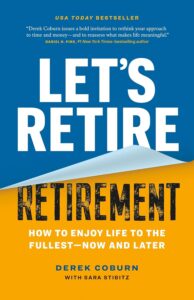
Let’s Retire Retirement author Derek Coburn finds the flaws in how we traditionally plan for life after work — and demonstrates how we can do it smarter.
What We Discuss with Derek Coburn:
- Traditional retirement planning is fundamentally broken. Financial advisors ask when you want to retire, not if you should, leading millions to sacrifice health, happiness, and relationships in pursuit of an arbitrary finish line they never actually chose.
- By planning to work just 10 years longer, the amount you need to save drops by 96% — from $2,400 per month to $110 — freeing up money and energy to actually live your life now rather than deferring it indefinitely.
- Alzheimer’s and dementia are the “iceberg to your financial plan’s Titanic.” These conditions don’t kill you quickly, meaning care costs can drain family resources for years, and your parents’ health has a direct impact on your retirement security.
- The pursuit of happiness as a direct goal actually backfires. Research shows people prioritizing personal pleasure get sicker and die sooner, while those driven by purpose and meaning experience lower inflammation and stronger immunity.
- You likely have more freedom than you realize. Finding work you don’t hate, even part-time, lets you stay engaged, maintain purpose, and enjoy the compounding benefits of extra years while spending more time with the people who matter most.
- And much more…
Like this show? Please leave us a review here — even one sentence helps! Consider including your Twitter handle so we can thank you personally!
 What if the entire concept of retirement is a trap we’ve willingly walked into? Most Americans are stressed about saving for some distant finish line, sacrificing vacations, family dinners, and gym memberships in the name of accumulating enough money to finally start living — someday. But the people who actually reach that finish line often discover it’s not what they imagined. Their spouse feels like a stranger after decades of prioritizing work, their body can’t do the things they’d been postponing, and the purpose that kept them going is gone. We’ve been sold a story that life happens after the grind, but what if that story is quietly making us miserable? What if there’s a better way?
Financial advisor and Let’s Retire Retirement: How to Enjoy Life to the Fullest — Now and Later author Derek Coburn has spent years watching clients chase a retirement dream that rarely delivers, so he joins us on this episode to offer you, our dear listeners, a radical reframe. Here, Derek walks us through the staggering math: by simply planning to work 10 years longer — not necessarily at your current grueling pace, but in some capacity you don’t hate — the amount you need to save drops by 96%. That’s not a typo. He illustrates why financial advisors rarely share this insight (it’s not great for their assets under management), explores the research showing that purpose-driven work actually keeps us healthier and happier than leisure, and makes a compelling case for giving your kids money while you’re alive to see it matter. Whether you’re panicking because you’re behind on savings, quietly wondering if you’re sacrificing too much for a future that may never arrive, or just trying to figure out how to talk to your aging parents about long-term care, Derek’s perspective offers something rare: permission to actually enjoy your life now. Listen, learn, and enjoy!
Please Scroll Down for Featured Resources and Transcript!
Please note that some links on this page (books, movies, music, etc.) lead to affiliate programs for which The Jordan Harbinger Show receives compensation. It’s just one of the ways we keep the lights on around here. We appreciate your support!
- Sign up for Six-Minute Networking — our free networking and relationship development mini-course — at jordanharbinger.com/course!
- Subscribe to our once-a-week Wee Bit Wiser newsletter today and start filling your Wednesdays with wisdom!
- Do you even Reddit, bro? Join us at r/JordanHarbinger!
This Episode Is Sponsored By:
- The Cybersecurity Tapes: Listen here: thecybersecuritytapes.com
- BetterHelp: 10% off first month: betterhelp.com/jordan
- Boll & Branch: 15% off first set of sheets: bollandbranch.com, code JORDAN
- Bombas: Go to bombas.com/jordan to get 20% off your first order
- ButcherBox: Free protein for a year + $20 off first box: butcherbox.com/jordan
- The President’s Daily Brief: Listen here or wherever you find fine podcasts!
Thanks, Derek Coburn!
Click here to let Jordan know about your number one takeaway from this episode!
And if you want us to answer your questions on one of our upcoming weekly Feedback Friday episodes, drop us a line at friday@jordanharbinger.com.
Resources from This Episode:
- Let’s Retire Retirement: How to Enjoy Life to the Fullest — Now and Later by Derek Coburn and Sara Stibitz | Amazon
- Website | Derek Coburn
- Nearly Half of American Households Have No Retirement Savings | USAFacts
- Millions of Americans Are Falling Behind on Their Retirement Goals | The Pew Charitable Trusts
- Saving for Retirement in America | Federal Reserve Bank of Minneapolis
- FIRE Movement: Financial Independence, Retire Early | Wikipedia
- Sparks Fly: The FIRE Movement Trend Is Fueling Early Retirement | Empower
- New AARP Survey: One in Five Americans Ages 50+ Have No Retirement Savings | AARP
- What Is the 4% Rule for Retirement Withdrawals? | Bankrate
- Spending in Retirement: Beyond the 4% Rule | Charles Schwab
- The Tail End | Wait But Why
- Tim Urban | What’s Our Problem (And How Do We Solve It)? | The Jordan Harbinger Show
- It’s All Quality Time | The Daily Dad
- The Daily Dad: 366 Meditations on Parenting, Love, and Raising Great Kids by Ryan Holiday | Amazon
- Ryan Holiday | How to Fix Your Life with Stoicism | The Jordan Harbinger Show
- A Functional Genomic Perspective on Human Well-Being | Proceedings of the National Academy of Sciences
- Be Happy: Your Genes May Thank You for It | ScienceDaily
- What the FIRE Movement Gets Wrong about Money and Happiness | Psychology Today
- Stumbling on Happiness by Daniel Gilbert | Amazon
- Retirement and Investments: Report on the Economic Well-Being of U.S. Households | Federal Reserve
- Planning for Care Costs | Alzheimer’s Association
- Does Long-Term Care Insurance Pay for Memory Care? | National Council on Aging
- Insurance Coverage for Alzheimer’s and Dementia | Alzheimer’s Association
- Bankrate’s 2025 Retirement Savings Report | Bankrate
- There’s No Such Thing as “Quality” Time | Ryan Holiday
- Barbara Fredrickson: The Science of Happiness, Theory and Practice | Pursuit of Happiness
- Scott Galloway | Solving the Algebra of Happiness | The Jordan Harbinger Show
- Scott Galloway | Solving the Algebra of Wealth | The Jordan Harbinger Show
- Arthur Brooks | The Art and Science of Getting Happier | The Jordan Harbinger Show
- Benjamin Hardy | How to Be Your Future Self Now | The Jordan Harbinger Show
- Ramit Sethi | I Will Teach You to Be Rich | The Jordan Harbinger Show
- Forget Finding Your Purpose — Do This Instead | Deep Dive | The Jordan Harbinger Show
- How to Make Friends as an Adult | The Jordan Harbinger Show
1286: Derek Coburn | Rethinking Retirement to Live Well Now and Later
This transcript is yet untouched by human hands. Please proceed with caution as we sort through what the robots have given us. We appreciate your patience!
Jordan Harbinger: [00:00:00] Coming up next on The Jordan Harbinger Show.
Derek Coburn: What's going on with your parents right now? What sort of health are they in? And how much money do they have? Because if something were to happen to your parents and you are going to step in to make sure that they don't end up on the street, then you need to get this information and you need to help plan for this.
And so I would have this conversation. I refer to Alzheimer's and dementia as the iceberg to your financial plan's Titanic. Those two don't kill you. You can live with those for a very long time and need to pay for care for a very long time. And if something happens to one of your parents and you have to start shelling out a million bucks over a five year period, then your financial plan is not as stable as you might think it is.
Jordan Harbinger: Welcome to the show. I'm Jordan Harbinger. On The Jordan Harbinger Show, we decode the stories, secrets, and skills of the world's most fascinating people and turn their wisdom into practical advice that you can use to impact your own life and those around you. Our mission is to help you [00:01:00] become a better informed, more critical thinker through long form conversations with a variety of amazing folks, spies to CEOs, athletes, authors, thinkers, performers, even the occasional tech luminary, legendary Hollywood actor or Emmy nominated comedian.
If you're new to the show or you want to tell your friends about the show, I suggest our episode starter packs. These are collections of our favorite episodes on topics like persuasion and negotiation. Psychology and geopolitics, disinformation, China, North Korea, crime, and cults, and more. That'll help new listeners get a taste of everything we do here on the show.
Just visit jordanharbinger.com/start or search for us in your Spotify app to get started. Alright. I'll be honest, when this was pitched to me as an episode about retirement savings and work, my first reaction was. I'll take the call 'cause I like Derek because retirement is, you know, boring or at least that's what I thought.
And, and the more we talk though, the more I realize this episode is not really about retirement at all. It's about stress. It's about people avoiding a topic because it feels overwhelming or confusing. Or just straight up depressing. And how that [00:02:00] avoidance actually makes everything worse. Americans are terrified about retirement.
Most people are not on track. And if we don't get this right, it's not just a personal problem, it's a societal one. A lot of people are basically staring down the barrel of working forever, or at least working way longer than they expected. So today we're taking a completely different angle. We're going to talk about why the traditional idea of retirement might actually be broken.
Why saving too much can be just as damaging, as saving too little, and how to stop putting your entire life on hold for some imaginary finish line way off in the future. If you're stressed about not saving enough, this episode is for you. If you're stressed about saving too much, uh, well bless you. But this episode is also for you and if you've been avoiding thinking about all this together, yeah, this episode is especially for you.
Here we go with Derek Coburn. I have to admit, man, when I first heard this was about retirement savings, I was like, all right, I am only taking this call because I like Derek, but, but, uh, the message is actually really important. And of [00:03:00] course, I read the book and that changed my mind on everything. And I, I just never thought I would do a show on retirement, because it's not a sexy topic, no offense.
But we're going to take a different angle on it here, and I think maybe give people a lot of relief by showing them a new way to think about this, which is really the main message that's coming through on this episode. And I want, I want people to stop stressing about this subject and avoiding it, because that makes the problem even worse, right?
Uh, you have compound interest, but you have compound problems when you bury your head in the sand. And I think that's where a lot of people are with retirement. A a lot of Americans are worried about it because it's kind of impossible for them to get on track in their opinion. What do you think?
Derek Coburn: Yeah.
You know, um. Most people when they meet with a financial advisor, the financial advisor is not asking them, do you want to retire? They're saying, what age do you want to retire? And everyone's automatically opted into it. They haven't given that a lot of thought. So they decide in the office, well, I don't really know.
And the advisor will say, well, let's pick 65 because that's the age that everyone else picks. And they'll say, great. And then they'll get on this train where [00:04:00] they're playing primarily the money game and they're sacrificing their health, their happiness, important relationships in the name of having a certain amount of money by a certain age.
And what we're seeing is a lot of people are getting there now, and it's not what they thought it was going to be. They wish they could go back in time and make different choices. And that's a big part of why I wrote the book and what I want to help people overcome.
Jordan Harbinger: Yeah. Tell me the numbers here. 'cause I think most Americans are not on track for retirement, but what does that mean?
What does most Americans and what is on track for retirement mean?
Derek Coburn: Yeah, depending on where you get your information from. I think something like 40% of Americans are not even saving anything for retirement and those people obviously need to read a different book and hear a different message and um, and I, you know, have empathy for them.
Jordan Harbinger: Hold on. Sorry. Saving Z, like just saving nothing.
Derek Coburn: Paycheck to paycheck. No money in a retirement account at all.
Jordan Harbinger: There's a difference between somebody who makes 80 grand a year and is just blowing all of it on stuff versus somebody who is unable to afford anything but the necessities of life. So, I dunno, one group I have sympathy for in the other group, [00:05:00] the other group needs a slap upside the head maybe.
I don't know. What, what do you think?
Derek Coburn: I think you could make a good case for that. Like I think that there needs to be some balance in all of this. Like I think that I'm not promoting or preaching that people should just work all the time.
Jordan Harbinger: No,
Derek Coburn: what I'm trying to do is I'm trying to reach a very large group of the population who are just blindly saving money and that's their priority.
And they're skipping family vacations, they're skipping family dinners, they're not going to the gym, they're not sleeping the right way. All in the name of accumulating all of this money. And um, you know, while the money compounded to your earlier point, a lot of these other things never compounded. And so what's the point if our kids aren't talking with us, if our spouse isn't talking with us, if we're not able to enjoy what we're doing?
You know, I had a lot of people come into my office over the years and no one had their hand raised to say, I know I don't want to retire. It was a conversation I started and I would humor them. I would say, well, what do you want to do when you retire? And sometimes they would say, we want to travel the world together.
This is a couple. And I would look at them and I would say, when was the last time the [00:06:00] two of you went out on a date? Yeah. 90% of the time they look at each other. They don't really know how to answer that question. And you know, I, I want to play golf five days a week, but you just had your hip replaced and you haven't been to the gym in four years.
So when is all of this going to start happening? And I think by leaning into more of these other things right now, it also frees up energy and creativity and productivity and wisdom so that you actually can more than make up for it, even though you might be spending less time, quote unquote working.
Jordan Harbinger: Yeah.
This is interesting. I want to go back to the numbers on Americans as a society because. 40% of people aren't saving anything. This is a little off topic, but whatever. Isn't that going to remake society? Because if those people, they're going to have to retire at some point, right? Eventually you just can't work.
No. Even if you want to, there's a certain age at which no one wants to hire you. Aside from maybe like Walmart, greeters, there's only so many of those positions. Right. And you can only do it for so long. Yeah. Those people aren't going to be able to survive unless we have social security, which is another topic that I'll get to in a minute, I guess.
But isn't that going to [00:07:00] remake society? If those people are paycheck to paycheck and they suddenly have to stop working, they get a back injury, they can't work. They have cognitive decline, they get made redundant, but they're 70, they're not going to retrain.
Derek Coburn: Yep.
Jordan Harbinger: You know what? What's that going to do to society?
Derek Coburn: Or AI takes their jobs. Um, yeah. You know, just all of this. Right. And I think that, um. Another thing that's interesting to think about is the way, one of the main reasons why the stock market has been propped up the way that it has been, and the way that it will continue to be propped up is the tremendous amount of inflows that are coming in from paychecks.
So what we're also looking at is a scenario where 20 years from now, there are not enough workers coming in on a one-to-one basis to replace the people in the jobs Now. Even more so, they're not really, you know, a lot of these jobs probably are not even going to exist at that point. So not only are they not going to be working, but they're not going to be funding their 401k plans to keep the balances continuing to to go up.
Jordan Harbinger: I see.
Derek Coburn: So I think too, I believe in human potential and I believe that, you know, everybody having access to, to this ai to [00:08:00] tools to be doing different things. Like I think that there, we, we could see scenarios where people are making a hundred grand a year cooking dinner for five families in their neighborhood five days a week.
Uh, I joked in my book that I think a really cool job might be, um, you rent a granddad or rent a Grand where you pair like kids with seniors supervised of course, where you know, the grandparents get to tell their stories and, and share their wisdom and their experiences with these kids who might not otherwise have grandparents.
So I do think that there might be some cool opportunities. Gary V recently talked about how there's. Now an app where you can pay somebody like 20 bucks to go on a walk with you for 30 minutes to talk about whatever you want to talk about with them.
Jordan Harbinger: That sounds simultaneously pathetic, but also really cool at the same time.
I don't know
Derek Coburn: exactly.
Jordan Harbinger: I think it's probably really good for chronically lonely people to do something like that.
Derek Coburn: And we have more and more of those right now that are popping up,
Jordan Harbinger: that's for sure. Yeah, that's for sure. I'm worried about these paycheck to paycheck folks. Aren't they going to be working forever but then when they can't?
I don't, I just don't know what happens to these people. Like they [00:09:00] go on disability or something.
Derek Coburn: Yeah, I mean, look, I think it's going to be hard to avoid a situation where if all of these things happen that we don't have some form of universal basic income to, to take care of people. And also my message, my story, it's helpful to everyone no matter where they are, because even the person that's living paycheck to paycheck.
They still might feel, I hope that they still feel that maybe it's not going to be like this forever. Maybe they're in a crunch right now. Maybe they're going to get a raise. Maybe they can start saving more of their raise. But I want to alleviate the pressure and the stress that they might feel, you know, all this doom and gloom, that they're stuck and, and they're never going to be able to escape.
Jordan Harbinger: What is the typical amount of time off that Americans get? Is it two weeks?
Derek Coburn: I think so. The numbers are absurd in terms of like the amount of vacation pay that doesn't get used. Yeah. Tell me about that. The primary reason for that being that they don't feel like they can afford to go on the vacations. I think it's something like 46% of all vacation times was not getting used.
It was just rolling over and it wasn't because for any other reason? Uh, primarily except for the fact that I don't know that I can afford to get away.
Jordan Harbinger: I see. So somebody might get two weeks off a year, but they go, [00:10:00] screw it. I can't afford to take my family anywhere, so I'm just going to keep working through those two weeks.
They get rolled over to another year and then maybe you cash it out if that's the thing you can do at your job, uh, at the end of your career.
Derek Coburn: Yeah. I don't know if they're thinking that far ahead. I mean, we're seeing now like other countries that are, I think doing it a little bit better. Like I think I just saw an article a couple days ago where the Dutch, now the average worker there is working 32 hours a week.
Their happiness levels are off the charts compared to the happiness levels in in the United States and a lot of other countries.
Jordan Harbinger: Yeah. My European friends, man, they get something like two months off every year.
Derek Coburn: Yeah,
Jordan Harbinger: it's amazing. My buddy in Sweden works for Apple, which is a company that, I don't know if people know this, but it, they're known as, it's tough.
It's a tough place to work if you work for Apple here in Silicon Valley. I had a friend who worked for Apple. She was working like six days a week. She had to skip many family events. Then one day she excitedly told me she was going to Australia. I said, what are you going to do? She's like, I don't know. I'm only there for one [00:11:00] day.
I said, you're flying to Australia from California for one day. She said, well, it's going to be kind of a day and a half, so I'm going to try and get to the Great Barrier Reef. And I'm like, I don't think you understand how big Australia is. Are you kidding me? You're, you'll be lucky to get to the shopping mall, let alone the Great Barrier Reef.
If you got half a day off like Australia, it's an island. It's not a small island. It's massive. It was just crazy to me. And then a another, a friend of mine, he told Apple, he was a, one of the, I gotta be careful how I identify him. He was one of the lead devs on iOS something. I won't give the number because it'll, he's the guy for that.
And he told them, I think two years in advance that his brother was getting married and he had to go to Turkey. And they were like, okay, of course, no problem. And then when the wedding came up, they were like, we really need you to stay here because the launch is a couple weeks after your brother's wedding.
And he goes, how about this? I quit. They were like, go ahead and go to your brother's wedding, but it's going to affect your career. And he's like, no, I don't care. I told you this is my brother's wedding. Yeah, different. He, he, yes, it was, that was his, I'm putting my [00:12:00] foot down moment for, at this company because he is like, okay, they, if I needed any more proof that this company gives zero shits about my wellbeing, this was it.
Derek Coburn: Yep.
Jordan Harbinger: Yeah. My European friends get like two months off a year. I text my buddy Johann, and I'm like, what's, what's, what are you doing, man? He's like, oh, we just finished school and we're going up to our, our lake house. How long are you going to be there? I don't know, 6, 7, 8 weeks. And I'm just like, oh, what do you, okay, uh, you don't have to like go to work or anything.
He's like, I'll check my email, uh, at the end of the month just to make sure. And he's like, but I don't have to, they can't make me. I'm just like, wow. Uh, yeah. It's illegal for them to make him. And then he told me later that the company. Again, apple had a policy that was like, please don't check your email because we're not, our lawyers aren't sure if you could actually be sued for, if we could be sued for supposedly pressuring you to do this.
And France has the same thing. You can actually sue, or the state can take some action against your employer if they make you answer emails after hours. So he is like, [00:13:00] well, I just want to make sure that I'm keeping up on project stuff. And they're like, no, don't even open the VPN, just like have your time off.
And his boss was like, we don't want the liability and also we don't need it. It's all good. If there's a real emergency, I'll call you. So he just unplugs and like sits and looks at the lake and hangs out with his kids. It's, it sounds so simple, and yet as an American, I'm like, wow, what does that feel like?
You unplug for that long and you just don't think about work. I don't even, I can't relate.
Derek Coburn: That is a wild story and I think that's part of it. Right? I, I think that maybe what first got me on this train, this thought process for the types of conversations that I wanted to be having with my clients was when I read the four Hour Work Week by Tim Ferris, and this is going back to like 2006, 2007 Yeah.
Where he introduced the ideas of mini retirement and among other things, and, and I thought that sounded really good. And so I started pushing back on my clients and I started helping them realize that they weren't going to be happy sitting around doing nothing for 30 years and the all the things that they wanted to do when they get there, they could start incorporating those things into their lives right [00:14:00] now.
Jordan Harbinger: So the idea of traditional retirement, you're, it, it sounds like you're saying it's not a great mindset because. I agree with this, these words that I'm putting in your mouth right now, uh, which is that the idea is I'm going to live later and enjoy life later and not right now because I need to work like the guy with the, the golf, the guy wants to golf and, you know, hasn't done it in a decade or whatever.
The idea that you're going to put your, the, all the living and all the fun part off until later. It doesn't really work. Uh, and I, I think in the book you give a lot of examples of couples that barely know each other by the time they're retired because it's been 40 years since they've actually done much together other than a few days a year.
Derek Coburn: Yeah. I mean, look, I think that what I'm doing, everybody recognizes, I think and realize is that they should be spending more time with their spouse. They should be spending more time with their kids. They should be taking better care of themselves. But no one's really addressing the elephant in the room, which is, how am I going to afford this when I'm told I need to save an amount of money?
That feels completely unreasonable to me. So the way that I am starting the conversation is by helping people [00:15:00] realize that they actually have more money and more time. Right now, the way out is by you planning to work longer, it means you don't have to save as much. You're going to have income coming in in those later years to help cover your expenses and all the things that you need to pay for.
And because of that, that means you have more money and more time that you get to spend on the people on things that are most important to you. Right now,
Jordan Harbinger: I want to talk more about each of those things, but I think a lot of people are wondering, okay, if I'm not saving enough, if people aren't saving enough, this episode is for you.
And if you're stressing because you're saving too much, this is also for you. This is something that surprised me though from your book, which was people save too much. Is that how, how, how common is this problem? 'cause it sounds like it's the opposite. It sounds like the other way around is the actual problem that we're having here.
Derek Coburn: Not many, right? I mean, not many at all. I mean, a lot of, depending on where you look, you, the industry standards will. People will say, how much should I save? And, and they'll say anywhere from 15 to 20%. And people that are saving 15 to 20% of what they're making, that means that they're saving almost as much as they're spending once you back out [00:16:00] taxes.
And I don't know many people who are doing that, but there's certainly some outliers who are earning some really good money. Like one of my clients I shared in the book is making $3 million a year as an attorney, and he's living in the same house he's been living in for 25 years and they give a lot of money to charity.
And, but that's not what, what's happening most of the time.
Jordan Harbinger: The fictional example of Tony in the book was pretty sobering. Tell me about that.
Derek Coburn: Yeah, so I shared this story in the book called A Tale of Two Tonys and Tony is, uh, 45 years old. He makes $150,000 a year, and he has $150,000 saved up in a retirement account.
So if these numbers don't apply to you, feel free to insert your own numbers if you want, I have a calculator on my website that you can plug in numbers as well, but essentially the math isn't going to change very much. Tony meets with his financial advisor and the financial advisor helps him realize, or, you know, to follow along with everybody else, that he's going to retire at 65 and he comes back and tells Tony that he has to save $2,400 a month, $2,400 a month, adjusted for inflation every single year for the next 20 years in order to retire.
As I just mentioned, that's [00:17:00] 20% of what he's making. That's a non-starter for Tony, and it's a non-starter for most people. Tony goes home, he says, I can't come home for dinner as much as I have been coming home. He's leaving, uh, the house earlier. He's coming home later. He's not taking care of himself. I introduced this, um, sort of alternate reality ala sliding doors with Gwyneth Paltrow, if you remember that movie.
Jordan Harbinger: Yeah. Yeah.
Derek Coburn: Where her fate is sort of like determined by whether or not she catches a, a train. And so I, I had this alternate scenario take place where in between these meetings, Tony's wife says, Tony, I don't think you're going to want stop working at 65. You like what you do, you like the people that you do it with.
And even if you're not doing that, I can't imagine you sitting around doing nothing at all. And he says, you know what? You're right. So he calls the advisor backup. He says, can we make my number 75 instead of 65? Then they get together. The advisor tells him that now the amount he has to save is not $2,400 a month, but $110 per month.
It goes down by 96%.
Jordan Harbinger: I want to highlight this because this is the real magic here. [00:18:00] It almost sounds impossible until you look at the numbers on paper. How is it that working 10 years longer allows me to save 96% less money? That's actually crazy. I mean, the, the amount of almost anybody can save that amount of money if they're making 150 grand a year.
Right? It goes, so it goes from a few thousand dollars, which is like, oh gosh. going to have to cut down. going to have to work more to, yeah, I guess I, I don't know, skip around a golf here and there, or like, maybe I won't spend as much on nonsense on Amazon when I'm feeling the need for retail therapy. I mean, it's almost like a, it's like a rounding error from a lifestyle hit.
Derek Coburn: For sure. Man. You know, in the first example, what happens is you have 10 less years of working, 10 less years of saving, and then 10 less years of the money compounding. And you need that money to last for 30 years because in both examples, I have Tony dying at 95.
Jordan Harbinger: Okay.
Derek Coburn: In the second example, it's 10 additional years of working.
10 additional years of saving 10 additional years of that money compounding. And then you only need the money to last for 20 years. [00:19:00] So we've all seen these articles about how we should have saved more when we were 22 to take advantage of compounding interest. And we feel kind of silly because we didn't fully do it.
And hopefully you're making a lot more now than you were then anyways, to where it wouldn't make that much of a difference. But we're not seeing many articles that are talking about how we can take advantage of the beauty of compounding interest by just leaving it in for a lot longer. And I think, you know, one of the reasons for this is, while I don't think there's some evil group of, you know, people in an office in a high skyscraper somewhere plotting to make people's lives miserable.
But you know, if you do the math, it really works against the financial interest of financial advisors to be having this conversation with their clients. Why? 'cause if you're meeting with me and you're saving $2,500 a month and I've got 500 clients that are doing this, and I have this conversation with all of them, and then they all start saving $110 per month.
The amount of assets under management that I get paid on is down dramatically 5, 10, 20 years from now.
Jordan Harbinger: I never thought about that. Right? I didn't realize that some advisors get paid, right? I forgot. Some of these advisors get paid on [00:20:00] assets under management, so they're incentivized to be like, you know what?
You need to stay on that hamster wheel and you need to put more money into more of these different products that I can help you with, as opposed to, you know what? What's best for you is actually working a little bit longer and saving way less, and putting less money into the pots that I happen to hold under my control.
That's interesting. I guess the problem is some people might be like, no, thank you. Why would I want to work longer? I hate working. Right? So what do we do about that?
Derek Coburn: Yeah. I don't want people that hate their job to work any longer than they have to, and I also changed the language that I use in my book.
Over the first few drafts, it was find something that you love doing and I, I think that can be problematic for a lot of people. Yeah. I don't think we necessarily need to find our passion and do that, but find something that you don't hate doing. Find something that you enjoy and find something that allows you the flexibility to lean into your passions that are not work related.
I think that if we find work doing that, uh, especially if it's on [00:21:00] our terms the way that we want to do it, I mean, it could be 20 hours a week, it could be taking off Fridays, it could be taking off summers. There's also some real evidence and data to show how bad it is for our happiness, our health, and our relationships to actually just be sitting around and not doing anything at all.
Jordan Harbinger: If your retirement plan is, ignore it and hope I die on a Tuesday. You're not alone. We'll unpack that nightmare in a second. We'll be right back. This episode is sponsored in part by Dell and a MD. Cybersecurity is one of those topics that sounds important, but the second people start talking about OT networks and C two infrastructure, your brain just taps out.
Totally fair goes over my head too. That's why the cybersecurity tapes is such a smart way to learn it, because you learn what cybersecurity actually looks like in real life, not code on a screen, but power flickering systems failing and normal people dealing with the consequences. In episode 12, part three, the storm is easing up and everyone's running on fumes thinking.
Maybe they made it through, and then the episode reveals just how close things came to spiraling. Like this could have shut down a whole [00:22:00] community kind of close. You follow the investigation as the clues finally line up and it becomes clear that this wasn't random, bad luck. Then Steven Samir, actual cybersecurity specialists, step in and translate what you just heard in plain English.
What was happening, how it works in the real world, and why preparation matters long before anyone realizes they're in trouble. It's basically the aha episode tense, easy to follow, and the kind of story that makes you go, oh, that's what cybersecurity really is. Episode 12, part three just drops, so don't miss its.
Subscribe to the cybersecurity tapes wherever you get your podcasts. This episode is also sponsored in part by BetterHelp. Sometimes February makes it look like everyone else has their love life totally dialed in, and no matter where you are, married, dating, single, it can mess with your head. But in reality, nobody's got it all figured out.
Even the people who look like they got it all together, and yes, that includes me. Shocking. I know. And yes, that's where therapy can be really useful. It's a way to get clear on what you actually want, what's been feeling heavy, and how to take some pressure off yourself, whether you're working on a relationship recovering from one or just trying to stop replaying the same unhealthy patterns.
That's why I use and recommend [00:23:00] BetterHelp BetterHelp therapists work according to a strict code of conduct. They're fully licensed in the us. Just fill out a short questionnaire so they can pair you with somebody who fits your needs. They've been doing this for 12 plus years, and their match fulfillment rate is industry leading, so they usually get it right one of the first few times, and if not, you can switch therapists anytime from their tailored recommendations.
Jen Harbinger: Sign up and get 10% off at betterhelp.com/jordan. That's betterhelp.com/jordan.
Jordan Harbinger: If you're wondering how I manage to book all these great authors, thinkers, and creators every week, it is because of my network. The circle of people I know, like, and trust. I'm teaching you how to build the same thing for yourself for free over at sixminutenetworking.com.
It's great at work, it's great if you're already retired. It's great if you're just entering the job market. It'll make you a better connector, a better friend, a better peer, and a few minutes a day is all it takes. Many of the guests on the show subscribe and contribute to the course. Come on and join us.
You'll be in smart company where you belong. You can find the course. It's all free, no shenanigans at sixminutenetworking.com. Now back to Derek Coburn. This is [00:24:00] interesting 'cause I think a lot of people assume you have to be doing a job that you really don't like, but you could retire from your, let's say, teaching job at age 65.
Then you could get a job doing, working part-time at a flower shop or something like that from 65 to 75. You don't have to do the same thing. You don't have to be a machine metal scamper from 65 to 75 once you retire from your job in Detroit. I don't know if those jobs still exist in Detroit. Um, but you know what I mean?
So that's an interesting take because I think a lot of people are going, this is, I'm just out, there's, my school district won't let me, you know, keep working that long. Right? Or my government job won't let me work past. I don't know. But I'm assuming that a lot of these jobs have mandatory retirement ages in some states or in some situations.
This is all hopefully really good news for people because when I read this, it, it changed the way that I thought about working as well. I really like what I do. I know I'm probably in the minority where it doesn't really feel like work most of the time. Mondays are the [00:25:00] exception 'cause I have a crap load of, I put all my meetings and all the things I don't, you know, necessarily love doing on one day.
So I have one sort of rip the bandaid off to start the week kind of day. And then the rest of my week I read books and talk to smart people, kind of, you know, that's really where I'm at. And it's not just about the work. You mentioned my buddy Tim Urban, wrote a post on his wait. But Y blog, which I love, I think a lot of people probably read that by the time you graduate high school, you've spent, I think it was 93% of the time that you'll ever have with your parents.
So if you are out of high school, which like 99 plus percent of my audience is, you've already spent 93% of the time that you'll ever have with your parents. And for some people that's great news. But for most of us, for most of us, we would like to see those people again. And Tim actually this post, which we'll, we'll link in the show notes.
This was a life-changing post for me because my parents, they now come over daily and they spend several hours at my house. But that's because, in part because I read that post, I told my parents they should move. It took 'em three-ish [00:26:00] some odd years to come around to the idea that living in Michigan for the rest of their lives, it includes winter.
And so I got 'em a house across the street, but I deliberately engineered the way that they can see me and their grandkids twice a day, every day, because I realized, oh, I'm either going to see 'em twice a year. For a few hours, really few days at most. Or I can see them every day until they're sick of us. Um, which is quickly, I assume, uh, de depending, depending on the day.
They, they leave a little earlier, but it's fine. And I love this idea that actually this is within our control for a lot of us, but it's also, it should be sobering for most of us. That life comes at you fast, I think is really the point of the post. You really find that the same thing is going to be true for your kids.
Do you have numbers for kids? I, I know in some of the groups you and I are in where they talk about like, you get eight summers or whatever. Do you know anything about this?
Derek Coburn: Well just take the exact data point that you just shared from Tim Urban, which I include in my book, except I highlight how it should potentially incentivize [00:27:00] someone and motivate someone to lean in more to spending time with their kids while they have them in their home.
Right. Because I think that society playing this money game, buying into a traditional retirement mindset, society wants us to work our hardest and earn most of our money in the years when our kids want us and need us the most. Even just on a micro basis, if my, if my macro theme is I get to kind of spend my time and my money differently right now because I know I'm going to be working into my seventies and eighties.
Well, right now I have a 15 and a 13-year-old. I have three and five years respectively left with them here in my house before they're gone. And me saying no to more speaking opportunities right now, me saying no to coaching opportunities, me solving on a daily basis for, I want to spend like an hour or two with each of my kids every single day is sponsored by almost like I'm writing.
The future version of me is writing the current version of me a, a sponsorship check. It's sponsored by the knowing that I'm going to be ready to work more than I am right now, once my youngest is gone and off to college, sign me [00:28:00] up for more speaking gigs, more impact, more work, you know, all of it.
Jordan Harbinger: I go through this a lot and my friend Rich Roll told me that.
I was like, oh man, that they want me to write a book and they want me to do this, and they want, he's like, work will be there later, man. Your kids are six and three. Take the time, work those lighter, quote unquote lighter days and spend time with the kids. And then, yeah, when your youngest is off to college.
Then you can sit down and do premium content, write books, do a speaking tour, whatever live podcast, all the stuff that sounds kind of fun. But for, you have kids at home and you don't want to leave them, you can just do it later. And that's probably a good way to look at things. It's hard though 'cause everyone's like, you're leaving money on the table.
So now I actually look for places where I can leave more money on the table. 'cause it's usually a good sign, especially if I, if I don't want to do the work, I don't need the extra, uh, cash, which I know is a, a privileged position to be in. Um, Ryan Holiday writes a newsletter called The Daily Dad, which I've talked about here on the show.
And I know you're, you're a fan of that as well. And he mentions that Seinfeld, quality time versus garbage time and how garbage time with kids and [00:29:00] quality time are basically the same, right? Whether you're sitting there eating a bowl of cereal or you're, I don't know, doing a workout together. Or having a heart to heart, it's all kind of the same in terms of the meaning to the kid.
And you have your own version of this, which is $50,000 moments. I'd love to hear about that.
Derek Coburn: Yeah, so when my kids were 10 and seven, respectively, approximately, um, we had a nighttime routine, my wife and I, where we would alternate lying in bed with each of them, reading a story, snuggling with them, waiting for them to fall asleep.
And I caught myself on a lot of nights thinking, gosh, I wish he would hurry up and fall asleep so I can go hang out with my wife. I can go answer this email, I can go watch this Netflix show. And I, I had the realization like, this is not going to last that much longer. Like my 10-year-old kid is not going to want me to keep laying in bed with him for too much longer.
So I, I tried to force myself to appreciate it more and that worked a little bit, but then I just had this wild, crazy thought of, what if 20, 30, 40 years from now there's a company that invented a time machine and they will gimme the opportunity to go back in time to relive one moment with my kids. [00:30:00] What would I be willing to pay for that?
What would I pay to have one nighttime snuggle with the 10-year-old version of my kid when I'm 60 and he's 30 something? And it's like I would write a $50,000 check without even thinking twice about that. And even though those moments are not happening anymore, the nighttime snuggles, we have these other moments and you know, to your point, my oldest son and I, we have a gym in the house and we work out about three times a week together.
That's an hour per session and 45 minutes of that hour. Like he's not talking to me. You know, he's kind of looking at his phone and he's sure distracted, but I'm in the game and I have an at bat and I'm there and if he wants to talk with me, we can have a conversation. And so for me it's more about presence.
I see a lot of parents who, who get frustrated because they come home early from work and you know, I'm available from four 30 to five, but my kid doesn't want to spend time with me and I don't know what to do. And it's like, no. Like you can't just put them into like one of your time blocks. It's just more being around and being available for them.
And when it was a couple years ago, before I was [00:31:00] working out with my oldest kid where. I was getting ready to work out for myself and he said, dad, can we play Legos together? And I said, sorry bud, I'm getting ready to work out. I need to get this in. I haven't worked out in a couple of days. And while I was in there I thought, oh my gosh, like I don't want to ever say no to him again.
So I just rearranged my days at that point to where I was going to get done everything that had to be done before they got home from school. I would leave the things that would be nice to do, but not necessary to do for after, for the days that they didn't want me to spend time with them. But if they were going to ask, I was going to say yes.
And the more I said yes, the more they kept asking.
Jordan Harbinger: Yeah, this is interesting. It's funny, I came to the same realization. There was just a lot of times where Jaden would say, dad, I want to play with my drone, or I want to play with this, or help me build a Lego house. And I'm like, sorry, I've gotta get my workout in because this is my only block.
And the look on his face is always just like, so it just, you just realize, you know, it's just not that important to do pushups right now. And you end up building a Lego boat or whatever instead. And, and I pretty much never [00:32:00] regret it, you know? Yeah. I'd be in a little bit, maybe. Maybe. I love handles would be slightly smaller if I got my act together.
But yeah, you're right. I do everything before they get home now. And if there's something late, it's just generally a mistake or somebody says, I can, I have to move this thing. And it's occasional because my, look, my dad and your dad too, probably from that generation. My dad got home at like 8:00 PM
Derek Coburn: Yep.
Jordan Harbinger: Most days. And he worked at Ford. It's not like he had some kind of crazy sort of business that he was running. It's just Ford would work you to the bone in the eighties and nineties. That was just, that's how they rolled. And he got up at, before I got up, he probably got up at six, left at six 30, I don't know.
And got home at eight. There was a long time where I didn't see much of him, and then he retired really early, but I think I was like a sophomore in high school by then. Right. Cat's in the cradle situation. And if it weren't for stuff like Boy Scouts and all that, I probably wouldn't have done much of anything with him, honestly, because he wasn't around and then I was too old.
So luckily we had that [00:33:00] system, the Boy Scout thing in place. Otherwise, I think we would've been in real trouble. And I, I, I know that a lot of guys in my generation are making this same mistake because that was what we were modeled for the most part. It's not a boohoo situation for me really, because I saw him do the same thing.
You know, as he, as he gets older, you forego time with your friends when you're younger and then we're older and then you're lonely. And my dad has had to sort of reconnect to all of his, he did a good job with this, reconnect with a bunch of his friends when he got older. 'cause he was like, oh, I neglected all of my relationships for 20, 30, whatever years.
I'm curious where the retirement system even comes from. Like who? Who came up with Let's retire at age 65. I don't even, who picked all this?
Derek Coburn: We'll go back to 1889 in Germany when they were putting together the first ever social program for workers who were leaving the working pool. The chancellor at the time, Otto Vn Bismarck, decided to make 65 the age that they would begin to receive benefit because that was the age at which people were expected to live until,
Jordan Harbinger: so like, we're going to pay [00:34:00] you, don't worry, you don't have to work anymore.
What age are you going to be? Well hopefully you'll be dead. That's what we're betting on right now we're, we we're betting you're going to be dead by that time or maximum two years left in your life.
Derek Coburn: Exactly.
Jordan Harbinger: That's grim.
Derek Coburn: And then FDR just kind of thought that sounded like a good number when they were putting together the social security program in the mid 1930s.
And, you know, social security in part was created because there was an employment crisis where you had all these younger workers that were looking to get into the workforce, but the older workers didn't want to let go of their jobs. So there was all this, all these shenanigans that took place, like the owners of the managers of the, of the businesses would, would look out for men who were starting to get old.
If they spotted a gray hair, they would give them harder work to do to increase the likelihood that they would mess up and they would have a reason to fire them and get rid of them. And this led to a lot of these workers going to Woolworth, you know, on a daily basis to buy shoe polish to put into their hair so that they would be able to pass off as not being as old as they actually were.
And, you know, life expectancy at that time was, you know, 70, 71. And [00:35:00] so if you think about it, and most companies had pension plans. You, you would get a third of your income from social security, a third of your income from a pension plan. You only had to come up with a third on your own. And you only needed to last for about five or six years because you were going to die after that.
Even though our life expectancy now is significantly higher, and it's certainly higher once you hit 65, like once you make it to 65, you're likely to make it to 85. But we haven't really adjusted the age at which most people are choosing to stop working or planning to stop working.
Jordan Harbinger: We talked about social security at the top of the show is that I know we can't really rely on it.
First of all, how much is that? How much do you even get is it's like a few hundred bucks a month, right? It's nothing.
Derek Coburn: It's all based on, yeah, it's a math equation based on how much you've worked and how much you've put into it. And that's, you know, it's interesting, when they were putting this plan together, there was going to be more of a universal basic income type of stipend.
And most of the workers rejected that because they didn't want to receive any handout. So the social security model was a nice compromise and, and everybody got buy-in because they got to feel the pride that I contributed to this. [00:36:00] And that's some of the money that I'm going to be taking out,
Jordan Harbinger: is social security even going to be there?
I remember even in high school in the nineties, teachers being like, don't count on that. It's probably not going to be enough for you. And then in college it was like, not only is it not going to be enough, it might not even exist. And now it's almost like a foregone conclusion that there's nothing is going to be there by the time we need it.
Is that correct?
Derek Coburn: Yeah, I look, if I were under the age of like 50, maybe even a little younger, um, I wouldn't be planning on it. You know, it's interesting. The first social security check was drawn in 1940 to a woman, woman named Ida May Fuller. The amount that she got was $22 and 54 cents. The amount that she contributed to social security was about $24 and 75 cents in total.
Wow. She, of course, lived to the ripe age of 100 and ended up taking out about $23,000 in benefits. So literally the very first person that got benefits from Social Security just got like multiples and multiples of what she got in. The writing was on the wall that this thing is [00:37:00] not going to be sustainable.
Jordan Harbinger: If you told me that there was an investment where I could put in that amount of money or a small amount of money, and I would keep getting paid out after it for the rest of my life. I would report you to the FBI because that's what a Ponzi scheme is. Is it not?
Derek Coburn: Yeah, totally man.
Jordan Harbinger: Yeah. Uh, no, don't worry.
We're taking money from other people who invest in this and we're giving it to you, and then when they need it, we're going to find other people who have to invest in it. We're going to give that to them. That's illegal everywhere else. Unless the government does it. Yeah, this is, this is the, because the math eventually doesn't work.
Alright, so we have 401k plans. Now, first of all, explain what that is. 'cause some people don't know because they're not American and other people don't know because they don't have one. Some people do have one and still don't know what it is. So tell us what these are and isn't this going to solve that problem?
Derek Coburn: Yeah, so 401k plans, and I'll lump in traditional IRAs with them, are essentially retirement plans where you contribute pre-tax dollars. You don't pay taxes on the money, it can go into an investment account and then whatever it grows to, you're [00:38:00] going to pay income taxes at your current tax bracket on the principle and the growth.
4 0 1 Ks sort of came around in 1978. Even the gentleman, uh, Ted Manna who started this movement, you know, thinks that it got really out of hand and he never, uh, his intention was never for it to be the end all, be all for retirement accounts. But I think one of the main reasons why these plans became all of the rage and why everyone has like, kind of dutifully put money into them without really questioning it, is that, oh, I get it.
I can put money away now while I'm working and when I take the money out, I'm going to be in a lower tax bracket because I'm not working. Well. Once you decided there's a chance that you're going to be working longer and you know, than what you were previously thinking into your sixties, into your seventies, into your eighties, then maybe it's not the great deal that it's being advertised as.
Jordan Harbinger: Oh man. So I better talk to my CPA because I have a feeling that I have a ton of money in something like that, and probably I'm going to [00:39:00] end up paying a ton of tax on something like that. I can't just give that to my kids, right? I have to spend it. Yeah, yeah,
Derek Coburn: yeah. And you'll have to start taking required minimum distributions at the age of 70 and a half.
And the way that they figure that out is they take all of the money that you have in your retirement accounts and then they figure out how many more years you have left to live based on their master mortality chart. So let's say you're 65 and they think you're going to live to be 85 based on what their chart, they have the same chart for everyone.
Then you would have to take out one 20th of that amount each year. I meant to say 75 and 95, but, um, okay. But that's essentially what we're looking at. I've been preaching, and I do preach, you know, the importance of diversifying how your money's ultimately going to be taxed. The same way that you prioritize diversifying your money between different asset classes.
I don't think that one is worse than the other. I think that it's perfectly fine to have money in a 401k plan, but also I think that we need to plan for the scenario where tax rates might be a lot higher in the future than they are [00:40:00] right now. And if you throw in some income on top of that, then there's a decent chance that you're not going to be in a higher tax bracket.
There's a decent chance that it would be better for you to contribute to a Roth IRA right now, or a Roth 401k plan instead of a traditional plan. And the way those plans work. You're putting after tax dollars into those plans, and then when you take the money out, it's all completely tax free to you.
Jordan Harbinger: So if you're currently lying awake at night thinking, cool, cool, cool.
I'm just going to work until I die. Don't worry, we're not there yet. But before we fix capitalism and the retirement system as a whole, let's take a quick break so the show can keep existing in the first place. We'll be right back. This episode is sponsored in part by Boll and Branch. We spend a huge chunk of our lives in bed, ideally more than than I do now, but the years of your life are basically you, a pillow, and whatever sheets you're sleeping on.
So if sleep is one of the most important things you do for your health, your mood, and your focus, why are we treating sheets like a random afterthought? That's why we're such fans of Boll and Branch. High quality bedding is one of the best adult investments you can make because you feel it every single night.
We loved these sheets right away. You can tell they're [00:41:00] breathable, soft, and just better. And the wild part is they get even softer after every wash. And we know that because we wash our sheets every Monday. It's a whole routine in our house. Monday equals fresh sheets so we can actually attest to it. They get even more comfortable over time.
Love Boll and Branch's waffle blanket as well. It's kind of like the upgrade where once you have it, you don't want to go back.
Jen Harbinger: Sleep sound with Boll and Branch. Get 15% off your first order plus free shipping at bollandbranch.com/jordan with code Jordan. That's bollandbranch.com/jordan, code Jordan to unlock 15 percent off. Exclusions apply.
Jordan Harbinger: This episode is sponsored in part by Bombas. One of the goals this year and all year round is to stay comfy, and Bombas is leading that charge in my house. We love Bombas so much. It's all we wear. We even gifted to our family and our friends and our nanny.
We're big fans of the grip socks, so we don't slip around on our floors. Bombas just launched their new sports socks, which are amazing for whatever you're into. Running golf, hiking. We're planning to do more snowboarding this year, and these things are cushioned, sweat wicking, and packed with techy features that make it feel like your feet are finally on [00:42:00] your side around the house at night, I'm living in their Sunday slippers, which keep my feet cozy during those cold winter nights.
And Bombas also has underwear and tees. Buttery, soft, breathable, the kind of base layers that ruin every other brand for you. Plus, for every item you purchase, Bombas donates an essential clothing item to somebody facing housing insecurity. One purchased, one donated over 150 million so far.
Jen Harbinger: Head over to bombas.com/jordan and use code Jordan for 20% off your first purchase.
That's bombas.com/jordan, code Jordan at checkout.
Jordan Harbinger: If you like this episode of the show, I invite you to do what other smart and considerate listeners do, which is take a moment, support the sponsors. They make the show possible. All of the deals, discount codes, and ways to support the show are searchable and clickable over on the website at jordanharbinger.com/deals.
If you can't remember the name of a sponsor, you can't find a code, please just email us. We are happy to dig that stuff
up for you. It is that important that you support those who support the show. Now back to Derek Coburn.
It's okay. What, tell me about the [00:43:00] fire movement. Have you heard of this? Of course you have, right?
What is it? It's financial independence. Retire early. Yeah. Is that what that is? Yep. So I see tons of people doing this and I've, occasionally, I'll rent a car on Touro or something, or I'll back when I used to rent a bunch of Airbnbs and, and stuff like that, I would always meet these people, right? 'cause these are the people who rent their car out on Touro when they're not using it.
Or they have an extra car. They have like 17 different side hustles that are app based here in Silicon Valley. This is a bizarre mindset to me, and I'm, I'm sure some people listening do this, so I don't want to be like too much of a dick about it. But really, I see these people telling me, oh, I take the bus when I, I rent my car out in Touro 'cause it's profitable and I rent a room in my house and, and yeah, I gotta share my bathroom.
I didn't want to have kids 'cause they're expensive and I eat the same thing every day and it's just cheap stuff that I got from Costco that I can kind of buy in bulk. And I, they've kind of given themselves this weird pathological addiction to frugality. Not all of them don't email me if you're doing this and you still take vacations or whatever.
But I, I've seen it also [00:44:00] destroy relationships because one partner realizes, you know, I kind of want to live my life now, not retire at 40 and then still be poor for 50 more years.
Derek Coburn: Yeah. I had a woman show up to my book release party. She bought 50 copies of my book. I hadn't spoken with her in four years and I, I had a conversation with her after the event.
While we were all hanging out and she said, thank you for writing this book, because I recently got, uh, separated and divorced from my husband. And the reason why we were getting separated and divorced is he was really leaning into this fire movement mentality. And I kept saying, I, I love what I do and I don't want to stop doing it, and I don't want to go on a vacation.
And he was like, no, we can't afford to go on a vacation because I want to stop working in 10 years. And she just said it really validated a lot of what I was thinking. And, and you covered like there's going to be exceptions to the rule and there's different people that are using the fire movement in different ways.
At a macro level, the buy-in to the fire movement is that you are supposed to be doing something that you don't enjoy doing and figure out a [00:45:00] way to stop doing it as soon as possible. And I just think that's a terrible thing for anybody just to opt into. These are mostly younger people who could, more likely than not find work that they don't hate and find a way to earn some money and enjoy their life a little bit more instead of, you know, skimping and saving at every chance they get.
Jordan Harbinger: So your book has destroyed a marriage so far. Congratulations. I think, I
Derek Coburn: don't know. No, but the marriage was already destroyed. I know. It just validated for her that, uh, you know, she wasn't crazy.
Jordan Harbinger: Yeah. No, it's true. It's interesting 'cause I, I do see a lot of people, again, I'm sure there's, look, if you're 29 and you're doing this and your wife doesn't want kids or you're also still single, whatever it is.
Do whatever you want. No shade. But if one of your partners wants to go on a cruise and you can't, you're wearing, you know, used clothing from Goodwill because you want to start, you want to retire at 35, it's worth maybe taking a second look at what's important to you and to your partner before you get married.
Ideally.
Derek Coburn: Yeah, for sure.
Jordan Harbinger: I'd love to talk about the, the consequences of retirement. The psychological consequences of retirement. For me, a lot of people [00:46:00] and friends of mine, you know, you'll be at a party and they're like, what would you do if you didn't have to work? And I'm like, I would work probably. It might look slightly different.
Maybe I had released one episode a week or two instead of three or something like that. My friend Neil Strauss was like, what would you do if you only had one year to live? And I'm like, oh, I would totally use that to book podcast guests that would, that keeps saying, no, hey, I'm going to be dead soon, so you better, you gotta jump on here.
You know, I'm going to be dead. I'm going to use that. I, that would be the, the ultimate Gelt trip, uh, to B. And he's like, you're no, really, what would you do? And I'm like, you know what? I, honestly, I would still, I would do this podcast again, one or two episodes a week instead of three or four, but I might be at a five star hotel in Greece for some of it.
I don't know. You know, whatever. Because I love doing this. I can't really imagine doing anything else. I know, again, that's a privileged position to be in. My parents when they retired, I think they kind of also went a little bit crazy. Not crazy, crazy, but a little bit crazy. They retired early 'cause they [00:47:00] worked their butts off.
They worked a lot of overtime. They missed out on a lot of stuff, and they retired while I was still in high school. And then it was like, oh, um, we can go up to our lake house anytime we want. Guess how often that happened? Right? They went up to cut the lawn and came home, and then it was like, oh, I can read all the books I want.
All right. I've read all the books after what literally should have been a normal vacation for them. They started to get a little bit nuts, man, because they hadn't taken enough time off. They were just burned out. They didn't, I don't think they needed to retire. I think they just had burned themselves out.
Derek Coburn: I talk about, uh, meaning versus happiness in my book, there was a study done by Barbara Frederickson out of, uh, Stanford. She put together two groups of people. The first group were prioritizing for personal happiness. They were waking up every day solving for how can I be happy. The second group was prioritizing purpose.
There's a reason that I'm getting outta bed every morning and it's beyond me and my own sort of feeling good personally. And, uh, what's crazy, they hooked them up to brain monitors, heart monitors, and the first group, the [00:48:00] ones who were prioritizing happiness, were more likely to get sick, get diseases and die.
Their inflammation went up significantly, their immunity went down. Whereas the second group, it was just the opposite. They were flourishing, their inflammation markers were low. And you know, I think that there's just something in our bodies that just say like, when you stop showing up and feeling like you want to make this world a better place, then we're going to stop going out of our way to keep you here as long as possible.
And I think the moral of the story is sort of like, if you want to be happy, don't directly pursue happiness.
Jordan Harbinger: Retiring and leaving what you have been doing for years if you really enjoy it. Or even probably if you don't, the lack of purpose would be a little scary. And the isolation, right? Like when you leave your coworkers who you see 60, 50, 40 hours a week, when you leave those people, if you haven't nurtured other relationships, you're kind of alone.
Uh, a lot of people are, and you know, like I said, people ask why I don't retire now. The other reason is 'cause I would go insane. I would drive my family insane [00:49:00] too, and I know that I would just end up starting something else that takes up a bunch of my time, but probably makes no money, right? So why do this when I actually love what I do?
Like I said earlier on the show, I basically just read books and talks of smart people. Most of the time I happen to be able to monetize that. I think even if I couldn't, I see these, you know, you see those lawyers, they retire and they're like uhoh, and then they start a nonprofit and they're like, oh, okay.
I'm still in alignment with my values. I'm still doing something that I enjoy. It feels, it checks the social box, it tick the purpose box. Maybe it doesn't make any money. They don't need any money. But I think just going, I'm going to sit around and read all day. I mean, my dad watched a, still watches a lot of TV, man, and I don't really think he enjoys it.
I just think it fills up the time.
Derek Coburn: The Unre retirement movement is interesting. Right now we have more people than ever before that are choosing to go back to work after the age of 65. Most of them are not doing it because they need money. They're doing it because they missed the connection and because they missed the contribution.
And you know, [00:50:00] we were talking about friends earlier. Did you see that research that went around about a year ago that showed the amount of time Americans spend with various people, either like by themselves or with coworkers or significant others or friends? No. What is
Jordan Harbinger: this?
Derek Coburn: So it's a really crazy interesting chart and um, Sahil Bloom covered this in his new book also.
When we are 15, 20, 25 years old, we're spending two and a half hours a day with our friends. Mm. When my kids wake up in the morning, they're thinking like, what are my friends doing? And what are we going to do to have fun today? That dips down to under 30 minutes a day by the time we're in our thirties, and then kind of gets around the 20 minute per day mark.
And I don't know, when we decided to start devaluing friendship and relationships and connections with other people, I'm really, that's amazing that your father was able to rekindle all of those friendships. But people spend so much time thinking about how much money do I need in order to retire? And hardly any time thinking about who do I want to actually retire with.
Jordan Harbinger: Tell me about financial planners and how they calculate the appropriate amount for people to [00:51:00] save, because I know that they often fail to do this correctly. Tell us how we actually figure this out.
Derek Coburn: Look, we can make it as complex or not as anyone wants. We can factor in all sorts of things. Uh, essentially the end of the day, the back of the KN and Math as this.
If your money is invested in an effective but still somewhat conservative way, let's say you're earning six or 7% a year on your money, you can reasonably take out four to 5% a year without really running the risk of depleting your principle. So what does that mean? That means that you need about a million dollars in order to live off of 40 to $50,000 a year.
So if you need $250,000, you're going to want to have $5 million whenever you decide to stop working. But again, we could be earning income from another source. We could be working 10 hours a week to offset that a little bit. There's a lot of ways around it, but that is like the quick and easy math, you know, to keep this, you know, simple.
Jordan Harbinger: How do you calculate what people need? Because I know in the book you mentioned historic inflation might actually not [00:52:00] apply in the future because of the national debt. Can you speak to that a little bit?
Derek Coburn: You know, one of my favorite books of all time is called Stumbling on Happiness by Daniel Gilbert.
He came out with a book 15 years ago. The punchline is that we just do a terrible job of predicting what our future selves are going to want or need. What we need to predict what our financial advisors are asking us to assume is kind of ridiculous. It's what is the inflation going to be, not just next year, but every single year for the next 30 years.
What is your rate of return going to be? What are the tax rates going to be? And oh, by the way, when are you going to die? And people like spend 20 minutes thinking about all eight or nine variable inputs and then feel really confident that they know exactly what they need to do when they walk out of there, which is kind of crazy.
Jordan Harbinger: Yeah.
Derek Coburn: But then there's also like, you know, do you have kids and do you want to help pay for their wedding? Do you want to pay for secondary school for them? My mom right now, I had a conversation with her and I talk about this in the book a little bit. Around, you know, leaving money for kids, making things a little bit easier for your kids.
And I told my mom, like, I don't really want [00:53:00] your $600,000 when I'm 71 years old when you pass away because you hopefully lived a really long life. I want you to spend this money to create experiences for yourself and your family right now. And so she's writing a check to cover a trip for all of us to go to the Caribbean the end of this year.
My family, my brother's family, my sister's family, and that's a conversation that I have with a lot of my clients as well is, is let's not hoard this. Let's use this money to, to provide these amazing experiences for the people that we care about.
Jordan Harbinger: I suppose if you keep earning, even if you're earning a lot less, like part-time work, as we touched on, instead of fully retiring at 65, spending just probably becomes psychologically easier, right?
You don't feel the need to hoard everything because you don't have that much. Well, this is a little grim, but what, forgive me, you don't have as much life on the end of it, right? So you're like, okay, I'm going to need less money. And since you're not just spending whatever your, you know, the interest on what are the, the appreciation on your investments.
At least for me personally, I would feel like if I have income coming in that's not just [00:54:00] passive investment income, I would feel a little bit better. You know? Yeah. Buying cruise tickets for my whole family, my grandkids, my all my kids, the other side of the family, et cetera. Because you see it coming back in.
It's not just taking a chunk out of what you need to live and you're one, you're just hoping you don't run out of runway.
Derek Coburn: Yeah. I have clients that, um, that have a lot of money. I have clients that have like well into eight figures, and it's interesting group one, and I'm not really looking for new clients at this point, by the way, I sold my practice a while ago, so I want to be clear that what I'm sharing here is not like a pitch or anything like that.
But I have clients who, let's just say client A has $15 million and client B has $15 million, and Client A is making a hundred thousand dollars a year running like a chartered boat to take people out fishing on the weekends. Client B is not doing anything at all. Client A continues to spend down their money in much more of a carefree way than client B, who even though I am begging them and encouraging them and reminding them that you are fine, like [00:55:00] you're going to die with a lot of money if you don't start spending it more.
The fact that they turned that knob off entirely psychologically is really preventing them from allowing them to enjoy all that they've worked hard to save up.
Jordan Harbinger: I'd love to cover the topic of sabbaticals and mini retirements. We, I brought up the thought exercise. What if you, what would you do if you won the lottery?
That my friends always like to spring on me. Talk about the mini retirement thing, man, because I know you and I, we talked about this years ago on, I think on Michael Port's boat or something, and it's a fun way for, I think most people to look at their career and most pe again, credit to Tim Ferris. I don't think anybody was really talking about this before.
The idea that you could take a break from the work and then maybe even switch industries or switch projects or whatever that, I mean, that's kind of, that was revolutionary at the time and I still don't think enough people do it. I think a lot of people figure, this is the career I'm in. I can never leave, which is a little bit, you know, depressing, especially if you're not in the moment loving it.
Derek Coburn: Yeah. Look, I think that part of what I'm sharing here is hopefully. [00:56:00] A way to liberate people to maybe, you know, I'm going to take a year off. I'm going to reflect, I'm going to think about what I want to do next. I share the story in my book about my friend Ti Williams, who was a home renovator and she was working at the time with her husband in DC just doing remodels and was enjoying it.
And they decided they wanted to move out to California once they had their daughter. And then they decided they wanted to kind of take a step back and lean into spending more time with their kid. That led to them realizing that they were not going to continue to be together. They, you know, sort of like stopped working in the business together.
She just spent her days for, you know, about months, you know, months, months, months went by where she was just kind of taking it easy, slowing down, reflecting on what she wanted to do next. And lo and behold, she ended up, you know, starting to work on higher end projects in California, fewer projects. She got connected to somebody at Netflix and ended up hosting a reality show called Hack My Home.
That ended up being really incredible. So she did that for a season and now she's [00:57:00] back into this reflective period where she's really leaning into being a mom and knows that that countdown is ticking down and just kind of thinking about what she wants to potentially do next.
Jordan Harbinger: I would love some practical stuff.
I've, I know I've called you over the years about stuff like life insurance, disability insurance, long-term care insurance. Can you speak to that? 'cause I know this is a little bit more rubber meets the road, but. A lot of my friends don't have life insurance and I, it's, they're like, I don't have kids, so it doesn't matter.
I don't know. Maybe that's true disability insurance. I don't know anybody that has that in long-term care insurance. The only people I know that have that are my parents, thank God, because, uh, and we'll get into why that's probably a good thing in a moment, but can we speak to that? 'cause I, I think you are the one who convinced me to get life insurance and it was just like, oh yeah, duh.
I should probably have that now that I have kids who are depending on me.
Derek Coburn: Yeah. That's crazy that not a lot of people have it. It just frustrates me so much when I see people that I know were successful and something happens to them and then they're doing like a GoFundMe for the family and kids because it's really not that [00:58:00] expensive.
And the calculus is really very similar to the one that I just shared about retirement, which is figure out what your spouse, the main reason somebody needs life insurance is to replace their income if they're not around anymore. So figure out how much income of mine do I want to replace each year and get a million dollars of life insurance for every $50,000 of income that you want to provide or leave behind.
Disability insurance is one of these things where there's a good percentage of us that are going to spend some time being disabled. It's not going to be a full on disability, but it's going to affect our ability to work and earn an income. And so where health insurance pays your medical bills, disability insurance is going to continue to have that paycheck coming in on a regular basis.
I think once you get to a point where you have a certain amount of assets and you're in a job that maybe is less likely to be affected by that, I don't know that it is as important. But, uh, I mean, I have a ton of disability insurance personally.
Jordan Harbinger: Now for a word from the people who fund my retirement plan.
We'll be right back. This [00:59:00] episode is sponsored in part by ButcherBox. Jen and I have been pretty much locked into a high protein diet lately. And if you're eating a lot of it, you want it to be high quality, not some random grocery store pick. That's why we subscribe to ButcherBox. It just makes our routine easier.
ButcherBox delivers over a hundred premium protein options straight to your door, including a hundred percent grass fed beef free range organic chicken crate, free pork, wild caught seafood, so we can keep the freezer stocked to help us stay on track, and the quality is consistent For over a decade, ButcherBox has led the industry with meat and seafood that's antibiotic free, hormone free, independently verified.
Our staples are ground beef or ground bison, chicken thighs. Jen makes an amazing soup out of it. And steaks your box is fully customizable. Every box ships free, and it's just a simple way to keep high quality protein in the house.
Jen Harbinger: As an exclusive offer, new listeners can get their choice between organic ground beef, chicken breast, or ground turkey in every box for a year plus $20 off when you go to butcherbox.com/jordan.
That's right. Your choice of organic ground beef, chicken breast, or ground turkey in every box for an entire year, plus $20 off your first box and free [01:00:00] shipping always. That's butcherbox.com/jordan. Don't forget to use our link so they know we sent you.
Jordan Harbinger: Don't forget about our newsletter Wee Bit Wiser.
It's something specific and practical that'll have an immediate impact on your decisions, psychology and relationships in under two minutes every Wednesday. It's a great companion to the show. jordanharbinger.com/news is where you can find it. Now for the rest of my conversation with Derek Coburn. Where do you even ask?
Because life insurance you call a broker and you know anybody's happy to sell you life insurance. How do you know how much you need
Derek Coburn: for life insurance?
Jordan Harbinger: Yeah,
Derek Coburn: so in addition to the income, you mean the income replacement?
Jordan Harbinger: Yeah, like, because I think, I can't remember what I got, but it's, it's more than income replacement.
It's basically like five or maybe even 10 years of my actual revenue. But it's not even that it was needed necessarily. 'cause theoretically I could retire. Now there was a different calculation 'cause you and I talked about this 'cause I got some for Jen too. And it, it was kind of like, and I was like, oh, I don't need that.
You know, we have, we have savings. And you said something [01:01:00] like, I'm trying to remember a conversation we had two years ago, but it was something like, what if you decide you need to take a break because you lose your wife? Uh, do you know what I'm talking about? Yep. Ma, does this ring your many bells? Okay.
Derek Coburn: Yeah. So I've got like three or $4 million of insurance on my wife, Melanie, and it's just to allow me to have the space and time to not have the pressure to keep earning if God forbid something would've happened to her three months ago, right? Like I get to lean into my kids, I get to pause what I'm doing, I get to mourn and I get to reflect on all of that.
And so I think in that scenario where especially if someone's is the primary breadwinner and their spouse is not working or is earning significantly less than them, getting it on them is more of a luxury than a need. But I think it's a luxury that's worth it because I'm paying a couple hundred dollars, you know, a year.
You know, depending if you're in your thirties, maybe it's closer to a thousand dollars a year if you're in your forties, to just have the reassurance to know that you're not going to have to like tell your kids, sorry, I gotta go to work even though your mom's not here anymore, right? So I always felt like a good, it's funny, like there was this really old [01:02:00] school lovable cheeseball guy who I interacted with when I first got into the industry.
He used to like tell his clients, do you want your wife to have to remarry because she wants to or because she has to. And he would use that phrase to get people to get like a little bit more on their wives than necessary, but um, that's funny. Yeah.
Jordan Harbinger: Yeah. Just appeal to the male ego works every time.
Derek Coburn: Yep.
Jordan Harbinger: Um, what about disability insurance? Is there a simple back of the napkin calculator? Is that just, Hey, if I can't work for a year, I still need to be able to get, I don't know, whatever, a hundred grand, which would be my post tax income, for example, as a dental hygienist. Is that, is that kind of how you do it?
Derek Coburn: Yeah, like when, when I was making a hundred grand a year, $200,000 a year, I would max out on the disability coverage, which is about 60% of what you're making.
Jordan Harbinger: I see.
Derek Coburn: And you would want to pay for this using after-tax dollars because you'd want the benefit to come into you on an after-tax basis. Once you start making more than that, and it's more of a, I need to cover needs and not necessarily my nights out at Michelin restaurants, [01:03:00] then it might not be like necessarily a 60%, uh, figure.
Jordan Harbinger: I see. So you pick a sustainable amount, not like, oh, I live pretty high on the hog. As a partner at this law firm, I need $600,000 a year in disability insurance. Right. It's, it could be like 200 grand to live normally through your disability. So where do you even get that? Just a regular insurance broker has that product.
Yep. Okay.
Derek Coburn: Yep.
Jordan Harbinger: We, we don't need to list brokers in the show notes. I don't know even, I don't even know any,
Derek Coburn: I mean, most financial advisors should be having these conversations. I see. And should have access to these vehicles.
Jordan Harbinger: I bet most people don't have financial advisors. I mean, I, I don't know. I don't think most people have that.
Man. I know you're in the industry, so maybe it seems like, I mean, everybody you talk to does 'cause it's you. But I don't, I don't think most people do. I really don't. Yeah. Long-term care insurance, again, your financial advisor should have this, right? Your insurance broker. But what do you recommend as far as this, what, what are we looking at?
What should we be looking for?
Derek Coburn: So long-term care insurance is what is going to pay for and cover long-term care in the event that something happens to [01:04:00] you or your parents where they need assistance. You know, they, they're either in a home or they have nurses that are coming in. And I was working with a lot of partners at big law firms and a lot of entrepreneurs and business owners who were doing really well in their thirties and forties.
And I'm surprised 'cause this is one that a lot of financial advisors are not talking about. Even if you have a financial advisor that talks about life insurance or disability insurance, and that is what's going on with your parents right now, what sort of health are they in and how much money do they have?
Because if something were to happen to your parents and you are going to step in to make sure that they don't end up on the street, then you need to get this information and you need to help plan for this. And so I would have this conversation. I I referred to Alzheimer's and dementia as the iceberg to your financial plans Titanic.
And I specifically mentioned those two because those two don't kill you. You can live with those for a very long time and need to pay for care for a very long time. And so I began having this conversation with a lot of my clients to say, [01:05:00] Hey, you know, it doesn't matter if we get 8% and the firm down the street gets 7.6% on your investments for the next 20 years, if something happens to one of your parents and you have to start shelling out a million bucks over a five year period, then your financial plan is not as stable as you might might think it is.
And you know, I went as far as to even like, have this conversation with my parents and help my parents. We copa for their policy. Lo and behold, my father ended up getting dementia in 2013 at the age of 61. Wow. He needed care for nine years and, um, the long-term care policy paid for all of it. My mom wouldn't have any money left if we hadn't done that.
And so that's something where yes, it applies to you. I think for on an individual level, it's something that you probably don't need to look at until you're 45, 50 years or maybe even older. But again, if you're not having conversations with your parents, if you don't know the shape that they're in and you are going to step up and help them, if they need your help and have some health issues, I strongly recommend that you start leaning [01:06:00] into like some of these discussions.
Jordan Harbinger: Yeah, this is an interesting point, right? I hadn't even really thought about that. You might say, oh, well my parents don't have it. It's on them. Well, not really, because if you're their first phone call when they need money and they are going to need it for 10 years, what are you going to do? Tell your parents to go fly a kite because you want to retire at a certain point, or you want to go on vacations every year, you're going to tell your mom you can't pay for her care.
So it's actually a good investment for you because you pay for their policy and then if something happens, they don't have to call you, they have insurance. So it's actually, you're actually buying the insurance. It's almost for yourself at that point. For sure. I hadn't thought about that.
Derek Coburn: We've had this conversation and I Yeah, we, I know that your parents, you know, had that and they do and are in a, in good shape.
But for a lot of other people I lived that they've thought about it much. Certainly. You're not talking with their parents.
Jordan Harbinger: No, my parents do have that. And I just, it's funny, I just, I just now was looking over at the screen, I was like, I'm just going to text my dad and be like, can you send me that policy? I just want to take a look at it.
Right. You know, make sure that you, you know, it still exists. [01:07:00] Yep. And that it's not like a one year long or something. Um, might be even too late. I mean, my dad's 80. My mom's 84. Forget retirement. Let's talk about dying. We're kind of already halfway there, but we'll round out the show this way. I, I wanted to make sure I discussed this with you before I let you go here.
What about giving kids money? I had this conversation and I posted about it on LinkedIn. It's Warren Buffet said something like, give kids enough to do whatever they want, but not enough to do nothing. Most people were like, oh, that's a really good point. Of course there's a couple guys that are like, sounds like you need to spend more time with your kids so that you actually trust them with your money.
And I thought that was a boneheaded take because, and I'm trying not to, I didn't want to reply to this guy in a, a way that was, you know, really aggressive or anything. But I'm kind of thinking, yeah, that doesn't really hold up at a certain amount of money. Like, yeah, you, maybe if you leave your kids a hundred grand, spend more time, they'll know how to use it.
If you leave your kids $40 million, there's a different calculation. Warren Buffett is not thinking, gee, I'm going to leave my kids 30 [01:08:00] grand so they can pay for school. Right. He's, he has to decide if he wants his kids to be billionaires and never have to work. Right. That's a different calculation. What's your philosophy on giving money to kids and how do you do that?
Derek Coburn: I don't think that there is a hard line in the sand here. I think, uh, people can have their opinions about this, and I won't push back too hard, but if I've had some success in my life and I am in a position where I can make things a little bit easier or a little bit better for my kids, then I want to do it.
It's interesting, I think that kids in the, you know, teenage years, twenties, thirties, have been one of the biggest benefactors of my book because I've helped people realize that like they'll enjoy and appreciate. Sharing some of what they have with their kids while they can like still do something about it instead of leaving them some money 30 years from now.
Like, who wants to get, you know, I mean, sure everybody would want to get it, but I mean, it's not going to be super helpful to receive a large sum of money when you're 68 after you've been stressing about money your entire life. And
Jordan Harbinger: True.
Derek Coburn: You know, I had a, a friend call me up [01:09:00] who was reading the book and she's saw her brother give money to his kids and how it kind of turned them into unproductive members of society to where they're still single and they're in their thirties and they're not that there's anything wrong being single, but like the part of her story is like that it kind of kept him comfortable and made him not go out and made him not meet people and
Jordan Harbinger: Yeah.
Derek Coburn: Be a little lonely. And so she was going to kind of like not do that for her kids. She didn't want it to turn into a similar situation. And I, I told her like, you know, there's a big difference to your point between giving them. A couple million dollars and giving them $50,000. Like you can say to your kid, you don't really know what you want to do right now.
I would love to be able to support you so that you can take some time and figure it out. If I find out that you're like, you know, spending the money on, on designer purses, then I'm not going to give you more money. But if I see that you're using the money in a productive way to sort of figure out what you want to do next, then you can give 'em more money if they show that they're going to be good caretakers and treat it well.
Right. And I just feel like. I know there's some who feel [01:10:00] like, you know, when my kid turns 17 or 18, he's out of the house. I never want him to come back. I want him to kind of work hard and go through everything that I went through. But I'll be honest, man, like if my kid wants to come back and, and stay with us for six months after he graduates college because he wants to figure out his next step, I think that would be like an amazing time to hang out with them and spend time with them.
And I don't need to force him out to teach him some sort of life lesson. And, and again, that's just my, my opinion.
Jordan Harbinger: Yeah, I a a lot of the LinkedIn comments were interesting. One guy had said, I'm going to get this wrong, probably, but it was like his grandfather had given three of his grandkids $18,000 each when they turned 18.
And the two that were doing really well in life now did a decent amount of things with that money and like put it towards stuff or saved it or whatever. And then one kid spent it all screwing around with his girlfriends and stuff like that, and that kid's still struggling. So it was like almost like a barometer for, well, how smart you were with decisions in general.
So I thought that was interesting. Yeah, you don't want to give young kids millions of dollars. And by the way, good reminder right [01:11:00] now for people to, if you have kids especially, but even if you don't get a trust, get a will. It's not expensive. If you're in California, I'll refer you to my lawyer. It took me way too long to do this.
I think I got it. I got it done in my late thirties and it was kind of garbage. And I redid it because I needed a lawyer who knew what Bitcoin was, for example, and understood digital business and I had to redo the whole thing. And thank goodness I did because the original one was just the person was way outta touch with modern society.
I'll leave it there, but you gotta have this, what do we do if we have young kids? Like what happens if, if something happens to me and Jen. I don't want Jaden and Juniper to get millions of dollars when they're 18. It just, you know, so how do we stage this? Do I give it to them when they're 40 by making them wait for, I don't, I just, I don't understand what to do with this.
Can you go over this? I know you have a, a concept called the board that's kind of an interesting thing. I'd love to hear about this.
Derek Coburn: Yeah, look, you can do whatever you want to do, like the state. They're not going to give money [01:12:00] to kids who are under the age of 18. And one of the primary things that you need to figure out before you have this meeting with an attorney is who are the guardians going to be and who are the trustees going to be?
This is where a lot of people just sort of get tripped up. They're feeling like they need to find the perfect people to be with their kids. But if you don't name guardians for your kids, and God forbid something would've happened to you three months ago, then the court gets to decide. And hopefully your brother and Jen sister and you know, other family members get along great and they come to a quick orderly decision as to who's going to get it.
But that to kids. But that's normally not what happens. And normally about 30% of an estate gets eaten up through probate while they're figuring all this out. So even just like defining who the guardians are going to be, and then the trustees, which can be separate and maybe should be separate, who's going to manage the money on behalf of them?
And so the board that you mentioned for me is that for my kids, if they want to go to college, great, but if they don't want to go to college and they want to start a business instead and use the money for other things, they get to present their ideas, their [01:13:00] business plan, if you will, to three individuals that we have highlighted.
Some friends of mine, my wealth management partner. Uh, present their idea and if two of the three agree, um, that it's a good use of the money, they can release the funds for that instead of keeping it back for college.
Jordan Harbinger: I see.
Derek Coburn: And there's a lot of different ways you can sort of, you know, lay out a unique plan.
And, and, uh, you, I've seen some clients, and I've done this too, like certain books you want your kids to read at certain ages, you know, certain things that you want to unlock for them at different ages, whether to buy a house or to take a trip or to go have it, any type of experience, if you will, so you can get as meaty or not as you want.
Jordan Harbinger: I asked you some random question the other day and you said something like giving them all of the money by 35 is better than spreading it out over time. Tell me why.
Derek Coburn: It would just have, again, in my own personal philosophy on this sort of piggybacking on what we were just talking about, where I just feel like it just has more of an opportunity to make a difference for them in a meaningful way than them getting it much later in life.
We see the majority of people that leave money to their kids do it when they [01:14:00] die. They're like in their fifties and sixties when they get it. And you know, I think that's probably nice to receive it, but, um, you haven't really done anything to, to make the lives of your kids better by sort of like withholding it from them for that long, in my opinion.
Jordan Harbinger: What if you die when they're younger? Do you make them wait until they're older to get it? You know, what if you croak and they're 20, then do you make 'em wait till 35 so they don't end up ruining their lives and ending up with a Scott Galloway says, the, the only things I would have if I had a trust fund would be a Range Rover and a cocaine habit.
Y you want to avoid that too.
Derek Coburn: Yeah. I think it's important to give them money like monthly or annually instead of like every couple of years. And this is while, even while they're still, you're still alive. And they're still alive. Instead of, if you want to help out a kid, if your kid says, I graduated college and I don't know what I want to do, can you help me take this year off to figure out what I want to do next?
Give 'em money on a monthly basis. You know, if they're mishandling it and they're not making smart choices, then you can cut 'em off and say you need to go get a job. If they're using it to lean into more of their interest and to really get [01:15:00] closer to figuring out what's next for them, then kind of keep the spigot on.
So, but I think that you can set up all these different unlocks and for sure, like I would wait to give them the majority of the money until after their prefrontal cortexes are fully developed at the age of 25. For sure,
Jordan Harbinger: man. Thank you. This is, to be honest, I think this is going to help a lot of people rest easier knowing they can work part-time later on in life, not worry about being so frugal now.
Not worrying about saving $3,000 a month or whatever when they, you know, after tax they're making five. You know, this episode I think is going to allow people to enjoy their lives a lot more. And that's, that's an important part of the mission of the show. And so I appreciate you coming on today and having thought all of this out.
'cause most people don't have access to someone like you. So get a lawyer, get a will, get a financial advisor, get insurance. What am I forgetting?
Derek Coburn: Yeah. Start living more, you know? Yeah. I think that's also, it's like somebody asked me, Dan Pink asked me, he said, what is that? What during my book release party, he's like, what is your, your word for the opposite of retirement?
I was like, just living, just doing this more. And that's ultimately what I want to do is I want to help people realize [01:16:00] that by opting out of this game, they can be spending a lot more of their time and their energy on a lot of different things with their significant others, with their kids, with their parents, going to the gym, taking trips, having more fun.
All of this. And uh, I really appreciate you having me on here to share this.
Jordan Harbinger: Thanks Derek.
Derek Coburn: Thanks so much, Jordan.
Jordan Harbinger: We will spend hours optimizing diets, workouts, and morning routines. Then sit in rooms with air bad enough to quietly wreck our focus, mood, and sleep. After the L.A. wildfires, air quality expert Mike Feldstein saw just how toxic invisible can get and why fear misinformation and neglect are making it worse.
JHS Trailer: My background was in wildfire remediation, floods, hurricane cleanup, so my career was traveling around to Hurricane Harvey and California wildfires, like wherever the most toxic disasters were. That's where I would go. The reason that I got into Jaspr making these air scrubbers is because the machines that we would use on the job site were these big, large industrial machines.
And when you would compare that to little [01:17:00] air purifiers in the store, I was able to see like these little things don't work. Basically, let's make the world's first air scrubber design for your home. So now I'm kind of on a mission to just talk about air quality. Anyone who's thinking about water and hasn't thought about air, my mission for the next 20 years is to increase people's awareness of the air that you breathe.
In the mold industry, they have two sayings. One is the mold rush, and the other one is mold is gold. A lot of people get triggered by mold, but it's become a very fear induced industry because there is a dark side of the mold industry. Not everybody's a bad actor, but you have to be quite careful when you're navigating it.
People often go into debt of hundreds of thousands of dollars, rip their homes apart, move into apartments or homes that were moldier than their first home and debt and stress, and then they get much more sick. So I've been seeing this increasing at a large scale, and that's why as a mold remediation guy, how would we do mold removal?
We'd remove the physical mold and we would scrub the air. It was very simple. If the average indoor air is five to 10 times [01:18:00] dirtier than outside, when you turn your bedroom into a clean air sanctuary, your body can heal itself if you get out of the way.
Jordan Harbinger: If you think clean air is a given, check out episode 1246 with Mike Feldstein.
It might completely change how you think about the air you're breathing right now. Thanks to Derek for coming on the show today. Honestly, I think this conversation is going to help a lot of people sleep better at night. Certainly, I'm in that boat. The idea that you don't have to grind yourself into dust now to maybe enjoy life later, that you can work part-time, stay engaged, not live like a monk in the present.
I just feel like that's also huge. It's, it's a relief, and I think it gives people permission to actually enjoy their lives without feeling reckless or irresponsible. And that's a big part of the mission of the show, helping people think more clearly, stress a little bit less, and build lives that don't require an escape ripcord at age 65.
Thanks to Derek for helping us reframe this in a way that is actually humane and all things Derek Coburn will be in the show notes on the website at jordanharbinger.com. Advertisers' deals, discount codes, ways to support the show, all at [01:19:00] jordanharbinger.com/deals. Please consider supporting those who support the show.
Six Minute Networking as well over at sixminutenetworking.com. I'm at Jordan Harbinger on Twitter and Instagram. You can also connect with me on LinkedIn, and this show is created an association with PodcastOne. My team is Jen Harbinger, Jase Sanderson, Robert Fogarty, Tadas Sidlauskas, Ian Baird, and Gabriel Mizrahi.
Remember, we rise by lifting others. The fee for the show is you share it with friends when you find something useful or interesting. In fact, the greatest compliment you can give us is to share the show with those you care about. If you know somebody who needs to hear about retirement is stressing about their retirement, definitely share this episode with them.
In the meantime, I hope you apply what you hear on the show so you can live what you learn, and we'll see you next time. Quick break, and if you like this show, there's another podcast you should check out if you want to stay informed about what's happening around the world without drowning in noise. Check out The President's Daily Brief.
It's built for people who want the big stories fast and clear. Think 20 minutes in the morning, then a quick 10 minute update in the afternoon. Just focused coverage of the developments shaping the world right now from the [01:20:00] Middle East and Venezuela to China, Russia, and beyond, with an emphasis on what actually has real world consequences for the United States.
The show's hosted by Mike Baker, a veteran of the CIA with decades of firsthand experience. So you're getting smart analysis from somebody who's been inside the system. You get straightforward context to help you understand what's happening and why it matters. Follow The President's Daily Brief wherever you get your podcasts and stay ahead of the curve.
Sign up to receive email updates
Enter your name and email address below and I'll send you periodic updates about the podcast.


 Tiktok
 Spotify
 Apple Podcasts
 Overcast